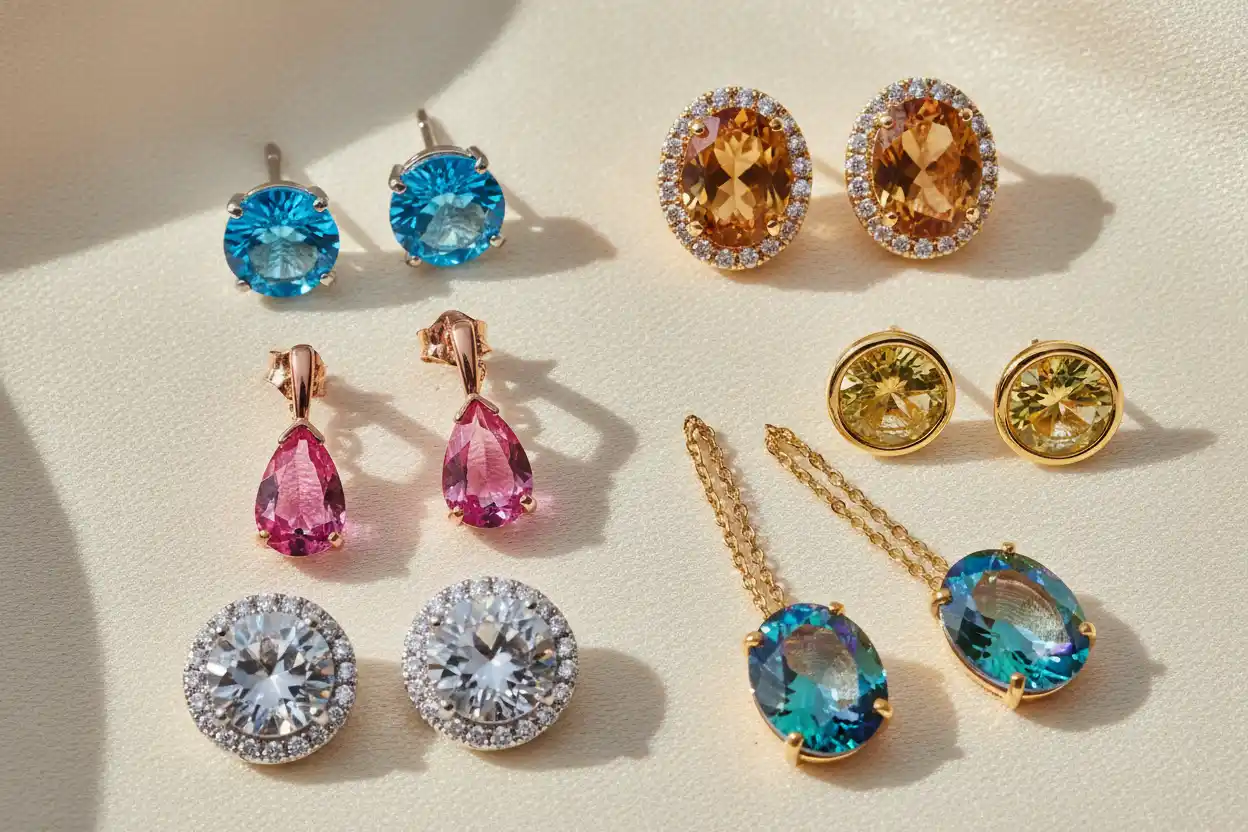
Topaz Earrings: A Style Guide
Topaz earrings offer an unusually broad range of colors, from icy colorless and bright blue to yellow, peach, orange, pink, red-brown and rainbow-coated varieties. The gem also takes a crisp polish, allowing well-cut stones to look bright and clean around the face.
Earrings are one of the safest ways to wear Topaz because they avoid the repeated impact experienced by rings and bracelets. Nevertheless, the mineral has strong cleavage and poor toughness, so setting pressure, exposed corners, treatment, pair matching and backing security all matter.
Topaz Earrings at a Glance
| Feature | What to Consider |
|---|---|
| Mineral | Topaz |
| Composition | Aluminum fluorosilicate |
| Common colors | Colorless, blue, yellow, brown, orange, pink and red |
| Mohs hardness | 8 |
| Toughness | Poor because of cleavage |
| Popular styles | Studs, halos, drops, hoops, clusters and chandeliers |
| Safest setting | Low bezel or substantial protected prongs |
| Most common treatment | Irradiation and heat for blue Topaz |
| Coated variety | Mystic Topaz |
| Important pair factor | Matching hue, tone, dimensions and cut |
| Safest cleaning | Warm water, mild soap and a soft brush |
| Birthstone connection | November |
Why Topaz Works Well in Earrings
Topaz has strong scratch resistance and accepts a bright polish. These qualities help faceted earrings remain crisp-looking when they receive sensible care.
However, hardness does not prevent cleavage damage. A stone may resist scratches yet split after concentrated pressure or a sharp blow from an unfavorable direction.
Earrings reduce this concern because they rarely contact work surfaces, tools or hard countertops. They are particularly suitable for large Blue, White or Imperial Topaz stones that would feel cumbersome and exposed in rings.
The completed Topaz meaning guide owns the mineral’s general geology and symbolism. This page focuses on matching, style, settings, comfort and earring care.
Topaz Stud Earrings
Stud earrings provide the most practical format for regular wear.
Round Topaz studs offer balanced brilliance and are relatively easy to match. Ovals appear longer face-up, while cushions create a softer geometric outline.
A four-prong basket exposes more of the gemstone. Six-prong settings provide additional retention for larger round or oval stones.
Bezel studs surround the girdle with metal and reduce the chance of edge impact. They are especially useful for stones with vulnerable corners or wearers who frequently handle hair, clothing or headphones.
The setting should sit close enough to the lobe to remain stable. Tall baskets may tilt forward and catch more easily.
Halo Earrings
Halo earrings surround Topaz with smaller accent stones, commonly Diamonds, white Sapphires or colorless Zircon.
A halo can increase the visible outline of a modest center stone and strengthen contrast around Blue, Imperial or pink Topaz.
Harder accent gems must not press directly against the Topaz. Diamond and Sapphire can scratch it, while tight contact may place pressure near its cleavage direction.
A compact single halo is usually lighter and easier to clean than a raised double halo.
Check that both halos have the same diameter and that the centers sit at equal heights. Small differences become noticeable when worn as a pair.
Topaz Drop Earrings
Drop earrings suspend one or more gems below the earlobe.
Pear-shaped Topaz works naturally in a vertical design. Ovals, cushions and emerald cuts can also create elegant drops.
Movement helps the facets catch light, but long earrings can tangle in hair, scarves and high collars.
Every joining ring should be securely closed. A weak link or thin open jump ring may present a greater loss risk than the gemstone itself.
Short drops provide a useful balance between movement and practicality. Long statement designs are better suited to controlled occasions.
Topaz Dangle and Chandelier Earrings
Dangles may combine several Topaz gems or create a progression of colors.
Graduated blue stones can move from pale Sky Blue near the lobe to darker London Blue below. Warm designs may combine yellow, peach and Imperial-colored material.
A chandelier arrangement should remain balanced on both sides. Differences in stone depth or metal weight can make one earring hang at a different angle.
Total weight matters. Large Topaz is readily available, but several substantial stones can make an earring uncomfortable even when each gem is individually attractive.
The backs and upper components should distribute weight across the lobe rather than pulling from one narrow point.
Topaz Hoop Earrings
Topaz may be set directly along a hoop or suspended as removable charms.
Front-facing stones offer clear visibility without requiring gems around the complete circumference. Inside-out hoops use stones along both the outer front and inner back, increasing brilliance but also weight and maintenance.
Hinged hoops should close with a definite click. The post must align cleanly with the receiving mechanism.
Removable charms need attachment loops that cannot slip over the open post. Their movement should not allow the stones to strike one another repeatedly.
Small bezel charms are safer than long exposed marquises or pears.
Cluster Earrings
Cluster earrings arrange several smaller Topaz stones into floral, geometric or asymmetrical patterns.
This format creates substantial color without requiring two unusually large matched centers.
Small Blue or White Topaz is widely available in calibrated sizes. Natural pink, red or fine Imperial material is harder to assemble into closely matched groups.
The cluster should look intentional in color and brightness. One dark, heavily windowed or poorly cut stone can interrupt the complete design.
Inspect the metal structure beneath the stones. It should remain strong while providing enough openings for gentle cleaning.
Matching Topaz Pairs
Matching is one of the most important factors in gemstone earrings.
The two stones should coordinate in visible dimensions, hue, tone, saturation, clarity and brilliance. Equal carat weights do not guarantee equal face-up size because one gem may be deeper.
Blue Topaz pairs should also match in color family. A bright cyan Swiss Blue stone may look noticeably different beside a grayish London Blue gem.
Warm natural colors can show pleochroism, so cutting orientation may create subtle differences between the pair.
Compare both earrings together under daylight-equivalent light, ordinary indoor light and warmer evening light.
The completed Topaz buying guide explains the broader color, clarity, cut and treatment factors.
Blue Topaz Earrings
Blue Topaz dominates the commercial earring market.
Natural blue is uncommon. Most material begins as colorless Topaz and receives irradiation followed by heat treatment.
Trade descriptions commonly include Sky Blue, Swiss Blue and London Blue. These names communicate general color impressions rather than official laboratory grades.
Sky Blue usually appears pale and airy. Swiss Blue tends to be brighter and more saturated, while London Blue is darker and may show gray or greenish modifiers.
The London Blue Topaz guide explains the darker variety. The completed Aquamarine versus Blue Topaz comparison separates two frequently confused blue gems.
Additional alternatives appear in the blue gemstones guide.
Imperial Topaz Earrings
Imperial Topaz describes prized warm-colored material, although the exact commercial definition varies.
Colors may include yellow-orange, peach, orange, pinkish orange and reddish orange. Saturated stones with attractive red or pink modifiers are especially sought after.
Matching pairs can be difficult because fine natural-color rough is scarce. Consequently, two carefully matched small stones may be more valuable than one larger gem of similar quality.
Yellow and rose gold complement the warmth. White metal creates a more pronounced border.
A valuable pair represented as natural-color Imperial Topaz may justify independent laboratory reports.
Pink and Red Topaz Earrings
Natural pink and red Topaz is rare.
Chromium can contribute to pink, red and violet colors, although treated and coated products also occur in the market.
The color should remain present through the body rather than appearing only as a thin surface reflection.
Pale pink stones may lose color intensity at small sizes. Halos and warm metal can help define their outline.
The pink gemstones guide provides broader comparisons, while orange-red material also fits within the orange gemstones guide.
Ask for treatment disclosure when rarity or natural color supports a high price.
Yellow and Golden Topaz Earrings
Yellow Topaz ranges from pale straw to rich gold and brownish yellow.
It is sometimes confused with Citrine, particularly in November birthstone jewelry. Topaz and Citrine belong to different mineral species and have different physical properties.
The completed Citrine versus Yellow Topaz guide explains the distinction.
The Yellow Topaz guide covers the variety itself. Related colors appear in the yellow gemstones guide.
Yellow gold creates a unified appearance, while white metal provides more contrast.
White Topaz Earrings
White Topaz is colorless material used as an affordable transparent gemstone.
It can look bright and clean, particularly when cut well, but it does not have Diamond’s hardness, dispersion or market value.
Residue from cosmetics and skin oil can reduce its brilliance quickly. Regular gentle cleaning therefore makes a noticeable difference.
The completed White Topaz guide explains the material’s identity. The white gemstones guide compares it with colorless Sapphire, Zircon, Quartz and other alternatives.
White Topaz should be sold under its own name rather than implied to be Diamond.
Mystic Topaz Earrings
Mystic Topaz is natural Topaz with a thin iridescent surface coating.
The coating can produce blue, green, purple, pink and gold reflections.
Earrings are a better format for Mystic Topaz than exposed rings or bracelets because they encounter less abrasion.
Nevertheless, the coating can be scratched or removed by polishing, abrasive cleaners and some repair processes.
The pair should be stored separately, and a jeweler should be told that the color is surface-applied before attempting work.
Clarity
Blue, colorless and yellow Topaz is commonly expected to appear clean to the unaided eye.
Natural warm colors may contain more visible inclusions, although clarity still influences appearance and value.
Surface-reaching fractures require caution because they can interact with the mineral’s cleavage.
Inspect the gems from the side as well as face-up. A fracture may be concealed beneath a prong.
Both earrings should have comparable clarity. One visibly included stone can make a pair feel mismatched.
Cut Quality
Topaz takes a high polish and can be fashioned into many cuts.
Rounds offer symmetry, while ovals and cushions preserve rough efficiently. Pears suit drops, and emerald cuts create broad flashes.
A shallow gem may display a transparent window through the center. Excessive depth makes it look smaller and may create dark areas.
Facet junctions should remain crisp, and both stones should have similar patterns.
Pointed shapes need protective prongs because corners are more likely to chip.
The guide to types of Topaz provides the wider variety context.
Treatments and Disclosure
Most Blue Topaz has been irradiated and heated. This treatment is standard and widely accepted.
Mystic Topaz receives a surface coating. Pink and other unusual appearances may also be treated or coated.
The planned treated or synthetic Topaz guide owns the full enhancement discussion.
The completed real-versus-fake Topaz guide covers glass, cubic zirconia and other substitutes.
Treatment does not automatically make earrings undesirable. It should be reflected in accurate description, care advice and price.
Choosing Earring Size
Small studs provide practical daily color and minimal weight.
Medium centers show stronger saturation, particularly in warm natural varieties.
Large Blue or White Topaz earrings can be visually impressive but may pull forward because substantial stones are relatively accessible.
Compare dimensions in millimeters rather than relying only on total carat weight.
A broad backing can support large studs. Drops distribute weight differently but can still become uncomfortable after several hours.
Earring Backings
Friction backs suit small and medium studs when they grip securely.
Broad disc backs help stabilize large centers and halos.
Screw backs provide additional security but require more time to operate. Their threaded posts may be uncomfortable for some wearers.
Locking backs combine security with a supportive surface.
Lever backs work well for drops. Open hooks should use silicone stoppers when loss is a concern.
The backing should match the earring’s complete weight and value.
Choosing the Metal
White gold and platinum suit Blue and White Topaz.
Yellow gold emphasizes Imperial, yellow, orange and brown material.
Rose gold pairs naturally with peach and pink stones.
Sterling silver provides an affordable setting for commercial Blue or White Topaz, although the prongs and posts still need adequate strength.
Metal sensitivity matters because earring posts pass through the skin.
November Birthstone Earrings
Topaz is one of November’s recognized birthstones, together with Citrine.
The completed November birthstone guide explains the calendar tradition.
Earrings are practical gifts because they do not require ring or wrist sizing. Confirm whether the recipient prefers studs, drops or hoops and which metal color they normally wear.
The completed November birthstone jewelry guide compares Topaz earrings with rings, necklaces and bracelets.
Comparing Other Topaz Jewelry
A Topaz bracelet creates repeated color but exposes the stones to more impact.
A Topaz necklace can accommodate a larger gemstone with similarly low abrasion risk.
A Topaz ring gives the gem maximum visibility but requires the strongest protection.
Earrings generally provide the safest combination of visible size, color and regular wear.
Cleaning Topaz Earrings
Clean Topaz with warm water, mild soap and a soft brush.
Work gently behind the settings and around the posts, where cosmetics and skin oil collect.
Rinse briefly and dry with a lint-free cloth.
Do not use ultrasonic or steam cleaners. Avoid sudden temperature changes and high heat.
Mystic Topaz needs particular care because polishing and abrasives can remove its coating.
The completed guide to cleaning Topaz jewelry provides detailed instructions.
Storage
Store each earring separately with its backing.
Keep Topaz away from Diamond, Sapphire and other harder gemstones. Topaz can also scratch softer materials such as Quartz and feldspar.
Do not allow coated Mystic Topaz surfaces to rub against metal or other stones.
Topaz appears in the crystals beginning with T and gemstones beginning with T directories.
Final Perspective
Topaz earrings benefit from the mineral’s broad color range and ability to occur in large, clean stones. The safest pair combines well-matched face-up color with secure low settings and backings proportionate to the total weight.
Color names alone should not determine the purchase. Verify whether the stones are routinely treated Blue Topaz, rare natural warm colors, colorless Topaz or coated Mystic material, then choose care and pricing expectations accordingly.
Frequently Asked Questions
1. Is Topaz suitable for earrings?
Yes. Earrings expose Topaz to relatively little impact, making them one of the safest formats for this cleavage-prone gem.
2. Are most Blue Topaz earrings treated?
Yes. Most commercial Blue Topaz has been irradiated and heated to create or strengthen its color.
3. Is irradiated Blue Topaz safe to wear?
Properly processed and legally released Blue Topaz is considered safe for normal jewelry wear.
4. What is the difference between Sky, Swiss and London Blue Topaz?
They are trade descriptions for generally pale, bright saturated and darker blue appearances. They are not standardized laboratory grades.
5. Is Imperial Topaz better than Blue Topaz?
Imperial Topaz is rarer and may be more valuable, but “better” depends on color preference, treatment expectations and budget.
6. Is Mystic Topaz natural?
The underlying Topaz is natural, but its rainbow appearance comes from an applied surface coating.
7. How closely should Topaz earrings match?
The pair should coordinate in hue, tone, saturation, visible dimensions, clarity and cut.
8. Which setting protects Topaz earrings best?
A low full or partial bezel provides strong edge protection. Substantial prongs can also work.
9. Which metal looks best with Topaz?
White metals suit blue and colorless stones, yellow gold complements warm colors, and rose gold pairs well with pink or peach material.
10. Do Topaz earrings need laboratory reports?
Commercial Blue or White Topaz usually does not. Reports become more useful for expensive natural pink, red or Imperial pairs.
11. Can Topaz earrings be cleaned ultrasonically?
No. Warm soapy water is safer because heat and vibration can damage cleavage-prone Topaz.
12. How should Topaz earrings be stored?
Keep each earring in a separate padded compartment away from harder gemstones and abrasive surfaces.