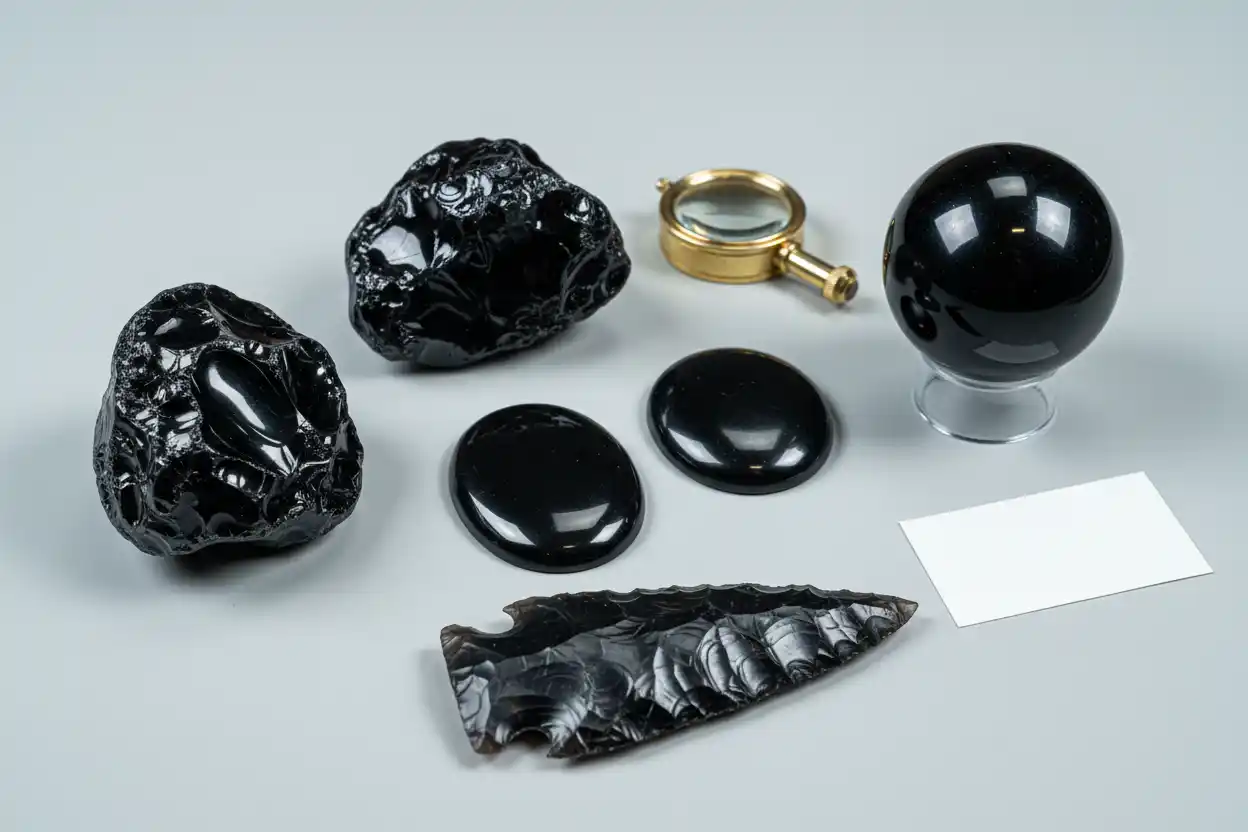
Where to Buy Real Black Obsidian and Avoid Glass Fakes
Black obsidian is common enough that a sophisticated laboratory-grown substitute would make little commercial sense. Even so, buyers frequently encounter manufactured glass, industrial slag, resin objects, mislabeled black stones and modern knapped pieces presented with invented archaeological stories.
Authenticity is only one part of a good purchase. Natural black obsidian can contain chips, internal strain, sharp edges, polishing defects and concealed repairs. In addition, an unsupported claim that a piece came from Mexico, Armenia, Iceland, Oregon or a famous archaeological source does not establish provenance.
The black obsidian meaning and properties guide covers the variety’s identity and traditional symbolism. This guide remains focused on seller selection, natural versus manufactured glass, product quality, locality documentation and safe ownership.
Understand What Black Obsidian Is
Obsidian is natural volcanic glass. It forms when silica-rich molten material cools rapidly enough to inhibit extensive crystal growth. Unlike quartz, tourmaline or onyx, obsidian does not have an orderly crystalline structure throughout its glassy body.
Most black obsidian is dark because its glass contains dispersed iron-bearing components and microscopic mineral matter. A thick piece may appear completely opaque, while a thin edge can transmit brown, gray, greenish or smoky light under a strong lamp.
Fresh fractures are typically conchoidal, producing smooth curved surfaces and potentially razor-sharp edges. That fracture behavior explains why people have shaped obsidian into cutting tools for thousands of years. It also means that a polished sphere or pendant can chip into a dangerous edge after a hard impact.
The broader obsidian guide explains its volcanic origin, while the types of obsidian guide separates black material from sheen, snowflake, mahogany and rainbow varieties.
Decide Which Form You Want to Buy
Different obsidian products carry different authenticity and quality risks.
| Product form | Best seller type | Main issue to investigate |
|---|---|---|
| Natural rough | Mineral or lapidary supplier | Locality, slag substitution, fresh damage and excessive surface oil |
| Tumbled stones | Established crystal retailer | Manufactured glass, coating, weak polish and batch substitution |
| Cabochons | Lapidary or gemstone seller | Chips, strain fractures, backing and surface coatings |
| Beads | Reputable bead supplier | Molded glass, resin, inconsistent drilling and sharp hole edges |
| Spheres and carvings | Lapidary retailer | Glass or slag substitution, filled pits and concealed fractures |
| Modern arrowheads or blades | Skilled knapper with material disclosure | Modern reproduction sold as an ancient artifact |
| Collector specimens | Mineral dealer with labels | Unsupported source claims and repaired display pieces |
| Jewelry | Jeweler familiar with natural glass | Exposed edges, adhesive settings and impact vulnerability |
A collector seeking documented rough should prioritize source history. Conversely, a jewelry buyer should concentrate on finish, construction and return rights.
Where to Buy Genuine Black Obsidian
Specialist mineral and lapidary dealers
A mineral dealer is the strongest source for locality-labeled rough, natural flow-banded specimens and pieces associated with volcanic deposits. A lapidary supplier is more useful when you need slabs, cabochons or cutting rough.
Reliable listings show the exact item or clearly explain that the buyer will receive a comparable piece from a batch. They include dimensions, weight, country or region, condition notes and treatment disclosure.
Ask whether the seller collected the material, purchased it from a known miner or received only a wholesaler’s country label. The strength of the provenance should influence how specifically the listing names the source.
Gem and mineral shows
In-person shows allow you to examine luster, translucency at thin edges, conchoidal chips and polish quality. Move the piece beneath directional light rather than judging it under one bright display lamp.
A loupe can reveal round gas bubbles, mold seams, coating scratches, polishing pits and internal flow structure. Nevertheless, bubbles require careful interpretation because natural volcanic glass can contain gas cavities. Their presence alone does not prove manufacture.
The crystal identification guide explains how to combine observations rather than relying on one feature.
Established online mineral shops
An online seller should provide neutral photographs of the front, back, sides and base. Large spheres need a rotating video because one image can hide a filled cavity, flat spot or repaired fracture.
The online gemstone buying guide covers payment protection, seller identity and return policies. For obsidian, also verify whether the photographed piece is dry. Oil or water can deepen the color and conceal fine scratches in rough material.
Skilled lapidaries and knappers
A skilled maker can add substantial value through precise polishing, carving or controlled flaking. The maker should name the raw material and distinguish a modern reproduction from an archaeological artifact.
Modern knapped points are legitimate decorative and educational objects. However, a seller must not imply that a newly produced arrowhead is ancient, Indigenous-made or excavated from a protected site.
Jewelry retailers
Obsidian jewelry should be sold with realistic durability advice. Smooth pendants, earrings and beads are generally more practical than exposed rings with sharp corners.
Check whether the stone is glued, wire-wrapped, drilled or bezel-set. Thin drill holes and pointed carvings can break even when the main body looks substantial.
What Genuine Black Obsidian Looks Like
Natural black obsidian commonly has vitreous luster and a smooth, glass-like surface. Rough pieces may show curved fracture ripples, sharp edges, flow bands, tiny mineral inclusions or weathered outer surfaces.
A thin edge often transmits some light. Depending on thickness and composition, the transmitted color may be smoky brown, gray, olive or nearly colorless. Still, a completely opaque thick piece can also be natural.
Internal appearance varies. Some material is exceptionally uniform, while other pieces contain streaks, flattened bubbles, microlites or layers produced by movement within viscous lava. Consequently, perfect uniformity is not required, and natural irregularity does not automatically make a piece valuable.
Black obsidian should not display a normal crystal habit. A six-sided “black obsidian crystal point” is generally a carved shape rather than a naturally terminated crystal. The product may still be genuine obsidian, but the seller should describe it as carved.
Black Obsidian Versus Manufactured Glass
Man-made glass is the most direct imitation because both materials are amorphous and can fracture conchoidally. A simple visual test cannot separate every case.
Manufactured glass may show abundant round bubbles, mold seams, flow lines related to industrial production, uniform artificial coloring or identical shapes across many pieces. It may also contain metallic glitter or decorative inclusions not typical of ordinary black obsidian.
Natural obsidian can contain bubbles and flow features too. Therefore, buyers should evaluate the complete pattern. A few stretched or irregular cavities integrated with natural banding differ from numerous perfectly round bubbles distributed through molded glass.
The planned glass versus crystal guide provides a broader comparison. For costly or disputed material, refractive-index testing, specific gravity, microscopy and infrared spectroscopy can offer stronger evidence than photographs.
Obsidian Versus Industrial Slag
Slag is glassy industrial waste formed during metal production or other high-temperature processes. It can be black, blue, green, brown or iridescent and may resemble volcanic glass after polishing.
Common clues include abundant vesicles, metallic droplets, unusual chemical residues, fused debris and a source story connected to an industrial area rather than a volcanic deposit. Even so, some natural obsidian is vesicular, so context and analysis matter.
Slag can be visually attractive when disclosed correctly. It becomes deceptive only when sold as naturally erupted obsidian or assigned an invented volcanic locality.
Black Obsidian Versus Onyx
True onyx is banded chalcedony, a cryptocrystalline quartz material. Much commercial “black onyx” is dyed chalcedony, whereas black obsidian is natural volcanic glass.
Obsidian commonly shows conchoidal fracture and glassy luster. Onyx is crystalline at a microscopic scale, generally harder and more resistant to scratching. It may show subtle banding, dye concentration or a waxier luster.
The onyx versus obsidian guide owns the detailed identification comparison. A seller should never use “black onyx obsidian” as though the terms name one material.
Black Obsidian Versus Black Tourmaline
Black tourmaline is crystalline, commonly striated and often sold as natural prisms or clusters. Obsidian lacks tourmaline’s crystal form and breaks as glass.
Polished pieces can be harder to separate. Obsidian usually has a smoother glass-like body, while tourmaline may show parallel growth lines, fractures and mineral-grain structure.
The planned black tourmaline versus obsidian guide will address that comparison without replacing this buying page.
Other Black Materials Mistaken for Obsidian
Jet, shungite, black spinel, hematite, basalt, smoky glass and resin can all enter poorly labeled listings. Their weight, luster, electrical behavior, fracture and internal structures differ, but no single home test separates every possibility safely.
Resin may show molding marks, soft scratches and low density. Jet is an organic material with a different texture and much lower hardness. Basalt is crystalline and usually lacks obsidian’s uniformly vitreous fracture.
Use the fake-crystal buyer’s guide to evaluate the seller, material and construction together.
Treatments, Coatings and Repairs
Ordinary black obsidian rarely needs color enhancement because its natural color is already commercially desirable. Nevertheless, finished products may be coated, waxed, oiled, painted, fracture-filled or glued.
Wax and oil can deepen color and temporarily improve luster. Clear resin may fill pits or stabilize a fractured carving. Metallic or iridescent coatings can create an effect marketed as aura obsidian, although that surface treatment is not a natural obsidian variety.
Repairs are particularly relevant to large carvings, mirrors and spheres. Look for straight joins, changes in polish, trapped bubbles within adhesive and glossy seams that cross natural flow structure.
The gemstone treatments guide explains why treatment is acceptable only when the seller discloses its type and extent.
Avoid Confusing Black Obsidian with Other Obsidian Varieties
This page covers plain black obsidian. Other varieties require separate evaluation because their patterns can be imitated or altered in different ways.
Snowflake obsidian contains pale cristobalite structures within dark glass. Rainbow obsidian displays colored internal layers under suitable lighting, while silver sheen obsidian and golden obsidian show directional reflective effects.
Mahogany obsidian has reddish-brown patterning, and Apache Tears are rounded or nodular obsidian forms commonly associated with perlite.
The completed guide to buying genuine Apache Tears addresses those nodules specifically. Meanwhile, the planned general obsidian buying guide will compare the wider commercial family rather than repeating the black-variety checks here.
How to Judge Rough Black Obsidian
Good lapidary rough should have enough solid material to produce the intended object. Examine all visible faces for fractures, weathered zones, pumice inclusions and strain.
A freshly broken surface may reveal quality better than an oxidized exterior. However, sellers should not create new breaks solely to prove authenticity unless the material is ordinary cutting rough and the action is appropriate.
Ask for dry photographs. Water and oil can make rough appear darker, smoother and less fractured than it is. If the seller includes a wet image, request a matching dry view from the same angle.
For large blocks, shipping cost and breakage risk can exceed the value of the stone. Confirm the packed weight and whether the seller guarantees arrival without major fractures.
How to Judge Tumbled Stones
A well-tumbled piece should feel smooth, with rounded edges and an even polish. Tiny pits can reflect natural bubbles or inclusions, but deep cavities may collect dirt or weaken the stone.
Inspect black stones under strong backlighting. Natural obsidian may transmit smoky light at thinner areas, although thick pieces can remain opaque. Uniform transparency does not prove authenticity, and opacity does not disprove it.
Batch sellers should disclose size ranges and show multiple examples. One exceptional photograph should not represent a shipment of lower-quality pieces.
How to Judge Cabochons and Beads
Cabochons need an even dome, clean girdle and chip-free edges. A highly polished surface reveals scratches readily, so check under oblique light.
Bead holes should be centered and free from sharp chips. Thin walls around large drill holes can crack during stringing or wear. In addition, black glass beads may be mixed into natural obsidian strands, especially when the seller sources by color rather than mineral identity.
Ask whether the strand is natural obsidian, manufactured glass or a mixture. An unusually low price for perfectly matched, flawless beads is a reason to request clarification, not automatic proof of fraud.
How to Buy Spheres, Mirrors and Carvings
Large polished objects require full-view inspection. A sphere should be round, balanced and free from concealed flat areas. Since obsidian reflects light strongly, studio photography can hide surface waves and fine scratches.
Traditional-style obsidian mirrors should have an even polish and a clearly described modern origin. Archaeological-looking mirrors require particularly careful provenance because genuine historic objects may be culturally sensitive, legally restricted or illicitly removed.
Carvings should have stable points and no dangerously thin edges. Decorative knives need secure handles and explicit warnings that the glass blade can chip.
Buying Modern Knapped Points
Modern knapping preserves a legitimate craft and demonstrates obsidian’s fracture behavior. A trustworthy maker states that the piece is contemporary, names the stone source when known and does not manufacture an archaeological narrative.
Look for balanced flake scars, secure notches and an appropriate base. Value comes from craftsmanship, raw-material quality and the maker’s reputation rather than an unsupported claim of age.
Avoid listings that use soil staining, artificial wear or vague phrases such as “estate-found ancient point” without documentation. Buying undocumented artifacts can create legal and ethical problems even when the object later proves modern.
Locality and Provenance
Commercial black obsidian comes from many volcanic regions, including parts of Mexico, the western United States, Armenia, Turkey and other countries with silica-rich volcanic deposits. Nevertheless, appearance alone rarely identifies a particular flow.
Scientific provenance work may use trace-element composition, often with X-ray fluorescence or related analytical methods. Retail sellers seldom perform that level of sourcing on inexpensive tumbles.
Therefore, treat “Mexican,” “Oregon” or “Armenian” as supply-chain claims rather than visual facts. A premium source claim should come with labels, invoices or direct collection information.
Legal collection matters too. Obsidian from national parks, archaeological reserves or protected lands may not be lawful to remove. A precise but questionable source story is not an advantage.
Price and Value
Common black obsidian rough and small polished pieces are generally affordable. Price increases usually reflect size, polish, craftsmanship, unusual transparency, documented locality, complex carving or the reputation of a knapper or lapidary.
A plain tumble should not receive an extreme rarity premium. Likewise, labels such as “AAA,” “master grade” and “investment obsidian” have little meaning without observable criteria.
Large flawless spheres can cost more because producing them requires substantial rough and removes a large amount of material. Hand-polished mirrors and precise carvings may also justify labor-based pricing.
The gemstone pricing guide explains why retail cost includes yield, workmanship, risk, documentation and seller overhead—not merely raw-material scarcity.
Questions to Ask the Seller
Ask the seller to identify the material as natural volcanic obsidian rather than merely “black glass.” Request the stated country or deposit and ask how that source was documented.
Confirm whether the item has been coated, oiled, waxed, filled, repaired or assembled. For carvings and spheres, request views of every side. For beads, ask whether the entire strand comes from one material batch.
When buying a knapped point, obtain a written statement that it is modern unless credible archaeological documentation proves otherwise. Finally, confirm the return period and whether normal visual inspection is allowed.
Professional Identification
Standard gemological testing can separate many natural obsidians from resins, crystalline black stones and some manufactured glasses. Useful observations may include refractive index, specific gravity, magnification and infrared spectroscopy.
Separating natural obsidian from certain manufactured glasses can require advanced analysis because both are glass. FTIR, trace-element chemistry and microscopic features may be useful, especially when a locality or natural-origin claim carries substantial value.
A decorative shop certificate that lists no methods is not equivalent to an independent laboratory report.
Shipping and Returns
Every obsidian object should be wrapped separately. A chipped edge can become extremely sharp, so spheres and carvings need rigid inner packaging rather than a thin padded envelope.
Knapped blades and points require guards around their edges and tips. Jewelry should be immobilized so metal chains and clasps do not strike the glass.
Inspect the item immediately after delivery. Photograph the package, packing and object before removing every protective layer, particularly when the purchase is large or fragile.
Ethical Buying
Responsible obsidian buying includes legal collection, cultural sensitivity and honest artifact representation. Do not purchase objects claimed to come from protected archaeological sites or Indigenous burials.
The ethical crystal sourcing guide explains how to evaluate traceability and seller claims. For obsidian, the strongest ethical documentation may involve the legality of collection and the maker’s transparency rather than mine-labor certification.
Cleaning and Storage
Clean a sound polished object with lukewarm water, mild soap and a soft cloth. Rinse briefly, dry completely and avoid sudden temperature changes.
Do not use abrasive powders or rough brushes. Although glass resists many household substances, coatings, adhesives and metal settings may not. The planned ultrasonic-cleaner guide is relevant because vibration can extend existing chips or loosen glued components.
The gemstone hardness chart helps compare scratch resistance, while gemstone toughness versus hardness explains why obsidian’s brittle fracture matters more than hardness alone.
Store polished obsidian in a padded compartment away from harder gems. Never allow a chipped piece to remain loose in a jewelry box.
Frequently Asked Questions
1. Is black obsidian a crystal?
Not in the mineralogical sense. It is natural volcanic glass with an amorphous structure, although crystal retailers commonly use “crystal” as a broad commercial term.
2. Is black obsidian easy to fake?
It is easy to substitute manufactured black glass because both materials can look similar. Resin, slag and unrelated black stones can also be mislabeled.
3. Do bubbles prove that obsidian is fake?
No. Natural volcanic glass can contain gas bubbles and stretched cavities. Numerous uniform round bubbles, mold seams and industrial context are stronger concerns than one bubble alone.
4. Should real black obsidian transmit light?
Thin edges often transmit smoky brown, gray or greenish light, but thick pieces may appear fully opaque. This observation supports an evaluation but does not prove authenticity.
5. Is black obsidian the same as black onyx?
No. Obsidian is volcanic glass, while true onyx is banded chalcedony. Much commercial black onyx is dyed chalcedony.
6. Is every black obsidian point an ancient artifact?
No. Many are modern knapped reproductions. A reputable seller should identify contemporary work clearly and provide evidence for any archaeological claim.
7. Can black obsidian be coated?
Yes. Sellers may apply oil, wax, resin, paint or iridescent coatings. Any permanent enhancement or filling should be disclosed.
8. Is Mexican black obsidian better?
Not automatically. Mexico produces abundant quality obsidian, but value depends on the specific piece, workmanship, condition and reliable source information.
9. Does a conchoidal fracture prove natural obsidian?
No. Manufactured glass and slag can also fracture conchoidally. Identification requires several observations and sometimes laboratory analysis.
10. Is black obsidian suitable for rings?
It can be used in protected occasional-wear rings, but its brittle glassy body can chip under impact. Pendants and earrings generally face less risk.
11. Do I need a laboratory report?
Usually not for inexpensive tumbles or ordinary jewelry. Testing becomes useful for valuable carvings, disputed natural-glass claims or premium locality assertions.
12. What is the biggest warning sign when buying black obsidian?
The strongest warning is a dramatic claim—ancient artifact, rare source or unique natural effect—combined with no provenance, no full-view photographs and no return policy.
Choose Traceability Over a Perfect Black Surface
Natural black obsidian can be glossy, uniform and beautifully polished, but appearance alone cannot establish volcanic origin or locality. The safest purchase combines a knowledgeable seller, realistic images, clear construction details and return rights.
The B crystal directory, B gemstone directory and gemstone types guide provide wider context for comparing black materials. A plain, accurately represented piece is ultimately more valuable than a flawless object supported by an invented story.
Safety note: Freshly chipped obsidian can produce exceptionally sharp edges. Handle damaged pieces with cut-resistant protection, keep them away from children and pets, and never dry-cut, grind or polish obsidian without suitable professional eye, respiratory and dust-control equipment.