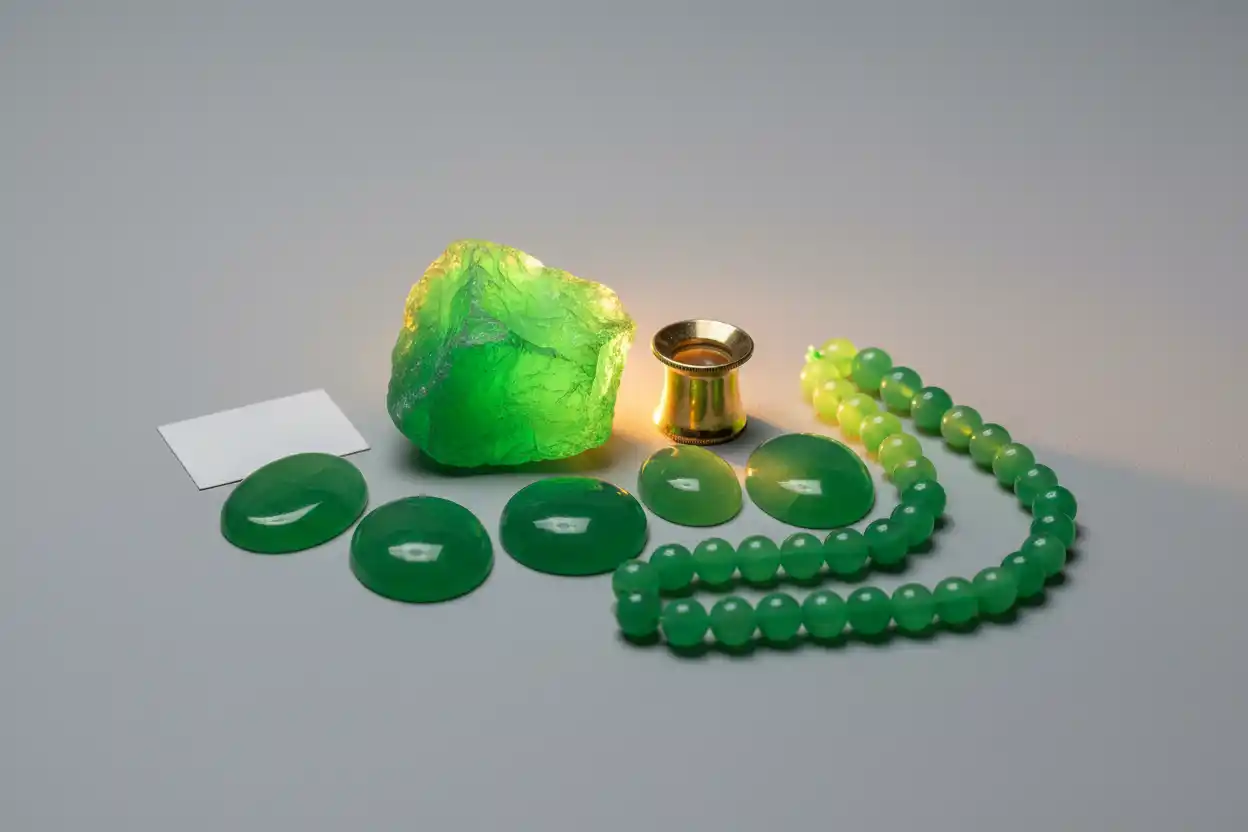
Where to Buy Real Chrysoprase and Avoid Dyed Green Fakes
Real chrysoprase is a naturally green chalcedony variety whose color is associated with nickel-bearing material. Fine stones can show vivid apple green, yellowish green, mint green or deeper leafy green with attractive translucency.
The market also contains dyed chalcedony, green glass, serpentine, prase opal, prehnite, green aventurine, jade substitutes and commercial trade names that blur the boundaries between different green silica materials.
Chrysoprase is usually durable enough for jewelry, but natural color, transparency and structural quality vary widely. A pale opaque bead should not be compared with a translucent fine cabochon simply because both listings use the same variety name.
The chrysoprase meaning and properties guide covers its identity and traditional symbolism. This guide focuses on sellers, color origin, lookalikes, treatments, locality, cutting quality and value.
What Makes Chalcedony Chrysoprase?
Chrysoprase belongs to the chalcedony family. Its body consists mainly of microscopic quartz with associated moganite, while finely dispersed nickel-bearing material produces the characteristic green color.
The color is usually yellowish green rather than bluish green. However, natural stones can range from pale mint through saturated apple green, and the exact shade depends on composition, concentration and internal structure.
The chalcedony guide explains the microcrystalline quartz parent material. The types of chalcedony guide separates chrysoprase from agate, carnelian, bloodstone, onyx, gem silica and other varieties.
A seller should not describe ordinary dyed green chalcedony as chrysoprase simply because the base material is chalcedony. Natural nickel-related color is part of the variety definition.
Choose the Product Form Before Comparing Prices
| Chrysoprase product | Best source | Main buying concern |
|---|---|---|
| Natural rough | Lapidary supplier or mineral dealer | Color depth, fractures, rind, treatment and cutting yield |
| Slab | Lapidary supplier | Natural-color continuity, hidden cracks and resin |
| Fine cabochon | Colored-stone dealer or independent cutter | Translucency, dye, backing and polish |
| Bead strand | Established bead supplier | Dyed chalcedony, serpentine, glass and drill-hole fractures |
| Tumbled stone | Reputable crystal retailer | Generic green stone substituted for chrysoprase |
| Carving | Skilled stone seller | Epoxy filling, pale interiors and color enhancement |
| Jewelry | Jeweler with treatment disclosure | Backing, glue, thin edges and metal quality |
| Collector rough | Mineral dealer with locality records | Source documentation and natural surface condition |
For rough, estimate how much useful green material lies beneath the rind. For jewelry, judge the finished stone under neutral light and inspect the construction.
Where to Buy Genuine Chrysoprase
Specialist lapidary suppliers
Lapidary suppliers are usually the strongest source for rough, slabs and preforms. An experienced seller should show natural surfaces, sawn faces and sample cabochons from the same parcel.
Ask for dry photographs. Water and oil deepen green color, improve apparent translucency and hide scratches.
A sawn edge should reveal whether strong color continues through the material. Some rough has a vivid green outer zone surrounding a much paler or brownish interior.
The seller should also state whether the rough contains opal, quartz, serpentine or host rock. Mixed material can be natural but may cut and polish unevenly.
Colored-stone dealers
Fine translucent cabochons belong in the specialist colored-gem market. Listings should include weight, dimensions, transparency, treatment and geographic origin when known.
Request photographs over white and neutral gray backgrounds. Green stones can look substantially different against warm skin, black velvet or strongly edited backgrounds.
When the price is significant, an independent report can confirm chalcedony and investigate color origin or treatment.
Gem and mineral shows
Shows allow direct comparison with jade, prehnite, serpentine, green aventurine and prase opal.
Examine the stone under daylight-equivalent lighting and a focused lamp. Fine chrysoprase may show a soft internal glow rather than glass-like transparency.
A loupe can reveal dye concentrations, glass bubbles, resin-filled fractures and granular textures inconsistent with compact chalcedony.
Do not scratch the stone. The crystal identification guide explains why several nondestructive observations are more reliable.
Established online stores
The online gemstone buying guide provides general checks for seller identity, protected payments and return rights.
For chrysoprase, insist on exact-item photographs for fine cabochons and carvings. Batch photography may be acceptable for inexpensive beads only when the seller clearly describes the color range.
Ask whether images were taken while the stone was wet, backlit or digitally saturated.
Independent cutters and jewelers
A lapidary who selected the rough may be able to explain its locality, internal color and treatment more accurately than a general reseller.
For custom jewelry, request photographs of the loose cabochon before setting. A white reflective backing can brighten pale stones, while a dark backing can deepen their green.
What Natural Chrysoprase Looks Like
Natural chrysoprase generally has yellowish-green, apple-green, mint-green or leaf-green color. Fine stones can be evenly colored, but clouds, pale areas and brown matrix are common in rough.
Translucency is an important value factor. Thin edges and fine cabochons may transmit a diffused green glow, while lower-grade material can be opaque.
The luster is typically waxy to vitreous. A well-polished cabochon should have a smooth surface without visible granular crystals.
Natural color may be uneven. Stronger green can follow selected zones, while white chalcedony, opal or host rock interrupts the body.
A perfectly uniform electric-green appearance deserves questions about dye, glass or digital editing. Nevertheless, fine untreated chrysoprase can be strongly saturated, so color intensity alone does not prove treatment.
Chrysoprase Versus Prase Opal
Prase opal is green common opal, and nickel can color it similarly to chrysoprase. The two materials can occur in related altered serpentinite deposits.
Chrysoprase has a chalcedony structure, while prase opal is noncrystalline to poorly crystalline hydrated silica. Their refractive index and specific gravity differ.
Prase opal can have a softer, more porcelain-like appearance. However, photographs may not separate them reliably.
A seller should not use “chrysoprase opal” as though it were one standardized mineral variety. Ask which silica material has been identified.
Chrysoprase Versus Jade
Jade refers to jadeite or nephrite, neither of which is chalcedony. Fine green jade can overlap with chrysoprase in color and translucency.
The jade meaning guide explains the umbrella term, while the jadeite guide covers the pyroxene mineral. The jadeite-versus-nephrite guide owns the distinction between the two accepted jades.
The completed jade buying guide covers texture, treatment and value. The real-versus-fake jade guide and treated-jade guide address dye, polymer and imitation issues.
Chrysoprase was historically marketed under names such as “Australian jade” or “Queensland jade.” These are misleading trade terms because the material is chalcedony, not jade.
Chrysoprase Versus Serpentine
Serpentine frequently appears yellow-green, apple-green, olive or darker green. It is commonly used as a jade substitute and can also be mislabeled as chrysoprase.
Serpentine may show a waxy appearance but is generally softer and can have fibrous, mottled or rock-like texture.
Dyed serpentine can become especially convincing. Refractive index, specific gravity, microscopy and Raman spectroscopy provide better identification than color.
Chrysoprase Versus Prehnite
Prehnite can show translucent pale green, yellow-green or apple-green color.
Prehnite often has a more crystalline or cloudy appearance and may contain dark epidote inclusions. Its mineral properties differ from chalcedony.
A pale polished stone can remain difficult to identify from one photograph. The future guide to buying real prehnite will own prehnite-specific treatment and inclusion checks.
Chrysoprase Versus Green Aventurine
Green aventurine is quartz-rich material containing reflective mica or related inclusions.
Its body often appears more granular and may show visible sparkle. Chrysoprase generally has a smoother, more uniform microcrystalline glow without aventurescence.
A seller who calls a sparkling green stone “chrysoprase aventurine” should clarify which material is present.
Chrysoprase Versus Green Calcite
Green calcite is a soft calcium-carbonate mineral. It can resemble pale opaque chrysoprase in low-quality photographs.
Calcite has prominent cleavage, much lower hardness and sensitivity to acids. Do not perform a scratch or vinegar test on a finished piece.
Professional refractive-index or Raman testing separates the materials safely.
Chrysoprase Versus Aquaprase and Chrome Chalcedony
Aquaprase is a trade name used for naturally colored bluish-green chalcedony containing chromium and nickel. Its color is generally bluer than traditional yellowish-green chrysoprase.
Chrome chalcedony is green chalcedony associated with chromium color. It can show a more emerald-like green.
These are related chalcedony markets, but a seller should not use the names interchangeably. The color-causing elements and commercial identities differ.
A premium trade name should be supported by laboratory data or reliable supply-chain documentation.
Dyed Chalcedony
Dyed chalcedony is the most direct treatment concern. Pale silica material can accept strong green color along fractures, pores and more permeable zones.
Examine the back, girdle and drill holes. Dye can concentrate in those areas and form dark green rings.
A completely uniform bright-green strand may also deserve scrutiny, particularly when the beads have different internal textures but identical color.
Well-executed dye can remain difficult to detect. Spectroscopy and chemical analysis may be needed for premium natural-color claims.
The fake-crystal buyer’s guide explains how to combine dye clues with seller and construction evidence.
Glass and Resin Imitations
Green glass can imitate translucent chrysoprase. Round bubbles, flow lines, mold seams and a highly uniform glassy body are useful clues.
Some glass contains no obvious bubbles and requires gemological testing.
Resin can be molded with green pigment, stone powder or cloudy inclusions. It may show casting marks, soft scratches and repeated patterns.
A reconstituted product may contain real chalcedony fragments but should not be sold as a solid natural chrysoprase cabochon.
Treatments Beyond Dye
Chrysoprase may be waxed, oiled, filled, resin-impregnated, coated or backed.
Wax and oil deepen color and improve luster temporarily. Clear filler can conceal fractures or cavities.
Polymer impregnation is less expected in fine compact chalcedony than in porous materials, but it can still occur in fractured rough or carvings.
A white or reflective backing can brighten translucent cabochons. The gemstone treatments guide explains how filling, impregnation and backing affect disclosure differently.
How to Evaluate Rough
Ask for a dry sawn face. The strongest green may occur near the outer portion of a nodule or vein, while the center becomes pale.
Inspect the edges to estimate color depth. A thin green layer over white chalcedony offers limited cutting yield.
Fractures can divide the best-colored zone. Brown host rock, opal and serpentine may also reduce usable material.
Ask whether sample cabochons from the parcel retain color after polishing. That evidence is more useful than a wet rough photograph.
How to Evaluate Slabs
A quality slab should show attractive green color on both faces and through its edges.
Backlighting can reveal translucent cutting areas and hidden fractures. However, judge the slab in reflected light as well, since extreme backlighting can exaggerate color.
Inspect for resin-filled cracks and dye concentrations. A treated fracture may show a different gloss or ultraviolet response.
How to Judge Cabochons
Fine cabochons balance saturation, translucency and polish. The color should remain attractive in ordinary light rather than only over a light box.
The dome needs an even reflection with no flat areas or deep scratches. A clean girdle reduces setting problems.
Inspect the back for backing, resin, brown matrix and color concentration. Natural variation is acceptable, but it should match the listing photographs.
Thin cabochons may look bright but become fragile. Overly thick stones may lose translucency and appear dark.
Buying Beads
Natural strands should show plausible variation in green intensity and translucency. Fine matching adds value, but identical neon-green color can suggest dye or glass.
Inspect drill holes for concentrated color, chips and radial fractures. Rough holes can damage cord.
Ask whether the strand consists entirely of chrysoprase or includes green chalcedony, serpentine or other stones selected for color.
Buying Carvings and Decorative Objects
Large carvings can contain brown rind, pale chalcedony, opal and fractures. Request photographs of every side.
A thick resin coating may create a glossy surface that hides uneven polish. Deep recesses can conceal filler or dye.
Thin carved details remain vulnerable even though chalcedony is relatively tough. Choose rounded forms for objects that will be handled frequently.
Buying Chrysoprase Jewelry
Sound chrysoprase is suitable for many rings, pendants, earrings and bracelets.
The gemstone hardness chart places chalcedony around Mohs 6.5 to 7. The gemstone toughness-versus-hardness guide explains why thin edges and fractures can still chip.
A bezel protects the perimeter better than high prongs. Closed-back settings should be disclosed because they can alter apparent color.
Ask whether glue, foil or colored backing contributes to the face-up appearance.
Locality and Provenance
Australia, particularly Western Australia and Queensland, is strongly associated with commercial chrysoprase. Tanzania has produced important nickel-bearing chrysoprase from altered serpentinite deposits.
Material also occurs in Brazil, Poland, the United States and other regions associated with nickel-bearing rocks.
Color cannot prove geographic origin. A premium mine or district claim requires invoices, labels or a reliable supplier history.
Country of cutting may differ from country of mining. A strand drilled in China or India may contain rough mined in Australia or Tanzania.
Price and Value
Value depends on natural color, saturation, translucency, evenness, usable size, condition, cut, treatment and provenance.
Fine apple-green translucent cabochons generally command greater interest than pale opaque material. However, an attractive natural cloud or matrix pattern can still suit carvings and designer jewelry.
Natural-color evidence matters when the seller charges a premium. Dyed chalcedony should not be valued as equivalent fine chrysoprase.
Large carvings cost more partly because of material loss and labor. A heavy object dominated by pale matrix may contain less valuable green material than a small fine cabochon.
The gemstone pricing guide explains how rarity, cutting yield, treatment and workmanship interact.
Questions to Ask the Seller
Ask whether the stone is natural-color chrysoprase, dyed green chalcedony, prase opal, Aquaprase or another material.
Request the country or mine and the basis for that information. Confirm dye, wax, oil, filling, polymer, coating, backing and repair.
For rough, request dry sawn-face images. For cabochons, ask for front, back, edge and transmitted-light photographs. For beads, request drill-hole close-ups.
Determine whether the exact pictured item will ship. Finally, obtain a return policy that allows normal gemological inspection.
Professional Identification
A gemologist can identify chalcedony through refractive index, specific gravity, microscopy and Raman spectroscopy.
Visible and infrared spectroscopy can help distinguish nickel-related natural color from some dyes. Chemical analysis may detect nickel, chromium or artificial coloring agents.
Testing can also separate chrysoprase from prase opal, jade, serpentine, prehnite and glass.
Geographic origin is harder to prove. A laboratory may confirm natural-color chrysoprase without assigning a mine or country.
Ethical Sourcing and Care
The ethical gemstone sourcing guide provides practical questions about mining, cutting labor and traceability.
Sound untreated chrysoprase can generally be cleaned with lukewarm water, mild soap and a soft cloth. Avoid prolonged soaking when dye, resin, backing or glue may be present.
Long exposure to strong heat or intense sunlight can alter the appearance of some colored chalcedonies or their treatments. The sunlight-fading guide provides broader display guidance.
Ultrasonic cleaning should be avoided when the stone is fractured, filled, backed or glued. The planned ultrasonic-cleaner guide explains those risks.
Store chrysoprase away from harder gems that can scratch its polish.
Frequently Asked Questions
1. Is chrysoprase a type of jade?
No. Chrysoprase is green chalcedony, while true jade is jadeite or nephrite.
2. What naturally colors chrysoprase green?
Its color is associated with finely distributed nickel-bearing material within the chalcedony.
3. Is all green chalcedony chrysoprase?
No. Green chalcedony may be dyed or colored by chromium, copper or other components. Chrysoprase specifically refers to nickel-associated natural green material.
4. Is chrysoprase the same as prase opal?
No. Chrysoprase is chalcedony, while prase opal is green common opal. Their refractive index and specific gravity differ.
5. Can chrysoprase be dyed?
Yes. Pale chalcedony may be dyed green and sold as chrysoprase. Color concentrations in fractures and drill holes are warning signs.
6. How is chrysoprase different from serpentine?
Chrysoprase is microcrystalline silica and is harder. Serpentine is a different, generally softer mineral group that may show a more mottled texture.
7. Is vivid apple-green color proof of treatment?
No. Fine natural chrysoprase can be strongly saturated. The color’s distribution and laboratory evidence matter more than intensity alone.
8. Is Australian chrysoprase always better?
No. Australia is an important source, but value depends on the individual stone’s color, translucency, condition and treatment.
9. Can chrysoprase contain resin?
Yes. Fractured stones or carvings may be filled or impregnated. Treatment should be disclosed.
10. Is chrysoprase suitable for daily-wear rings?
Sound chalcedony is generally wearable. A protective setting and removal during heavy work reduce damage risk.
11. Do ordinary chrysoprase beads need certificates?
Usually not. Reports are more useful for expensive natural-color cabochons, large matched suites or disputed treatments.
12. What is the strongest warning sign in a listing?
Be cautious when a perfectly uniform neon-green stone is described as rare untreated chrysoprase but the seller provides no back, edge, treatment or provenance information.
Buy Natural Color, Not a Jade-Like Trade Name
Chrysoprase does not need to be sold as “Australian jade” to be desirable. Its own value comes from nickel-related green color, chalcedony translucency and a smooth durable polish.
The C crystal directory, C gemstone directory and visual gemstone guide provide broader green-stone comparisons. Choose the seller who identifies the material precisely and can explain why its color is believed to be natural.