Where to Buy Real Moss Agate and Avoid Dyed or Resin Fakes
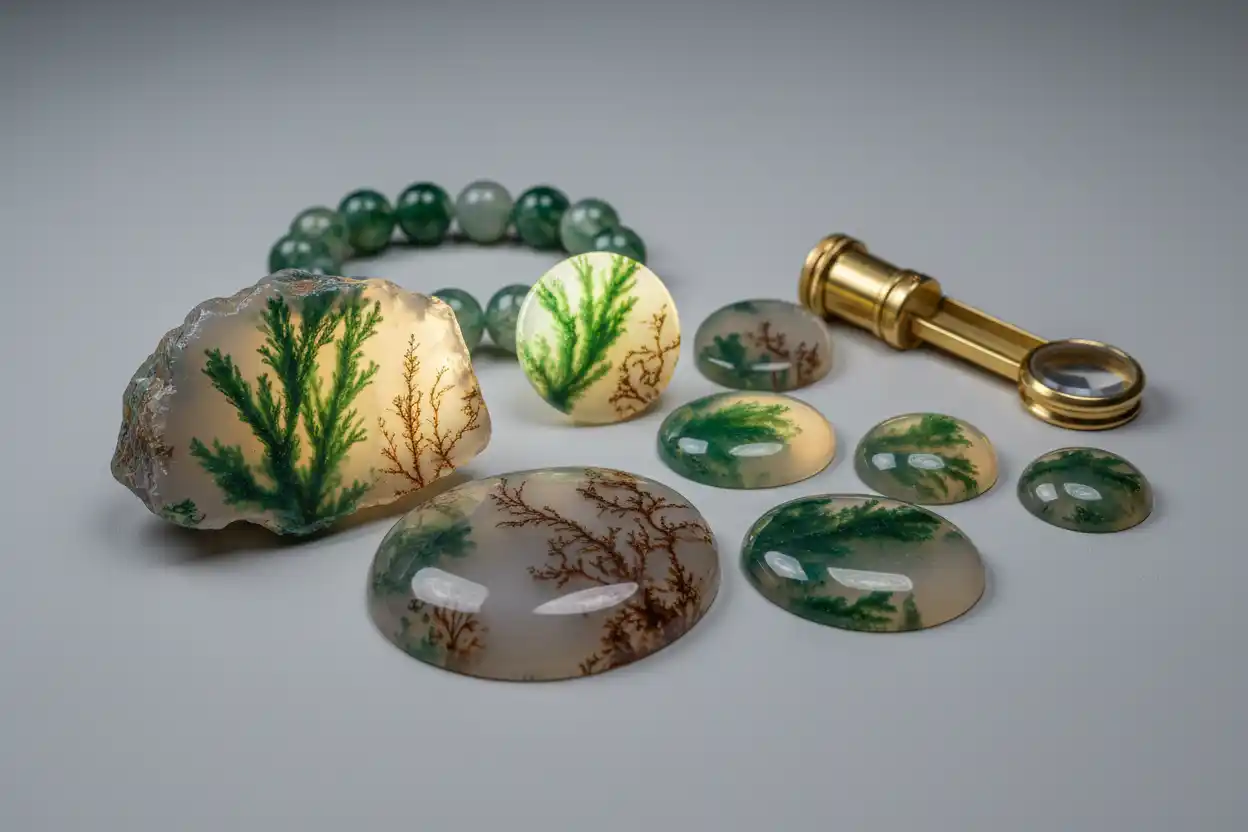
Real Moss Agate is translucent to semitransparent chalcedony containing green, brown, black, red or yellow inclusions that resemble moss, branches, ferns, underwater plants or miniature landscapes.
The inclusions are mineral structures rather than preserved moss, plants or other organic matter. Depending on the specimen, they may include chlorite, amphibole-related minerals, iron oxides, manganese oxides or other finely distributed mineral phases.
Moss Agate is widely available, yet quality varies sharply. Buyers may encounter dyed chalcedony, resin containing plant fragments, glass with colored swirls, assembled stones and ordinary green quartz or Jasper sold under the name. The Moss Agate meaning and properties guide covers identity and traditional symbolism. This guide focuses on inclusion depth, treatment, sellers, lookalikes and value.
Moss Agate Is an Included Chalcedony
Moss Agate belongs to the broader Agate family and consists mainly of chalcedony, a microcrystalline quartz material.
Unlike classic banded Agate, Moss Agate may show little or no obvious banding. Its commercial identity depends on moss-like mineral inclusions within a translucent host.
The Chalcedony guide explains the parent material, while the types of Agate guide separates moss, dendritic, lace, plume, fortification and other structures.
Some gemologists use the term broadly for translucent chalcedony with green mineral inclusions. Brown or black branching inclusions may move a piece toward the Dendritic Agate market, though retail naming overlaps.
The Inclusions Are Not Living Moss
The plant-like patterns formed through mineral deposition rather than biological preservation.
Green inclusions may consist of chlorite or other iron- and magnesium-bearing silicates. Brown, red and black branches can include iron or manganese oxide compounds.
Exact identification cannot be made from color alone. A seller should avoid claiming that every green inclusion is chlorite or that every black branch is manganese oxide without testing.
The pattern can still be entirely natural when its mineral species remains unidentified.
A listing such as “natural Moss Agate with green mineral inclusions” is more defensible than an unsupported catalogue of several precise inclusion minerals.
Choose the Product Form Before Shopping
| Product form | Best source | Main buying concern |
|---|---|---|
| Natural rough | Chalcedony or lapidary supplier | Inclusion depth, fractures, dye and cutting yield |
| Slab | Lapidary dealer | Pattern continuity, resin and useful scene placement |
| Cabochon | Independent cutter | Three-dimensional inclusions, polish, backing and filling |
| Faceted stone | Included-gem specialist | Windowing, fractures and whether inclusions remain visible |
| Tumbled stone | Reputable crystal retailer | Generic green Agate, dyed chalcedony or resin |
| Bead strand | Established bead supplier | Artificial color, mixed varieties and drill-hole fractures |
| Sphere | Experienced lapidary retailer | Assembled halves, filler and weak reverse pattern |
| Carving | Skilled stone seller | Resin, artificial plant material and structural cavities |
| Ring stone | Jeweler familiar with included chalcedony | Open fractures, backing and protective setting |
| Locality specimen | Mineral dealer | Accurate origin and treatment history |
A cabochon should be judged by its scene and construction, while rough should be evaluated for how deeply that scene continues.
Where to Buy Genuine Moss Agate
Specialist lapidary suppliers
A lapidary supplier should show the rough dry, wet and through a sawn face.
Dry images reveal fractures and surface quality. Wet views help preview the finished translucency but should not replace ordinary photographs.
Ask whether the inclusion field continues into the block. A green exterior stain or one thin layer may yield little desirable material.
Request sample cabochons cut from the same parcel.
Independent gem cutters
A cutter who oriented the stone can explain whether the inclusions were fully enclosed or connected to an open cavity.
Good cutting places the most attractive moss scene beneath the dome and preserves enough transparent chalcedony around it to create depth.
Ask for front, back and side photographs. Dark backing can improve contrast and should be disclosed.
Gem and mineral shows
Shows allow direct comparison with Tree Agate, Dendritic Agate, Garden Quartz, dyed chalcedony, glass and resin.
Rotate the stone over white and black backgrounds. Natural inclusions should shift relative to one another because they occupy different depths.
Use a loupe to inspect fractures, resin and dye concentration. Do not apply solvents or scratch tests.
Established online stores
The online gemstone buying guide covers seller identity, payment protection and returns.
Request continuous video under neutral white light. Strong backlighting can make weak inclusions appear darker and more dramatic than they look in ordinary wear.
Ask whether the image shows the exact stone. Moss patterns vary too much for a stock photograph to represent random selection.
Jewelry specialists
Moss Agate has become popular for rings, including engagement-style settings.
A jeweler should identify open fractures, cavities, backing and resin. Ask to see the loose stone before mounting.
A beautiful landscape does not compensate for a crack that reaches the girdle and threatens the stone during setting.
What Genuine Moss Agate Looks Like
The chalcedony host may be colorless, milky, gray, bluish, pale green, yellowish or brownish.
Inclusions can form:
- Mossy clouds
- Filaments
- Branches
- Fern-like shapes
- Dendrites
- Plumes
- Tufts
- Floating islands
- Layered landscapes
- Dense forest-like scenes
Natural patterns rarely repeat exactly. Their density, color and depth can vary across one cabochon.
Some inclusions touch the surface or enter open cavities. Others remain fully enclosed.
Small pits, fractures and colorless areas are normal. A flawless host is not required, although structural condition should affect price.
Moss Agate Versus Tree Agate
Tree Agate commonly has an opaque white or cream host with green branching or moss-like inclusions.
Moss Agate is usually more translucent, allowing the inclusions to appear suspended within the stone.
Retail usage overlaps, especially for material with both milky and translucent zones.
A seller should describe the actual transparency instead of treating Tree Agate as a higher or lower grade automatically.
Moss Agate Versus Dendritic Agate
Dendritic Agate is valued for branching tree-like inclusions, commonly dark brown, black or red.
Moss Agate generally emphasizes softer green moss-like structures, although brown dendrites may occur within the same stone.
One cabochon can fit both descriptions. The dominant visual feature should guide the listing.
Detailed inclusion identification may require Raman spectroscopy rather than visual assumptions about iron and manganese.
Moss Agate Versus Garden Quartz
Garden Quartz is larger-crystal quartz containing scenic mineral inclusions.
Moss Agate uses a chalcedony host, which has a microcrystalline aggregate structure.
Garden Quartz may show natural crystal faces, internal veils and sharply separated inclusion depths. Moss Agate often has a softer, waxier chalcedony appearance.
The completed guide to buying real Garden Quartz covers inserted inclusions, synthetic quartz and polished points.
Moss Agate Versus Moss Jasper
Moss Jasper is a loose commercial term generally used for more opaque material crowded with moss-like inclusions or patterns.
When the host is opaque and lacks the translucency expected of Moss Agate, Jasper or mossy Jasper may be a more appropriate description.
The distinction can be gradual rather than absolute. Thin edges may transmit light while the main body remains opaque.
The completed general Jasper buying guide explains broad Jasper terminology.
Moss Agate Versus Green Aventurine
Green Aventurine is quartz-rich and commonly shows reflective Fuchsite mica.
Its green effect appears as sparkle or aventurescence rather than branch-like inclusions suspended in chalcedony.
The completed guide to buying real Green Aventurine covers polymer impregnation and aventurine glass.
Moss Agate Versus Chrysoprase
Chrysoprase is translucent green chalcedony whose body color is generally more evenly distributed.
Moss Agate relies on visible inclusions within a paler or colorless host.
A chalcedony piece with both green body color and darker moss may be described with additional detail, but the seller should not apply a Chrysoprase premium without supporting the color mechanism.
The completed guide to buying genuine Chrysoprase covers nickel-related color and treated lookalikes.
Dyed Moss Agate
Pale chalcedony can be dyed green, red, brown or black.
Artificial color may concentrate along fractures, pores, cavities and drill holes. It can also strengthen existing natural inclusions.
Inspect the back and edges. Dye may be darkest near surface-reaching cracks and fade toward the center.
Natural mineral deposition can also follow fractures, so one colored pathway is not conclusive.
The treated-Agate guide owns the full treatment discussion, while the real-versus-fake Agate guide covers broad identity checks.
Resin with Artificial Plant Material
Clear resin can suspend dried moss, fibers, leaves, pigment or mineral fragments.
Such objects can resemble unusually vivid Moss Agate, particularly in cabochons and spheres.
Look for casting seams, bubbles, soft scratches and organic material with recognizable cellular or leaf-like forms.
Natural Moss Agate inclusions are mineral structures, not preserved green plants.
Resin products can be decorative when labeled accurately. They should not be sold as natural chalcedony.
Glass Imitations
Glass can contain green swirls, branching particles and bubbles.
Round bubbles, flow lines, mold seams and a uniform glassy host support manufacture.
Natural chalcedony typically has a waxier luster and aggregate texture, although highly polished material can appear quite glassy.
The glass-versus-crystal guide provides broader separation methods.
Fracture Filling and Stabilization
Natural Moss Agate can contain open cavities and surface-reaching cracks.
Clear resin may stabilize those areas and improve polish. Color-matched filler can also strengthen the moss effect.
Inspect fractures for bubbles, a different luster and ultraviolet response.
Limited filling may be practical for jewelry, but the amount and position should be disclosed.
The gemstone treatments guide explains fracture filling, impregnation and composites.
Assembled and Backed Stones
A thin Moss Agate slice can be attached to a dark backing to improve contrast.
Two chalcedony pieces may also be joined around a visually attractive layer.
Inspect the edge for straight seams, adhesive bubbles and a sudden change in material.
A doublet can be suitable for jewelry when disclosed. It should not be sold as one solid natural cabochon.
How to Evaluate Rough
Request dry photographs, wet photographs and a sawn face.
Look for inclusion depth rather than one green surface patch. A block with moss throughout several layers provides better cutting potential.
Inspect fractures that intersect the best scene. A large stone can yield poorly if open cracks divide the inclusion field.
Ask whether test cabochons from the parcel required resin.
How to Evaluate Slabs
Compare both faces and the edges. The moss pattern should shift naturally through the slab.
A good slab contains enough transparent or translucent host around the inclusions to create visual depth.
Dense opaque material may be attractive, but it belongs closer to the Moss Jasper market.
Check for surface oil, filler and straight joined seams.
How to Judge Cabochons
The strongest cabochons create depth rather than presenting a flat green patch.
A cutter may place darker moss near the base and clearer chalcedony above it, producing a landscape effect.
The dome should be evenly polished. Surface-reaching cavities need stable edges and full disclosure.
Inspect the back for backing, dye and resin. A natural pattern should remain visible from more than one direction.
Buying Beads
Natural strands should show related colors without identical moss arrangements.
Inspect drill holes for dye, resin and radial fractures. Dark color around every opening can indicate treatment.
Ask whether the strand consists entirely of Moss Agate or includes Tree Agate, Dendritic Agate or other green chalcedony selected for appearance.
Buying Spheres and Carvings
Request a full rotation. A dramatic landscape may exist only on one face.
A sphere should not contain a straight assembly seam or obvious resin-filled equator.
Carvings should use the inclusions intentionally. Thin projections crossing open cavities can break easily.
Most Moss Agate towers are carved, not naturally crystallized points.
Buying Moss Agate Rings
Chalcedony has approximately Mohs hardness 6.5 to 7 and generally good toughness.
However, cavities, open fractures and resin can reduce durability. The gemstone hardness chart and toughness-versus-hardness guide explain the distinction.
A protective bezel or low-profile halo is safer than exposed sharp corners.
For engagement-style rings, request magnified views of every fracture and obtain treatment disclosure in writing.
Locality and Provenance
Moss Agate occurs in many regions. Commercial material is associated with India, the United States, Brazil, Indonesia, Africa and other sources.
Montana Moss Agate has a distinct market and commonly shows reddish, brown or black inclusions in translucent chalcedony. Indian material frequently supplies green scenic cabochons.
Appearance alone does not establish a country or mine. A locality premium needs supplier records.
The ethical gemstone sourcing guide provides broader questions about extraction, cutting labor and traceability.
Price and Value
Moss Agate is generally affordable, but exceptional landscape scenes can command meaningful premiums.
Important factors include:
- Inclusion depth
- Natural color
- Host transparency
- Scene composition
- Pattern uniqueness
- Structural condition
- Cutting quality
- Treatment disclosure
- Size
- Locality and provenance
A small cabochon with a balanced forest-like scene can be worth more than a large cloudy sphere with diffuse green areas.
Heavy digital enhancement should not substitute for a strong natural pattern.
The gemstone pricing guide explains how cutting, rarity and evidence affect value.
Questions to Ask the Seller
Ask whether the host is natural chalcedony and whether the inclusions were identified or only described visually.
Request disclosure of dye, resin, backing, assembly, coating and fracture filling.
For rough and slabs, ask for dry and wet views of both faces. For cabochons, request front, back and edge photographs.
For rings, ask for magnified images of surface-reaching cracks. For spheres, obtain a full rotation.
Finally, confirm that the return policy allows independent gemological inspection.
Professional Identification
Refractive index, specific gravity and microscopy can identify chalcedony and distinguish it from most glass and resin.
Microscopy is especially useful for tracing inclusion depth, dye pathways, filler and assembly seams.
Raman spectroscopy can identify many mineral inclusions, but several points may require testing because one stone can contain multiple phases.
Confirming chalcedony does not prove that its color and inclusions are untreated.
Cleaning and Storage
Clean sound untreated Moss Agate with lukewarm water, mild soap and a soft cloth.
Avoid prolonged soaking when cavities, dye, resin, backing or glue are present.
Do not use steam or ultrasonic equipment on fractured, filled or assembled stones.
Store rings separately from diamonds and sapphires, which can scratch the chalcedony surface.
Frequently Asked Questions
1. Does Moss Agate contain real moss?
No. Its moss-like features are natural mineral inclusions rather than preserved plants.
2. Is Moss Agate a true Agate?
It is a chalcedony variety traditionally placed within the Agate market, even though many pieces lack obvious banding.
3. What minerals create the green moss?
Chlorite and other silicate inclusions may contribute, but exact composition varies and requires testing.
4. What creates brown or black branches?
Iron or manganese oxide compounds commonly form dendritic structures, though color alone cannot identify the exact mineral.
5. Is Moss Agate the same as Tree Agate?
No. Tree Agate usually has a more opaque white host, while Moss Agate is generally more translucent.
6. Is Moss Agate the same as Dendritic Agate?
The terms overlap, but Dendritic Agate emphasizes branching dark inclusions, while Moss Agate commonly emphasizes softer green moss-like patterns.
7. Can Moss Agate be dyed?
Yes. Dye can intensify the host or inclusions, especially through fractures and porous areas.
8. Can fake Moss Agate contain real plants?
Yes. Resin objects may contain dried moss or fibers, but they are not natural gemstone material.
9. Can Moss Agate be fracture-filled?
Yes. Clear or colored resin may stabilize cavities and cracks.
10. Is Moss Agate suitable for engagement rings?
Sound cabochons can be worn in protective settings, but open fractures, cavities and filler must be evaluated carefully.
11. Do ordinary pieces need laboratory reports?
Usually not. Testing is more useful for expensive rings, disputed treatments or unusual inclusion claims.
12. What is the biggest warning sign in a listing?
Be cautious when every bead has an identical bright-green plant pattern or when a stone contains recognizable organic leaves suspended in a perfectly clear body.
Buy the Mineral Landscape, Not a Flat Green Pattern
The best Moss Agate reveals different layers as it turns. Its inclusions should occupy the chalcedony in three dimensions rather than sit as dye, print or preserved plant material.
The M crystal directory, M gemstone directory, green gemstones guide and visual gemstone guide provide wider comparison points. Choose the stone whose host, inclusions and construction remain convincing from every side.
Safety note: Moss Agate is silica-rich chalcedony. Cutting, drilling, sanding or grinding can create hazardous respirable crystalline-silica dust. Never dry-work the material; use professional wet methods, effective local extraction and appropriate eye and respiratory protection.