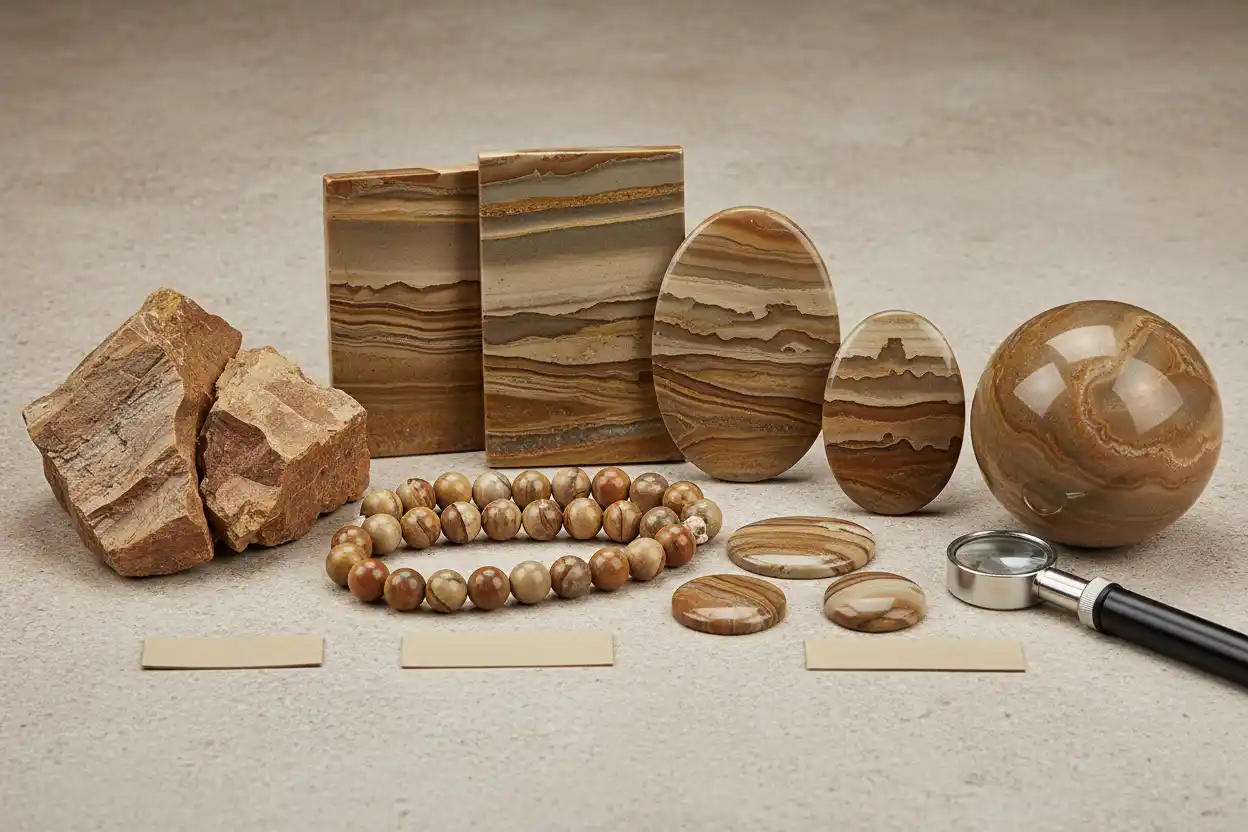
Where to Buy Real Picture Jasper and Avoid Dyed Fakes
Real Picture Jasper is an opaque, patterned lapidary material whose brown, tan, cream, rust, yellow, gray and black markings can resemble deserts, mountains, river valleys, forests or abstract landscapes. The scenes are natural geological patterns rather than painted pictures or preserved photographs.
However, Picture Jasper is a commercial appearance category rather than one precisely defined mineral species. Some material fits the conventional definition of impurity-rich microcrystalline silica, while other trade parcels may be jasper-like silicified rock with more complex compositions.
The market also contains dyed pale stone, printed patterns, painted cabochons, resin composites and ordinary brown rock promoted under invented locality names. Therefore, the strongest purchase combines a convincing three-dimensional pattern with accurate material, treatment and source disclosure.
The Picture Jasper meaning and properties guide covers its identity and traditional symbolism. This buying guide focuses on scenic-pattern quality, treatment, seller evidence, locality claims and finished-product construction without duplicating the broader Jasper buying guide.
What Counts as Picture Jasper?
The term Picture Jasper generally applies to opaque silica-rich material whose natural markings suggest recognizable scenery.
Its patterns may result from combinations of:
- Iron oxides and hydroxides
- Manganese-rich material
- Clay and fine sediment
- Silica-filled fractures
- Brecciation and later cementation
- Color zoning
- Mineral replacement
- Flow or depositional structures
No rule requires a pattern to resemble one specific landscape. One person may see a canyon where another sees clouds or abstract bands.
The Jasper meaning guide explains conventional Jasper, while the types of Jasper guide separates scenic, orbicular, brecciated and source-specific commercial materials.
Because the name is visual, sellers should avoid presenting every Picture Jasper as one uniform composition or geological formation.
Picture Jasper Belongs to the Wider Chalcedony and Jasper Market
Conventional Jasper is closely related to Chalcedony and chert. It is usually more opaque and contains more mineral impurities than translucent Chalcedony.
Nevertheless, some materials sold as Picture Jasper may include visible grains, volcanic components or silicified sedimentary textures that place them outside a narrow chalcedony definition.
That does not automatically make them fake. Instead, an accurate listing should explain whether the object is:
- Conventional silica-rich Jasper
- Silicified sedimentary rock
- Jasper-like volcanic material
- Brecciated and re-cemented rock
- Dyed or stabilized natural stone
- Reconstructed stone and resin
- Glass or ceramic imitation
The commercial name can remain useful as long as it does not replace composition and treatment disclosure.
Choose the Product Form Before Shopping
| Picture Jasper product | Best source | Main buying concern |
|---|---|---|
| Natural rough | Lapidary supplier | Pattern depth, fractures and usable yield |
| Slab | Specialist lapidary dealer | Scene continuity, dye, resin and backing |
| Cabochon | Independent cutter | Composition, polish, backing and pattern placement |
| Tumbled stone | Reputable crystal retailer | Generic brown rock and artificial color |
| Bead strand | Established bead supplier | Printed pattern, dye and mixed varieties |
| Sphere | Experienced carving retailer | Weak reverse pattern, resin and assembly |
| Tower | Stone seller with exact-item video | Carved point, repaired tip and surface-only scene |
| Carving | Skilled lapidary dealer | Composite construction and unstable seams |
| Jewelry | Jeweler with treatment disclosure | Backing, glue and exact-stone photography |
| Locality specimen | Geological or rock dealer | Evidence supporting the named source |
Rough should be evaluated for cutting potential. Cabochons should be judged for their final face-up composition rather than rough weight.
Where to Buy Genuine Picture Jasper
Specialist lapidary suppliers
Lapidary suppliers are usually the strongest source for rough and slabs.
Request dry photographs of the exterior, sawn faces and edges. Wet or oiled material appears darker and more dramatic while hiding scratches and fine fractures.
Ask whether sample cabochons have been cut from the same parcel. Their appearance reveals whether the scenic pattern continues through the material.
A reliable supplier should also explain whether soft seams, cavities or different mineral zones polish unevenly.
Independent cutters
An experienced cutter can orient bands and shapes so the finished stone resembles a balanced landscape.
Ask to see the original slab before purchasing an expensive cabochon. That photograph helps confirm that the scene existed naturally before cutting.
Request front, back and girdle views. The pattern should continue into the stone rather than appearing only on one coated face.
Gem and mineral shows
Shows allow direct comparison with Noreena Jasper, Mookaite, landscape Agate, rhyolite, dyed quartzite and resin.
Use a loupe to inspect color boundaries, grain texture, filler and surface coatings.
Rotate the piece. Natural bands and inclusions should change in relation to the viewer because they occupy three-dimensional space.
Do not scratch the stone or apply solvents. The crystal identification guide provides safer visual and instrumental methods.
Established online stores
The online gemstone buying guide explains seller identity, payment protection and returns.
Exact-item photographs are essential. The primary value lies in an individual pattern, so one stock photograph cannot represent a randomly selected cabochon or sphere.
Request images under neutral light. Heavy contrast can turn faint tan lines into a dramatic mountain scene, while digital saturation can create unrealistic red or yellow areas.
Geological and locality dealers
Some Picture Jasper names depend strongly on source.
Request the country, district, mine or collecting area and the evidence behind the claim. Original parcel labels, invoices and collection records are more useful than visual resemblance.
A dealer should admit when a locality is uncertain rather than assigning a famous trade name from color alone.
What Genuine Picture Jasper Looks Like
The body is commonly opaque, though thin edges or chalcedony-rich zones may transmit light.
Natural colors often include cream, beige, tan, ochre, mustard, rust, brick red, brown, gray and black.
Patterns can appear as:
- Horizontal landscape bands
- Mountain-like peaks
- Rolling curves
- Clouds and horizons
- Branching dark lines
- Brecciated fragments
- Sedimentary-looking layers
- Spots and plumes
- Water-like waves
- Abstract geometric fields
The polish should reveal a fine rock texture. Some pieces are uniformly smooth, while multi-mineral material may show slight undercutting where softer areas meet harder silica-rich zones.
A realistic scene can occur by chance. However, identical landscapes across several stones strongly suggest printing, painting or molded resin.
How Natural Landscape Patterns Develop
Picture-like designs can form through several stages of geological activity.
Fine sediment may accumulate in changing layers. Later silica can replace or cement that material. Iron-rich fluids can add yellow, red or brown coloration, while manganese-bearing material contributes black or dark gray markings.
Fracturing can divide the rock into angular pieces. New silica or mineral material may then fill the gaps, creating a brecciated landscape.
Other stones may record volcanic flow, alteration or replacement rather than sedimentation.
Consequently, sellers should avoid claiming that every line represents one ancient shoreline, tree or mountain. The scenic interpretation belongs to the viewer; the structure remains geological.
Picture Jasper Versus Red Jasper
Red Jasper is dominated by red, rust or brown iron-rich color.
Picture Jasper can contain substantial red, but its commercial identity depends more on a scenic or landscape-like pattern.
A mostly uniform red stone with no picture-like structure belongs more naturally in the Red Jasper market.
Color and scene should be evaluated separately because dye can strengthen either one.
Picture Jasper Versus Yellow Jasper
Yellow Jasper commonly ranges from mustard and ochre to tan and brownish yellow.
Yellow areas frequently appear within Picture Jasper scenes. However, a uniform mustard stone does not become Picture Jasper without a recognizable natural pattern.
The distinction affects description more than mineral identity.
Picture Jasper Versus Noreena Jasper
Noreena Jasper is an Australian trade material known for red, mustard, cream and dark angular designs.
Its geometric fracture-like pattern can resemble an abstract aerial landscape.
Picture Jasper is a broader scenic category, while Noreena Jasper requires Australian source provenance.
A seller should not assign the Noreena name merely because a brown-and-yellow stone contains angular lines.
Picture Jasper Versus Mookaite
Mookaite is a Western Australian silicified radiolarite or porcellanite known for cream, mustard, burgundy, red and purple color fields.
The completed guide to buying real Mookaite owns Mooka Creek provenance and radiolarite-specific concerns.
Mookaite can produce scenic cabochons, but not every landscape cut from Mookaite should be relabeled generic Picture Jasper when the source identity is known.
Picture Jasper Versus Ocean Jasper
Ocean Jasper is a Madagascan trade material valued primarily for circles, eyes and orbicular structures.
The completed guide to buying genuine Ocean Jasper addresses Madagascan provenance, vein claims and orb quality.
Ocean Jasper occasionally creates landscape-like arrangements, but the orbicular source identity remains more precise.
Picture Jasper Versus Landscape Agate
Landscape Agate and scenic Agate usually contain more translucent chalcedony than Picture Jasper.
Bands, plumes or dendrites may appear suspended within a clearer host, producing depth similar to a miniature landscape.
Picture Jasper is typically more opaque and rock-like.
The boundary can be gradual. An object containing translucent Agate bands and opaque Jasper zones may be described accurately as Jasper-Agate.
Picture Jasper Versus Dendritic Agate
Dendritic Agate contains branching mineral structures that resemble trees, ferns or shrubs.
Picture Jasper scenes may include dark branches, but the host is generally more opaque and the overall design may involve broad sedimentary-looking bands.
A stone dominated by distinct tree-like dendrites within translucent Chalcedony belongs more naturally in the Dendritic Agate market.
Picture Jasper Versus Rhyolite
Rhyolite is a silica-rich volcanic rock that can contain flow patterns, spherulites and contrasting mineral grains.
Some rhyolites are sold under Jasper names because they are opaque, colorful and polish well.
A natural rhyolite is not a counterfeit stone. The issue is whether the seller explains its rock identity rather than claiming pure microcrystalline Jasper.
Petrographic examination may be required when exact geological classification affects value.
Dyed Picture Jasper
Pale Jasper, chert, quartzite and other porous rocks can be dyed red, yellow, brown, green, blue or black.
Artificial color may gather in:
- Open fractures
- Grain boundaries
- Pits and cavities
- Drill holes
- Porous sedimentary layers
- Weathered surfaces
Chipped areas may reveal a paler interior. Nevertheless, natural iron-rich staining can also follow fractures and bedding.
Therefore, one dark line does not prove dye. Compare several depths and request a treatment statement.
The fake-crystal buyer’s guide provides broader checks for artificial color and manufactured materials.
Painted and Printed Landscapes
A manufacturer can paint a scenic image onto plain stone, ceramic or resin.
Under magnification, paint may cross scratches, form a raised boundary or stop abruptly at the edge.
Printed designs often remain at one uniform depth and may repeat exactly across several objects.
Natural patterns should enter the girdle, reverse and any exposed chip in a plausible way.
Do not scrape a suspected design. Use the seller’s return policy and professional inspection instead.
Resin and Reconstructed Stone
Stone fragments or powder can be mixed with resin and molded into beads, carvings and spheres.
A composite may contain genuine Jasper but lacks the continuous geology of one natural piece.
Mold seams, identical patterns, bubbles and resin-rich chips support reconstruction.
Resin can also fill fractures in otherwise solid natural stone. Limited filling and fully reconstructed material should receive different descriptions.
The gemstone treatments guide explains filling, impregnation and composite construction.
Backed and Assembled Cabochons
A thin scenic slice can be attached to a darker or stronger backing.
Backing may improve contrast, provide structural support or reduce the amount of premium patterned material required.
Inspect the girdle for a straight seam and adhesive. Closed settings can conceal the join entirely.
A doublet can be practical when disclosed, but it should not be represented as one solid cabochon.
Glass and Ceramic Imitations
Opaque glass can be swirled or printed with brown, cream and red patterns.
Round bubbles, flow structures, mold seams and chipped glassy edges support manufacture.
Ceramic may reveal a uniformly fired body beneath a printed glaze.
Natural Picture Jasper should show a fine geological texture rather than a factory coating separated from its substrate.
How to Evaluate Rough
Request dry photographs of the natural surface and multiple sawn faces.
Look for pattern continuity through the block. A scenic crust over a plain interior provides limited cutting yield.
Inspect fractures crossing the most desirable area. A large block may split before producing one complete landscape cabochon.
Ask whether test stones polished evenly and whether stabilization was required.
Do not pay only for weight. Usable patterned area is more important.
How to Evaluate Slabs
Compare both faces and all edges.
A natural design should change through the slab’s thickness. Mountains or bands can shift, narrow or disappear as the cut moves through the structure.
A good slab provides several possible cabochon compositions rather than one attractive corner.
Inspect for oil, wax, resin, backing and straight assembly seams.
How to Judge Cabochons
A skilled cutter frames the natural pattern rather than merely cutting the largest shape possible.
Horizontal bands can form a horizon, while a dark plume may become a tree or mountain. The interpretation should arise from the stone rather than painted additions.
The dome needs an even polish without deep pits or broad flat areas.
Inspect the back and girdle for pattern continuity, dye, resin and backing.
Buying Beads and Bracelets
Natural beads should share a related color palette without repeating identical scenes.
Inspect drill holes for concentrated dye, resin and radial cracks.
Ask whether the strand contains only Picture Jasper or several brown Jasper varieties selected for visual consistency.
Perfectly repeated mountain shapes on every bead strongly suggest printing or molded resin.
Buying Spheres, Towers and Carvings
Request a complete rotation. One side may contain a strong landscape while the reverse is plain brown or cream.
A sphere should not have a straight equatorial seam or reconstructed section hidden beneath its stand.
Most towers are carved. Their point did not form naturally.
Carvings should avoid thin projections across open fractures or soft mineral seams.
Buying Picture Jasper Jewelry
Sound silica-rich Picture Jasper is generally suitable for pendants, earrings, bracelets and protected rings.
However, durability varies if the material contains cavities, soft layers or resin.
The gemstone hardness chart provides approximate scratch-resistance context. The gemstone toughness-versus-hardness guide explains why fractures and heterogeneous rock texture still matter.
A bezel protects cabochon edges better than widely spaced prongs.
Locality and Provenance
Picture Jasper occurs under numerous source-specific trade names.
Material is marketed from the western United States, Africa, Australia, Indonesia and other regions. However, scenic appearance alone cannot prove one country or deposit.
Be cautious with phrases such as “desert Jasper,” “old mine,” “lost vein” or “one-source material” unless the seller provides records.
The ethical gemstone sourcing guide provides practical questions about legal collecting, land access, cutting labor and traceability.
Price and Value
Picture Jasper is generally affordable, but exceptional natural scenes and documented old-source material can command premiums.
Value depends on:
- Scene clarity
- Pattern balance
- Natural color
- Contrast
- Pattern depth
- Structural condition
- Cutting quality
- Polish
- Treatment disclosure
- Size
- Provenance
A small cabochon resembling a complete landscape may be more desirable than a large slab with weak scattered markings.
The gemstone pricing guide explains why cutting skill and usable yield can outweigh the raw stone’s cost.
Questions to Ask the Seller
Ask whether Picture Jasper is being used for conventional silica-rich Jasper or another jasper-like rock.
Request the country, deposit or supplier and the evidence supporting the claim.
Confirm dye, paint, print, resin, oil, wax, backing, filling and reconstruction.
For rough and slabs, request dry photographs of both faces and edges. For cabochons, request front, back and girdle views.
For spheres and carvings, obtain a complete rotation. Finally, confirm that the return policy permits professional examination.
Professional Identification
Microscopy can reveal natural rock texture, color pathways, printed patterns, resin and assembly seams.
Raman spectroscopy and X-ray diffraction can identify quartz, Chalcedony and associated crystalline minerals.
Petrographic microscopy may be necessary when distinguishing conventional Jasper from silicified sedimentary or volcanic rock.
Because the material can be heterogeneous, several test points may be needed. One quartz reading does not define the whole object.
Cleaning and Storage
Clean sound untreated Picture Jasper with lukewarm water, mild soap and a soft cloth.
Avoid prolonged soaking when dye, resin, backing or glue is present.
Do not use steam or ultrasonic cleaning on fractured, filled or assembled pieces.
Store polished stones away from diamonds, sapphires and other harder gemstones.
Frequently Asked Questions
1. Is Picture Jasper a recognized mineral species?
No. It is a commercial name for natural scenic-patterned Jasper or jasper-like lapidary rock.
2. Are the landscapes painted?
Natural Picture Jasper scenes are geological patterns. Painted and printed imitations also exist, so the edges and reverse should be inspected.
3. What creates the brown and red colors?
Iron oxides and hydroxides commonly contribute brown, yellow and red tones, while other minerals and sedimentary structures affect the pattern.
4. Is Picture Jasper always microcrystalline quartz?
Not necessarily. Some trade materials are complex silicified or volcanic rocks rather than strict Chalcedony Jasper.
5. Is Picture Jasper the same as Landscape Agate?
No. Landscape Agate is generally more translucent, while Picture Jasper is usually opaque. Some stones contain both Jasper and Agate zones.
6. Is Noreena Jasper a Picture Jasper?
Noreena Jasper can produce scenic patterns, but it is a specific Australian trade material with its own source identity.
7. Can Picture Jasper be dyed?
Yes. Pale stone can absorb dye through fractures, pores and grain boundaries.
8. Can the pattern be printed onto stone?
Yes. Printed, painted and resin-coated imitations can reproduce landscape designs.
9. Can Picture Jasper contain resin?
Yes. Fractures may be filled, while powder or fragments can be reconstructed with polymer.
10. Is Picture Jasper suitable for daily jewelry?
Most sound silica-rich cabochons are wearable, though fractures, cavities and mixed mineral seams must be considered.
11. Do ordinary pieces need laboratory reports?
Usually not. Testing becomes more useful for expensive locality claims, suspected composites or disputed composition.
12. What is the biggest warning sign in a listing?
Be cautious when several stones show the same detailed landscape or when the seller refuses to provide edge and reverse photographs.
Buy a Natural Scene That Continues Through the Stone
Picture Jasper’s strongest appeal comes from geological coincidence interpreted through thoughtful cutting. The scene should remain plausible after the stone is turned over and the marketing story is removed.
The P crystal directory, P gemstone directory and visual gemstone guide provide wider comparisons. Choose the piece whose pattern, composition and source can be explained without relying on imagination alone.
Safety note: Picture Jasper and many jasper-like rocks contain crystalline silica. Cutting, drilling, sanding or grinding can create hazardous respirable silica dust. Never dry-work the material; use professional wet methods, effective local extraction and suitable respiratory and eye protection.