Where to Buy Real Rhodonite and Avoid Dyed Pink Fakes
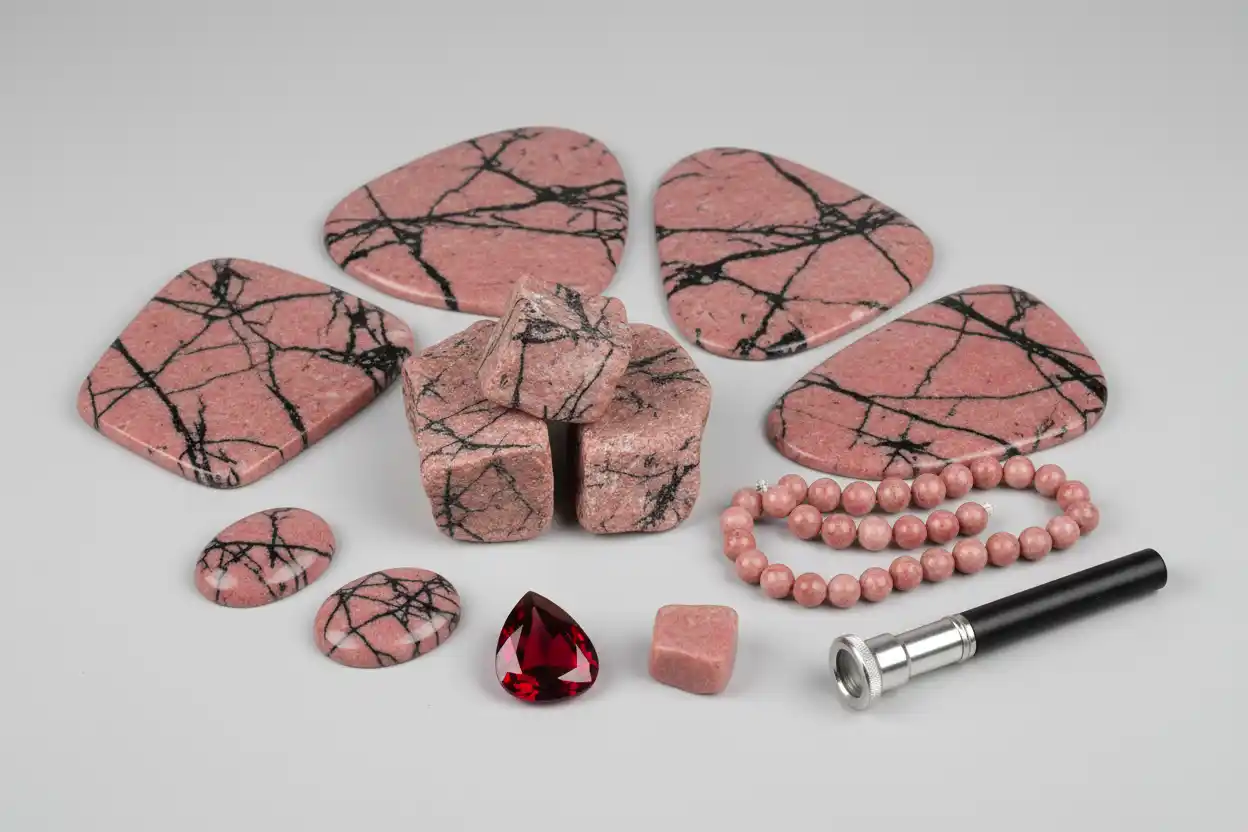
Real Rhodonite is a manganese-rich silicate mineral or rhodonite-group material commonly recognized by rose, pink, red, salmon or brownish-pink color. Massive lapidary material frequently contains black manganese oxide veins, patches or dendritic-looking structures.
Most commercial Rhodonite is translucent to opaque and is cut into cabochons, beads, spheres, carvings and decorative slabs. Transparent red crystals and faceted gems are far rarer and belong primarily to a collector market.
Imitations and misidentifications include dyed Marble, dyed Calcite, Rose Quartz, Rhodochrosite, Thulite, Pink Opal, glass, ceramic, resin and other manganese-rich silicate rocks. Natural Rhodonite can also be fracture-filled, stabilized or backed.
The Rhodonite meaning and properties guide covers its identity and traditional symbolism. This buying guide focuses on mineral complexity, black matrix, treatment, seller evidence, durability and value.
Rhodonite Is a Manganese-Rich Pyroxenoid
Rhodonite belongs to the pyroxenoid mineral group and crystallizes in the triclinic system.
Its composition can include manganese, calcium, iron and magnesium in varying proportions. Consequently, exact formulas and species boundaries can become more complex than a simple MnSiO3 description suggests.
Some material sold historically as Rhodonite may be more accurately classified as another closely related rhodonite-group mineral or as Pyroxmangite.
For ordinary lapidary products, “Rhodonite” remains an established commercial name. However, an expensive transparent crystal or scientifically important specimen may require chemical and X-ray analysis for exact classification.
What Creates Rhodonite’s Pink and Black Pattern?
Manganese within the silicate structure contributes Rhodonite’s pink-to-red color.
Black veins and patches commonly consist of secondary manganese oxides formed through alteration and oxidation.
Those dark areas can create attractive contrast, but they may also mark fractures, weathering or mineral boundaries.
Not every genuine Rhodonite contains black veins. Fine transparent crystals can be relatively free from dark oxide, while some massive material contains so much black matrix that only small pink islands remain.
The seller should describe the actual percentage and distribution rather than treating black veining as an absolute authenticity requirement.
Choose the Product Form Before Shopping
| Rhodonite product | Best source | Main buying concern |
|---|---|---|
| Natural crystal specimen | Fine-mineral dealer | Exact species, cleavage, repairs and locality |
| Massive rough | Lapidary supplier | Pink-to-black balance, fractures and mixed minerals |
| Slab | Specialist lapidary dealer | Pattern continuity, resin and cutting yield |
| Cabochon | Independent cutter | Color, black matrix, filler and backing |
| Bead strand | Established supplier | Dye, reconstructed material and drill-hole cracking |
| Sphere | Experienced carving retailer | Pattern coverage, resin and assembly |
| Tower or carving | Stone seller with exact-item video | Repaired point, coating and soft black seams |
| Transparent faceted gem | Collector-gem specialist | Identity, cleavage and clarity enhancement |
| Jewelry | Jeweler familiar with Rhodonite | Protective setting, backing and treatment |
| Historic locality specimen | Specialist dealer | Original labels and provenance |
The evidence required for a common opaque bead differs greatly from that required for a transparent faceted red gem.
Where to Buy Genuine Rhodonite
Specialist mineral dealers
Mineral dealers are the best source for crystals, locality specimens and rare transparent material.
Listings should state the mine, district, dimensions, condition and associated minerals.
Request photographs of every termination, edge and base. Rhodonite can have pronounced cleavage and brittle fracture, so repairs may be present.
Ask whether the specimen was analyzed as Rhodonite, identified visually or classified more broadly as rhodonite-group material.
Lapidary suppliers
Request dry photographs of rough, slabs and representative finished stones.
Water and oil deepen pink and black colors and temporarily reduce the visibility of scratches.
Ask whether the black areas are stable manganese oxide, open fractures, soft material or resin-filled seams.
A good supplier should show how the pattern continues through the rock and whether the material polished evenly.
Gem and mineral shows
Shows allow comparison with Rhodochrosite, Rose Quartz, Thulite, Pink Opal, Sugilite and dyed stone.
Use a loupe to inspect black veins, color boundaries, resin, coating and glue.
Do not perform acid or scratch tests. Rhodonite may occur with carbonate minerals, while its polished surface can be damaged unnecessarily.
Established online stores
The online gemstone buying guide explains seller identity, protected payments and returns.
Request exact-item photographs against neutral backgrounds. Pink saturation and black contrast are easy to exaggerate digitally.
Ask for a full rotation of spheres and carvings. The display face may contain far more pink than the reverse.
The seller should show drill holes and girdles where dye and resin often become visible.
Collector-gem dealers
Transparent Rhodonite is rare and difficult to facet.
Request an independent laboratory report for a significant stone. The report should address mineral identity and visible clarity enhancement.
Inspect the girdle and facet junctions for cleavage chips.
Transparent Rhodonite should be purchased as a collector gem rather than a durable alternative to Ruby or Pink Tourmaline.
What Genuine Rhodonite Looks Like
Natural Rhodonite may be:
- Rose pink
- Raspberry pink
- Salmon
- Pinkish red
- Orangy red
- Brownish pink
- Gray-pink
- Pink with black veins
- Pink with white or gray associated minerals
Most commercial material is opaque to translucent.
The black manganese oxide may form straight veins, branching structures, patches, webbing or broad fields.
White areas can include Quartz, Calcite or other associated minerals. Brown zones may reflect weathering or iron-rich alteration.
The polished surface can be smooth and vitreous, though multi-mineral material may undercut where black or white components differ in hardness.
Rhodonite Versus Rhodochrosite
Rhodochrosite is manganese carbonate. Rhodonite is a manganese-rich silicate.
Rhodochrosite commonly shows white-to-pink carbonate bands, rhombohedral cleavage and lower hardness.
Rhodonite more often displays pink with black manganese oxide veins and is generally harder.
The Rhodochrosite versus Rhodonite guide owns the complete comparison, while the completed guide to buying genuine Rhodochrosite covers banded and transparent Rhodochrosite markets.
Do not use acid as a home test. It damages Rhodochrosite and can affect mixed Rhodonite specimens containing carbonate.
Rhodonite Versus Rose Quartz
Rose Quartz is pink Quartz and usually lacks black manganese oxide webbing.
Rhodonite often has a denser, more granular appearance and stronger pink-to-red areas.
The Rose Quartz versus Rhodonite guide owns the direct identification workflow.
The treated Rose Quartz guide covers dye, coating and reconstructed Quartz.
A pale pink carving without black veins still requires testing because genuine Rhodonite does not always contain dark matrix.
Rhodonite Versus Thulite
Thulite is pink manganese-bearing Zoisite.
It commonly appears pink, rose or reddish with white, gray or green associated material.
Thulite usually lacks the characteristic black manganese oxide webbing seen in much Rhodonite, although visual overlap remains substantial.
Raman spectroscopy and refractive testing provide safer identification than pattern alone.
Rhodonite Versus Pink Opal
Pink Opal is hydrated silica and generally has a softer, waxier appearance.
The completed guide to buying real Pink Opal covers dye, polymer stabilization and Peruvian provenance.
Pink Opal can contain brown or dark inclusions but usually lacks Rhodonite’s manganese-rich mineral structure.
Rhodonite Versus Sugilite
Sugilite is a complex purple-to-pink silicate commonly associated with manganese deposits.
It can appear reddish purple, magenta or pink with black matrix.
Rhodonite is generally more rose or red-pink, while Sugilite often has a stronger purple component.
The future guide to buying genuine Sugilite will own purple color, South African provenance and treatment.
Laboratory testing is appropriate for high-value material because visual boundaries overlap.
Rhodonite Versus Charoite
Charoite is a purple silicate-rich rock known for swirling, feathered and fibrous patterns.
Rhodonite generally shows granular pink areas and black oxide veins rather than Charoite’s flowing lilac structures.
The completed guide to buying genuine Charoite covers Russian provenance, resin and imitation material.
Rhodonite Versus Mangano Calcite
Mangano Calcite is a soft manganese-bearing carbonate commonly found in pale pink and peach.
The completed guide to buying Mangano Calcite owns fluorescence and related carbonate identification.
Rhodonite is harder and generally resists acid better, although associated carbonate can occur within a mixed specimen.
Instrumental testing avoids destructive confusion.
Rhodonite Versus Dyed Marble and Calcite
White Marble, Calcite and other carbonate rocks can be dyed pink and crossed with black-painted lines.
Artificial color may concentrate in fractures, pores and grain boundaries.
A chipped edge can reveal a pale interior or show that black lines sit only on the surface.
Natural Rhodonite’s pink and black components should continue into edges and drill holes in a geological pattern.
Rhodonite Versus Glass and Ceramic
Opaque pink glass can imitate beads, cabochons and carvings.
Round bubbles, flow lines, mold seams and conchoidal chips support glass.
Ceramic can reproduce pink-and-black pattern through glaze or printing. A chip may expose a uniform fired body beneath the decorative layer.
The fake-crystal buyer’s guide provides broader glass, ceramic and resin checks.
Dye and Color Enhancement
Pale Rhodonite or another porous stone can be dyed pink or red.
Artificial color may enter fractures, black matrix boundaries and drill holes.
Natural manganese coloration can also vary strongly through the stone. Therefore, uneven pink does not prove treatment.
Ask for a written treatment statement and inspect several depths under magnification.
Fracture Filling and Clarity Enhancement
Transparent and translucent Rhodonite may contain surface-reaching fractures.
GIA has documented clarity-enhanced transparent Rhodonite with filler in fractures and cavities.
Filling can improve transparency and reduce the visibility of cleavage-related damage.
Under magnification, resin may show bubbles, flow structures or a different flash.
Treatment does not change the mineral identity, but it affects value, durability and cleaning.
The gemstone treatments guide provides wider enhancement terminology.
Stabilized and Reconstructed Rhodonite
Massive material with extensive black oxide or fractures can be impregnated with polymer.
Clear resin may strengthen weak areas, while pink or black filler can conceal missing material.
Fragments and powder can also be molded with binder.
Mold seams, repeated patterns and polymer-rich chips support reconstruction.
A heavily bound composite should not receive the value of one solid natural cabochon.
Glued Specimens and Matrix Repairs
Natural crystals can be reattached to matrix after mining.
Inspect each crystal base for glossy adhesive, bubbles and a mismatch between the crystal and socket.
A repaired original specimen differs from a fully fabricated arrangement, but both require disclosure.
For historic locality pieces, restoration records should remain with the specimen.
Rhodonite and Pyroxmangite Confusion
Rhodonite and Pyroxmangite are related manganese silicates with similar appearance and overlapping compositions.
Some massive or transparent material historically sold as Rhodonite may contain Pyroxmangite or another rhodonite-group phase.
Visual inspection alone may not separate them.
X-ray diffraction and chemical analysis are usually needed when exact species matters.
For ordinary jewelry, a cautious “rhodonite-group manganese silicate” description may be more accurate than unsupported precision.
How to Evaluate Rough
Request dry natural-surface and sawn-face photographs.
Determine how much of the rock is pink Rhodonite versus black oxide, white mineral or weathered matrix.
Inspect fractures and weak black seams. A large block may split or undercut during cutting.
Ask whether test cabochons polished evenly and whether resin was required.
Usable pink area matters more than total weight.
How to Evaluate Slabs
Compare both faces and every edge.
The black webbing and pink body should continue through the slab rather than remain on one painted surface.
A strong slab offers several balanced cutting areas with stable black pattern.
Broad soft black zones can undercut or crumble, while open fractures reduce yield.
Ask whether the surface is oiled, waxed or resin-treated.
How to Judge Cabochons
Fine cabochons balance saturated pink with attractive black matrix.
Some buyers prefer mostly pink stones, while others value dramatic black webbing. Neither preference defines authenticity.
The dome should have an even polish without broad pits or resin pools.
Inspect the girdle for cracks and the back for treatment, backing and pattern continuity.
A smaller stone with well-composed black lines may be more desirable than a larger piece dominated by dull matrix.
Buying Transparent Faceted Rhodonite
Transparent facet-grade Rhodonite is rare.
Fine gems can show vivid orangy red, red or purplish pink color. However, perfect cleavage and brittle behavior make cutting difficult.
Inspect facet junctions and the girdle for abrasions or chips.
Ask whether clarity enhancement was detected.
A faceted stone should be worn in a protected pendant or retained as a collector gem rather than placed in an exposed daily ring.
Buying Beads and Bracelets
Natural strands should show plausible variation in pink color and black pattern.
Inspect drill holes for dye, resin and radial cracks.
Perfectly repeated black webbing can indicate printed ceramic or resin.
Ask whether the strand contains solid Rhodonite, reconstructed material or mixed pink stones.
Heavy beads should be restrung periodically because rough drill holes can weaken cord.
Buying Spheres, Towers and Carvings
Request a complete rotation.
One face may contain rich pink color while the reverse is mostly black, gray or white.
A sphere should not have a straight equatorial assembly seam.
Most towers are carved rather than naturally crystallized.
Carvings should avoid thin projections across black oxide veins or fractures.
Buying Rhodonite Jewelry
Massive Rhodonite commonly has Mohs hardness around 5.5 to 6.5, but durability varies with cleavage, fractures and associated minerals.
The gemstone hardness chart, gemstone cleavage guide and toughness-versus-hardness guide explain why hardness alone is insufficient.
Pendants, earrings and protected cabochon rings are practical when the stone is sound.
A bezel supports edges more evenly than narrow prongs.
Locality and Provenance
Important Rhodonite comes from Australia, Russia, Brazil, Peru, Mexico, the United States, Canada, Sweden, Madagascar and other manganese-rich deposits.
Broken Hill in Australia is renowned for fine crystals and transparent material.
Russia has supplied ornamental Rhodonite used in large decorative objects, while other sources produce commercial lapidary rough.
Appearance cannot prove locality. Request original labels and supplier records when source affects value.
The ethical gemstone sourcing guide provides broader questions about mining, cutting labor and traceability.
Price and Value
Common massive Rhodonite is affordable. Fine pink-and-black cabochons, large clean carvings, transparent crystals and documented locality specimens can cost more.
Value depends on:
- Pink or red saturation
- Balance of black matrix
- Transparency
- Crystal form
- Structural condition
- Polish
- Size
- Treatment
- Repair
- Provenance
- Cutting quality
Transparent faceted material belongs to a separate rarity category and should not be compared directly with opaque beads.
The gemstone pricing guide explains how rarity, yield and craftsmanship affect retail prices.
Questions to Ask the Seller
Ask whether the material is Rhodonite, Rhodonite-group rock, Pyroxmangite, Rhodochrosite, dyed carbonate, glass or composite.
Request the locality and evidence supporting it.
Confirm dye, resin, filling, backing, coating, glue and reconstruction.
Ask what the black material is believed to be and whether it forms stable veins or open fractures.
For transparent gems, request a laboratory report. For cabochons, request front, back and girdle views.
Finally, obtain a return policy that permits professional identification.
Professional Identification
Refractive index, specific gravity, microscopy and optical testing can support Rhodonite identification.
Raman spectroscopy can distinguish it from many lookalikes, while X-ray diffraction and chemical analysis help separate Rhodonite from Pyroxmangite and related phases.
Microscopy can reveal manganese oxide, dye, filler and glue.
Several test points may be necessary because one polished object can contain multiple minerals.
Confirming Rhodonite does not automatically prove untreated color or a specific locality.
Cleaning and Storage
Use lukewarm water, mild soap and a soft cloth for sound untreated material.
Avoid acids, bleach, steam and ultrasonic cleaning.
Do not soak filled, backed or glued stones.
Store Rhodonite separately from harder gemstones and remove rings before household work or impact-prone activities.
Frequently Asked Questions
1. Is Rhodonite a manganese mineral?
Yes. It is a manganese-rich pyroxenoid silicate or rhodonite-group material.
2. What causes Rhodonite’s pink color?
Manganese within its silicate structure produces the characteristic rose, pink and red colors.
3. What creates the black veins?
They commonly consist of secondary manganese oxide material formed through alteration.
4. Does genuine Rhodonite always have black veins?
No. Some genuine pieces contain little black material, and rare transparent crystals may have none.
5. Is Rhodonite the same as Rhodochrosite?
No. Rhodonite is a silicate, while Rhodochrosite is manganese carbonate.
6. Is Rhodonite the same as Rose Quartz?
No. Rose Quartz is harder crystalline silica and usually lacks Rhodonite’s black manganese oxide pattern.
7. Can Rhodonite be confused with Thulite?
Yes. Both can be pink and massive, but they have different mineral structures and require testing when appearance overlaps.
8. Can Rhodonite be dyed?
Yes. Rhodonite and pale lookalike stones can be dyed pink or red.
9. Can Rhodonite contain resin?
Yes. Fractures may be filled, massive material can be stabilized and fragments can be reconstructed with polymer.
10. Is transparent Rhodonite rare?
Yes. Transparent facet-grade material is much rarer than opaque ornamental Rhodonite.
11. Is Rhodonite suitable for daily rings?
Protected cabochons can be worn carefully, but cleavage, fractures and mixed mineral veins make exposed daily wear risky.
12. What is the biggest warning sign in a listing?
Be cautious when identical bright-pink objects have printed-looking black veins and the seller provides no edge, drill-hole or treatment photographs.
Buy the Pink Mineral and Its Black Structure Together
Rhodonite’s black pattern can improve its appearance or expose structural weakness. A strong purchase accounts for both rather than grading color alone.
The pink gemstones guide, R crystal directory, R gemstone directory and visual gemstone guide provide wider comparisons. Choose a seller who explains mineral identity, matrix, treatment and durability with equal care.
Safety note: Rhodonite and associated manganese minerals are not dietary manganese sources. Do not ingest the stone or place it in drinking water. Cutting, drilling and grinding should use wet methods, effective extraction and suitable respiratory and eye protection.