Where to Buy Real Selenite and Avoid Satin Spar or Glass Fakes
Real Selenite is a transparent-to-translucent crystalline variety of Gypsum. It commonly forms clear, colorless, white, gray, pale yellow or lightly tinted tabular and bladed crystals with a pearly-to-vitreous luster.
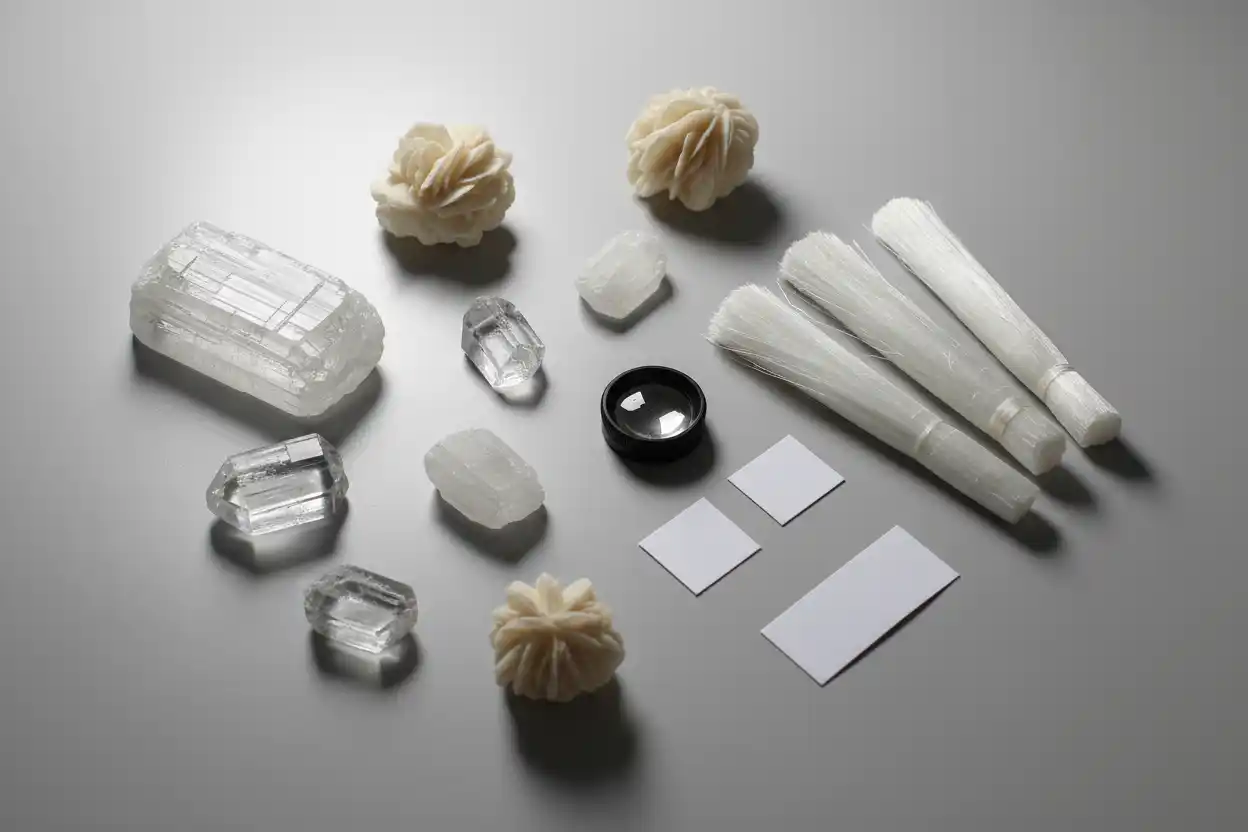
However, most white “Selenite” wands, towers, bowls and charging plates in crystal shops are technically Satin Spar Gypsum. Satin Spar has parallel fibrous structure and a silky moving light, while true Selenite forms clearer, flatter crystals.
Both materials are genuine Gypsum, so Satin Spar is not a fake merely because the retail label says Selenite. The problem arises when sellers charge a clear-crystal Selenite premium for ordinary fibrous material, confuse Gypsum with glass or Calcite, or hide coatings, glue and reconstructed products.
The Selenite meaning and properties guide covers identity and traditional symbolism. This buying guide focuses on terminology, sellers, crystal form, water sensitivity, imitation materials and choosing Gypsum suitable for collecting or decoration.
Selenite Is a Variety of Gypsum
Gypsum is hydrated calcium sulfate with the formula CaSO4·2H2O.
The Gypsum meaning and properties guide explains the parent mineral, while the types of Selenite guide separates clear crystals, Satin Spar, desert roses, Gypsum flowers and other commercial forms.
Gypsum has Mohs hardness 2. A fingernail can scratch it, although buyers should never damage a seller’s specimen to test that property.
The mineral has excellent cleavage and can split into thin sheets, blades or fibrous fragments depending on its growth structure. It is also somewhat soluble in water, particularly after long exposure.
These properties make authentic Selenite easy to damage. A flawless object that behaves like durable glass deserves closer examination.
Selenite Versus Satin Spar
True Selenite usually refers to relatively clear, transparent or translucent Gypsum crystals with tabular, bladed or elongated forms.
Satin Spar is a fibrous variety of Gypsum. Parallel fibers create a silky luster and a bright line that moves across a polished surface.
The detailed Selenite versus Satin Spar guide owns the full mineral and terminology comparison.
For purchasing purposes, the distinction affects product expectations:
| Feature | Selenite | Satin Spar |
|---|---|---|
| Structure | Clear tabular or bladed crystals | Parallel fibrous aggregate |
| Transparency | Often transparent to translucent | Usually translucent to opaque |
| Optical effect | Pearly or glassy reflections | Silky moving band |
| Common products | Collector crystals, plates, window-like specimens | Wands, towers, bowls, lamps and palm stones |
| Main risk | Cleavage and surface scratches | Splintering fibers and water damage |
| Retail label | Correctly called Selenite | Frequently sold broadly as Selenite |
A seller may use “Selenite” as a broad retail category, but the exact product description should still identify Satin Spar when that is the material.
Choose the Product Form Before Shopping
| Product form | Best source | Main buying concern |
|---|---|---|
| Clear crystal specimen | Specialist mineral dealer | Natural form, cleavage and locality |
| Large tabular crystal | Fine-mineral dealer | Repairs, coatings and edge damage |
| Satin Spar wand | Reputable crystal retailer | Splinters, coating and mislabeling |
| Tower | Stone retailer with exact-item images | Carved shape, repaired tip and resin |
| Charging plate | Experienced carving supplier | Satin Spar identity, scratches and glue |
| Bowl or lamp | Gypsum-carving specialist | Structural cracks, filler and heat exposure |
| Desert rose | Geological or mineral dealer | Natural sand inclusions and glued clusters |
| Gypsum flower | Cave-mineral or specialist dealer | Legal provenance and fragile growth |
| Jewelry | Jeweler familiar with Gypsum | Extremely limited durability and backing |
| Educational specimen | Geological supplier | Accurate variety labeling |
A collector seeking transparent Selenite should not order a random white wand. Conversely, a Satin Spar buyer should not pay extra simply because the listing uses the more familiar Selenite name.
Where to Buy Genuine Selenite
Specialist mineral dealers
Mineral dealers are the best source for natural crystal plates, transparent blades and documented localities.
Request photographs of the front, back, edges and base. Gypsum cleavage can produce smooth flat surfaces that resemble sawing or polishing, so the seller should identify which faces are natural.
Ask whether the specimen was repaired, glued, coated or stabilized.
Large clear crystals often contain internal cleavage and contact damage. Those features are normal, but they should appear in the condition report.
Geological and educational suppliers
Educational suppliers often sell labeled examples of clear Selenite, Satin Spar and desert rose Gypsum together.
These sets are useful because they demonstrate that the forms share the same parent mineral despite their different appearances.
Check that the labels distinguish crystal habit rather than treating each form as a separate mineral species.
Gem and mineral shows
Shows allow direct comparison with Calcite, Halite, Clear Quartz, glass, Satin Spar and fibrous synthetic materials.
Inspect the specimen under neutral light. Genuine Selenite may show pearly cleavage, internal planes and a relatively light feel.
Use a loupe to identify scratches, fibers, adhesive and coatings.
Do not scratch, lick, soak or bend the specimen. Those destructive home tests are unnecessary and can permanently damage the object.
The crystal identification guide provides safer observational methods.
Established online retailers
The online gemstone buying guide explains seller identity, payment protection and return policies.
Request exact-item photographs for clear crystals and fragile specimens. Stock photographs can conceal edge damage, clouding and repairs.
For Satin Spar products, ask whether the object contains glue, filler or coating. Large bowls and lamps may have repaired fractures.
The seller should package the item with rigid support rather than allowing pressure against crystal edges or fibrous points.
What Genuine Selenite Looks Like
True Selenite commonly appears colorless, clear, translucent white, pale gray, yellowish or lightly brown from inclusions.
Natural crystal habits include:
- Transparent plates
- Tabular crystals
- Long blades
- Flattened prisms
- Swallow-tail twins
- Spearhead-like twins
- Rosette formations
- Curved or bent crystals
- Large window-like sheets
Crystal faces can have pearly or vitreous luster. Cleavage surfaces often look especially smooth.
The mineral may contain internal planes, veils, sand, clay, bubbles of trapped fluid or other inclusions.
Because Gypsum is soft, exposed surfaces commonly show scratches and bruised edges. A modest amount of wear does not make the specimen low quality, though it should affect price.
What Genuine Satin Spar Looks Like
Satin Spar consists of tightly packed parallel Gypsum fibers.
When polished perpendicular to those fibers, the surface shows a bright line that travels as the object rotates. This effect resembles chatoyancy but occurs across a fibrous aggregate rather than a conventional gemstone cabochon.
Natural Satin Spar is commonly white, cream, pale peach, orange, gray or lightly brown from impurities.
The ends of wands may reveal straight fibers. Broken material can produce sharp splinters.
Most commercial Selenite towers, plates and sticks belong to this category. They are genuine natural Gypsum products when the material and any treatment are stated accurately.
Selenite Versus Clear Quartz
Clear Quartz is silicon dioxide with Mohs hardness 7, while Selenite is hydrated calcium sulfate with Mohs hardness 2.
Quartz usually forms six-sided prisms with pointed terminations. Selenite commonly forms tabular, bladed or twinned crystals.
The Clear Quartz versus Selenite guide owns the full comparison.
A polished transparent object without visible crystal form may require refractive-index or Raman testing. Scratching is unnecessary and inappropriate.
Selenite Versus Calcite
Calcite is calcium carbonate with Mohs hardness 3 and strong double refraction.
Clear Calcite commonly splits into rhombohedra, while Gypsum has a different cleavage pattern and can form thinner flexible sheets.
Both are soft and may look colorless or white.
Do not apply vinegar or acid. The test would damage Calcite and could affect Gypsum, coatings or attached matrix.
The Calcite meaning and properties guide provides further mineral context.
Selenite Versus Halite
Halite is sodium chloride and commonly forms cubic crystals.
Selenite forms tabular, bladed and twinned crystals rather than cubes with three directions of right-angle cleavage.
Halite is also much more readily soluble in water.
Some older identification advice recommends tasting an unknown mineral. Buyers should not lick specimens because they may contain contamination, coatings or associated minerals.
Selenite Versus Apophyllite
Apophyllite commonly forms clear or white glassy crystals with square outlines and pyramidal terminations.
It is harder than Gypsum and often occurs on Zeolite-rich matrix.
The completed guide to buying genuine Apophyllite addresses crystal repair and glass imitations.
A clear square crystal should not be labeled Selenite solely because both materials look transparent.
Selenite Versus Scolecite
Scolecite is a white Zeolite that forms needles and radiating sprays.
The completed guide to buying real Scolecite covers Natrolite, Mesolite and glued clusters.
Fibrous Satin Spar generally forms parallel continuous fibers rather than separate radiating Zeolite needles.
Selenite Versus Glass
Glass can imitate clear Selenite crystals, plates and decorative forms.
Warning signs include mold seams, numerous round bubbles, conchoidal chips and a harder scratch-resistant surface.
However, surface appearance alone may remain ambiguous, particularly when glass has been frosted.
Genuine Gypsum should show appropriate cleavage and low hardness through professional testing rather than deliberate scratching.
Resin and Plastic Imitations
White or transparent resin can be molded into towers, plates, moons and bowls.
Casting seams, soft plastic scratches, numerous bubbles and repeated internal swirls support polymer manufacture.
Some resin products contain Gypsum powder or fragments. That does not make the object one solid natural crystal.
A synthetic decorative item can remain useful when labeled accurately, but it should not receive a natural mineral premium.
Coatings and Lacquer
Clear lacquer may be added to Satin Spar carvings to reduce splintering, deepen luster or protect the surface temporarily.
Colored coatings can create peach, pink, blue, gold or rainbow effects.
Inspect high points, scratches and the base for peeling or a change in luster.
A coated Gypsum item remains natural material with an applied surface treatment. Its cleaning requirements differ from those of untreated stone.
The gemstone treatments guide explains coating, filling and reconstruction terminology.
Glue, Repairs and Reconstructed Objects
Gypsum breaks easily along cleavage and fibers, so towers, lamps and large carvings may be repaired.
Inspect the tip, base and any change in fiber direction for adhesive.
Powdered Gypsum can also be mixed with binder and cast into decorative forms. Such a product resembles plaster more closely than natural Satin Spar.
Molded material may have a uniform chalky texture without continuous natural fibers.
A repaired natural object and a cast Gypsum composite require different descriptions.
Desert Rose Gypsum
Desert roses consist of Gypsum crystals that incorporate sand during growth.
They form flower-like rosettes with tan, cream, brown or reddish surfaces.
Natural specimens should contain sand through the crystal rather than a layer glued onto a white core.
Separate rosettes can be attached to one another to create larger decorative clusters. Inspect the base and contact points for adhesive.
Desert rose is genuine Gypsum but should not be confused with transparent Selenite.
How to Evaluate a Clear Crystal
First, inspect the natural crystal habit. Tabular forms, blades and twins are more informative than color alone.
Next, examine cleavage and edges. Fresh smooth surfaces may be natural breaks rather than polished faces.
Look for repairs at the base and along major internal planes.
Assess transparency under neutral light without expecting flawless gem clarity.
Finally, request locality and collection information when a large or unusual crystal carries a premium.
How to Evaluate Satin Spar Wands and Towers
The fibers should run continuously through the material.
Move the object beneath one light. A silky line should travel across the surface perpendicular to the fiber direction.
Inspect the ends for splinters and the point for repair.
The base should not contain a molded seam or thick polymer layer.
Large cracks can expand if the object is soaked, heated or struck, so condition matters more than pure white color.
Buying Plates, Bowls and Lamps
A charging plate is usually a carved slab of Satin Spar rather than a natural Selenite crystal plate.
Check the edges for chips and the underside for felt, adhesive and filler.
Bowls need sufficient wall thickness because Gypsum scratches and splits easily.
Lamps should use low-heat bulbs and stable electrical fittings. Heat can dehydrate Gypsum and weaken or alter the material over time.
Do not place drinks, plant pots or wet objects directly on Gypsum surfaces.
Buying Selenite Jewelry
Selenite and Satin Spar are poorly suited to conventional daily jewelry.
The gemstone hardness chart and gemstone toughness-versus-hardness guide explain why Mohs hardness 2 and strong cleavage create serious wear limitations.
Pendants or earrings may be possible when the stone is protected, backed and worn occasionally.
Rings and bracelets are likely to scratch, splinter or dissolve at exposed surfaces.
Ask whether resin, backing or coating is essential to the jewelry’s construction.
Water and Sunlight Safety
Gypsum is somewhat soluble in water, and prolonged exposure can dull, roughen or weaken the surface.
The dedicated Selenite water and sunlight guide owns the complete care discussion.
For physical cleaning, use a soft dry brush, air bulb or barely damp cloth followed by immediate drying.
Do not soak Selenite or place it in drinking water. Avoid leaving it in bathrooms, humid windows or outdoor displays.
The broader crystals-in-water guide provides comparison with other water-sensitive minerals.
Locality and Provenance
Important clear Gypsum crystals come from Mexico, the United States, Morocco, Spain, Australia and numerous evaporite or clay deposits worldwide.
Satin Spar is also widespread and is quarried in several countries.
The famous giant crystals at Naica, Mexico, demonstrate how large Selenite crystals can grow under exceptional geological conditions. However, commercial objects should not be attributed to Naica without documentation.
A locality premium requires labels, invoices or a traceable dealer chain.
Price and Value
Common Satin Spar wands, plates and towers are inexpensive.
Value increases with:
- Transparency
- Large intact crystal size
- Well-developed natural form
- Attractive twinning
- Minimal cleavage damage
- Luster
- Unusual inclusions
- Locality
- Provenance
- Responsible preparation
- Limited repair
A natural transparent twin can be worth more than a substantially larger carved Satin Spar tower.
Meanwhile, carving labor may justify a higher price for lamps and bowls even when the raw Gypsum is common.
Questions to Ask the Seller
Ask whether the item is true transparent Selenite, Satin Spar Gypsum, alabaster, desert rose, glass, resin or cast Gypsum.
Request disclosure of coating, lacquer, glue, resin and repairs.
For collector crystals, ask which faces are natural and which are cleaved or polished.
For towers and plates, request photographs of the ends, base and every major crack.
Confirm the country or locality and the basis for that claim.
Finally, obtain a return policy that covers undisclosed repairs or incorrect material descriptions.
Professional Identification
Hardness, cleavage, crystal habit and refractive properties can identify Gypsum without destroying an important specimen.
Raman spectroscopy and X-ray diffraction can distinguish Gypsum from Calcite, Quartz, Halite and glass.
Microscopy can reveal fibers, coating, glue and molded construction.
Identifying Gypsum does not settle the Selenite-versus-Satin Spar terminology by itself. Crystal habit must also be described.
Cleaning and Storage
The Selenite cleansing and charging guide offers non-water options for traditional practices.
For physical care, use a clean soft brush or dry microfiber cloth.
Keep the object away from sinks, humidifiers, direct rain and wet plant containers.
Store clear crystals flat or securely supported so their cleavage planes cannot flex.
Wrap Satin Spar separately from harder minerals because even Quartz can scratch it easily.
Frequently Asked Questions
1. Is most shop Selenite actually Satin Spar?
Yes. Most white fibrous wands, towers and plates are Satin Spar Gypsum sold under the broader Selenite retail name.
2. Is Satin Spar fake Selenite?
No. Satin Spar is genuine natural Gypsum, although it has a different crystal habit from transparent Selenite.
3. What is true Selenite?
True Selenite commonly refers to clear or translucent tabular and bladed Gypsum crystals.
4. Is Selenite the same as Gypsum?
Selenite is a crystalline variety or habit of the mineral Gypsum.
5. Can genuine Selenite be scratched with a fingernail?
Gypsum has Mohs hardness 2, but buyers should not scratch a finished or collectible specimen.
6. Can Selenite go in water?
Prolonged water exposure can dissolve and roughen Gypsum, so soaking is not recommended.
7. Is Selenite the same as Clear Quartz?
No. Quartz is much harder and has a different composition, crystal habit and cleavage behavior.
8. Can glass imitate Selenite?
Yes. Clear and frosted glass can imitate plates, points and carvings.
9. Can Selenite be coated?
Yes. Lacquer and colored surface treatments may reduce splintering or alter its appearance.
10. Are Selenite towers natural crystals?
Most retail towers are carved from Satin Spar rather than naturally terminated crystals.
11. Is Selenite suitable for rings?
Generally, no. Its extreme softness, cleavage and water sensitivity make rings impractical.
12. What is the biggest warning sign in a listing?
Be cautious when a seller calls an ordinary fibrous wand rare transparent Selenite and refuses to show the fibers, ends or treatment history.
Buy the Correct Gypsum Form for Its Intended Use
Clear Selenite, fibrous Satin Spar and desert rose are all genuine Gypsum, but they serve different collecting and decorative purposes. The strongest seller explains those differences rather than using one familiar name for every white object.
The white crystals guide, white gemstones guide, S crystal directory and S gemstone directory provide wider comparisons. Choose the piece whose crystal habit, preparation and care requirements are stated accurately.
Safety note: Gypsum should not be ingested or placed in drinking water. Satin Spar can produce sharp fibers when broken. Avoid dry sawing or sanding, and use professional dust control, eye protection and suitable respiratory protection during any fabrication.