Where to Buy Real Unakite and Avoid Dyed Stone Fakes
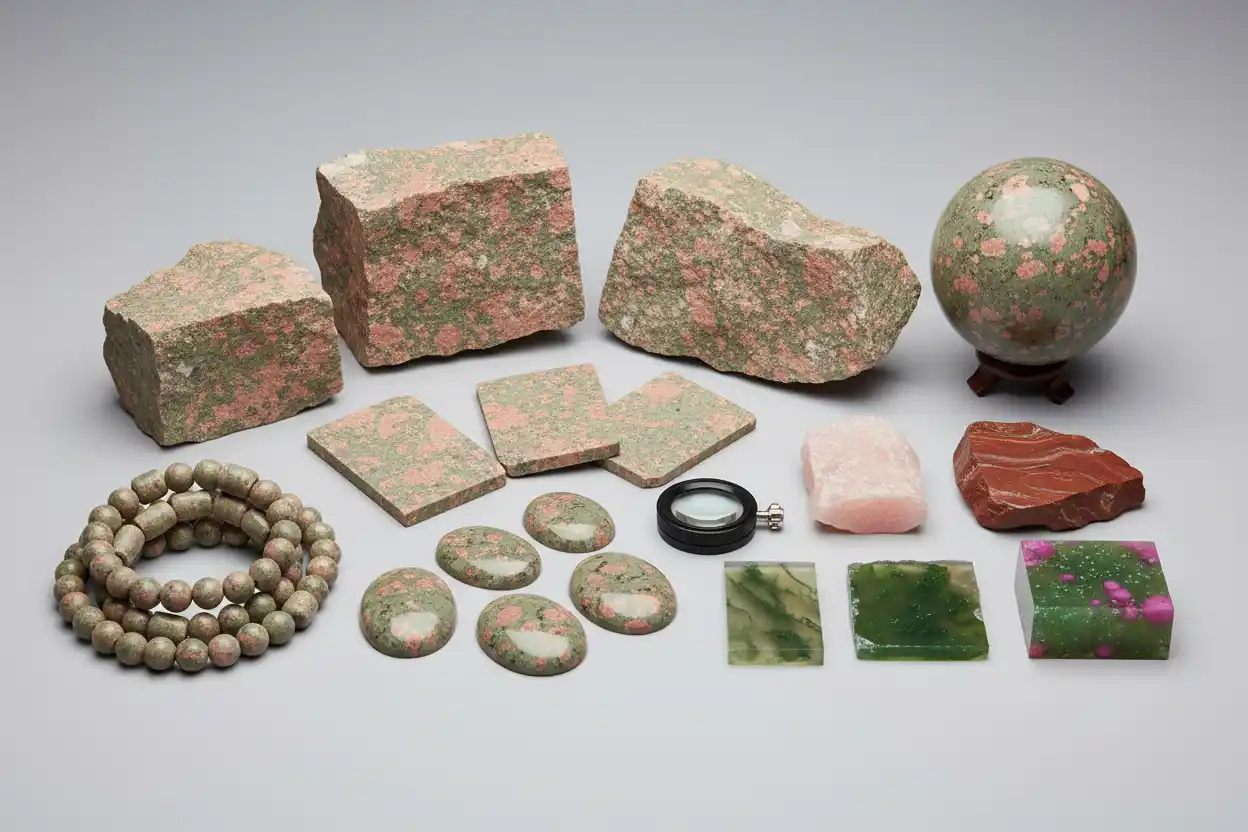
Real Unakite is a mottled pink-and-green rock composed mainly of green Epidote, pink potassium feldspar and colorless-to-milky Quartz. Its colors come from visibly intergrown minerals rather than from one uniformly colored crystal.
Because Unakite is abundant and generally affordable, outright counterfeiting is less common than inaccurate naming. Sellers may offer ordinary pink-and-green granite, dyed quartzite, Jasper, resin composites, painted stone or weakly altered granitic rock under the Unakite name.
Some listings also call the material “Unakite Jasper.” That term is widespread in crystal retail, but Unakite is not a variety of Jasper. It is an altered granitic rock whose visible components retain their separate mineral identities.
The Unakite meaning and properties guide covers its geology and traditional symbolism. This buying guide focuses on seller selection, authentic mineral texture, color balance, treatment, lapidary quality and value.
Unakite Is a Multi-Mineral Rock
Unakite does not have one fixed chemical formula because it contains several minerals.
Its principal components are usually:
- Pink potassium feldspar, commonly orthoclase or microcline
- Green Epidote
- Colorless, gray or milky Quartz
- Variable accessory minerals
- Occasional white feldspar
- Dark mica, amphibole, magnetite or other minor phases
The Epidote meaning and properties guide explains the principal green mineral. The Feldspar family guide covers the pink component, while the Quartz family guide explains the clear-to-milky silica-rich areas.
Mineral proportions vary from one deposit and even one slab to another. Some pieces are predominantly green, while others show large pink feldspar patches separated by smaller Epidote grains.
A seller should not promise a standardized ratio such as “50 percent Epidote and 50 percent pink feldspar” without analysis of the exact sample.
How Unakite Forms
Unakite generally develops when granitic rock undergoes hydrothermal or metasomatic alteration.
During that process, fluids change part of the original feldspar-bearing rock. Epidote forms as some earlier minerals are replaced or chemically altered, while pink potassium feldspar and Quartz remain prominent.
The final product retains a coarse granitic texture. Individual pink, green and clear mineral grains commonly interlock rather than forming neat stripes.
This origin distinguishes Unakite from a sedimentary Jasper, a dyed porous stone or a molded composite.
The types of gemstones guide provides the wider distinction among minerals, rocks, organic gems and natural glasses.
Choose the Product Form Before Shopping
| Unakite product | Best source | Main buying concern |
|---|---|---|
| Natural rough | Geological or lapidary supplier | Mineral proportions, fractures and authentic texture |
| Dry slab | Specialist lapidary dealer | Color continuity, resin and usable pattern |
| Cabochon | Independent cutter | Color balance, polish and backing |
| Tumbled stone | Reputable crystal retailer | Dyed rock, Jasper and artificial gloss |
| Bead strand | Established bead supplier | Resin, dye and drill-hole fractures |
| Sphere | Experienced carving retailer | Total color coverage, filler and assembly |
| Tower | Seller with exact-item video | Carved point, repaired tip and coating |
| Decorative carving | Skilled lapidary seller | Mixed hardness, weak seams and composites |
| Jewelry | Jeweler with treatment disclosure | Backing, glue and structural condition |
| Source specimen | Geological dealer | Locality and original labels |
Unakite’s attractiveness depends on the complete pink-green-gray composition. One carefully selected front photograph does not represent a sphere or carving adequately.
Where to Buy Genuine Unakite
Lapidary suppliers
Lapidary suppliers are usually the strongest source for rough, slabs and cutting material.
Request dry photographs. Water and oil deepen the green Epidote, strengthen the pink feldspar and temporarily conceal fine scratches.
The supplier should show the natural exterior and at least one sawn face. This helps confirm that the color pattern continues through the block.
Ask whether test cabochons from the parcel polished evenly. Quartz and feldspar may take a strong polish, while altered or fractured Epidote-rich areas can undercut.
Determine whether resin was needed to stabilize the material.
Geological and mineral dealers
A geological dealer should identify Unakite as altered granitic rock rather than Jasper.
Request the collection location, rock description and photographs of the granular texture.
A dealer may also explain whether the sample represents classic Appalachian Unakite, transported river material or a similar rock from another region.
An exact Unaka Mountains or Blue Ridge claim requires locality records rather than visual resemblance.
Gem and mineral shows
Shows allow direct comparison with Epidote-rich rock, pink granite, Moss Agate, Ruby in Zoisite, Jasper and dyed stone.
Use a loupe to inspect separate mineral grains. Genuine Unakite should show green, pink and gray-to-clear components entering one another through a natural rock texture.
Look at chipped edges and drill holes for color continuity.
Do not apply acids, solvents or scratch tests. Unakite contains several minerals, and destructive testing can damage polished surfaces without proving provenance.
Established online sellers
The online gemstone buying guide explains seller identity, protected payment methods and return rights.
Request exact-item images under neutral white light.
Ask whether saturation and contrast were adjusted. Digital editing can transform muted olive-and-salmon rock into vivid emerald-and-rose material.
For spheres, towers and carvings, obtain a continuous rotation. The reverse may contain substantially more gray Quartz or pale feldspar than the display face.
What Genuine Unakite Looks Like
Natural Unakite commonly combines:
- Salmon pink
- Rose pink
- Peach-pink
- Brick pink
- Olive green
- Pistachio green
- Yellow-green
- Dark Epidote green
- Milky white
- Gray Quartz
- Clear Quartz
- Occasional black accessory minerals
The texture is typically coarse and granular.
Pink feldspar may occur as blocky patches. Green Epidote can form irregular grains, streaks or replacement zones. Quartz often appears as gray, white or translucent areas between them.
Natural patterns rarely repeat exactly. One cabochon may contain large pink fields, while another from the same slab contains mostly Epidote.
The surface can show minor pits where altered minerals polish differently. A completely plastic-smooth surface deserves inspection for resin or a thick coating.
The Best Pink-to-Green Balance
There is no official grading standard.
Some buyers prefer an approximately balanced mixture of pink and green. Others value predominantly green material with small contrasting feldspar patches.
A strong decorative piece usually has:
- Clearly recognizable pink feldspar
- Distinct green Epidote
- Enough Quartz to create visual separation
- Natural interlocking texture
- Limited dull gray matrix
- No large open fractures
- An even polish
- Color distributed beyond one display face
Color contrast matters more than one exact mineral percentage.
A large sphere dominated by gray Quartz may be less desirable than a smaller cabochon with well-composed pink and green areas.
Unakite Versus Epidote
Epidote is one of Unakite’s essential minerals, but a solid Epidote specimen is not Unakite.
Massive Epidote may appear yellow-green, pistachio or dark green without substantial pink feldspar.
The completed guide to buying genuine Epidote owns crystal form, Pistachio color, coatings and Epidote-specific value.
A green stone with a few unrelated pink stains should not receive the Unakite name unless its granitic mineral relationship is evident.
Unakite Versus Pink Granite
Pink granite can contain pink potassium feldspar, gray Quartz and dark mica.
If the rock lacks substantial green Epidote alteration, ordinary granite is the more accurate name.
Unakite can be understood as altered granitic material, so the boundary is geological rather than purely visual.
A seller should not call every pink granite with minor green staining premium Unakite.
Strong Epidote development and a coherent altered texture provide the best evidence.
Unakite Versus Moss Agate
Moss Agate is translucent-to-semitranslucent Chalcedony containing green, brown or black moss-like inclusions.
The completed guide to buying genuine Moss Agate owns dendritic patterns, dye, glass and scenic inclusions.
Unakite is coarser, more opaque and visibly granular. Its green areas consist mainly of Epidote rather than plant-like inclusions suspended in Chalcedony.
A translucent cabochon with green internal filaments is more likely Moss Agate than Unakite.
Unakite Versus Green Aventurine
Green Aventurine is a Quartz-rich material commonly colored by green mica.
It may show fine sparkle or aventurescence and generally lacks Unakite’s large salmon-pink feldspar patches.
The completed guide to buying real Green Aventurine covers aventurine glass, dye and mica-related sparkle.
A green stone with one painted pink streak is not convincing Unakite.
Unakite Versus Ruby in Zoisite
Ruby in Zoisite combines green Zoisite with red-to-pink Ruby and commonly black Hornblende.
Its red areas may be intensely saturated and can show a distinct crystal outline.
Unakite’s pink component is feldspar, usually with a softer salmon or rose appearance rather than a corundum-red Ruby crystal.
Ruby in Zoisite commonly has stronger black matrix and different density and hardness relationships.
A seller should not apply the Ruby name to Unakite solely because pink areas occur in green rock.
Unakite Versus Pink Opal
Pink Opal is hydrated silica with a waxy pink, peach or cream body.
The completed guide to buying real Pink Opal owns dye, resin stabilization and common-Opal quality.
Pink Opal lacks Unakite’s coarse green Epidote and pink feldspar mixture.
A carving may contain several colors, but a granular green-and-pink rock texture supports Unakite rather than Opal.
Unakite Versus Jasper
Jasper is an opaque silica-rich material or trade category applied to several dense polishable rocks.
Unakite is commonly marketed as Unakite Jasper, yet its defining texture consists of coarse feldspar, Epidote and Quartz.
The completed Jasper buying guide owns general Jasper identification and trade-name boundaries.
The types of Jasper guide should not absorb Unakite as a strict mineralogical variety.
Using “Unakite Jasper” as a familiar retail synonym is acceptable only when the description clarifies that the rock is not conventional microcrystalline Jasper.
Unakite Versus Dyed Quartzite
Quartzite consists mainly of interlocking Quartz grains.
Pale Quartzite can receive green and pink dye or paint.
Artificial color may concentrate along fractures, pores and grain boundaries. A chipped edge can reveal a white or gray core.
Genuine Unakite should contain separate feldspar and Epidote grains rather than only colored Quartz.
Raman spectroscopy or petrographic examination can distinguish the components without relying on color.
Painted and Printed Imitations
Plain granite, ceramic, resin or another rock can receive pink-and-green surface decoration.
Under magnification, paint may:
- Bridge scratches
- Pool in pits
- Sit above the polish
- End at the girdle
- Wear from high points
- Repeat across identical objects
- Conceal a uniform core
Natural mineral boundaries should enter the stone and change through the front, edge and reverse.
Do not scrape a seller’s product. Use magnification and a return policy instead.
The fake-crystal buyer’s guide provides broader checks for painted, molded and reconstructed material.
Dye and Color Enhancement
Pale or weakly colored rock may be dyed to strengthen its pink or green areas.
Dye can enter fractures, porous alteration zones and drill holes.
Natural Epidote and feldspar colors can also vary around grain boundaries, so one darker crack is not conclusive.
Compare several depths and request treatment disclosure.
Dyed natural Unakite remains a natural rock with enhanced color, but it should not receive an untreated premium.
Wax, Oil and Coatings
Oil and wax can deepen colors and temporarily improve the polish.
Clear lacquer or polymer may seal a porous surface. Colored coating can conceal gray areas or strengthen the pattern.
Inspect chips, drill holes and the underside for residue or peeling.
A treated product may still be useful, but heat and solvents can disturb its finish.
The gemstone treatments guide explains dye, coating, filling and impregnation.
Resin Filling and Stabilization
Unakite can contain fractures where minerals with different structures meet.
Clear resin may enter those cracks and improve stability. Pink or green filler can conceal missing material.
Under magnification, resin may show bubbles, glossy pools or a different reflection.
Limited stabilization should not be confused with a completely reconstructed object.
The amount and location of filler should appear in the listing.
Reconstructed Unakite
Fragments and powder can be mixed with polymer and molded into beads, spheres, skulls and other carvings.
The product may contain genuine Unakite without being one continuous natural rock.
Warning signs include:
- Mold seams
- Repeated patterns
- Numerous bubbles
- Uniform polymer-rich chips
- No interlocking mineral grains
- Color concentrated in the binder
- Identical objects
A heavily reconstructed composite should not receive the price of solid natural material.
How to Evaluate Rough
Request dry photographs of the natural exterior and several sawn surfaces.
Look for pink feldspar, green Epidote and Quartz continuing through the block.
Assess fractures, weathered surfaces and areas dominated by weak alteration.
Ask whether representative pieces from the parcel polished evenly.
Large rough containing substantial dull gray matrix may produce relatively little attractive finished material.
Usable pattern and structural condition matter more than total weight.
How to Evaluate Slabs
Compare both faces and every edge.
Natural grains should shift through the slab’s thickness rather than form one surface print.
A good slab offers several balanced pink-and-green cutting areas.
Inspect open fractures and areas where Epidote or feldspar undercuts.
Ask whether the surface is oiled, waxed or resin-treated.
Dry photographs reveal scratches and pits more honestly than wet display images.
How to Judge Cabochons
A strong cabochon should display intentional color composition.
The cutter may center a pink feldspar patch against dark green Epidote or use a broader mosaic of smaller grains.
The dome should polish evenly without extensive dull patches.
Inspect the girdle for fractures and the back for color continuity, backing and resin.
A smaller well-composed cabochon may be more attractive than a large stone with unfocused gray areas.
Buying Beads and Bracelets
Natural strands should show variation in pink-green balance and grain pattern.
Inspect drill holes for dye, resin and radial fractures.
Perfectly identical patterns across every bead suggest printed resin or molded composite.
Ask whether the strand contains Unakite only or includes green Aventurine, Jasper or other mixed stones.
Heavy beads can strike one another, so open grain boundaries and existing fractures matter.
Buying Spheres, Towers and Carvings
Request a complete rotation.
One side may show a balanced pattern while the reverse is mostly gray Quartz or green Epidote.
A sphere should not contain a straight equatorial assembly seam.
Most towers are carved; their pointed shape did not form naturally.
Thin projections should not cross major grain boundaries because the minerals can separate under impact.
Buying Unakite Jewelry
Sound Unakite is suitable for pendants, earrings, bracelets and protected cabochon rings.
Its individual minerals have different hardnesses. Quartz is relatively hard, feldspar is moderately hard and Epidote can show cleavage and brittle fracture.
The gemstone hardness chart and gemstone toughness-versus-hardness guide explain why a multi-mineral rock cannot be judged through one Mohs number.
A bezel helps support grain boundaries and protects cabochon edges.
Avoid concentrated prong pressure over a major Epidote-rich fracture.
Locality and Provenance
Unakite takes its name from the Unaka Mountains along the Tennessee–North Carolina border.
Classic material is associated with the wider Blue Ridge region, including Virginia and North Carolina.
Similar altered granitic rocks occur in other parts of the United States and internationally.
Appearance cannot prove Appalachian origin.
A seller charging a locality premium should provide collection records, original labels or a documented supply chain.
The ethically sourced gemstones guide provides broader questions about quarrying, lapidary labor and traceability.
Price and Value
Ordinary Unakite is affordable.
Value depends on:
- Strong pink-green contrast
- Recognizable mineral texture
- Balanced color distribution
- Limited dull matrix
- Stable grain boundaries
- Size
- Polish
- Treatment disclosure
- Cutting quality
- Carving workmanship
- Locality
- Provenance
A large carving can cost more because of labor rather than raw-material rarity.
Undefined labels such as premium, AAA or collector grade add little information. Ask the seller to describe mineral balance, fractures, resin and polish instead.
The gemstone pricing guide explains how cutting yield, workmanship and evidence affect price.
Questions to Ask the Seller
Ask whether the object is genuine altered granitic Unakite or a Jasper, quartzite, dyed stone or resin composite.
Request dry front, back and edge photographs.
Ask whether pink feldspar, green Epidote and Quartz are visible throughout the object.
Confirm dye, wax, oil, coating, resin, backing and reconstruction.
For rough, ask whether test pieces polished successfully.
For beads, request drill-hole close-ups. For spheres and carvings, obtain a complete rotation.
Request locality evidence when an Appalachian or Unaka Mountains premium is charged.
Finally, confirm that the return policy permits petrographic or Raman examination.
Professional Identification
A hand lens or microscope can reveal Unakite’s coarse interlocking minerals.
Raman spectroscopy can identify Epidote, Quartz and feldspar at individual grains.
X-ray diffraction can characterize the principal crystalline components.
Petrographic thin-section analysis provides the strongest explanation of the rock texture and alteration relationships.
Microscopy can also reveal dye, resin, coating and printed patterns.
Testing one green grain does not identify the complete rock, so several areas should be examined.
Cleaning and Storage
Clean sound untreated Unakite with lukewarm water, mild soap and a soft cloth.
Avoid ultrasonic and steam cleaning when grain boundaries, fractures, backing or resin are present.
Do not use acids or abrasive powders.
Store jewelry away from harder gems that can scratch the feldspar and Epidote-rich areas.
Remove rings before heavy work, exercise or exposure to household chemicals.
Frequently Asked Questions
1. Is Unakite a mineral?
No. Unakite is a multi-mineral altered granitic rock.
2. What minerals make up Unakite?
It consists mainly of green Epidote, pink potassium feldspar and clear-to-milky Quartz.
3. Is Unakite a type of Jasper?
No. “Unakite Jasper” is a retail trade term, but Unakite is not conventional microcrystalline Jasper.
4. What makes Unakite green?
Green Epidote provides most of its characteristic green color.
5. What makes Unakite pink?
Pink orthoclase or microcline feldspar creates the salmon, rose and peach areas.
6. Does genuine Unakite always contain equal amounts of pink and green?
No. Mineral proportions vary substantially among pieces and deposits.
7. Can Unakite be dyed?
Yes. Pale or porous material can receive pink or green dye, especially along fractures and grain boundaries.
8. Can Unakite contain resin?
Yes. Fractures may be filled, while fragments or powder can be reconstructed with polymer.
9. Is Unakite the same as Moss Agate?
No. Moss Agate is Chalcedony containing moss-like inclusions, while Unakite is a coarse-grained altered rock.
10. Is Unakite suitable for everyday jewelry?
Sound cabochons can be worn regularly, although fractures and mixed mineral boundaries require protection.
11. Does Unakite require a laboratory report?
Ordinary pieces usually do not. Testing is more useful for disputed material, treatment or premium locality claims.
12. What is the biggest warning sign in a listing?
Be cautious when pink-and-green color appears only on the surface or repeats identically across molded objects without visible mineral grains.
Buy the Interlocking Minerals, Not Merely the Color Combination
Authentic Unakite should preserve the geological relationship among green Epidote, pink feldspar and Quartz through its front, edges and reverse. A convincing stone remains recognizable even before the colors are digitally intensified.
The green gemstones guide, pink gemstones guide, U crystal directory and U gemstone directory provide wider comparisons.
Safety note: Unakite contains Quartz and can generate hazardous respirable crystalline-silica dust during dry cutting, grinding or drilling. Use professional wet methods, effective local extraction and suitable respiratory and eye protection.