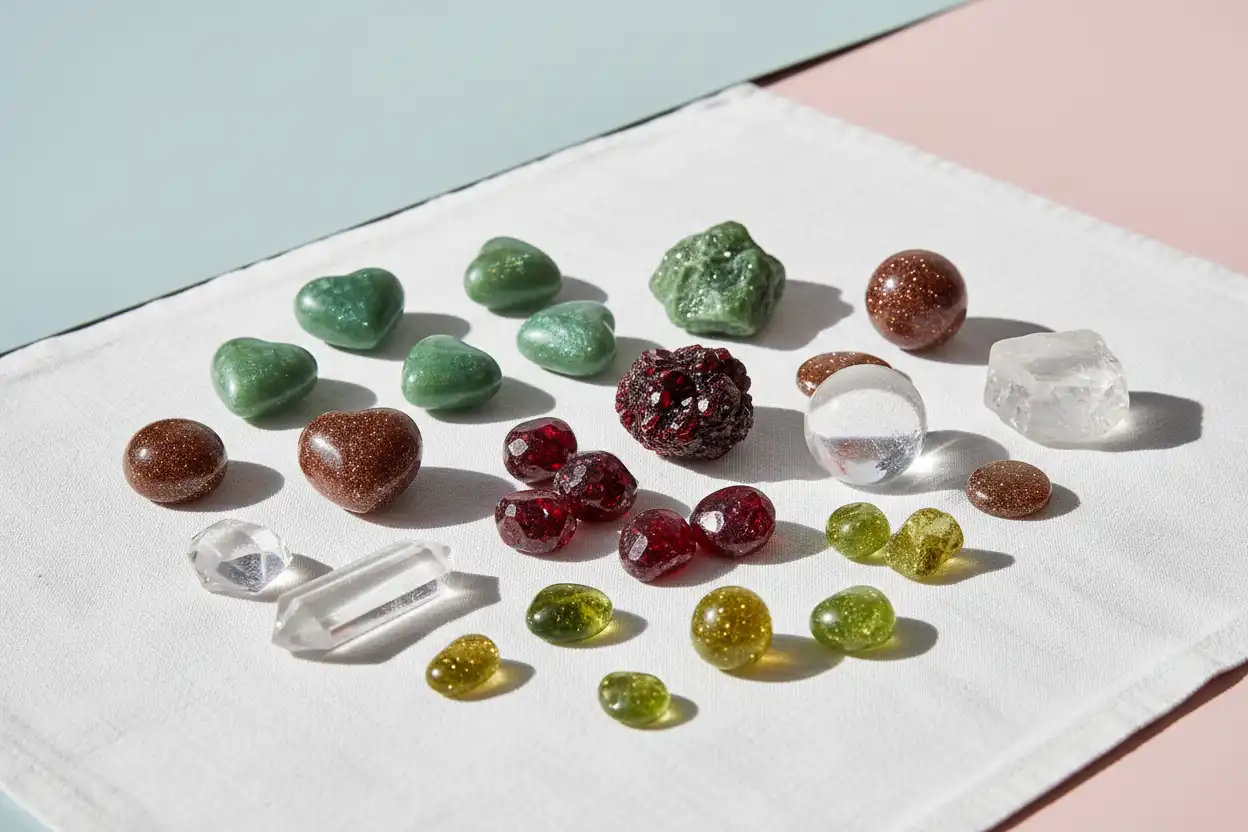
Crystals That Start With G: Names and Meanings
Crystals that start with G include gabbro, galena, garden quartz, garnet, gaspeite, gem silica, girasol quartz, goethite, golden healer quartz, golden obsidian, goldstone, goshenite, grandidierite, grape agate, green aventurine, green calcite, green fluorite, green onyx, grossular garnet and gypsum.
These materials include natural minerals, rocks, volcanic glass, quartz varieties and one manufactured crystal-like material.
Crystal meanings are traditional and spiritual associations rather than scientifically proven medical effects.
Continue from the previous alphabetical guide with Crystals That Start With F.
G Crystals at a Glance
| Crystal or material | Typical appearance | Common symbolic meaning |
|---|---|---|
| Gabbro | Dark coarse-grained rock | Stability and resilience |
| Galena | Silver-gray metallic cubes | Grounding and practical awareness |
| Garden Quartz | Clear quartz with scenic inclusions | Growth and reflection |
| Garnet | Red, green, orange or other colors | Energy and commitment |
| Gaspeite | Yellow-green to apple-green | Renewal and confidence |
| Gem Silica | Vivid blue-green translucent chalcedony | Calm communication |
| Girasol Quartz | Milky translucent quartz with a soft glow | Clarity and gentle reflection |
| Goethite | Brown, black or yellow iron mineral | Persistence and grounded action |
| Golden Healer Quartz | Quartz with golden iron-oxide coating | Optimism and renewal |
| Golden Obsidian | Black volcanic glass with a golden sheen | Protection and self-awareness |
| Goldstone | Sparkling manufactured glass | Ambition and confidence |
| Goshenite | Colorless transparent beryl | Clarity and honesty |
| Grandidierite | Blue-green to green gemstone | Resilience and individuality |
| Grape Agate | Purple or green botryoidal chalcedony | Community and personal growth |
| Green Aventurine | Sparkling green quartz | Opportunity and optimism |
| Green Calcite | Pale to vivid green calcite | Renewal and emotional balance |
| Green Fluorite | Transparent or banded green fluorite | Focus and organization |
| Green Onyx | Green banded or uniform chalcedony | Confidence and balance |
| Grossular Garnet | Green, yellow, orange or brown garnet | Growth and abundance |
| Gypsum | White, clear or pale soft mineral | Clarity and release |
Gabbro
Gabbro is a dark, coarse-grained igneous rock formed when magma cools slowly beneath Earth’s surface.
It commonly contains:
- Plagioclase feldspar.
- Pyroxene.
- Olivine.
- Other dark minerals.
Its traditional meanings include:
- Stability.
- Resilience.
- Grounding.
- Endurance.
- Remaining calm during change.
Some polished gabbro is sold under trade names such as indigo gabbro or mystic merlinite. Its exact appearance depends on the minerals within the rock.
Galena
Galena is a lead sulfide mineral known for its metallic silver-gray color and cubic crystals.
It is traditionally associated with:
- Grounding.
- Practical awareness.
- Responsibility.
- Establishing firm boundaries.
- Recognizing material priorities.
Galena contains lead. Wash your hands after handling it, avoid creating dust and keep it away from children, pets, food and drinking water.
Its dense, metallic appearance makes it popular with mineral collectors, but it requires responsible storage and handling.
Garden Quartz
Garden quartz is clear or translucent quartz containing mineral inclusions that resemble landscapes, moss, clouds or underwater gardens.
It is also commonly called:
- Lodolite.
- Scenic quartz.
- Landscape quartz.
- Inclusion quartz.
Garden quartz is traditionally associated with:
- Reflection.
- Personal growth.
- Memory.
- Imagination.
- Appreciating complex experiences.
The inclusions may include iron minerals, chlorite, feldspar or other materials. Each specimen has a unique internal pattern.
Explore its broader mineral family in the quartz guide.
Garnet
Garnet is a mineral group rather than one single stone.
Although deep red is the most familiar color, garnet also occurs in:
- Green.
- Orange.
- Yellow.
- Pink.
- Purple.
- Brown.
- Nearly black.
Garnet is traditionally associated with:
- Energy.
- Commitment.
- Courage.
- Motivation.
- Loyalty.
- Personal strength.
Its symbolism can vary by color and variety. Explore these differences in the garnet color meaning guide.
Gaspeite
Gaspeite is a nickel carbonate mineral known for its yellow-green, apple-green or olive-green color.
It may display:
- Brown veining.
- Dark matrix.
- Mottled patterns.
- Smooth opaque surfaces.
Gaspeite is traditionally associated with:
- Renewal.
- Confidence.
- Personal independence.
- Embracing change.
- Connection with nature.
It is relatively soft and should be protected from scratches, acids and harsh cleaners.
Some green stones may be mislabeled as gaspeite, so identification should consider color, matrix, hardness and seller disclosure.
Gem Silica
Gem silica is a vivid blue-green variety of chalcedony colored by copper.
It is also called chrysocolla chalcedony, although its composition differs from ordinary chrysocolla.
Gem silica is traditionally associated with:
- Calm communication.
- Emotional balance.
- Clear expression.
- Patience.
- Thoughtful listening.
High-quality material can be translucent and intensely colored.
Learn more about its mineral family in the chalcedony guide.
Girasol Quartz
Girasol quartz is a translucent quartz with a milky, softly glowing appearance.
The name “girasol” refers to a light effect that appears to move within the stone.
It is commonly associated with:
- Gentle reflection.
- Mental clarity.
- Emotional calm.
- Patience.
- Seeing a situation from another perspective.
Girasol quartz is usually pale white, grayish or nearly colorless. It should not be confused with girasol opal, which belongs to a different material family.
Goethite
Goethite is an iron oxide-hydroxide mineral that commonly appears:
- Brown.
- Yellow-brown.
- Black.
- Reddish brown.
- Metallic or earthy.
It may form needles, fibrous masses, botryoidal surfaces or inclusions within quartz and amethyst.
Goethite is traditionally associated with:
- Persistence.
- Grounded action.
- Endurance.
- Realistic planning.
- Working steadily through difficulty.
Some pieces can shed earthy residue or develop fragile surfaces, so avoid aggressive cleaning.
Golden Healer Quartz
Golden healer quartz is quartz coated or included with yellow, gold or orange iron oxides.
Its color may appear as:
- A thin golden surface.
- Internal clouds.
- Yellow patches.
- Orange-brown staining.
- Layered iron deposits.
It is traditionally associated with:
- Optimism.
- Renewal.
- Confidence.
- Purposeful action.
- Recognizing personal progress.
The golden coloring usually comes from natural iron minerals rather than gold.
Golden Obsidian
Golden obsidian is black volcanic glass with a gold or bronze sheen visible under direct light.
Its reflective effect is created by microscopic gas bubbles or inclusions formed as the lava cooled.
Golden obsidian is traditionally associated with:
- Protection.
- Self-awareness.
- Confidence.
- Recognizing hidden motivations.
- Setting practical boundaries.
Obsidian is natural glass rather than a mineral crystal. Raw or chipped pieces may have extremely sharp edges.
Explore related varieties in the obsidian guide.
Goldstone
Goldstone is a manufactured glass containing countless reflective metallic particles.
Common varieties include:
- Brown goldstone.
- Blue goldstone.
- Green goldstone.
- Purple goldstone.
It is traditionally associated with:
- Ambition.
- Confidence.
- Creativity.
- Motivation.
- Continuing toward a long-term goal.
Goldstone is not a naturally occurring mineral crystal. Its glittering appearance is deliberately created during manufacturing.
The guide to lab-grown and natural gemstones explains how manufactured materials differ from naturally formed stones.
Goshenite
Goshenite is the colorless variety of beryl.
It belongs to the same mineral family as:
- Emerald.
- Aquamarine.
- Morganite.
- Heliodor.
- Red beryl.
Goshenite is traditionally associated with:
- Clarity.
- Honesty.
- Simplicity.
- Clear intentions.
- Unbiased thinking.
Transparent stones may resemble clear quartz or white topaz, but their mineral properties differ.
Grandidierite
Grandidierite is a rare mineral known for blue-green, greenish-blue or deep green colors.
Gem-quality material may be transparent, while more common specimens are translucent or opaque.
Its traditional meanings include:
- Resilience.
- Individuality.
- Confidence.
- Calm decision-making.
- Following a personal direction.
Fine transparent grandidierite is uncommon and can be valuable. Its color may resemble aquamarine, apatite or tourmaline, making professional identification useful for expensive stones.
Grape Agate
Grape agate is a trade name for clusters of small rounded chalcedony formations resembling bunches of grapes.
It commonly appears:
- Purple.
- Lavender.
- Green.
- Gray.
- Blue-gray.
Grape agate is traditionally associated with:
- Community.
- Cooperation.
- Personal growth.
- Emotional balance.
- Appreciating gradual development.
Despite the name, it usually lacks the banding associated with traditional agate.
Its rounded formations can be fragile, so specimens should be displayed securely rather than carried loose.
Green Aventurine
Green aventurine is a form of quartz containing mineral inclusions that create a subtle sparkling effect.
It is traditionally associated with:
- Opportunity.
- Optimism.
- Confidence.
- Practical growth.
- Trying a new approach.
The sparkle commonly comes from green mica inclusions.
Explore other colors and varieties in the aventurine guide.
Green Calcite
Green calcite is a pale to medium-green form of calcite.
It may appear:
- Mint green.
- Yellow-green.
- Cloudy.
- Translucent.
- Waxy or softly polished.
Its traditional meanings include:
- Renewal.
- Emotional balance.
- Patience.
- Growth.
- Releasing unnecessary tension.
Calcite is soft and reacts with acids. Avoid abrasive storage, vinegar, lemon juice and harsh cleaners.
Learn more about related varieties in the calcite guide.
Green Fluorite
Green fluorite ranges from pale mint green to deep emerald tones.
It may form cubes, octahedrons, clusters or polished stones.
Green fluorite is traditionally associated with:
- Focus.
- Organization.
- Learning.
- Clear priorities.
- Reducing distraction.
Fluorite is soft and has strong cleavage, making it vulnerable to scratching and breakage.
Some green fluorite may fade after prolonged exposure to strong sunlight. Explore other colors in the fluorite guide.
Green Onyx
Green onyx is a commercial name that may refer to green chalcedony or banded calcite material.
It can appear:
- Uniform green.
- Banded green and white.
- Translucent.
- Opaque.
- Dyed or naturally colored.
It is traditionally associated with:
- Confidence.
- Balance.
- Self-control.
- Calm communication.
- Emotional steadiness.
Because the name is used for different materials, ask whether a piece is chalcedony, calcite or dyed stone.
The broader onyx guide explains common varieties and naming differences.
Grossular Garnet
Grossular is a garnet species that occurs in:
- Green.
- Yellow.
- Orange.
- Brown.
- Pink.
- Colorless forms.
Important grossular varieties include tsavorite and hessonite.
Grossular garnet is traditionally associated with:
- Growth.
- Abundance.
- Confidence.
- Generosity.
- Creating stable opportunities.
Its durability makes many gem-quality varieties suitable for jewelry, although inclusions and fractures still require consideration.
Gypsum
Gypsum is a soft sulfate mineral that includes familiar forms such as:
- Selenite.
- Satin spar.
- Desert rose.
- Alabaster.
It commonly appears white, clear, cream, gray or pale peach.
Gypsum is traditionally associated with:
- Clarity.
- Simplicity.
- Release.
- Reflection.
- Creating a calmer environment.
With a Mohs hardness of about 2, gypsum scratches easily and may be damaged by water.
G Crystals by Color
Green G Crystals
Green examples include:
- Gaspeite.
- Gem silica.
- Grandidierite.
- Green aventurine.
- Green calcite.
- Green fluorite.
- Green onyx.
- Grossular garnet.
Golden and Yellow G Crystals
Examples include:
- Golden healer quartz.
- Golden obsidian.
- Goldstone.
- Yellow grossular garnet.
- Yellow-brown goethite.
Purple G Crystals
Purple examples include:
- Grape agate.
- Purple goldstone.
- Some garden quartz inclusions.
Black, Gray and Metallic G Crystals
Examples include:
- Gabbro.
- Galena.
- Golden obsidian.
- Goethite.
- Gray gypsum.
Which G Crystals Are Suitable for Jewelry?
Common jewelry materials include:
- Garnet.
- Gaspeite.
- Gem silica.
- Goldstone.
- Goshenite.
- Grandidierite.
- Green aventurine.
- Green onyx.
- Grossular garnet.
Materials requiring extra care include:
- Fluorite, because it scratches and cleaves.
- Gypsum, because it is very soft.
- Grape agate, because its rounded formations may break.
- Galena, because it contains lead.
- Garden quartz, when internal fractures reach the surface.
- Gaspeite, because it is softer than many everyday gemstones.
Care and Safety
G crystals have different handling requirements.
- Galena contains lead and should be kept away from children, pets and drinking water.
- Gypsum is very soft and water-sensitive.
- Fluorite scratches and cleaves easily.
- Obsidian can break into sharp edges.
- Goldstone may be damaged by excessive heat or harsh chemicals.
- Green onyx may be calcite, chalcedony or dyed material.
- Grape agate formations can chip.
- Goethite may shed earthy or metallic residue.
- Gaspeite is soft and acid-sensitive.
Before cleaning an unfamiliar material, review How to Identify Crystals, Which Crystals Can and Cannot Go in Water and Which Crystals Fade in Sunlight.
When storing hard and soft pieces together, consult Crystals You Should Not Combine.
Frequently Asked Questions
What is the most popular crystal that starts with G?
Garnet is one of the most widely recognized. Green aventurine, garden quartz, grape agate, golden healer quartz and gypsum are also popular.
Which green crystals start with G?
Gaspeite, gem silica, grandidierite, green aventurine, green calcite, green fluorite, green onyx and grossular garnet are notable examples.
Which G crystals are purple?
Grape agate is the best-known purple example. Purple goldstone and some included quartz specimens may also appear purple.
Is goldstone a natural crystal?
No. Goldstone is a manufactured glass containing reflective metallic particles.
Is golden obsidian a crystal?
Golden obsidian is natural volcanic glass rather than a mineral crystal.
Is grape agate really an agate?
Grape agate is a trade name for rounded chalcedony formations. It usually does not show the traditional banding associated with agate.
Is gabbro a crystal?
Gabbro is an igneous rock composed of several minerals rather than a single crystal.
Is galena safe to touch?
Galena can be handled responsibly, but it contains lead. Wash your hands afterward and avoid dust, ingestion and prolonged handling by children.
Can gypsum go in water?
Routine soaking is not recommended. Gypsum is soft and can be damaged or weakened by prolonged water exposure.
Continue Exploring Crystals and Gemstones
Explore jewelry use, rarity and notable gem materials in Gemstones That Start With G.
Continue alphabetically with Crystals That Start With H, or browse the complete Crystals 101 collection.