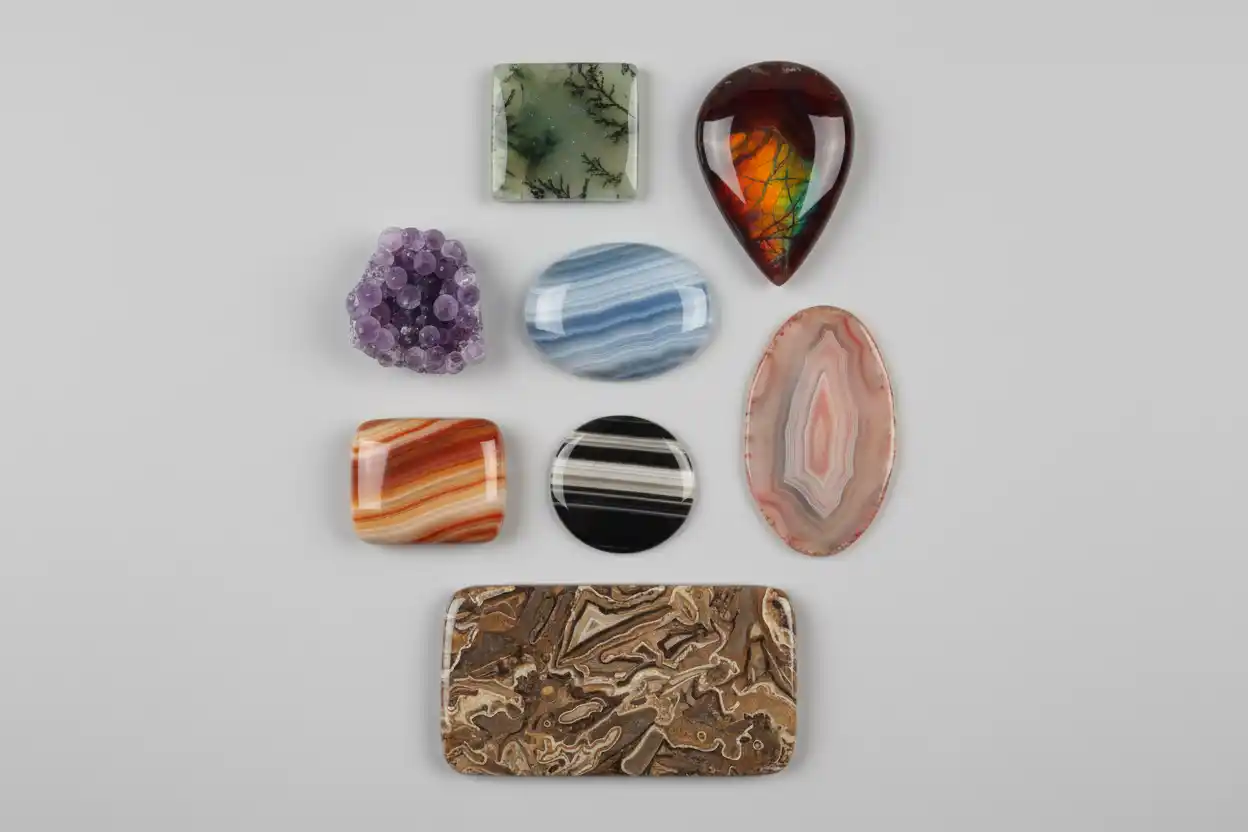
Types of Agate: Colors and Varieties Explained
Agate is a patterned form of chalcedony, the microcrystalline variety of Quartz. Classic Agate contains rhythmic bands, but the commercial name also covers inclusion-rich, dendritic, mossy, plume-like, iridescent, botryoidal, and locality-defined chalcedonies that may show little or no conventional banding.
Hundreds of Agate names appear in the market. Some describe growth structure, others refer to color, inclusions, locality, optical effect, or a modern trade label. Understanding which naming system is being used prevents attractive stones from being mistaken for separate mineral species.
Agate at a Glance
| Property | Agate |
|---|---|
| Composition | Microcrystalline silica, mainly SiO₂, commonly with moganite, water, and mineral inclusions |
| Group or type | Patterned or included chalcedony |
| Main colors | Colorless, white, grey, black, blue, green, red, orange, yellow, pink, purple, and brown |
| Crystal system or texture | Trigonal Quartz expressed as microscopic fibrous and granular aggregates |
| Habit | Nodules, geodes, veins, cavity fillings, seams, breccias, stalactitic and botryoidal forms |
| Luster | Waxy to vitreous when polished |
| Transparency | Transparent to opaque |
| Mohs hardness | Approximately 6.5–7 |
| Cleavage | None |
| Tenacity | Brittle but generally durable in compact material |
| Common uses | Cabochons, beads, cameos, carvings, slices, bowls, bookends, rings, specimens |
| Primary care concern | Dye, heat treatment, resin, fractures, hidden composites, thermal shock, and silica dust |
What Counts as Agate?
The parent material is chalcedony, whose microscopic Quartz fibers grow in dense interlocking aggregates.
Strict geological definitions commonly emphasize visible banding. Rhythmic layers can follow the wall of a cavity, form flat horizontal levels, surround a central void, or create angular fortification patterns.
Commercial usage is broader. Moss Agate, Tree Agate, Dendritic Agate, and several plume varieties may lack classic bands but remain established trade members of the Agate family.
Some materials carrying “Agate” in the name are even further removed from strict Agate. Grape Agate is botryoidal Chalcedony, while Turritella Agate is fossil-bearing Chalcedony whose common name preserves an outdated fossil identification.
The Agate parent page owns the material’s general formation, symbolism, and broad properties. This guide focuses specifically on variety names and how they relate.
How Agate Types Are Named
Most Agate names fall into one of five systems.
Structural Names
These describe how silica grew: fortification, waterline, tube, eye, lace, plume, or stalactitic Agate.
Inclusion Names
Moss, dendritic, sagenite, plume, and Tree Agate are named for the appearance or arrangement of included minerals.
Optical-Effect Names
Fire Agate and Iris Agate are defined partly by interference colors rather than body pattern alone.
Color Names
White, black, blue, red, orange, pink, purple, green, and grey Agate describe dominant appearance.
Locality Names
Botswana, Laguna, Condor, Lake Superior, Coyamito, Fairburn, Dryhead, and many other names link Agate to a deposit or geographic region.
One stone may fit several categories. A Botswana specimen can be banded, fortification-patterned, pink-grey, and partially translucent at the same time.
Major Agate Types
| Agate type | Defining feature | Typical colors |
|---|---|---|
| Banded Agate | Repeated Chalcedony layers | Nearly any combination |
| Fortification Agate | Angular bands resembling fortress walls | White, grey, red, orange, brown, black |
| Waterline Agate | Straight horizontal bands | White, grey, brown, red, blue |
| Lace Agate | Fine looping and swirling bands | Blue-white or multicolored |
| Onyx | Parallel, relatively straight bands | Traditionally black-white; also brown, red, and other colors |
| Sardonyx | Sard-brown or red bands with white Onyx | Brown-red, orange-red, white |
| Moss Agate | Moss-like inclusions in translucent Chalcedony | Green, brown, black, red |
| Tree Agate | Green branching inclusions in white Chalcedony | White and green |
| Dendritic Agate | Tree- or fern-like oxide dendrites | White, grey, brown, black |
| Plume Agate | Feather-, cloud-, or flower-like inclusions | Red, yellow, cream, green, black |
| Fire Agate | Iridescent interference over botryoidal Chalcedony | Red, orange, green, gold, purple |
| Iris Agate | Rainbow interference in very thin banding | Colourless-to-pale body with spectral colors |
| Flower Agate | Pale flower-like plumes in translucent Chalcedony | Pink, peach, white, grey |
| Botswana Agate | Fine rhythmic banding from Botswana | Grey, pink, brown, white, black |
| Blue Lace Agate | Pale blue and white lace bands | Sky blue, blue-grey, white |
| Crazy Lace Agate | Complex looping and brecciated lace | Red, yellow, cream, grey, brown |
| Grape Agate | Botryoidal Chalcedony clusters | Purple, green, blue, grey |
| White Agate | Predominantly white Chalcedony or bands | White, cream, pale grey |
Banded Agate
Banded Agate is the central structural category. It contains repeated Chalcedony layers deposited during changing conditions inside a cavity or fracture.
Bands differ in thickness, color, transparency, texture, and mineral content. Some are visible only under backlighting, while others create strong black-and-white or red-and-cream contrast.
Concentric bands generally follow the walls of a nodule or geode. Flat bands may form where silica-rich fluids settled in repeated levels.
Fine banding usually contributes more value than broad muddy layers, especially when the stone has strong contrast and an attractive center.
The types of Chalcedony guide explains how Agate relates to Onyx, Carnelian, Chrysoprase, Jasper-like silica, and other microcrystalline Quartz materials.
Fortification Agate
Fortification Agate contains angular bands resembling the outlines of a fortress, map, or walled city.
The pattern develops as Chalcedony follows the irregular geometry of a cavity. Repeated inward growth preserves corners and projections through several layers.
Fortification patterns are especially common in nodular Agates from volcanic rocks.
The best examples have sharp contrasting bands and a recognizable center. Poor cutting can miss the centre or place the strongest pattern near an edge.
Fortification is a structural description rather than a locality. Botswana, Brazilian, Mexican, Scottish, Lake Superior, and many other Agates can display it.
Waterline and Level-Banded Agate
Waterline Agate contains horizontal bands that appear to record changing fluid levels inside a cavity.
Silica settled repeatedly along a relatively flat surface rather than coating every cavity wall equally.
The resulting lines can resemble landscapes, horizons, stacked layers, or calm water.
Some nodules contain both fortification walls and level bands, showing that more than one growth process occurred.
Slices should be oriented to keep the waterlines horizontal. A rotated cut can hide the visual logic of the pattern.
Lace Agate
Lace Agate has fine curved, looping, scalloped, and swirling bands.
Blue Lace Agate is known for pale sky-blue, blue-grey, and white layers. Fine material has delicate rhythmic bands rather than a flat dyed blue body.
Crazy Lace Agate commonly combines red, yellow, cream, grey, brown, black, and white in dense looping patterns.
The word lace describes structure. It does not indicate one chemical variety or one source.
Dyeing can intensify pale lace patterns, so saturated blue, purple, hot pink, or black pieces require treatment disclosure.
Botswana Agate
Botswana Agate is a locality-defined banded Agate associated with volcanic rocks in Botswana.
Typical colors include grey, brown, pink, mauve, white, black, orange, and occasional blue-grey.
Fine examples contain narrow, orderly bands with fortification, eye, lace, or parallel patterns.
Commercial beads may be genuine but heavily selected, waxed, or polished to emphasize colour. Exceptionally bright purple or blue material deserves closer examination for dye.
The Botswana name should be reserved for credible locality material rather than any grey-pink banded Agate.
Onyx
True Onyx is parallel-banded Chalcedony. Traditional material contains relatively straight black-and-white layers, although other color combinations occur.
Much of the “black Onyx” sold in jewelry is uniformly dyed Chalcedony without visible bands.
Natural black-and-white Onyx suitable for cameos is less common than the market volume suggests.
The dedicated Onyx pages own its full treatment, identification, jewelry, and trade history. In an Agate classification, its important feature is parallel rather than curved banding.
Sardonyx
Sardonyx combines reddish-brown, orange-brown, or sard-colored Chalcedony with contrasting white Onyx layers.
Its parallel bands made it a major material for cameos, seals, intaglios, and carved jewellery.
The best carving rough has clean, continuous layers thick enough for the artist to use different colors at different depths.
Dyed and heated materials exist. A red-brown layer does not by itself prove natural Sardonyx.
Moss Agate
Moss Agate is translucent Chalcedony containing green, brown, black, red, or yellow mineral inclusions resembling moss, seaweed, or landscapes.
The inclusions are not plants. Possible minerals include chlorite, celadonite, iron oxides, manganese oxides, amphiboles, and other alteration phases.
Moss Agate may have little conventional banding, making it a trade Agate rather than a strict banded variety.
Fine stones show depth, transparent windows, natural movement, and a balanced scenic composition.
Tree Agate
Tree Agate usually contains green branching inclusions against an opaque white or cream Chalcedony background.
The trade boundary with Moss Agate is visual. Tree Agate is generally whiter and more opaque, while Moss Agate is commonly clearer and more three-dimensional.
Neither material contains fossilized trees or vegetation.
Strong natural contrast, attractive branching, and a clean polish determine quality.
Dendritic Agate
Dendritic Agate contains branching tree-, fern-, or lightning-like patterns, commonly formed by manganese and iron oxides.
Dendrites often spread through fine fractures before becoming enclosed or exposed in the Chalcedony.
Black dendrites against translucent white or grey stone create the classic appearance.
Scenic pieces that resemble landscapes or winter trees can command collector and designer-cabochon premiums.
The word dendritic describes branching form rather than one mineral species.
Plume Agate
Plume Agate contains soft branching, feathered, cloud-like, flame-like, or flower-like inclusions.
Unlike flat dendrites, plumes often occupy three-dimensional volumes and may look like smoke or vegetation suspended within Chalcedony.
Colors include red, orange, yellow, cream, green, black, brown, and white.
Famous locality varieties include Graveyard Point, Priday, Carey, and several Mexican plume Agates, although deposit names should be supported by provenance.
Plume Agate has no dedicated tracker page, so its section remains descriptive rather than replacing a separate article.
Flower Agate
Flower Agate is translucent Chalcedony with pale plume inclusions that resemble flowers, blossoms, seeds, or clouds.
Commercial material is strongly associated with Madagascar.
Pink, peach, cream, white, grey, and occasional green or brown areas occur.
A flower-like appearance is subjective. Genuine stones should still show natural Chalcedony texture rather than printed floral patterns or resin inclusions.
Fire Agate
Fire Agate is a botryoidal Chalcedony whose thin iron-oxide layers produce iridescent red, orange, gold, green, blue, and purple interference colors.
It differs from ordinary banded Agate because value depends heavily on the quality of the moving fire.
The cutter must carefully grind away colourless Chalcedony without cutting through the thin iridescent layers.
Arizona and Mexico are the major commercial sources.
Fine Fire Agate can cost far more than common banded Agate because cutting yield is low and the optical effect is difficult to expose.
Iris Agate
Iris Agate contains extremely fine parallel bands that diffract or interfere with transmitted light.
A normal slice may appear nearly colourless, grey, or faintly banded until held against a strong point of transmitted light. It can then display rainbow colours.
The effect depends on band thickness, slice orientation, and viewing setup.
Iris Agate is not the same as dyed rainbow Agate or aura-coated Chalcedony.
Grape Agate
Grape Agate consists of rounded botryoidal Chalcedony aggregates that resemble bunches of grapes.
Purple is best known, although green, blue-grey, and pale material also occur.
Mineralogically, most Grape Agate is Chalcedony rather than classic banded Agate.
Its inclusion in the Agate market reflects trade usage and appearance rather than strict geological definition.
Fine specimens should retain intact rounded surfaces and natural sparkle rather than polished or glued artificial clusters.
White Agate
White Agate contains predominantly white, cream, and pale grey Chalcedony.
Some pieces have subtle bands visible under backlighting. Others are nearly uniform and overlap with white Chalcedony.
Bleaching and dye removal can create unnaturally white material, while white resin and glass can imitate polished stones.
Natural translucency, fine layering, and a smooth polish generally improve quality.
Eye, Tube, and Sagenite Agate
Eye Agate contains concentric circular patterns that resemble eyes. The effect can form around a small growth centre, tube, mineral grain, or rounded cavity feature.
Tube Agate contains elongated channels or tubes, often surrounded by contrasting Chalcedony layers. A cross-section can reveal circles, rings, or star-like openings.
Sagenite Agate contains sprays or networks of needle-like inclusions. Rutile, goethite, manganese oxides, and other minerals may create the structures.
These descriptive names overlap with plume, moss, and dendritic categories. Laboratory analysis may be needed to identify the actual inclusion mineral.
Locality-Named Agates
Many prized Agates are named for a mine, district, river, state, or region.
Laguna Agate from Mexico is known for fine high-contrast fortification bands.
Condor Agate from Argentina commonly displays strong red, orange, yellow, white, and grey patterns.
Lake Superior Agate is associated with iron-rich red, orange, and yellow bands around the Great Lakes.
Fairburn Agate from South Dakota and Nebraska can show sharp fortification bands and distinct colour combinations.
Coyamito, Agua Nueva, Dryhead, Kentucky, Scottish, Brazilian, Moroccan, and Turkish Agates each have recognised collector markets.
Locality names should be supported by provenance. Attractive material from another deposit should not receive a premium name solely because the pattern looks similar.
Agate Colors
Agate occurs naturally in nearly every colour, but highly saturated examples are often treated.
The dedicated Agate color meaning page owns symbolic interpretations by colour. Mineralogically, colour comes from iron oxides, manganese minerals, clay, chlorite, organic material, trace elements, and light scattering.
Red and orange commonly involve hematite or other iron oxides.
Yellow and brown may contain goethite, iron staining, or finely dispersed oxides.
Green can come from chlorite, celadonite, nontronite, amphibole, nickel-bearing minerals, or dye.
Blue is naturally possible but often pale. Strong cobalt-blue or electric-blue Agate is frequently dyed.
Black Agate is commonly dyed because porous Chalcedony accepts carbon-based or sugar-acid treatments readily.
Treated Agate
Agate has been dyed, heated, bleached, impregnated, coated, and chemically altered for centuries.
Porous layers absorb dye more readily than dense bands, allowing treatments to emphasize pattern.
Heating can intensify red, orange, and brown iron-related colors. Sugar-acid treatment has historically darkened porous layers to black.
Resin can strengthen fractured slices or fill cavities. Thin decorative slabs may be backed with glass, resin, or another stone.
The dedicated treated Agate page owns detailed enhancement and synthetic-identification intent.
Treatment is not automatically unacceptable, but sellers should disclose it and price the stone accordingly.
Identifying Real Agate
Natural Agate should show Chalcedony properties: hardness around 6.5–7, no cleavage, waxy-to-vitreous luster, and conchoidal fracture.
Bands should continue into the stone rather than exist only as printed surface decoration.
Natural patterns are irregular. Repeated identical designs, mold seams, bubbles, or a perfectly uniform resin surface indicate imitation or composite material.
Dye often concentrates inside fractures, pits, drill holes, and more porous layers.
The dedicated real vs fake Agate guide provides detailed authenticity tests, while this article remains focused on variety classification.
Agate Value and July 2026 Asking Prices
Agate ranges from abundant inexpensive material to rare collector varieties.
As of July 2026, common tumbled stones and small cabochons commonly carry asking prices around $1–$10 each.
Better Blue Lace, Botswana, Moss, Tree, Dendritic, Flower, and scenic cabochons often appear around $10–$50 per stone.
Fine locality Agates, matched designer cuts, large scenic cabochons, and high-quality slices can range from $50–$300 or more.
Exceptional Fire Agate, Iris Agate, rare locality nodules, museum specimens, and major artistic carvings can exceed these ranges substantially.
Weight alone does not establish value. Pattern, locality, natural color, cutting, condition, treatment, rarity, and artistic use matter more.
Seller and purchasing boundaries belong on where to buy Agate.
Choosing an Agate Type
For visible rhythmic bands, choose Botswana, Blue Lace, Crazy Lace, fortification, waterline, Onyx, or Sardonyx.
For natural landscape effects, consider Moss, Tree, Dendritic, or plume varieties.
For optical phenomena, Fire Agate and Iris Agate offer moving or transmitted rainbow color.
For sculptural specimens, Grape Agate, geodes, and botryoidal pieces provide natural three-dimensional form.
A buyer who wants a daily-wear cabochon should prioritize compact, fracture-free Chalcedony over delicate geodes, thin slices, or heavily treated material.
The geological context behind nodules, cavities, and repeated silica growth is explained in how gemstones are formed.
Cleaning and Storage
Clean stable untreated Agate with lukewarm water, mild soap, and a soft brush or cloth.
Avoid sudden temperature changes because internal fractures and layered inclusions can expand unevenly.
Hand cleaning is preferable when the stone is dyed, resin-filled, backed, glued, or contains a druzy cavity.
Ultrasonic cleaning may damage fracture-filled, composite, or heavily included pieces. Wider guidance appears in gemstones in ultrasonic cleaners.
Store polished Agate separately from Sapphire, Topaz, and Diamond, which can scratch it.
Frequently Asked Questions
1. How many types of Agate are there?
There is no fixed number. Hundreds of structural, colour, inclusion, optical, and locality trade names are used.
2. What is the most traditional type of Agate?
Rhythmically banded Chalcedony, including fortification and waterline patterns, represents the classic geological definition.
3. Is Moss Agate a true banded Agate?
Usually not. It is an established trade Agate defined mainly by moss-like mineral inclusions.
4. Is Onyx a type of Agate?
Yes. True Onyx is parallel-banded Chalcedony within the Agate family.
5. Is Grape Agate really Agate?
It is generally botryoidal Chalcedony rather than classic banded Agate, but Grape Agate is the established trade name.
6. Which Agate shows rainbow colours?
Fire Agate shows reflected iridescence, while Iris Agate displays rainbow colours mainly in transmitted light.
7. Which Agate types are commonly dyed?
Black, blue, green, purple, pink, and brightly multicoloured commercial Agates are frequently dyed.
8. What is the difference between Tree Agate and Moss Agate?
Tree Agate usually has green branching patterns in opaque white Chalcedony, while Moss Agate is generally more translucent and three-dimensional.
9. What is the difference between Dendritic and Plume Agate?
Dendritic Agate has flatter branching oxide patterns, while Plume Agate contains fuller feather-, cloud-, or flower-like inclusions.
10. Are locality Agate names reliable?
Only when the seller has credible mine, district, collection, or supplier provenance.
11. Which Agate type is most valuable?
Exceptional Fire Agate, rare locality Agates, Iris Agate, scenic Dendritic stones, and important specimens can be valuable, but quality varies within every category.
12. What should be checked before buying Agate?
Confirm the variety, natural or treated colour, locality claim, construction, fractures, polish, exact dimensions, and return terms.
Agate variety names become useful when they explain a real feature—band structure, inclusion type, optical effect, or documented source. They become misleading when a seller uses several attractive names interchangeably to make ordinary dyed Chalcedony appear rare.
Agate is microcrystalline silica. Cutting, drilling, carving, grinding, or dry-polishing can release respirable crystalline silica dust capable of causing serious lung disease. Use wet methods, effective local exhaust ventilation, sealed eye protection, suitable respiratory protection, and controlled cleanup.