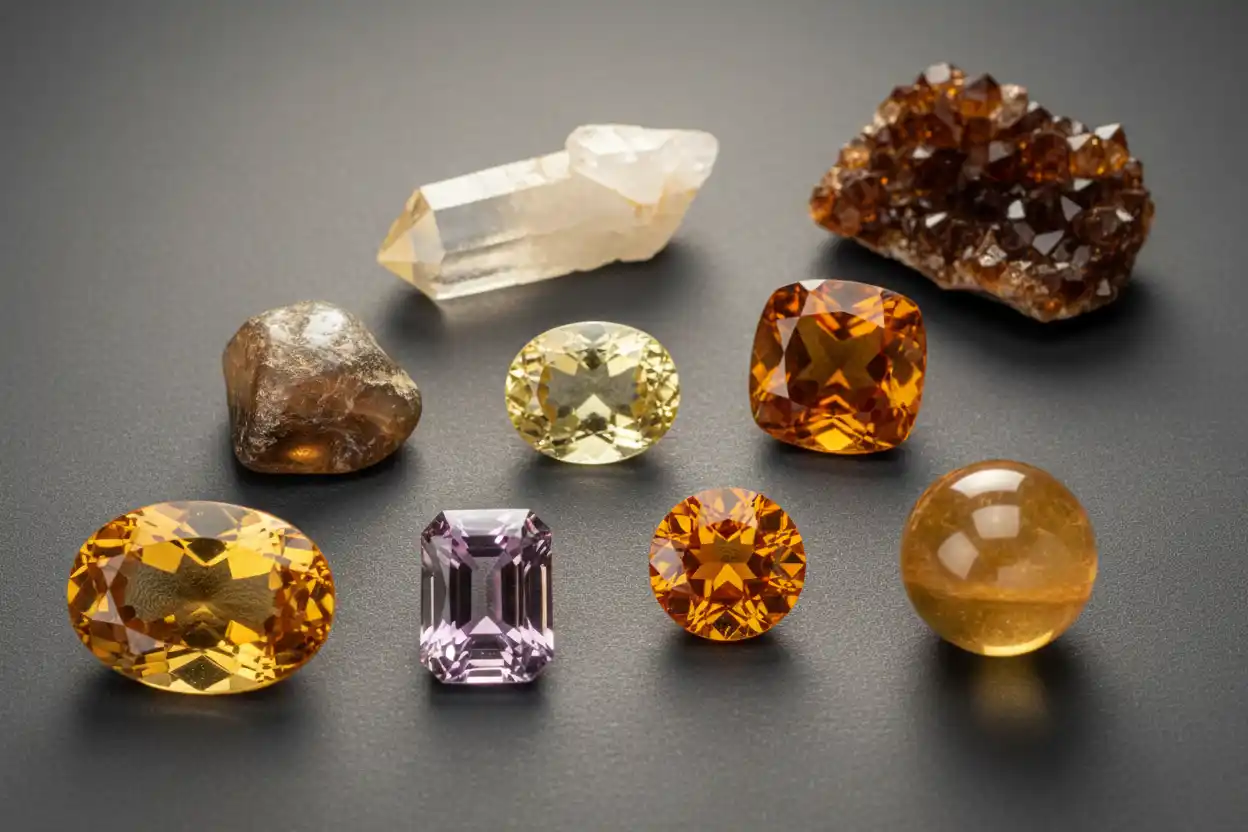
Types of Citrine: Colors and Varieties Explained
Citrine is the transparent yellow-to-orange variety of crystalline quartz. Its recognized “types” are defined less by separate mineral species than by color depth, color origin, zoning, locality, treatment history, inclusions, and trade terminology.
Every genuine citrine shares the basic quartz structure described in the main citrine meaning and properties guide. However, a pale natural yellow crystal, an orange-brown heat-treated stone, and a smoky-yellow specimen can differ substantially in geology, appearance, rarity, and market value.
Citrine at a Glance
| Property | Citrine |
|---|---|
| Composition | Silicon dioxide, SiO₂, with trace iron-related color centers |
| Mineral group | Quartz |
| Main colors | Pale yellow, lemon-yellow, golden yellow, orange-yellow, reddish orange, brownish orange, and smoky yellow |
| Crystal system | Trigonal |
| Typical habit | Six-sided prismatic crystals with pyramidal terminations; massive material; faceted stones |
| Luster | Vitreous |
| Transparency | Transparent to translucent |
| Mohs hardness | 7 |
| Cleavage | None |
| Tenacity | Brittle |
| Common uses | Faceted jewelry, beads, carvings, collector crystals, and decorative specimens |
| Main care concern | Chipping at exposed edges, sudden temperature changes, undisclosed treatment, and possible color fading under prolonged intense light |
What Counts as a Type of Citrine?
Citrine does not have a long list of formally recognized mineral varieties. Pale yellow, golden, orange, and brownish stones remain the same quartz variety, even when dealers apply different trade names.
A practical citrine classification therefore considers several questions. Is the color natural or treatment-induced? Does the stone show even yellow color, smoky zoning, or purple-and-yellow ametrine zoning? Is the name a standardized gemological term or an informal description such as Madeira, Palmeira, or champagne?
This distinction prevents ordinary marketing labels from being mistaken for different minerals. The parent quartz family guide covers the broader mineral group, while the general types of gemstones guide explains the difference between a mineral species, a color variety, and a trade name.
Natural Citrine
Natural citrine receives its yellow-to-orange color from iron-related defects and color centers within quartz. It is much less common than amethyst and considerably rarer than the volume of yellow quartz in the retail market suggests.
Typical natural material is pale yellow, golden yellow, smoky yellow, or brownish yellow. The color often appears comparatively soft and evenly distributed rather than concentrated in intensely orange crystal tips.
Natural citrine develops when quartz grows under suitable geological conditions or when naturally occurring heat and radiation alter iron-bearing quartz over geological time. Even so, color mechanism can differ among deposits, and appearance alone cannot prove that a stone is untreated.
Fine natural citrine may command a premium when its color origin is supported by reliable provenance or advanced testing. Nevertheless, not every pale yellow crystal sold as “untreated citrine” has been independently verified.
Heat-Treated Amethyst Citrine
Most commercial citrine begins as pale or moderately colored amethyst. Controlled heating changes the iron-related color centers, converting purple material into yellow, orange, reddish orange, or brownish orange quartz.
Heat-treated amethyst remains natural quartz, but the color is human-induced. It should therefore be sold as heated citrine or heat-treated quartz rather than represented as untreated natural-color citrine.
Crystal clusters with white bases and intensely orange or burnt-brown tips are commonly heated amethyst geodes. The original amethyst color was strongest near the points, so the resulting yellow-orange color remains concentrated in the same zones.
Heating may produce attractive and durable color, yet overly dark brown, opaque, or chalky areas can indicate excessive treatment or low-quality starting material. The dedicated guide to treated and synthetic citrine owns the detailed identification intent.
Pale Yellow Citrine
Pale yellow citrine ranges from a barely visible straw tint to soft lemon-yellow. Natural material frequently falls within this lighter range, although treated and laboratory-grown quartz can produce similar colors.
Light stones may show exceptional brilliance because the body color does not absorb much light. However, extremely pale material can appear nearly colorless in weak indoor illumination.
Value depends on whether the stone looks intentionally delicate or simply washed out. Fine cutting, high transparency, and even color can make pale citrine attractive, while grayness and noticeable windowing usually lower value.
Pale citrine overlaps visually with some stones marketed as yellow quartz. Gemological terminology matters because iron-stained quartz, coated quartz, and included yellow quartz are not always true citrine.
Lemon-Yellow Citrine
Lemon-yellow citrine has a fresh, moderately saturated yellow body color with little orange or brown. The trade sometimes uses “lemon citrine,” although the label is not standardized.
True citrine should be distinguished from lemon quartz, a commercial name frequently applied to greenish-yellow quartz produced through irradiation and heating. Some sellers use both terms interchangeably, which can blur treatment and color distinctions.
A balanced lemon-yellow stone can perform well in jewelry because it remains bright under a wide range of lighting. However, a slight green cast may indicate a different treatment route or a broader yellow-quartz trade category rather than conventional citrine.
Golden Citrine
Golden citrine shows a warm, saturated yellow resembling honey, polished gold, or amber-toned sunlight. It is one of the most commercially popular color ranges because it remains visibly yellow without becoming excessively brown.
The best golden stones combine even color, strong brilliance, and enough saturation to avoid a washed-out appearance. Orange modifiers may enhance warmth, while greenish or grayish undertones usually reduce demand.
Golden citrine occurs in both natural-color and heat-treated material. Consequently, “golden” describes appearance rather than treatment status.
Orange Citrine
Orange citrine ranges from yellow-orange to mandarin and burnt orange. Much of the intensely colored commercial material results from heating amethyst, although natural orange-yellow citrine also exists.
Bright orange stones can be eye-catching, but saturation should not overwhelm transparency. Very dark material may look brown or nearly black at the center when cut too deeply.
Orange citrine appears alongside other warm-colored materials in the broader orange gemstones guide. Unlike orange sapphire, fire opal, or spessartine garnet, citrine remains relatively abundant and available in large sizes.
Madeira Citrine
Madeira citrine is a color-grade trade name for rich orange, reddish orange, brownish orange, or red-brown citrine. The name refers to the warm color associated with Madeira wine, not proof that the stone came from the Portuguese island of Madeira.
Fine Madeira-color stones show deep warmth without becoming muddy or too dark. Red or orange modifiers generally make them more valuable than ordinary pale commercial citrine, provided transparency and brilliance remain strong.
Many Madeira stones are heat-treated. Therefore, the term does not establish natural color, geographic origin, or lack of enhancement.
Because the name has no universally enforced color boundary, one dealer’s Madeira citrine may be another dealer’s deep orange or cognac citrine. Buyers should judge the actual stone rather than paying for the label alone.
Palmeira Citrine
Palmeira citrine is another commercial color term, generally applied to bright orange-yellow or saturated golden-orange quartz. Some dealers use it for colors lighter and more yellow than Madeira, while others apply it to vivid orange stones from Brazil.
The definition varies significantly across the market. Palmeira should therefore be treated as a descriptive trade name rather than a formal gemological variety or guaranteed locality.
A seller using the name should still disclose whether the stone is heated, laboratory-grown, or of unknown treatment status.
Champagne and Cognac Citrine
Champagne citrine generally describes light brownish yellow, beige-yellow, or muted golden material. Cognac citrine usually refers to deeper orange-brown or reddish brown colors.
Neither term has a standardized gemological definition. Both borrow language from beverages to make subtle color differences easier to market.
Champagne-colored stones can be elegant when they remain bright and transparent. By contrast, overly gray or weakly colored quartz may receive the label primarily as a marketing strategy.
Cognac material can overlap strongly with Madeira citrine and smoky quartz. Lighting, white balance, and the dealer’s naming preference often determine which term appears on a listing.
Smoky Citrine
Smoky citrine is yellow quartz with a visible brown, gray-brown, or smoky component. The color may represent overlapping citrine and smoky-quartz color centers within the same crystal.
Some natural crystals grade from pale yellow into smoky brown. Others display uneven smoky zoning, yellow centers, or darker terminations.
The boundary between smoky citrine and smoky quartz is subjective when yellow and brown components occur together. The dedicated smoky quartz versus citrine guide owns the identification comparison.
Smoky citrine may be less valuable than a bright golden stone when grayness dominates. Nevertheless, collectors often appreciate naturally zoned crystals whose growth history remains visible.
Ametrine
Ametrine contains both purple amethyst and yellow-to-orange citrine zones within one quartz crystal. It is better treated as a bicolored quartz variety than as a simple type of citrine.
Natural ametrine is strongly associated with the Anahí deposit in Bolivia. Its color zoning reflects changes in iron oxidation states and crystal-growth conditions within the same crystal.
Synthetic and treated bicolored quartz also exists. Consequently, sharp purple-yellow division alone does not confirm natural origin.
The purple side remains mineralogically linked to amethyst, while the yellow side falls within the citrine color range.
Bicolored and Zoned Citrine
Not every zoned citrine is ametrine. Some crystals show pale-to-deep yellow zoning, yellow and smoky zones, colorless sections, or uneven orange concentration.
Zoning can follow crystal growth sectors or form bands perpendicular to the crystal’s length. Cutters may orient strongly colored sections beneath the table to improve face-up saturation.
Visible zoning generally lowers the value of a conventional faceted stone when it creates distracting patches. In collector crystals, however, sharp zoning can provide evidence of growth history and increase visual interest.
Cat’s-Eye Citrine
Cat’s-eye citrine is an uncommon chatoyant quartz in which aligned needles, fibers, channels, or inclusions reflect a narrow band of light.
The best effect appears as a sharp, centered eye that moves smoothly across a cabochon as the stone turns. A high dome and correct orientation are essential because faceting would disperse the effect.
Some chatoyant yellow quartz may contain fibrous inclusions rather than possessing the same color mechanism as transparent citrine. Laboratory identification becomes more important when an exceptional stone carries a premium price.
Star Citrine
Rare included yellow quartz can show asterism when oriented inclusions reflect intersecting rays of light. Such material is far less common than star rose quartz or star sapphire.
A genuine star should move across the cabochon under a single point light source. Diffuse stationary lines, surface scratches, or fiber-optic glass can imitate the effect.
Because star citrine lacks a large standardized market, quality and pricing depend on the strength of the star, body color, transparency, size, and confidence in identification.
Natural Citrine Localities
Brazil supplies enormous quantities of quartz and remains the country most closely associated with commercial citrine. Minas Gerais, Rio Grande do Sul, Goiás, and Bahia have all produced quartz suitable for faceting, carving, and treatment.
Bolivia is important for natural ametrine and associated citrine-rich zones. Madagascar, Zambia, Namibia, Russia, Spain, and other regions have also produced natural yellow quartz.
Locality claims can influence collector appeal, but visual appearance rarely proves origin. A generic statement such as “Brazilian citrine” may describe where a dealer purchased the rough rather than a fully documented mine source.
Formation and Color Chemistry
Quartz crystallizes from silica-rich hydrothermal fluids, pegmatitic melts, cavities in volcanic rocks, and veins associated with several geological environments.
Pure quartz is colorless. Citrine’s color requires trace iron and suitable defects or charge states within the crystal structure. Natural radiation and geological heating can influence those centers over time.
Amethyst contains iron-related centers that produce purple. Heating can alter those centers and generate yellow-to-orange colors. Different starting material responds differently, which is why some heated amethyst turns attractive yellow while other material becomes brown, opaque, greenish, or nearly colorless.
Not all yellow quartz is citrine. Surface iron staining, microscopic hematite, coatings, irradiation, or other included phases may produce yellow material that belongs to a different commercial category.
Inclusions and Internal Features
Fine faceted citrine is commonly eye-clean because quartz often forms in large transparent crystals. Noticeable fractures, veils, liquid-filled cavities, mineral crystals, or color zoning usually reduce value in conventional jewelry stones.
Collector crystals may contain fluid inclusions, phantoms, negative crystals, healed fractures, hematite, goethite, chlorite, or other minerals. Those features can make an otherwise ordinary specimen scientifically or aesthetically distinctive.
Heat-treated amethyst may retain characteristic growth features from its purple starting material. Nevertheless, inclusion interpretation requires training because no single internal feature proves treatment history in every stone.
Citrine Lookalikes
Citrine can resemble yellow topaz, yellow sapphire, heliodor, yellow zircon, yellow glass, synthetic spinel, scapolite, orthoclase, and several other yellow gems.
Refractive index, birefringence, optic character, specific gravity, and spectroscopy separate quartz from most lookalikes. Color alone is unreliable.
The broader how to identify crystals guide explains why scratch tests and photographs cannot replace proper gemological testing.
Large, perfectly clean yellow stones are not automatically fake because quartz naturally occurs in substantial crystals. Suspicion should focus more on inaccurate treatment claims, misleading trade names, glass imitations, and prices inconsistent with the quality offered.
Treatments and Color Enhancement
Heating amethyst is the dominant citrine treatment. Irradiation followed by controlled heating can also produce yellow, greenish-yellow, or orange quartz from colorless or smoky starting material.
Coatings can add metallic, iridescent, or unusually saturated surface color. Dye may enter fractures in low-quality material, although dyeing is less central to transparent citrine than to porous chalcedony.
The general gemstone treatments guide explains why enhancement does not automatically make a gem undesirable. Disclosure allows buyers to compare treated and untreated stones fairly.
Synthetic Citrine
Quartz can be grown hydrothermally in laboratories. Industrial synthetic quartz supports electronics and precision equipment, while gem-quality production can create amethyst, colorless quartz, citrine-colored quartz, and bicolored material.
Laboratory-grown citrine has the same basic chemical composition and crystal structure as natural quartz. It is not the same as yellow glass or cubic zirconia.
Natural-looking synthetic material may require advanced testing because hydrothermal growth can produce convincing crystals and clean faceted stones. The distinction between synthetic and imitation gems is covered in lab-grown versus natural gemstones.
Cutting Behavior
Citrine is available in large crystals, which gives cutters freedom to create rounds, ovals, cushions, emerald cuts, pears, briolettes, fantasy cuts, and substantial carvings.
Color zoning influences orientation. A cutter may place the strongest orange zone near the culet or center it under the table, but poor placement can create dark patches or uneven face-up color.
Quartz has no cleavage, so it presents fewer directional splitting problems than topaz. However, its brittle tenacity means thin points, sharp corners, and exposed girdles can chip.
Large stones may show a window when the pavilion is too shallow. A window allows the wearer to see through the center rather than returning light, making even strongly colored citrine look lifeless.
Durability and Jewelry Suitability
Citrine’s Mohs hardness of 7 makes it suitable for most jewelry, including rings, earrings, bracelets, pendants, and brooches. The gemstone hardness chart places it above many common household materials but below topaz, sapphire, and diamond.
Quartz has no cleavage, yet it can still chip or fracture under a hard blow. The distinction between cleavage and brittle breakage appears in the gemstone cleavage guide.
Daily-wear rings benefit from secure prongs or a protective bezel. Large high-domed stones and sharply pointed fancy cuts require more protection than compact ovals or cushions.
Citrine also appears among possible yellow engagement-ring stones. It is more wearable than many soft yellow gems, although it will accumulate scratches faster than sapphire or diamond.
Citrine Prices in 2026
Citrine is generally affordable because large quantities of quartz rough and heat-treated material reach the market. Size alone does not cause the dramatic per-carat price escalation seen in ruby, sapphire, or rare collector gems.
Commercial heat-treated stones commonly retail for approximately $3–$15 per carat. Attractive golden or orange faceted citrine may fall near $10–$40 per carat, depending on color, clarity, cut, retailer, and whether the stone is loose or mounted.
Fine Madeira-color material, precision cutting, unusually attractive natural crystals, or well-supported untreated color claims can move into approximately $30–$100 per carat. Exceptional designer cuts or documented natural-color gems may exceed that range.
Small tumbled stones and ordinary points often cost $2–$20, while larger polished towers, geodes, and decorative specimens range from tens to hundreds of dollars. Museum-scale crystals, important provenance, or exceptional carving can raise prices substantially.
The dedicated citrine price guide should retain detailed value tables and future market updates. The general guide to how gemstone prices work explains why retail setting costs, cutting labor, documentation, and seller reputation can exceed the value of the rough material.
Buying Guidance
Begin by deciding whether natural color matters to you. Heat-treated citrine can be beautiful, durable, and affordable, but it should not be priced or described as verified untreated material.
Assess color in neutral daylight-equivalent illumination. Strong editing can make pale yellow quartz look orange or conceal brown extinction.
Check the face-up dimensions as well as carat weight. Quartz has moderate density, and a deeply cut stone may hold weight beneath the setting without appearing correspondingly large.
Request disclosure of heat, irradiation, coating, laboratory growth, and any uncertainty. For an expensive natural-color claim, independent testing may be more meaningful than a retailer-issued card.
The dedicated citrine buying guide covers seller selection and quality evaluation in greater depth.
Cleaning and Storage
Clean citrine with lukewarm water, mild soap, and a soft brush. Rinse it briefly and dry it with a lint-free cloth.
Untreated, unfractured citrine can sometimes tolerate ultrasonic cleaning, but unknown treatments, repaired settings, large inclusions, and surface-reaching fractures create additional risk. The equipment-specific guide to gemstones in ultrasonic cleaners provides broader guidance.
Avoid steam, sudden temperature changes, and placing a cold stone directly into hot water. Heat may not reverse every commercial treatment, but thermal shock can enlarge internal fractures.
Prolonged exposure to strong sunlight or display-window heat may weaken some quartz colors over time. The guide to crystals that fade in sunlight covers conservative light-storage practices.
Store citrine separately from topaz, sapphire, diamond, and other harder materials that can scratch it.
Meaning and Symbolism
Citrine has long been associated in modern spiritual traditions with warmth, optimism, confidence, generosity, and prosperity. Its yellow and golden colors also inspire personal associations with sunlight, creativity, and motivation.
Pale citrine may be interpreted as gentle clarity, while golden and orange varieties are often connected with confidence and purposeful action. Smoky citrine sometimes combines the symbolic themes assigned to yellow and brown quartz.
These interpretations belong to cultural, spiritual, and personal belief systems. Mineralogical science does not demonstrate that one citrine color produces a specific emotional, financial, or medical outcome.
Frequently Asked Questions
1. Are there officially recognized mineral varieties of citrine?
Citrine is itself a yellow-to-orange variety of quartz. Names such as Madeira, Palmeira, champagne, and cognac are commercial color descriptions rather than separate mineral species.
2. What is the rarest type of citrine?
Verified natural-color citrine with strong, even golden or orange color is much rarer than heat-treated amethyst. Large, clean natural-color stones with credible provenance are especially uncommon.
3. Is heat-treated amethyst real citrine?
It is natural quartz whose color has been changed by heating. The jewelry trade commonly sells it as citrine, but the heat treatment should be disclosed.
4. What color is natural citrine usually?
Natural citrine is often pale yellow, golden yellow, smoky yellow, or brownish yellow. Saturated orange natural material exists but is less common.
5. Is Madeira citrine from Madeira?
Not necessarily. Madeira is a trade term describing reddish orange, orange-brown, or wine-like color, not a guaranteed geographic origin.
6. What is the difference between Palmeira and Madeira citrine?
Palmeira generally describes brighter golden-orange material, while Madeira tends to be darker, redder, or browner. Neither name has a universally enforced color standard.
7. Is lemon quartz the same as citrine?
Not always. Lemon quartz often refers to greenish-yellow quartz created through irradiation and heating, while citrine conventionally covers yellow-to-orange quartz without a strong green modifier.
8. Is smoky citrine a real variety?
Smoky citrine is an accepted descriptive term for quartz showing both yellow and smoky brown components. The boundary with smoky quartz is subjective.
9. Is ametrine a type of citrine?
Ametrine contains both amethyst and citrine zones. It belongs to the quartz family but is normally treated as a distinct bicolored variety.
10. Can citrine show a cat’s-eye effect?
Yes, although cat’s-eye citrine is uncommon. Aligned inclusions can produce a moving reflective band when the material is correctly cut as a cabochon.
11. Is synthetic citrine common?
Laboratory-grown quartz exists and can be colored like citrine. It is less visible in ordinary low-priced jewelry than heat-treated natural quartz, but significant natural-color claims may require laboratory confirmation.
12. Which citrine type is best for jewelry?
An evenly colored, transparent golden or orange stone with strong brilliance and a well-proportioned cut offers the best balance for most jewelry. Treatment status matters less to wearability than honest disclosure, structural condition, and cutting quality.
Citrine’s named types form a color and treatment spectrum rather than a collection of unrelated minerals. Separating pale natural material, heated orange quartz, Madeira and Palmeira trade colors, smoky zones, and ametrine prevents marketing language from obscuring what the stone actually is. Related entries are organized in the crystals that start with C directory and the gemstones that start with C guide.