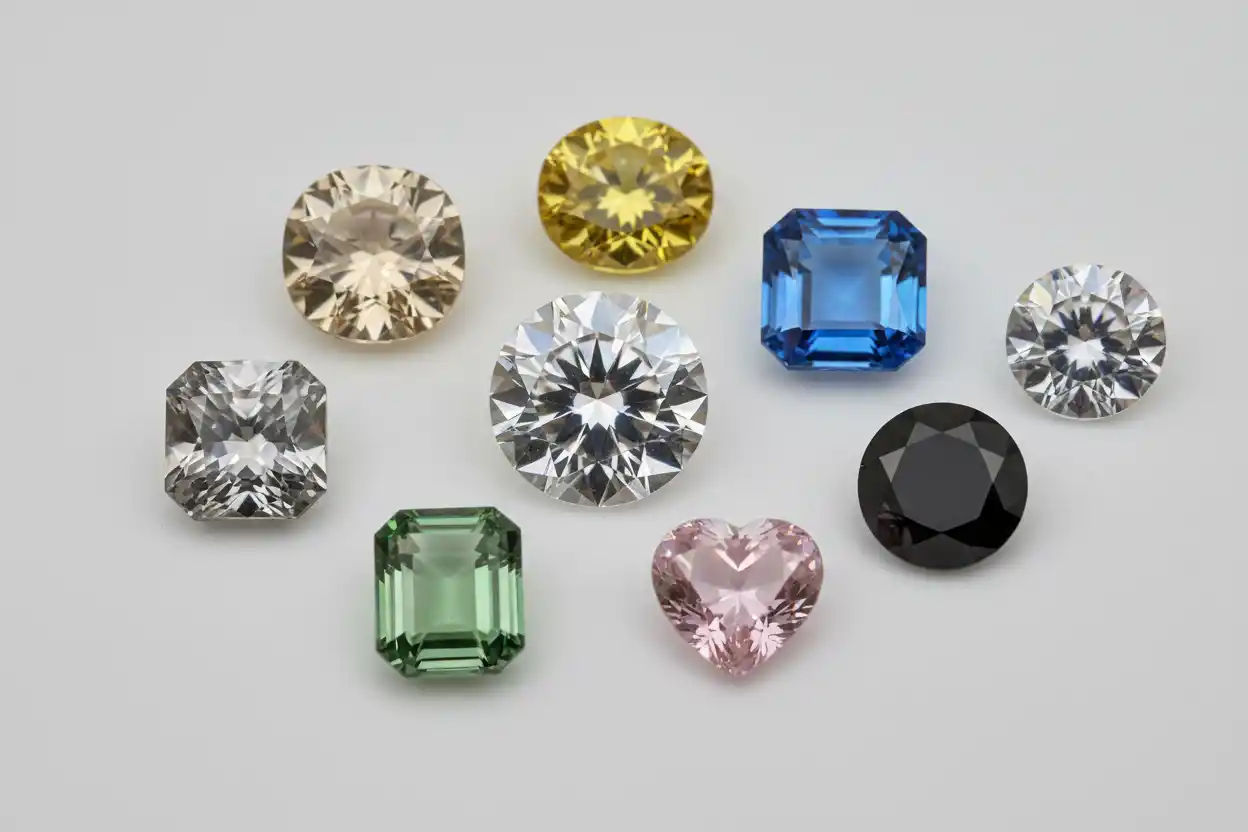
Types of Moissanite: Colors and Varieties Explained
Moissanite is silicon carbide, a material valued for exceptional brilliance, strong spectral fire, high hardness, and resistance to everyday abrasion. Natural moissanite exists, but crystals large and clean enough for jewelry are extraordinarily rare, so virtually every moissanite sold as a gemstone has been grown in a laboratory.
The principal types of moissanite are classified by crystal polytype, body color, color treatment, clarity, cut, and commercial grade. These distinctions affect appearance and price, but they do not turn each color or brand into a separate mineral species. The main moissanite meaning and properties guide covers the material’s broader identity and symbolism.
Moissanite at a Glance
| Property | Moissanite |
|---|---|
| Composition | Silicon carbide, SiC |
| Material group | Naturally occurring mineral in rare specimens; laboratory-grown silicon carbide in jewelry |
| Main colors | Colorless, near-colorless, cream, yellow, champagne, green, blue, gray, brown, black, pink, purple, and coated rainbow colors |
| Crystal system | Varies by polytype; jewelry material is commonly hexagonal or related silicon-carbide structure |
| Typical habit | Laboratory-grown boules or crystals cut into faceted gems; natural crystals are generally microscopic or very small |
| Luster | Adamantine to subadamantine |
| Transparency | Transparent to opaque |
| Mohs hardness | Approximately 9.25 |
| Cleavage | No prominent gemological cleavage |
| Tenacity | Brittle |
| Common uses | Engagement rings, wedding bands, earrings, pendants, bracelets, watches, and accent stones |
| Main care concern | Chipped points, oil and soap buildup, abrasion of surface coatings, and confusion with diamond or cubic zirconia |
Natural and Laboratory-Grown Moissanite
Natural moissanite was first identified in material associated with the Canyon Diablo meteorite in Arizona. Subsequent discoveries have found tiny silicon-carbide crystals in meteorites, kimberlites, mantle-derived rocks, and unusual geological environments.
These occurrences are scientifically important, yet they do not provide a practical source of faceting rough. Most natural crystals measure only fractions of a millimeter or contain inclusions and structural features unsuitable for jewelry.
Laboratory-created moissanite has the same silicon-carbide composition as natural moissanite. However, its controlled growth allows manufacturers to produce crystals large and clean enough for rounds, ovals, cushions, radiants, pears, emerald cuts, and other jewelry shapes.
Calling gem moissanite “lab-grown” is therefore accurate, but it should not be confused with lab-grown diamond. Diamond is crystalline carbon, whereas moissanite is silicon carbide. The broader distinctions among manufactured and mined materials are covered in lab-grown versus natural gemstones.
Moissanite Crystal Polytypes
Silicon carbide can arrange its atoms in several repeating stacking patterns called polytypes. These structures have the same SiC chemistry but differ in the sequence of atomic layers.
6H Moissanite
The 6H polytype has a hexagonal structure with a six-layer repeating sequence. Much early commercial gem moissanite was associated with 6H silicon carbide.
Its optical properties include strong double refraction and very high dispersion. Facet doubling can become visible through some viewing directions, particularly in larger or less carefully oriented stones.
4H Moissanite
The 4H polytype is another hexagonal silicon-carbide structure with a four-layer sequence.
Modern colorless gem production has included 4H material because manufacturers can optimize crystal purity, color, and cutting performance. Consumers generally cannot identify a polytype from an ordinary product photograph.
3C Silicon Carbide
The 3C polytype has a cubic structure and is also known in technical contexts as beta silicon carbide.
Although important in materials science, electronics, and research, it is not the dominant consumer-facing category in ordinary moissanite jewelry.
Polytype descriptions rarely appear on retail invoices. Cut quality, color, transparency, and accurate disclosure usually matter more to a jewelry buyer than the crystal stacking sequence.
Colorless Moissanite
Colorless moissanite aims to show no readily visible yellow, green, gray, or brown body color.
The best material appears crisp and white in daylight-equivalent illumination. Its high refractive index creates strong brilliance, while dispersion produces flashes of red, orange, yellow, green, blue, and violet.
Colorless grades are often compared with D–F diamond colors. However, moissanite does not have one universally enforced grading system equivalent to a recognized diamond color scale. A brand’s “colorless” category may not match another supplier’s terminology exactly.
Round brilliant cuts usually mask body color more effectively than elongated step cuts. Emerald, Asscher, oval, pear, and marquise stones can reveal warmth or grayness near their ends or broad facets.
Colorless moissanite is the main material considered in the moissanite versus diamond guide. That comparison retains the deeper discussion of brilliance, fire, weight, value, and long-term appearance.
Near-Colorless Moissanite
Near-colorless moissanite may show a faint cream, yellow, gray, or greenish component under certain lighting.
Retailers often compare this material with G–I or similar diamond color ranges. Once mounted in yellow or rose gold, slight warmth may become difficult to notice.
Near-colorless stones frequently offer good value because the visual difference from premium colorless material can be minor. The distinction becomes more visible in large stones, open-sided settings, and step cuts.
A buyer should view the stone face-up and from the side. Side views often reveal body color that brilliance conceals from the top.
Warm White and Classic Moissanite
Earlier generations of commercial moissanite often displayed more noticeable yellow, greenish, or gray warmth than current premium colorless material.
These stones may be marketed as classic, warm white, vintage, or J–K-like color. Brand names and grade terminology have changed over time, so an older certificate does not necessarily correspond to a current product line.
Warm moissanite can suit antique-inspired settings, yellow gold, rose gold, and designs intended to resemble old-cut diamond jewelry. The color is not inherently defective when it is disclosed and priced appropriately.
Yellow and Champagne Moissanite
Yellow moissanite ranges from pale lemon and buttery yellow to canary, golden, amber, and orange-yellow.
Color can be created during crystal growth, through post-growth processes, or with a surface coating. Buyers should ask whether the color extends through the crystal or rests primarily on the exterior.
Champagne moissanite usually describes warm beige, pale brown, yellow-brown, or golden-brown stones. Cognac is commonly used for darker orange-brown material.
Neither champagne nor cognac represents a standardized mineral variety. Both are commercial color descriptions whose boundaries vary among sellers.
Yellow moissanite may imitate a fancy yellow diamond from a distance, but its stronger fire and double refraction create a different visual character.
Green Moissanite
Green moissanite occurs in mint, olive, yellow-green, forest green, teal-green, and deep bottle-green tones.
Some green or greenish material reflects growth-related impurities and structural features. Other stones receive color through coating or post-growth processing.
Deep green stones can show dark extinction if the cut retains too much depth. Lighter mint and teal colors usually display more obvious brilliance and spectral fire.
Green body color was once considered undesirable in near-colorless moissanite, but deliberately saturated green stones now occupy their own fashion-jewelry market.
Blue and Teal Moissanite
Blue moissanite ranges from pale ice blue and gray-blue to aqua, teal, royal blue, and dark navy.
Surface coatings are common in strongly colored blue material. A coating can create an attractive result, but exposed facet edges may wear or scratch over time.
Color-through blue moissanite may offer better long-term stability, although the seller should provide a clear description rather than relying on phrases such as permanent color without supporting details.
Teal stones combine blue and green modifiers. They may resemble blue-green sapphire or tourmaline, but moissanite generally shows much stronger dispersion.
Gray Moissanite
Gray moissanite has become popular in alternative engagement rings and contemporary jewelry.
Shades range from pale silver and smoke to graphite, steel, blue-gray, and dark charcoal. Some stones remain transparent, whereas others contain enough internal features to look translucent.
Gray color may be associated with crystal-growth characteristics, impurities, inclusions, or deliberate production choices. Retailers may use names such as salt-and-pepper moissanite, storm gray, galaxy gray, or icy gray.
These labels are not standardized. A transparent gray stone and a heavily included salt-and-pepper stone should not be assessed as the same product.
Black Moissanite
Black moissanite is opaque or nearly opaque and receives a smooth, reflective polish.
Its darkness may come from internal inclusions, structural features, post-growth processing, or coatings. Some lower-cost black stones can show lighter areas where a surface treatment becomes worn.
Black moissanite provides a durable alternative to black cubic zirconia, glass, and some treated black gems. Nevertheless, heavy inclusions may reduce toughness even when the surface remains hard.
The material should be identified clearly as moissanite rather than described simply as black diamond.
Pink, Red, and Purple Moissanite
Pink, red, violet, and purple moissanite commonly receives color through a surface coating.
Thin-film coatings can produce blush pink, hot pink, magenta, red, lilac, violet, and shifting iridescent effects. GIA research has documented multilayer coatings on colored synthetic moissanite.
These treatments can be attractive, but the color may abrade at facet edges or areas in contact with prongs. Repeated polishing, harsh chemicals, and abrasive cleaning can accelerate wear.
A seller should disclose coated color rather than implying that every pink or purple stone grew with that color throughout its crystal.
Rainbow and Mystic Moissanite
Rainbow, mystic, or aurora moissanite displays multicolored iridescence across the surface in addition to the stone’s natural fire.
A vapor-deposited coating generally creates the effect. Because ordinary colorless moissanite already shows strong spectral flashes, coated rainbow material can appear extremely colorful under spot lighting.
The distinction between dispersion and coating matters. Dispersion moves as separate flashes from inside the stone, while an iridescent coating may create broader surface color.
Coated material requires gentler care than uncoated colorless moissanite.
Clear, Cloudy, and Included Moissanite
Most premium jewelry moissanite is eye-clean. However, laboratory growth can produce needles, platelets, cavities, dark crystals, growth tubes, clouds, and internal strain.
Small inclusions may have little effect on beauty, particularly in brilliant cuts. Dense clouds or surface-reaching features can reduce transparency and structural integrity.
Some sellers intentionally market heavily included gray stones as salt-and-pepper moissanite. The aesthetic can be appealing, but inclusions should be evaluated for durability rather than treated only as decoration.
Branded and Unbranded Moissanite
Branded moissanite usually includes a defined color range, cutting specification, warranty, inscription, or quality-control process.
Unbranded stones may come from several global manufacturers and can range from poorly proportioned commercial goods to excellent precision-cut material.
A brand name does not make the silicon carbide chemically different. Its price premium may reflect cutting consistency, customer service, replacement policies, marketing, and product traceability.
Older branded categories such as classic, brilliant, or premium may remain in secondhand jewelry even when a manufacturer has changed its current range.
Brilliant-Cut Moissanite
Round brilliant, oval, cushion, radiant, pear, marquise, and heart shapes use numerous facets to maximize sparkle.
These cuts suit moissanite’s strong fire. However, poorly chosen angles can create a splintery pattern, overly dark center, or obvious facet doubling.
Round brilliants usually deliver the most balanced performance. Elongated shapes can show bow-tie shadows, while cushions vary from broad chunky flashes to a crushed-ice appearance.
Step-Cut Moissanite
Emerald, Asscher, baguette, and other step cuts use broad parallel facets.
They emphasize transparency, symmetry, and body color rather than hiding inclusions beneath intense scintillation. Consequently, warmth, doubling, strain, and polishing quality may become more visible.
A clean, well-oriented step-cut stone can look elegant and restrained. Buyers who prefer diamond-like white brilliance rather than pronounced rainbow fire may appreciate this category.
Crushed-Ice Moissanite
Crushed-ice moissanite uses a modified pavilion intended to create numerous small, scattered reflections.
The style is common in elongated cushions, radiants, ovals, and pears. It can reduce the organized facet pattern associated with conventional moissanite and create a softer appearance.
Poor crushed-ice cutting may look hazy, milky, or dull. A buyer should assess video performance rather than choosing the label alone.
Antique and Old-Style Cuts
Old European, old mine, rose, portrait, and other antique-inspired cuts are available in moissanite.
Broad facets can reduce the nonstop splintery scintillation of modern cutting and create slower flashes. Warm or near-colorless material often complements these styles.
Rose cuts have a flat base and faceted dome, making them suitable for shallow settings. Portrait cuts are thin and transparent, so body color and clarity remain highly visible.
How Moissanite Is Identified
Moissanite has a refractive index near 2.65–2.69, high dispersion, strong double refraction, specific gravity around 3.2, and hardness near 9.25.
Through many viewing directions, doubled back-facet edges can help separate it from singly refractive diamond. However, cutters orient moissanite to minimize obvious doubling in the face-up position.
Basic diamond thermal testers can mistake moissanite for diamond because both conduct heat efficiently. Modern combination testers also measure electrical behavior.
The dedicated real versus fake moissanite guide owns consumer identification methods. Significant uncertainty should be resolved through a gemologist rather than home scratch or flame tests.
Moissanite, Diamond, Lab Diamond, and Cubic Zirconia
Moissanite is a diamond simulant, not a type of diamond.
Natural and laboratory-grown diamonds are crystalline carbon. Moissanite is silicon carbide, while cubic zirconia is stabilized zirconium dioxide.
Moissanite is harder and generally maintains facet polish longer than cubic zirconia. It also displays more brilliance, substantially more fire, and less density.
The focused moissanite versus cubic zirconia guide covers that comparison. Buyers deciding between manufactured diamond and moissanite can use the dedicated lab diamond versus moissanite guide.
Treatments and Coatings
Colorless and near-colorless moissanite may be sold without a surface treatment. Colored stones are more likely to involve coating, irradiation, annealing, or proprietary post-growth processes.
Some processes affect the entire stone, while others create only a thin exterior layer. The seller should disclose which category applies.
Fracture filling is not a defining mainstream treatment, but resins or oils can conceal damage in low-quality stones or assembled jewelry.
The dedicated treated moissanite guide retains the full detection and disclosure intent. General terminology appears in gemstone treatments explained.
Cutting Behavior
Moissanite is difficult to cut because of its high hardness and directional optical properties.
Diamond-bearing laps and abrasives are used to shape and polish the material. A cutter must orient the rough to control facet doubling, body color, bow ties, and overall light return.
Moissanite weighs less than diamond. A stone with the same dimensions as a one-carat diamond therefore has a lower actual carat weight.
Retailers often describe moissanite through diamond-equivalent weight or DEW. Buyers should compare millimeter measurements rather than assuming actual carat weights represent the same visual size.
Durability and Jewelry Suitability
Moissanite’s hardness of approximately 9.25 makes it one of the most scratch-resistant jewelry materials. The gemstone hardness chart places only diamond clearly above it among mainstream gems.
It lacks diamond’s prominent octahedral cleavage, but moissanite remains brittle and can chip at sharp points or thin girdles. The difference between surface hardness and resistance to breakage is explained in gemstone toughness versus hardness.
Rounds, ovals, and cushions are suitable for frequent wear. Princess, marquise, pear, and heart shapes need settings that protect their points.
Its durability makes moissanite practical for moissanite engagement rings, although secure mounting and routine inspection still matter.
Moissanite Prices in 2026
Moissanite pricing depends on brand, cut, color, size, coating, warranty, and retailer rather than natural rarity.
Generic loose stones near one-carat diamond-equivalent size commonly retail for approximately $20–$100. Better-cut unbranded colorless stones may cost around $75–$250.
Premium branded colorless moissanite commonly falls near $250–$600 per carat or equivalent retail tier, depending on shape and size. Large stones may cost more per item but do not show the severe nonlinear rarity premium associated with large natural diamonds.
Fancy-color, gray, black, coated pink, and custom-cut stones commonly range from approximately $30 to $300 per stone. Precision cutting and distinctive designs can increase prices further because skilled labor becomes the main cost.
The dedicated moissanite price guide should retain detailed and frequently updated price comparisons.
Buying Guidance
Start with millimeter size, cut style, and visible performance.
Request video in diffused daylight and ordinary indoor lighting. Jewelry-store spotlights can exaggerate spectral fire and conceal warmth or haziness.
Ask whether the color is inherent, post-growth modified, or surface coated. An invoice should also state the material as laboratory-created moissanite rather than diamond.
Check facet alignment, girdle thickness, bow-tie shadows, crushed-ice haze, inclusions, and whether the stone faces up evenly.
The complete purchasing checklist belongs in the moissanite buying guide. General safeguards for remote purchases appear in how to buy gemstones online.
Moissanite Jewelry Types
A moissanite ring can use solitaires, halos, three-stone designs, bezels, and pavé.
Moissanite earrings receive less impact than rings and are well suited to rounds, cushions, halos, and matching pairs.
A moissanite necklace may use one pendant, a graduated line, or small station stones. Brilliance remains visible even when the stones are relatively small.
Moissanite bracelets need secure links and clasps because wrist jewelry experiences frequent contact with desks and hard surfaces.
Cleaning and Storage
Moissanite attracts oils, soap, lotion, and cosmetic film. This buildup can create a temporary cloudy or rainbow-like surface often called an oil slick.
Clean uncoated stones with lukewarm water, mild soap, and a soft brush. Pay particular attention to the pavilion and underside of the setting.
Many secure uncoated moissanite pieces can tolerate ultrasonic cleaning, but coatings, fractures, glue, plated metal, and loose settings create exceptions. Review the guide to gemstones in ultrasonic cleaners before using equipment.
The complete hand-cleaning process belongs in how to clean moissanite jewelry.
Store moissanite separately because it can scratch quartz, feldspar, opal, and most other gems.
Meaning and Symbolism
Moissanite has a modern rather than ancient gemstone tradition.
Its brilliance and laboratory origin have inspired associations with innovation, confidence, personal choice, resilience, and accessible celebration. Colorless stones may symbolize clarity and commitment, while colored material can carry contemporary color-based meanings.
Some people choose moissanite because it allows a larger or more distinctive design without the cost structure of natural diamond. That decision can give the stone personal meaning independent of rarity.
These interpretations are cultural and personal. They are not scientifically demonstrated effects of silicon carbide.
Frequently Asked Questions
1. What are the main types of moissanite?
The principal practical types include natural and laboratory-grown material, 6H and 4H polytypes, colorless and near-colorless grades, fancy colors, coated stones, included gray material, and different cutting styles.
2. Is natural moissanite used in jewelry?
Almost never. Natural crystals are exceptionally rare and generally too small or included for ordinary faceting. Jewelry moissanite is laboratory-created.
3. Is 4H moissanite better than 6H moissanite?
Not automatically. Polytype can influence optical behavior, but cut quality, body color, transparency, orientation, and polish determine the finished appearance more directly.
4. What is the whitest type of moissanite?
Premium colorless material designed to resemble D–F diamond color provides the whitest appearance. However, grading language varies among manufacturers.
5. Why does some moissanite look yellow or green?
Body color can come from impurities, crystal defects, growth conditions, post-growth processes, or coatings. Large and step-cut stones reveal it more easily.
6. Is blue moissanite naturally blue?
Most jewelry blue moissanite is laboratory-created, and strong blue may result from coating or another post-growth process. Treatment should be disclosed.
7. Is pink moissanite color stable?
Many pink stones use a thin surface coating. The color can remain attractive with careful wear but may abrade at exposed facets or during polishing.
8. What is salt-and-pepper moissanite?
It is a commercial name for gray or transparent moissanite with visible dark and light inclusions. The phrase is not a standardized clarity grade.
9. Which moissanite cut looks most like diamond?
A well-proportioned round brilliant usually produces the most balanced diamond-like light pattern. Step cuts and antique cuts offer a more restrained alternative to intense rainbow fire.
10. Does moissanite become cloudy permanently?
The crystal normally remains transparent, but oil, soap, scratches, coating wear, and dirt beneath the setting can reduce brilliance. Proper cleaning often restores the appearance.
11. Can moissanite pass a diamond tester?
It may activate basic thermal diamond testers because it conducts heat well. Combination testers or professional gemological analysis separate it from diamond.
12. Which moissanite type is best for daily wear?
An uncoated colorless or near-colorless stone with sound structure, excellent cutting, and a protective setting offers the most straightforward durability for frequent wear.
Moissanite’s varieties come primarily from laboratory growth, polytype, color control, treatment, and cutting rather than geological rarity. A colorless round, warm antique cut, teal coated oval, included gray cushion, and opaque black stone may all be silicon carbide, yet they deliver very different visual and practical experiences. Related M entries are organized in the crystals that start with M directory and the gemstones that start with M guide.