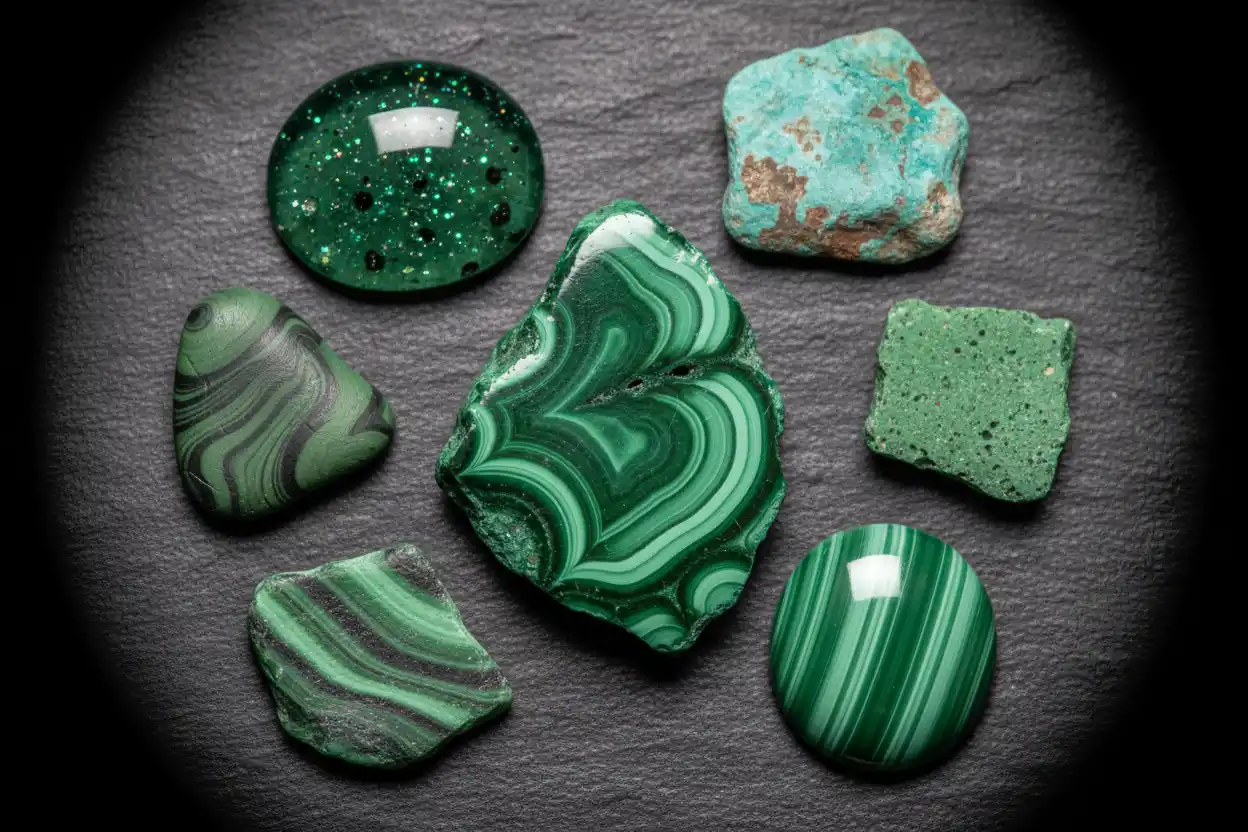
Real vs Fake Malachite: Pattern, Resin and Treatment Tests
Real malachite is a green copper carbonate hydroxide mineral that commonly forms botryoidal, stalactitic, mammillary, fibrous, and banded masses in the oxidized zones of copper deposits.
Cut sections reveal concentric rings, sweeping curves, eyes, waves, parallel layers, and irregular combinations of pale, bright, dark, and nearly blackish green. These patterns reflect radial and layered mineral growth rather than printing or poured pigment.
Imitations include resin, polymer clay, glass, ceramic, dyed howlite, serpentine, calcite, reconstructed powder-and-resin products, and other green stones. Genuine malachite can also be waxed, coated, filled, stabilized, or assembled.
True laboratory-grown malachite has been produced experimentally, but it is not the usual explanation for inexpensive striped jewelry. A product marketed casually as synthetic malachite is more likely to be a simulant or composite unless its mineral identity is documented.
This page owns the direct authenticity workflow. The completed treated malachite guide retains dye, coating, filling, stabilization, reconstruction, and synthetic-material details.
Genuine Malachite vs Common Imitations
| Feature | Natural malachite | Striped resin or polymer clay | Reconstructed malachite | Glass or ceramic | Dyed natural stone |
|---|---|---|---|---|---|
| Material | Copper carbonate hydroxide | Manufactured polymer | Malachite fragments or powder bonded with filler | Manufactured glass or ceramic | Different natural mineral |
| Pattern | Irregular concentric, radial, eye, wave, and fibrous bands | Poured, rolled, printed, or molded stripes | Fragmented or granular green structure with binder | Painted, fused, or molded pattern | Host texture with dye concentration |
| Color | Multiple natural greens, commonly without pure white | Any green, black, or white combination | Green with polymer or pigment | Any manufactured color | Dye-controlled |
| Hardness | About 3.5–4 | Commonly much softer | Variable | Material-dependent | Host-dependent |
| Specific gravity | Close to 4.0 | Commonly much lower | Variable | Variable | Host-dependent |
| Surface | Stone-like with possible fibrous or granular texture | Plastic-like or extremely smooth | Mixed luster and fragment boundaries | Glassy or glazed | Host-mineral texture |
| Internal clues | Fibrous growth, mineral inclusions, pores, and natural bands | Mold seams, bubbles, soft scratches, repeated swirls | Resin boundaries and trapped bubbles | Gas bubbles or glazed body | Dye in fractures and pores |
| Best confirmation | Microscopy, density, Raman, XRD, and chemistry | Polymer analysis | Microscopy and spectroscopy | Optical and material testing | Mineral identification |
Pattern inspection is valuable, but sophisticated resin can imitate natural curves convincingly. Density and mineral analysis provide a stronger conclusion.
What Is Genuine Malachite?
The completed malachite meaning guide owns its geology, symbolism, localities, and general properties.
Malachite has the composition Cu₂CO₃(OH)₂ and crystallizes in the monoclinic system.
It forms as a secondary mineral when copper-bearing deposits react with oxygenated water and carbonate-rich conditions near Earth’s surface.
The resulting material commonly appears with azurite, chrysocolla, cuprite, calcite, iron oxides, and other minerals.
Individual malachite crystals exist, but most ornamental material is a compact, fibrous, or banded aggregate cut into cabochons, beads, carvings, boxes, and inlay.
Natural Malachite Color
Natural malachite includes pale green, apple green, vivid grass green, emerald-like green, dark forest green, and nearly blackish green.
Bands normally differ in tone. Some transitions are gradual, while others form sharp boundaries between growth layers.
Pure bright white is not a characteristic malachite bodycolor. White areas may represent calcite, another associated mineral, filler, or artificial pigment.
A piece with alternating neon green, jet black, and bright white stripes may be manufactured, particularly when the pattern repeats mechanically.
However, dark natural bands can look almost black under ordinary light. One dark line should not be treated as proof of resin.
How Natural Banding Forms
Malachite commonly grows in radial fibers around a center or along the walls of a cavity.
When those masses are cut across the growth direction, they reveal rings, eyes, curves, and feathered bands.
A cut parallel to the fibers may show straight, silky, or flame-like structures instead.
Natural band widths change irregularly. Lines may merge, divide, curve around an earlier growth center, or end against another mineral.
This three-dimensional growth produces different patterns on the front, back, and edge of one cabochon.
A manufactured stripe often remains flat, uniform, or rhythmically repeated.
Is Every Repeated Pattern Fake?
No. Beads cut sequentially from one slab can share related banding.
A matched pair of earrings may be deliberately cut from adjacent material and display near-mirrored patterns.
Suspicion increases when many inexpensive beads reproduce exactly the same line widths, curves, and black-green sequence.
Photographing the full strand and rotating individual beads can reveal whether the pattern continues naturally through the material or sits only on the surface.
Natural Eyes and Concentric Rings
Malachite eyes form when radial growth is cut across its center.
The rings may be circular, oval, distorted, incomplete, or intersected by later bands.
A resin imitation can copy an eye pattern, but the manufactured rings may be perfectly centered, evenly spaced, and identical across several objects.
Under magnification, genuine layers may reveal fine fibers or subtle mineral texture. Polymer patterns appear smoother and may contain microscopic bubbles.
Fibrous and Silky Malachite
Some natural malachite displays a silky sheen caused by aligned fibers.
The effect changes with viewing direction and can resemble chatoyancy across curved surfaces.
Fibrous rough can be fragile. Fine needles and velvet-like coatings should be handled as mineral specimens rather than rubbed or washed aggressively.
Resin can reproduce a bright surface sheen but usually lacks the underlying radial mineral structure.
Malachite Versus Azurite
Azurite is a blue copper carbonate mineral that commonly alters to malachite.
Mixed blue-and-green material can contain both minerals naturally. A specimen with intergrown azurite is not fake malachite.
The completed malachite versus azurite guide owns the full mineral comparison.
Painted blue areas, dyed resin, and assembled pieces can imitate the combination. Magnification should show a natural mineral boundary rather than a surface layer.
Malachite with Chrysocolla
Chrysocolla can occur beside or within malachite, producing blue-green, turquoise, dark-green, and black patterns.
The completed chrysocolla guide owns that material’s identity.
Mixed copper-mineral rocks vary in hardness and porosity. Some require stabilization before polishing.
A seller should identify a mixed material honestly rather than calling every blue-green piece pure malachite.
Malachite Versus Dioptase
Dioptase is a vivid green copper silicate commonly seen as transparent to translucent crystals.
Malachite is usually opaque to translucent and aggregate in texture.
A faceted transparent green stone is unlikely to be ordinary malachite, although rare small crystals can be cut.
Refractive properties, crystal habit, hardness, and composition separate the minerals.
Resin Imitations
Resin is one of the most common modern malachite imitations.
Pigments can be poured, swirled, rolled, or layered to create green and black bands. Clear resin can increase depth and gloss.
Look for mold seams, casting bubbles, soft scratches, rounded pattern boundaries, and repeated designs.
Resin is usually much lighter than malachite. A large bracelet or sphere may feel unexpectedly light for its dimensions.
Manufacturers can add mineral powder or dense filler, so weight alone is not proof.
Polymer Clay
Polymer clay can reproduce malachite banding through layered rolling and folding techniques.
The pattern may be extremely convincing in beads and cabochons. It often includes sharp black lines and saturated green areas.
A cut edge may reveal a soft, uniform clay body. Surface scratches can look different from mineral abrasion.
Polymer-clay beads may show small holes, fingerprints, or slightly flattened areas from manufacture.
Hot-needle testing should not be used. It damages the object and can release fumes.
Reconstructed Malachite
Malachite chips or powder can be mixed with resin and molded into larger pieces.
The product may contain genuine malachite, but it is not one continuous natural mass.
Under magnification, look for angular fragments, granular green zones, transparent binder, bubbles, and unnatural boundaries.
Reconstruction allows small mining fragments to become affordable decorative objects. Accurate disclosure is the issue, not the existence of the product.
Terms such as block malachite, pressed malachite, or stabilized malachite should be clarified because sellers use them inconsistently.
Glass and Ceramic Imitations
Glass can reproduce malachite colors through layered or fused green material.
Round bubbles, curved flow lines, glassy fractures, and high surface luster may appear. Devitrified glass can contain crystalline structures that make identification more difficult.
Ceramic products may use a painted or glazed malachite pattern over a pale body. Chips can expose the substrate beneath the green surface.
A ceramic carving may feel cool and substantial, making touch tests unreliable.
Dyed Howlite, Magnesite, and Calcite
Howlite and magnesite accept dye readily.
Their natural veins can be colored dark green or black to create a malachite-like pattern. Dye frequently concentrates in pores and cracks.
Calcite and banded carbonate rocks can also be dyed green. They may resemble low-grade malachite carvings but have different optical and chemical properties.
Do not use acid to identify them. Malachite itself is a carbonate mineral and can be damaged.
Serpentine and Other Green Stones
Serpentine may appear waxy, green, mottled, and easy to carve.
It usually lacks malachite’s distinctive radial green banding, but dyes or paint can add a striped pattern.
Green jasper, aventurine, marble, and other rocks may also receive misleading trade names.
The host mineral remains genuine natural stone, but it is not malachite.
Coated Malachite
A clear coating can deepen color, fill pits, and create a glossy surface.
Colored coating can make pale material look more saturated or disguise repairs.
Inspect scratches, carving recesses, drill holes, and worn edges. A film may peel, chip, or reveal a duller underlying surface.
Coating can occur on genuine malachite, reconstructed material, or an imitation substrate.
The correct description should identify both the base and the treatment.
Filled and Stabilized Malachite
Porous or fractured malachite may receive resin to improve polish and durability.
Small amounts of filler can support otherwise fragile material. Heavy impregnation changes value and care expectations.
Transparent bubbles, glossy fracture fillings, and areas with different ultraviolet reactions may provide clues.
The completed treatment page owns the complete distinction between surface wax, fracture filling, polymer stabilization, and reconstruction.
Does True Synthetic Malachite Exist?
Malachite has been grown experimentally in laboratories.
It is not a major mainstream synthetic gemstone in the way laboratory-grown ruby or sapphire is.
Retail objects described as synthetic malachite are therefore often resin, glass, ceramic, or reconstructed products rather than documented laboratory-grown Cu₂CO₃(OH)₂.
A seller should provide the actual composition. Synthetic terminology should not be used merely because an imitation was manufactured.
Hardness and Scratch Testing
Malachite ranks only about 3.5–4 on the gemstone hardness chart.
A steel object, quartz dust, or many other gemstones can scratch it.
That softness makes deliberate scratch testing especially damaging. A resin coating may scratch even when genuine malachite lies beneath it.
Hardness also cannot distinguish every imitation because soft stone, polymer, and carbonate substitutes overlap.
The toughness-versus-hardness guide explains why fibrous growth, pores, and fractures influence breakage separately.
Density and Heft
Malachite is unusually dense for an opaque ornamental stone, with specific gravity near 4.0.
An equal-sized resin, howlite, serpentine, or quartzite object normally weighs less.
Comparing two objects by hand is unreliable unless their dimensions and shapes are almost identical.
Metal fittings, hollow construction, dense fillers, and hidden cores can distort the impression.
Hydrostatic weighing of a loose solid object provides stronger evidence.
Refractive and Optical Properties
Malachite has high and variable refractive indices, although aggregate and curved surfaces complicate routine measurement.
A spot reading, microscopic texture, and density can distinguish it from resin, glass, quartz, serpentine, and calcite.
Natural malachite is biaxial and pleochroic in suitable transparent material, but most commercial objects are too opaque or aggregate for easy observation.
Instrument results should be interpreted together rather than compared with one rigid number.
Pale-Green Streak
Malachite produces a pale-green streak on an appropriate unglazed surface.
However, streak testing removes material and damages a polished gem or collectible specimen.
Resin, coating, and dyed host minerals may leave misleading marks.
The property is useful in controlled mineral identification, not as a home test for finished jewelry.
Ultraviolet Light
Malachite is commonly weak or inert under ordinary ultraviolet examination, but associated minerals, polymers, dyes, and coatings may fluoresce.
An uneven reaction can reveal filler or composite construction.
Some imitations remain inert, while some natural mixed-mineral material reacts.
UV cannot prove malachite by itself.
Raman, X-Ray, and Chemical Testing
Raman spectroscopy can identify malachite through its molecular-vibration pattern and distinguish it from serpentine, quartz, calcite, glass, and polymers.
X-ray diffraction confirms crystalline malachite in fine-grained or reconstructed material.
Chemical analysis detects copper-rich carbonate composition and can help separate natural from unusual synthetic material through trace elements.
The gemstone certification guide explains when formal testing is useful. The gem-lab-report guide helps determine whether the laboratory tested only the green mineral or also addressed treatment and composite construction.
Malachite Safety
Malachite contains copper within its mineral structure.
An intact polished object is generally handled as decorative stone, but cutting, drilling, sanding, or crushing creates dust that should not be inhaled or ingested.
Use appropriate respiratory protection, local dust extraction, wet lapidary methods designed for safety, and careful cleanup.
Do not lick malachite or place it in drinking water. The completed toxic-crystals safety list provides broader handling context.
The crystal water-safety guide explains why a stone’s survival in water does not make direct elixir preparation appropriate.
Tests to Avoid
Do not use acid. Malachite is a carbonate mineral and reacts chemically.
Avoid hot needles, flame, deliberate scratching, grinding, and taste tests.
Do not soak the piece in vinegar, lemon juice, saltwater, or cleaning chemicals.
Solvents can damage resin, coating, glue, and reconstructed material without proving what lies underneath.
A non-destructive inspection followed by professional testing offers more evidence and less risk.
A Safe Home Inspection Sequence
Observe the front, back, and edges under neutral light.
Determine whether the bands have depth and whether their shapes change through the object.
Use a loupe to inspect fibers, grain boundaries, bubbles, mold seams, dye, clear binder, and coating wear.
Compare several beads for exact pattern repetition. Note whether the piece feels implausibly light, but do not treat heft as proof.
Review the seller’s terminology for natural, reconstructed, stabilized, synthetic, or imitation material.
Stop before any destructive test.
Buying Genuine Malachite
The completed malachite buying guide owns band quality, polish, construction, seller, and specimen evaluation.
Detailed market values remain in the malachite price guide.
Request exact-item photographs, including the back and edges. Ask whether the material is solid, filled, coated, reconstructed, or composite.
For online purchases, follow how to buy gemstones online and preserve the return period for examination.
Jewelry and Care
Malachite scratches and chips more readily than many common gemstones.
A malachite necklace or malachite earrings generally faces less repeated contact than a ring or bracelet.
Use the completed malachite jewelry cleaning guide for physical care. Avoid steam, ultrasonic cleaning, acids, harsh chemicals, and prolonged soaking.
Belief-based practices belong in how to cleanse and charge malachite and should not involve direct drinking water, salt, or chemical exposure.
Frequently Asked Questions
1. What is genuine malachite?
Genuine malachite is naturally formed copper carbonate hydroxide with characteristic green fibrous or banded aggregate growth.
2. Does all real malachite have stripes?
No. It may be banded, botryoidal, fibrous, crystalline, massive, or relatively uniform.
3. Are black lines proof of fake malachite?
No. Very dark natural green bands can appear black, although uniform jet-black manufactured stripes are a warning sign.
4. Why do fake malachite beads repeat patterns?
Resin and polymer clay are produced from repeated molds or layered blocks, allowing identical bands to recur.
5. Is reconstructed malachite real?
It may contain real malachite chips or powder, but it is a bonded composite rather than one solid natural piece.
6. Does synthetic malachite exist?
Experimental laboratory-grown malachite exists, but it is uncommon. Most inexpensive “synthetic malachite” is resin, glass, ceramic, or composite material.
7. Can density identify malachite?
Its high density near 4.0 is useful, but fillers, mountings, hollow objects, and composites can distort the result.
8. Can I scratch-test malachite?
No. Malachite is soft, and the test causes permanent damage without resolving treatment reliably.
9. Can I use vinegar to test malachite?
No. Acid reacts with malachite and destroys the surface.
10. Is malachite safe to touch?
Intact polished pieces are generally handled normally. Avoid dust from cutting or grinding, wash after handling crumbly rough, and never ingest it.
11. Can malachite go in drinking water?
No. Do not use malachite for direct crystal-water or elixir preparation.
12. Which laboratory tests confirm malachite?
Raman spectroscopy, X-ray diffraction, density, microscopy, and chemical analysis can identify malachite and reveal many composites or treatments.
Natural malachite patterns are complex because they record layered and radial mineral growth. Resin can copy the colors, but it often repeats the design, lacks mineral texture, and weighs substantially less. The most reliable identification combines pattern depth with density, microscopic structure, and spectroscopy while avoiding acid, scratching, and dust-producing tests.
Malachite is indexed in Crystals That Start With M and Gemstones That Start With M.