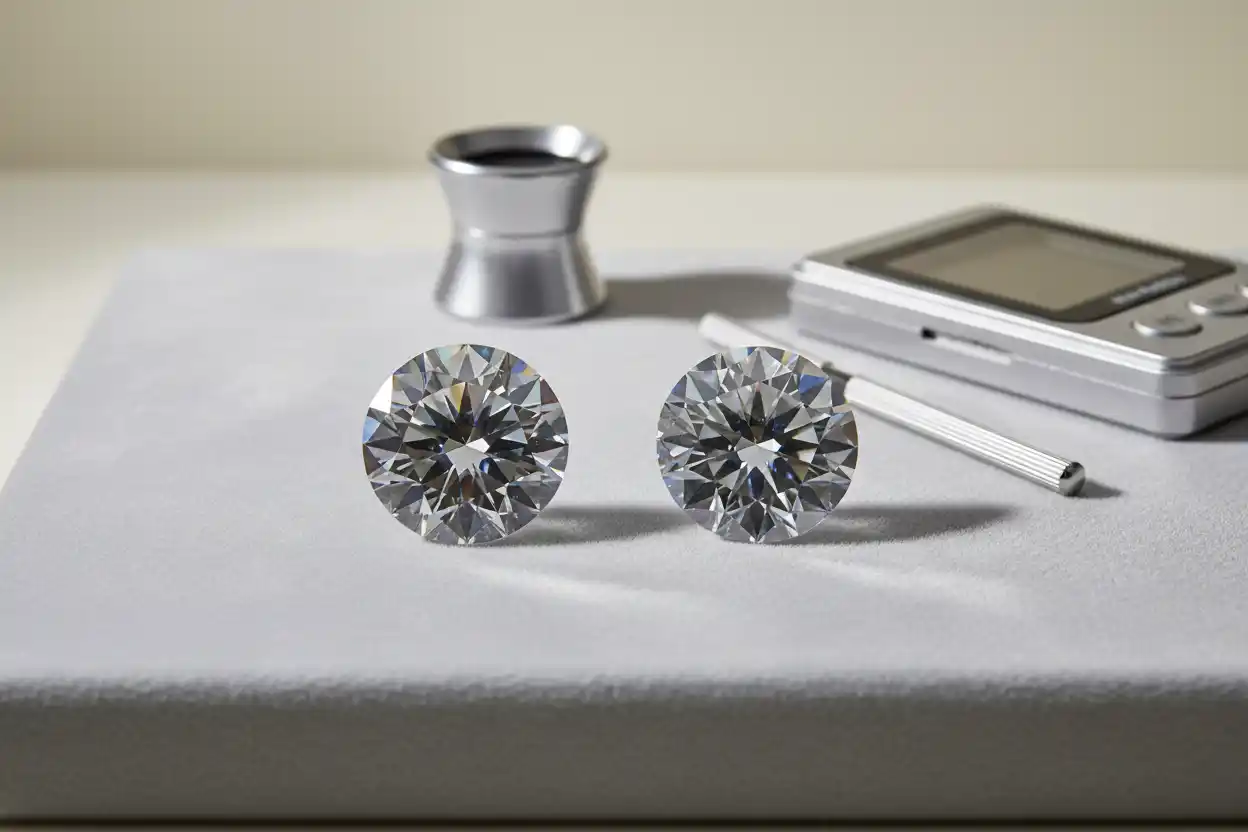
Moissanite vs Cubic Zirconia: Complete Comparison
Moissanite and cubic zirconia are laboratory-created gemstones commonly used as colorless diamond simulants. Both can appear bright, clean and colorless, particularly when newly polished and viewed without magnification.
They are not the same material. Moissanite is silicon carbide, while cubic zirconia is stabilized zirconium oxide. Their different compositions create measurable differences in hardness, density, refractive behavior, dispersion, thermal conductivity and long-term wear.
Moissanite usually provides sharper brilliance, stronger rainbow fire and greater resistance to abrasion. Cubic zirconia is heavier for its size, substantially less expensive and more likely to develop scratches or rounded facet junctions during extended wear.
The broad Moissanite guide and Cubic Zirconia guide own each material’s complete identity. This page focuses strictly on telling them apart and understanding the practical consequences of the difference.
Moissanite vs Cubic Zirconia at a Glance
| Property | Moissanite | Cubic zirconia |
|---|---|---|
| Composition | Silicon carbide, SiC | Stabilized zirconium oxide, ZrO₂ |
| Commercial origin | Laboratory-created | Laboratory-created |
| Crystal character | Common jewelry material is doubly refractive | Singly refractive |
| Mohs hardness | Approximately 9.25 | Approximately 8–8.5 |
| Specific gravity | Approximately 3.22 | Commonly around 5.6–6.0 |
| Refractive index | Approximately 2.65–2.69 | Approximately 2.15–2.18 |
| Dispersion | Very high, approximately 0.104 | High, commonly around 0.06 |
| Visual fire | Strong, sharp spectral flashes | Broad colorful flashes |
| Brilliance | Very high | High but generally lower |
| Weight for equal dimensions | Lighter | Noticeably heavier |
| Long-term abrasion | Highly resistant | More likely to scratch and dull |
| Thermal testing | May register as diamond on basic thermal tester | Usually separates readily from diamond |
| Typical price | Higher than CZ | Very inexpensive |
| Best use | Long-term everyday jewelry | Fashion, travel, temporary and budget jewelry |
Composition
Moissanite consists of silicon and carbon arranged as silicon carbide.
Cubic zirconia consists of zirconium oxide stabilized in a cubic crystal structure through added elements such as yttrium or calcium.
Neither material is diamond. Diamond consists of carbon arranged in the diamond structure.
The word cubic in cubic zirconia refers to crystal structure. It does not mean the stone is natural zircon, and CZ should not be shortened simply to zircon.
The Types of Cubic Zirconia guide explains colored and specialty CZ products, while Types of Moissanite covers Moissanite cuts and colors.
Laboratory Origin
Nearly all jewelry Moissanite is manufactured because natural Moissanite is extremely rare and does not supply the commercial jewelry market.
Cubic zirconia is also produced industrially. Commercial crystals can be grown in large sizes and made in colorless or nearly any colored form.
Laboratory origin does not make the two materials equivalent. A synthetic or laboratory-created gemstone matches a particular material’s structure and composition, while a simulant merely resembles another gemstone.
Moissanite and CZ are both commonly used as diamond simulants. They remain distinct gemstones from each other.
A seller should identify the actual material rather than using only simulated diamond or diamond alternative.
Brilliance
Brilliance refers broadly to the white light returned from a faceted gemstone.
Moissanite has a higher refractive index than CZ and can produce intense brightness when well cut.
Cubic zirconia can also appear highly brilliant, particularly when clean and newly polished. However, its light return often looks broader and less crisp.
Cut quality strongly affects both materials. A poorly proportioned Moissanite can appear lifeless, while a well-cut CZ can look attractive.
Comparisons should use similar dimensions, shapes and cutting styles. A precision-cut round Moissanite should not be compared with a deep, poorly finished CZ and treated as proof of every stone’s behavior.
Fire and Dispersion
Dispersion is the separation of white light into spectral colors.
Moissanite has exceptionally high dispersion. It can show sharp flashes of red, green, blue and yellow, particularly in larger brilliant cuts.
CZ also has more fire than diamond, but its flashes often appear broader and less intense than Moissanite’s.
Under concentrated spotlights, both stones can look strongly rainbow-colored. Diffused daylight produces a more realistic comparison.
The visual preference is subjective. Some buyers enjoy Moissanite’s lively spectral display, while others prefer CZ’s broader, softer flashes for fashion jewelry.
Double Refraction
Moissanite is usually doubly refractive.
When viewed through suitable directions with magnification, back facets may appear doubled. Cutting orientation reduces the effect face-up, but it can remain visible through the crown or pavilion.
Cubic zirconia is singly refractive and does not show the same facet doubling.
This is one of the stronger gemological distinctions. However, it can be difficult to observe in small stones or busy brilliant cuts.
A loupe user should focus through the stone toward the rear facet junctions. Blurriness alone is not conclusive because dirt, poor cutting and viewing angle can create similar impressions.
Hardness and Scratch Resistance
Moissanite ranks approximately 9.25 on the Mohs scale.
Cubic zirconia is generally around 8–8.5. It remains harder than quartz but scratches more easily than Moissanite, sapphire or diamond.
The Gemstone Hardness Chart provides broader comparison.
Over extended wear, CZ facet junctions may become rounded or abraded. The surface can lose its crisp polish, especially in rings and bracelets.
Moissanite normally retains sharper edges longer.
A scratch test should not be used to identify either stone. It damages the jewelry and produces unreliable conclusions.
Toughness and Chipping
Both materials can chip under sufficient force.
Moissanite generally performs well in everyday jewelry and is suitable for rings, bracelets, earrings and necklaces.
CZ can also tolerate normal wear, but surface abrasion and edge damage become more likely over time.
The distinction between hardness and resistance to breaking is explained in Gemstone Toughness vs Hardness.
Setting design remains important. A protected CZ can outlast a Moissanite held in damaged prongs, while either stone may be lost if the metal fails.
Density and Weight
Cubic zirconia is substantially denser than Moissanite.
Two loose stones with identical dimensions and shape will not weigh the same. CZ commonly feels heavier, while Moissanite is lighter.
This difference can provide a useful clue when the loose stones can be measured accurately.
Carat weight alone is therefore misleading in comparisons. A one-carat CZ, one-carat Moissanite and one-carat diamond will have different face-up dimensions.
Mounted stones cannot be compared reliably by hand because metal weight and setting construction interfere.
Size Measurements
Millimeter dimensions provide a better comparison than carat weight.
Moissanite is frequently sold by diamond-equivalent size, which estimates the apparent dimensions of a comparable diamond.
CZ is commonly sold by scale weight or millimeter size, but listings may also use diamond-equivalent language.
A buyer should request length, width and depth for any loose stone.
The Moissanite Buying Guide and Cubic Zirconia Buying Guide own material-specific purchase evaluation.
Color
Both materials can be produced in colorless and colored forms.
Modern colorless Moissanite may still show a slight gray, green or yellow undertone in some lighting or viewing directions.
Colorless CZ often appears neutral when new, although some material may develop a yellowish appearance with wear, surface contamination or aging.
Pink, blue, yellow, green, purple and black versions exist in both materials.
Some Moissanite colors extend through the crystal, while selected fashion shades may be coated. CZ color is commonly introduced during growth but coatings can also occur.
The seller should disclose coatings because surface color may wear or be removed during polishing.
Clarity
Commercial CZ is often virtually inclusion-free because the manufacturing process produces large clean crystals.
Moissanite may contain needles, growth structures, cavities or small reflective inclusions, although most jewelry stones are clean to the unaided eye.
Visible inclusions can therefore favor Moissanite over CZ, but the absence of inclusions proves neither identity.
Gas bubbles may indicate glass rather than either material.
Microscopy is most useful when several features are considered together, including facet doubling, inclusions, polish and color zoning.
Luster and Surface Appearance
A clean Moissanite typically shows a bright, sharp luster.
CZ can also be highly polished, but long-term abrasion may soften facet junctions and reduce crispness.
An oily film can make either stone look dull. CZ is sometimes blamed for becoming cloudy when the actual cause is lotion, soap or residue beneath the setting.
Cleaning should precede identification. A dirty Moissanite may look less brilliant than a clean CZ.
Surface scratches that remain after cleaning support CZ or another softer simulant, but they are not conclusive without additional testing.
Oil and Dirt Attraction
Moissanite is often described as less grease-attractive than diamond, but it still collects skin oil, cosmetics and soap.
CZ also accumulates residue, particularly on pavilion surfaces hidden beneath a setting.
A fog test is unreliable. Breath condensation depends on temperature, cleanliness, setting, airflow and surface condition.
How quickly a stone clears does not establish whether it is Moissanite or CZ.
Proper cleaning belongs to How to Clean Moissanite Jewelry Safely and How to Clean Cubic Zirconia Jewelry Safely.
Thermal and Electrical Testing
Basic diamond thermal testers commonly separate CZ from diamond because CZ conducts heat differently.
Moissanite has relatively high thermal conductivity and may register as diamond on older or basic testers.
Modern multi-testers measure additional properties, including electrical conductivity, to distinguish Moissanite more effectively.
No handheld tester should be trusted without understanding its limitations. Metal contact, small stones, coatings and user error can affect results.
A positive diamond reading does not prove diamond when Moissanite remains possible.
Refractive Index Testing
Moissanite’s refractive indices are higher than the range of most standard gem refractometers.
CZ also commonly gives an over-the-limit reading on conventional instruments.
Consequently, a simple OTL result cannot separate them.
Reflectivity meters, specialized refractometers and spectroscopy provide more useful evidence.
Professional testing becomes worthwhile when a valuable setting or disputed sale is involved.
Ultraviolet Reaction
Moissanite and CZ can show variable ultraviolet reactions according to growth chemistry, treatment and impurities.
Neither material has one universal fluorescence pattern that can provide simple identification.
A lack of fluorescence proves nothing. Strong fluorescence also requires interpretation alongside other tests.
Ultraviolet observation may contribute to a professional examination but should not be used as an isolated home test.
Treatments and Coatings
The treated-Moissanite guide owns Moissanite coatings and color alterations.
CZ can also be coated to change color, increase apparent luster or imitate another gem.
Surface films may show wear at facet junctions, uneven color near prongs or damage from polishing.
A coated stone remains the underlying material, but the treatment affects durability and value.
The invoice should describe both the base gemstone and the coating.
Long-Term Wear
Moissanite is generally the stronger choice for a ring intended to remain crisp through years of frequent use.
CZ is useful for fashion jewelry, travel rings, temporary proposal rings, costume designs and buyers who prioritize low replacement cost.
The choice does not need to be framed as genuine versus fake. Both are real manufactured materials when represented correctly.
The practical question is whether the buyer wants longer-lasting surface polish or the lowest possible purchase price.
The Best Diamond Alternatives guide places both within a broader selection.
Price and Replacement
The Moissanite Price Guide and Cubic Zirconia Price Guide own current valuation.
CZ is generally much less expensive. Large stones and elaborate jewelry can be produced at accessible prices.
Moissanite costs more because of production, cutting, branding and market positioning, but remains far below many comparable natural diamonds.
Replacement availability matters in matched jewelry. Standard round stones are easier to replace than proprietary colors or unusual facet patterns.
Neither material should be purchased with guaranteed investment or appreciation claims.
Moissanite, CZ and Diamond
Moissanite and CZ are diamond simulants. Laboratory-grown diamond is not a simulant because it has the diamond crystal structure and properties.
The broad Moissanite vs Diamond vs Lab Diamond guide owns that three-way distinction.
The Lab Diamond vs Moissanite guide focuses specifically on laboratory-grown diamond and Moissanite.
A seller should not describe CZ or Moissanite using terminology that implies either material is diamond.
Safe At-Home Observations
Begin by cleaning the stone and examining it under magnification.
Facet doubling supports Moissanite. Greater weight for equal measured dimensions supports CZ. Rounded or scratched facet junctions favor CZ, particularly in older jewelry.
Strong sharp spectral fire favors Moissanite, while broader flashes and softer luster may favor CZ.
These observations create a working hypothesis. They do not replace instrument testing.
Avoid scratch tests, flame, hot needles and chemical experiments.
Professional Identification
A gemologist may combine microscopy, thermal-electrical testing, reflectivity, spectroscopy, density and optical observations.
The Real vs Fake Moissanite guide owns Moissanite-specific authentication.
An identification report can confirm whether a loose or mounted stone is Moissanite, CZ or another simulant. The Gemstone Certification guide explains what documentation can establish.
Fraudulent inscriptions can occur, so a laser number should be verified rather than accepted as proof by itself.
Buying Online
Follow How to Buy Gemstones Online Without Getting Scammed.
Request the material name in writing. The listing should not rely only on simulated diamond, created stone or premium alternative.
Exact dimensions, treatment disclosure, metal description and return terms should accompany the sale.
A low-cost CZ should not be marketed at Moissanite prices through vague terminology.
Similarly, Moissanite should not be represented as laboratory-grown diamond merely because both are manufactured.
Frequently Asked Questions
1. Are Moissanite and cubic zirconia the same?
No. Moissanite is silicon carbide, while cubic zirconia is stabilized zirconium oxide.
2. Which stone is harder?
Moissanite is harder at approximately 9.25, while CZ is generally around 8–8.5.
3. Which one has more fire?
Moissanite usually shows stronger, sharper spectral fire. CZ also produces colorful flashes but generally less intensely.
4. Which one is heavier?
CZ is substantially denser and will weigh more than an equally sized Moissanite.
5. Does Moissanite stay clearer longer?
Its harder surface usually retains sharper facet junctions and polish longer than CZ.
6. Can CZ become cloudy?
Oil and dirt can make it appear cloudy, while long-term scratches and abrasion can also reduce crispness.
7. Can a diamond tester confuse them?
Basic thermal testers usually separate CZ but may register Moissanite as diamond. A multi-tester or professional examination is more reliable.
8. Does facet doubling prove Moissanite?
Visible doubled back facets strongly support Moissanite, although small stones and cutting orientation can make the effect difficult to see.
9. Which is better for an everyday ring?
Moissanite generally offers better long-term scratch resistance. CZ works well when low cost and easy replacement matter more.
10. Can either stone be colored?
Yes. Both are produced in many colors, and selected fashion shades may involve coatings.
11. Is Moissanite more valuable than CZ?
Moissanite generally has a higher retail price, although neither carries natural rarity comparable with mined gemstones.
12. When should I obtain professional testing?
Testing is worthwhile when the material was sold under a disputed name, the setting is valuable or home observations remain inconclusive.
Moissanite and cubic zirconia can share a colorless diamond-like outline, but their long-term behavior differs significantly. Moissanite is lighter, harder, more refractive and more strongly dispersive. CZ is heavier, less expensive and more vulnerable to surface abrasion. Identification begins with those physical differences rather than with marketing terms.