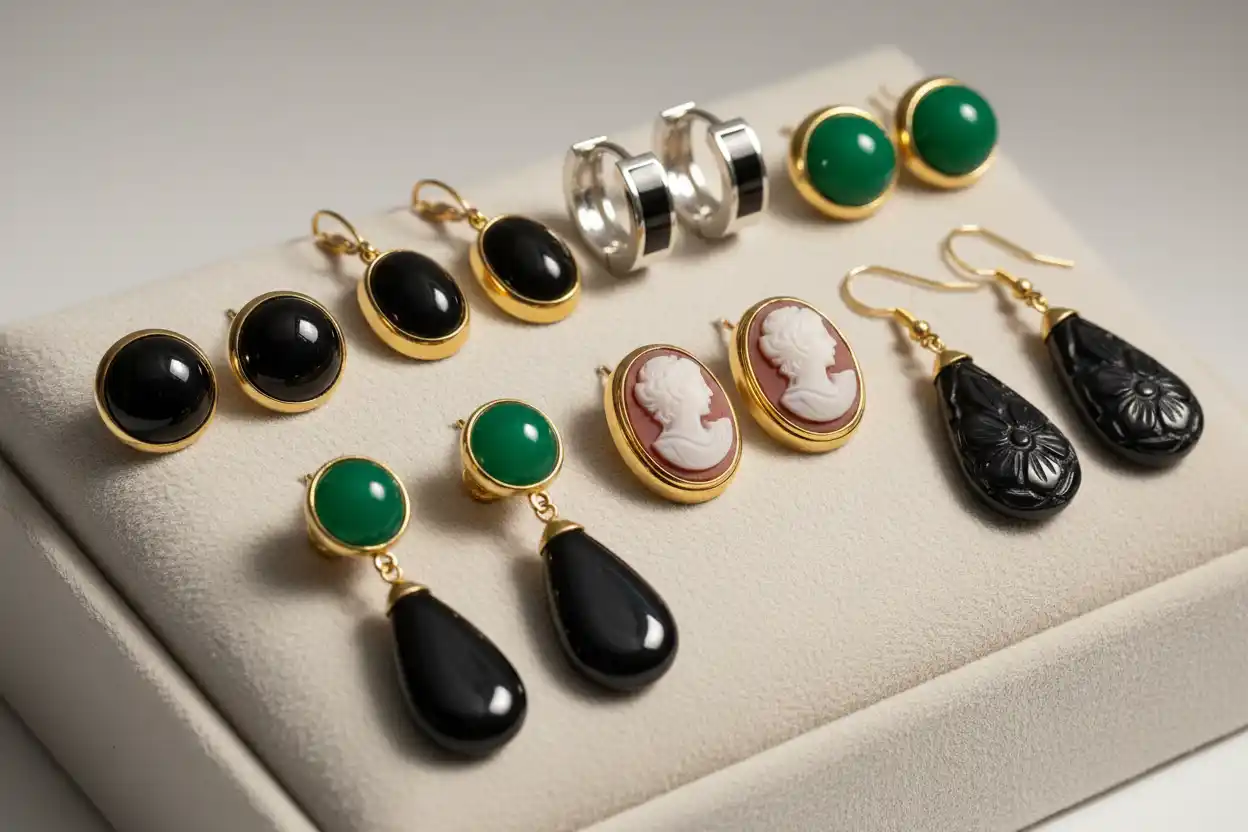
Onyx Earrings: Styles, Quality and Buying Guide
Onyx earrings use smooth black surfaces, parallel bands and carved contrasts to create designs that range from minimal studs to Art Deco drops, cameos and substantial geometric statements. Their neutral color can frame the face without competing with patterned clothing or other colored gemstones.
The material name deserves careful attention. Traditional Onyx is chalcedony with straight, parallel layers. Much of the uniform black material used in modern earrings is dyed black chalcedony rather than naturally solid-black banded Onyx.
This treatment is common and can produce durable, attractive jewelry. Accurate disclosure matters because a treated commercial cabochon should not be marketed as an extraordinarily rare untreated black gemstone.
The broader Onyx gemstone guide owns geology, history and symbolism. This page focuses specifically on earring styles, pair matching, settings, backs, comfort, buying and maintenance.
Onyx Earrings at a Glance
| Feature | What to evaluate |
|---|---|
| Material family | Chalcedony |
| Traditional appearance | Straight, parallel light and dark bands |
| Common modern appearance | Uniform opaque black, often dyed |
| Mohs hardness | Approximately 6.5–7 |
| Toughness | Generally good |
| Most practical style | Low bezel stud |
| Main pair-quality concern | Matching dimensions, polish, color and banding |
| Main comfort concern | Total weight and post placement |
| Main treatment concern | Dye, coatings and assembled carvings |
| Main setting concern | Glue, thin tablets and unsupported corners |
| Main metal concern | Post and back alloy |
| Safest routine cleaning | Brief washing with mild soap and lukewarm water |
Onyx as an Earring Material
Onyx belongs to the Chalcedony family.
Its microcrystalline Quartz structure accepts a smooth polish and provides enough durability for frequent earring wear.
Opaque material does not require an open setting for light return. This allows jewelers to use full bezels, closed backs and broad metal frames without sacrificing transparency.
Thin tablets, carvings and sharply pointed geometric pieces remain vulnerable to impact despite the material’s general toughness.
Earrings offer a safer position than rings or bracelets because they rarely contact desks and hard surfaces.
Traditional Onyx and Black Trade Onyx
Traditional Onyx contains straight, parallel bands. Black-and-white examples can be cut so that both layers contribute to the design.
Modern black Onyx jewelry commonly uses chalcedony dyed to an even opaque black.
The Types of Onyx guide owns the full terminology boundary.
Uniform color is useful for pair matching, particularly in calibrated studs and drops. Naturally banded pairs require more selective cutting because stripe width and direction must coordinate.
Treatment should be stated on the receipt rather than hidden behind descriptions such as genuine midnight gemstone.
Main Onyx Earring Styles
| Earring style | Main advantage | Main concern |
|---|---|---|
| Round stud | Minimal and versatile | Post position and back size |
| Bezel stud | Smooth and protective | Closed-back construction |
| Prong-set stud | Lighter appearance | Exposed corners |
| Halo stud | Strong contrast and larger outline | Hard accent stones |
| Button earring | Broad black surface | Weight and forward tilt |
| Short drop | Movement without excessive length | Connector security |
| Long dangle | Dramatic geometric form | Weight and snagging |
| Huggie | Compact daily style | Hinge and closure |
| Hoop charm | Flexible styling | Charm collision |
| Cameo earring | Uses natural contrasting layers | Carving condition |
| Intaglio earring | Historic engraved appearance | Thin recessed areas |
| Green Onyx earring | Alternative translucent color | Material-name ambiguity |
Onyx Stud Earrings
Studs offer the easiest everyday format.
Round, oval, square and cushion shapes can sit close to the earlobe, while opaque black color provides strong contrast without requiring a large gemstone.
The post should be attached near the setting’s center of gravity. A post placed too high can make the stud tilt downward.
Large button earrings need broad support backs. A small friction back may not distribute the weight across the lobe effectively.
The reverse should appear clean and structurally finished. Excessive visible adhesive suggests the stone may be glued rather than mechanically secured.
Bezel-Set Onyx Studs
A bezel surrounds the stone and creates a smooth edge.
Because Onyx is opaque, a closed metal backing does not reduce a visible optical effect. It can support thin cabochons and geometric tablets effectively.
The bezel should follow the stone evenly without gaps, ripples or sharp edges.
A completely closed setting may conceal a very thin slice, foil or adhesive. Construction should be disclosed when the value depends on the amount of gemstone material.
Bezel studs are practical for scarves, long hair and knitwear because they contain fewer projecting elements.
Prong-Set Onyx Earrings
Prong settings expose more of the outline and reduce visible metal.
The stone should rest in a supportive basket rather than balance only between the tips.
Square, rectangular and pointed Onyx requires protection at corners. A damaged corner may be concealed beneath a broad prong, so close inspection is useful.
Prongs should remain smooth and equally tightened. One loose prong can allow an opaque cabochon to rock even when movement is difficult to see.
A low basket is more comfortable than a deep setting that presses into the earlobe.
Halo Onyx Earrings
A halo surrounds black Onyx with Diamond, laboratory-grown Diamond, Moissanite, Sapphire or Cubic Zirconia.
The color contrast produces a formal Art Deco or evening appearance.
Every accent material should be identified. White stones differ in price, brilliance and hardness even when they appear similar in small sizes.
Hard accents must not touch the Onyx directly. Their girdles can scratch the chalcedony during movement or repair.
A halo adds many small prongs and increases total weight. The pair should be tested for comfort before extended wear.
Onyx Drop Earrings
Short drops allow larger stones while keeping the design relatively controlled.
Round, oval, pear, fan and rectangular Onyx elements can hang beneath a simple post or decorative metal section.
The connector should hold each drop face-forward. One earring should not rotate sideways while the other remains visible.
Articulated joints must move without letting stones collide.
Leverbacks, locking posts and hinged hoops provide greater loss protection than open hooks.
Long Dangles and Geometric Earrings
Onyx is well suited to long bars, arches, triangles and stepped Art Deco forms.
Opaque black surfaces create clear geometric silhouettes, particularly when paired with polished gold or white metal.
Long designs should be evaluated for weight per earring. A thin-looking piece may contain substantial stone and metal.
The lowest element should clear the shoulder during ordinary movement.
Sharp corners and thin bridges are more vulnerable than rounded cabochons. Remove long earrings before changing tight clothing or brushing long hair.
Huggies and Hoops
Huggies sit close to the lobe and may contain small Onyx inlays, bezel stations or hanging charms.
Their compact form makes them practical for regular wear.
The hinge should operate independently from the stone-set section. Closing the earring should not flex an inlay panel.
Hoop charms require enough clearance to move without striking the hoop continuously.
Interchangeable charms should have secure bails rather than open jump rings that can spread.
Onyx Cameo Earrings
Cameos use contrasting layers to create a raised image against a different-colored background.
Naturally banded Onyx and Sardonyx have long been used for this purpose. The cutter removes selected layers so the portrait or motif remains lighter than the field.
Sardonyx frequently provides reddish-brown, orange, white and dark contrasts.
A cameo pair should coordinate in carving style, dimensions, color and orientation. Exact hand-carved identity is not expected.
Inspect noses, fingers, hair details and other thin raised areas for chips or repair.
Intaglio and Engraved Onyx
An intaglio is carved below the surface rather than raised above it.
The recessed image may represent a portrait, monogram, seal or geometric symbol. Dark Onyx creates strong contrast when engraved lines are left matte or filled.
Thin tablets need complete support behind them. A broad metal frame reduces flexing.
Antique intaglios should not be repolished casually because polishing can soften carving details and remove historical surfaces.
The seller should distinguish an antique hand engraving from a modern molded or laser-produced design when that difference affects price.
Matching Black Onyx Pairs
Uniform black color makes matching easier than in many naturally patterned gemstones.
The pair should still coordinate in polish, dimensions, dome height, edge thickness and surface condition.
One stone should not show a gray patch, chip or cloudy polish beside a deep reflective partner.
Under strong transmitted light, dyed chalcedony may reveal lighter internal areas. This does not necessarily make the pair unsuitable when the treatment is disclosed.
A continuous video of both earrings together is more useful than separate optimized photographs.
Matching Banded Onyx and Sardonyx
Banded stones require more selective matching.
Stripe direction should appear deliberate. Horizontal bands in one stone and steep diagonal bands in the other can make the pair look unrelated.
The widths and contrast of the bands should coordinate even when the patterns are not identical.
For cameos, the background and raised layer colors should match closely enough to read as a pair.
Natural variation is part of the appeal. Perfectly repeated patterns can suggest printed, molded or assembled material.
Green Onyx Earrings
Green Onyx may refer to green chalcedony, dyed chalcedony or, in some markets, banded calcite.
These materials have different hardness and care requirements.
A translucent green cabochon should be identified before the buyer assumes it has black Onyx’s chalcedony durability.
Intense uniform green often reflects dye or treatment. Disclosure is more important than whether the color is attractive.
Pairs should match in transparency, saturation and internal zoning.
Onyx Hardness and Durability
Onyx generally ranks around 6.5–7 on the Gemstone Hardness Chart.
This provides reasonable scratch resistance for earrings. Diamond, Sapphire, Topaz and other harder materials can still abrade the surface.
Chalcedony has no cleavage and generally good toughness. Thin carved sections and sharp corners remain vulnerable.
A dropped earring can chip even when the main stone survives intact.
Store the pair separately so posts, backs and accent stones do not scratch the polished Onyx.
Onyx vs Obsidian Earrings
The direct Onyx vs Obsidian comparison owns the complete material distinction.
Onyx is microcrystalline chalcedony. Obsidian is natural volcanic glass.
Obsidian generally scratches and chips more readily. A fresh fracture can also create a very sharp edge.
Both can appear uniformly black, so appearance alone is insufficient for identification.
Onyx usually offers better durability for thin geometric earrings, while Obsidian may show glassier reflections.
Treatment and Coating
The treated Onyx guide covers dye, coating, impregnation and imitation material.
Deep black dye is common and may remain stable through ordinary wear. Surface coatings are more vulnerable to abrasion, heat and polishing.
A metallic or iridescent finish should be disclosed as a coating rather than described as a rare natural sheen.
Glue may be used in inlay, cameo and stud construction. Excess heat or prolonged soaking can weaken the adhesive.
Treatment should influence care and price without automatically making the earrings undesirable.
Authenticity
The Real vs Fake Onyx guide owns the complete identification workflow.
Glass and plastic are common imitations. Glass may contain bubbles or flow features, while plastic is generally lighter and softer.
Dyed chalcedony is not the same as glass imitation. It retains natural chalcedony structure despite treated color.
A black appearance and cool touch are not conclusive tests.
Professional examination may use microscopy, refractive index, density and spectroscopy.
Posts, Backs and Metal
The setting metal often creates more skin-contact risk than Onyx.
The guide to gemstones and metals for sensitive skin explains alloy, nickel, plating and solder concerns.
Friction backs suit light studs. Broad support backs help large button earrings remain upright.
Screw backs provide security but can be slow to insert. Locking backs combine stronger retention with easier operation.
Drops may use leverbacks, posts or hooks. Open hooks should include stoppers when loss would be significant.
Weight and Comfort
Request weight per earring for large studs, cameos and long drops.
A pair can match visually while differing in weight because one stone is thicker or one setting contains more metal.
Heavy earrings create leverage and may stretch the piercing temporarily during wear.
Broad backs distribute the load of large studs. Long dangles should remain light enough that movement does not pull painfully.
A dramatic pair that can be worn for only a few minutes may not be a successful gift for someone seeking regular use.
Styling Onyx Earrings
Black Onyx coordinates with nearly every metal color.
Yellow gold creates strong warm contrast. White gold, platinum and silver produce a cooler graphic appearance, while rose gold softens the black-and-metal boundary.
An Onyx bracelet or Onyx necklace can repeat the material without requiring identical size or shape.
An Onyx ring can supply a larger focal point while the earrings remain minimal.
Onyx appears in both the Black Gemstones guide and Black Crystals guide, although color-based grouping does not make all black materials physically equivalent.
Belief-based grounding and protection traditions belong to the Onyx healing-properties guide.
Buying Onyx Earrings Online
Follow How to Buy Gemstones Online Without Getting Scammed.
Request photographs of the front, side and reverse, plus continuous video of the pair together.
The listing should state stone dimensions, weight per earring, metal alloy, closure, treatment and whether the Onyx is banded, dyed black or another trade material.
For carved or antique pieces, ask whether repairs, replacement backs or modern recutting have occurred.
The guide to Where to Buy Real Onyx covers seller selection.
A laboratory report is rarely necessary for small commercial studs, but the Gemstone Certification guide explains when valuable carvings or disputed material may justify testing.
Cleaning and Storage
Follow How to Clean Onyx Jewelry Safely.
Use lukewarm water, mild soap and a soft cloth or brush. Keep washing brief when the earrings contain glue, coatings, foil or antique construction.
Avoid steam, ultrasonic cleaning, acids, bleach and abrasive powders.
Apply perfume, hairspray and cosmetics before inserting the earrings.
Store each piece separately so its post, back or harder halo stones do not scratch the other Onyx.
Inspect posts, bails and prongs whenever the earrings have been dropped.
Frequently Asked Questions
1. Is black Onyx in earrings naturally black?
It can be naturally dark, but uniformly black jewelry material is commonly dyed chalcedony.
2. Are dyed Onyx earrings genuine?
The stone can be natural chalcedony with treated color. Accurate disclosure is the important distinction.
3. What is the safest Onyx earring style?
A low bezel stud provides smooth edges, good support and reduced snagging.
4. Is Onyx too heavy for earrings?
Small studs are usually comfortable, but broad buttons, carvings and long drops can become heavy. Request weight per earring.
5. Can Onyx earrings be worn every day?
Yes, provided the posts and settings are sound and the pieces are protected from drops and harder jewelry.
6. What is the difference between Onyx and Sardonyx earrings?
Sardonyx contains reddish-brown or orange layers with white or dark bands, while traditional Onyx commonly uses black-and-white parallel layers.
7. Are Onyx cameos hand carved?
Some are hand carved, while others may be machine cut, molded or laser engraved. Construction should be stated.
8. Is green Onyx the same material as black Onyx?
Not always. The name may refer to green chalcedony, dyed material or banded calcite.
9. Can Onyx be set with Diamonds?
Yes, provided the harder Diamond girdles do not touch the Onyx directly.
10. How do I keep large studs from tilting?
Broad support backs and correctly centered posts distribute weight more effectively.
11. Can Onyx earrings go in an ultrasonic cleaner?
Gentle hand washing is safer, especially when dye, glue, coatings, carvings or antique construction are present.
12. How can I tell Onyx from black glass?
Bubbles, mold marks and different optical properties may provide clues, but professional testing gives the most reliable answer.
Onyx earrings succeed when the black surface is treated as a design material rather than a claim of mystery or rarity. Matching polish, secure posts and well-supported carvings matter more than whether the stone was described with an elaborate trade name. Dyed chalcedony can deliver excellent durability and contrast when the treatment and construction are stated honestly.