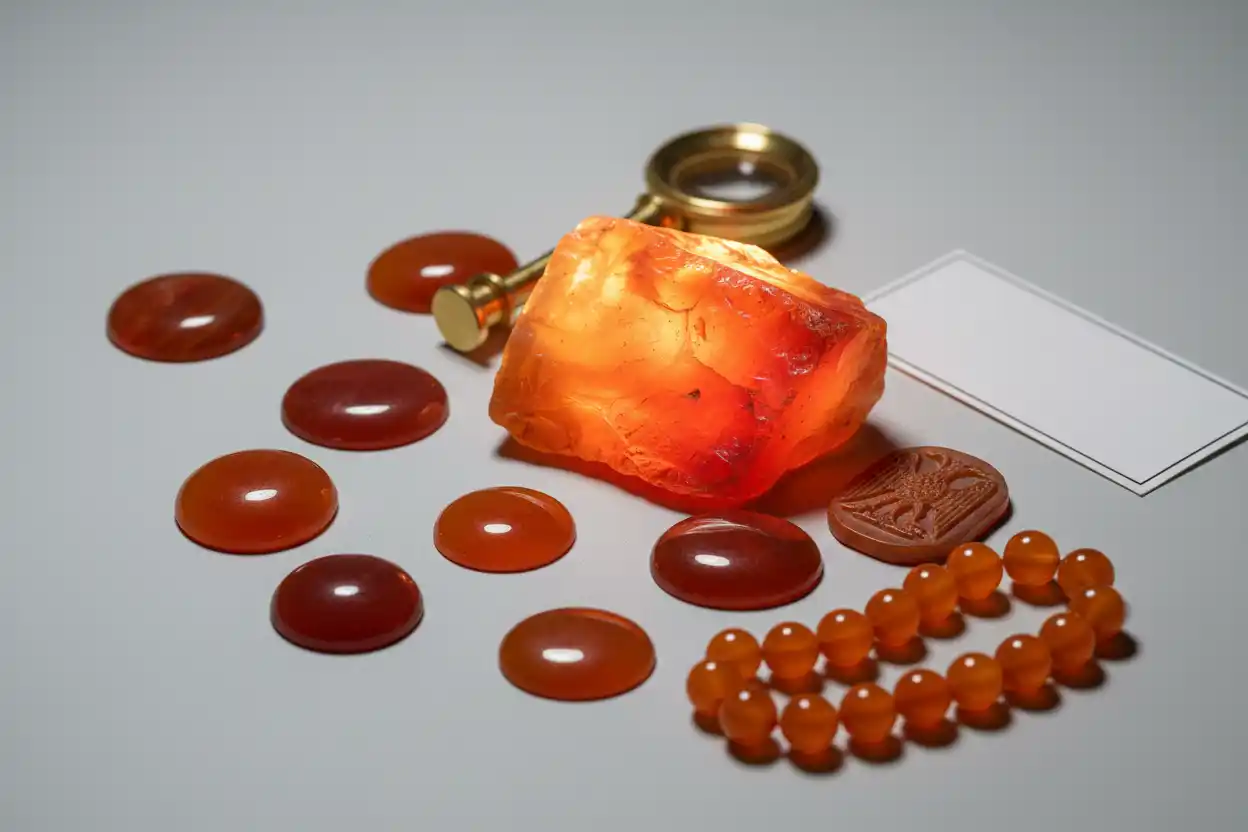
Where to Buy Real Carnelian and Avoid Dyed or Glass Fakes
Real carnelian is widely available, but the name is applied to several different products. A seller may offer naturally orange-red chalcedony, heat-enhanced pale chalcedony, dyed agate, red jasper, colored glass, resin or a composite made from stone powder and binder.
Heat treatment deserves particular attention because it has been used on carnelian and related chalcedony for thousands of years. Heating can deepen or brighten iron-related orange and red colors without turning the stone into an artificial material. However, the treatment should still be disclosed when known, especially if the seller charges a premium for untreated color.
The carnelian meaning and properties guide covers the stone’s identity and traditional symbolism. This page concentrates on sellers, natural versus treated color, imitation risks, product quality, documentation and practical buying decisions.
Understand What Carnelian Is
Carnelian is orange, red-orange, reddish-brown or warm brown chalcedony. Chalcedony is a microcrystalline silica material composed principally of extremely fine quartz with associated moganite.
The color usually relates to finely dispersed iron oxides or hydroxides. Pale yellow-orange material may become more strongly orange or red after heating as the iron-bearing components change.
Carnelian typically ranges from translucent to opaque. Thin edges and lighter cabochons may glow strongly under transmitted light, while dark sard-like material can appear almost opaque.
The chalcedony family guide explains the parent material, while the types of chalcedony overview separates carnelian from agate, bloodstone, chrysoprase, onyx and other varieties.
Carnelian, Agate and Sard Are Not Perfectly Separate Markets
Carnelian belongs to the chalcedony family and may show faint bands, cloudy zones or color concentrations. Some sellers call any orange-red banded chalcedony carnelian agate, while others reserve carnelian for material with relatively even color.
The agate guide owns family-level banding and formation. When a stone has obvious decorative bands, evaluate it as both carnelian-colored chalcedony and an agate product.
Sard is a traditional name for darker brownish-red chalcedony. The boundary between sard and carnelian is not rigid, so a seller should not claim that sard is a chemically separate rare species.
Buy according to the actual color, transparency, pattern and treatment rather than paying extra for whichever historical name sounds more exclusive.
Choose the Product Form Before Choosing the Seller
| Carnelian product | Best source | Main buying concern |
|---|---|---|
| Natural rough | Lapidary supplier or mineral dealer | Color depth, fractures, treatment and misleading wet photographs |
| Slab | Lapidary supplier | Dye penetration, cutting yield and surface-only red color |
| Cabochon | Colored-stone dealer or independent lapidary | Heat, dye, backing, polish and translucency |
| Beads | Established bead supplier | Dyed agate, glass, resin and fractures around drill holes |
| Carving or seal | Skilled carver or specialist dealer | Artificial staining, repairs and unsupported age claims |
| Tumbled stone | Reputable crystal retailer | Generic orange agate, glass or red jasper substitution |
| Ring or pendant | Jeweler with treatment disclosure | Glue, backing, thin edges and metal quality |
| Antique intaglio | Antique-gem specialist | Restoration, recutting, provenance and legal ownership |
Rough buyers need evidence that color continues through the interior. Jewelry buyers should focus on construction and whether the delivered stone matches the listing.
Where to Buy Genuine Carnelian
Specialist lapidary suppliers
Lapidary dealers are often the strongest source for rough and slabs. A competent supplier should show dry surfaces, sawn faces and edge views.
Wet photographs can help predict polish, but they deepen color and hide fine scratches. Ask for a dry photograph from the same angle before deciding whether a pale-looking rind contains valuable red material.
Determine whether sample cabochons have been cut from the parcel. Their color, translucency and polish reveal more than a selectively photographed rough surface.
Colored-stone dealers
A gemstone dealer is appropriate for calibrated cabochons, matched pairs and higher-quality translucent stones. Listings should state dimensions, weight, treatment and country of origin when known.
For a meaningful purchase, ask whether the seller describes the color as natural, heat enhanced, dyed or uncertain. An honest “heat status undetermined” is more credible than an unsupported guarantee that every orange stone is completely untreated.
Gem and mineral shows
Shows let you compare natural chalcedony, dyed agate, red jasper and glass under the same lighting.
Place the stone over white paper, then examine it with a focused light. Natural carnelian often shows diffused translucency and internal clouds rather than the perfectly uniform transparency of colored glass.
Use a loupe to inspect fractures, drill holes, color concentrations and resin-filled pits. Do not scratch the stone or apply solvents to test dye.
Established online stores
An online seller should show the exact cabochon, carving or strand whenever pattern and color materially affect the purchase.
The online gemstone buying guide explains payment protection, seller verification and return policies.
For carnelian, request photographs in daylight and neutral indoor light. Strong orange backgrounds and aggressive saturation editing can make pale agate appear dramatically red.
Independent jewelry makers
A maker who selects and cuts the stone can often explain its origin and treatment more accurately than a high-volume reseller.
Ask whether the stone was purchased as untreated rough, heated carnelian, dyed agate or simply orange chalcedony. For custom jewelry, request photographs of the loose stone before it enters a closed-back setting.
What Genuine Carnelian Looks Like
Natural carnelian can be pale orange, apricot, reddish orange, rust red, brownish red or deep warm brown. Color may be even, cloudy, zoned or faintly banded.
Translucent areas usually glow when placed over a small light. However, a strong light can make nearly any thin orange material look impressive, so also judge the stone under ordinary room conditions.
Under magnification, natural chalcedony may show fine clouds, iron-rich patches, small fractures and microcrystalline texture. It should not contain obvious mold seams or a repeated manufactured pattern.
Color can vary between the outer rind and the interior. In some agate nodules, iron-bearing zones become redder after heating, while central areas remain pale.
A dark stone is not automatically higher quality. Fine carnelian balances attractive color, useful translucency, structural integrity and good cutting.
Natural Color Versus Heat-Treated Carnelian
Heating carnelian is historically established and commercially widespread. It can deepen orange-red color by altering or oxidizing iron-bearing components already present in the chalcedony.
Heat-treated material remains natural chalcedony. Nevertheless, the treatment changes the color presentation and should be stated when the seller knows it occurred.
Home inspection may not reliably separate natural and heat-enhanced carnelian. Unlike dye, heating may introduce no foreign substance, and its effects can resemble natural iron oxidation.
A laboratory may identify evidence in some cases, although determining color origin can remain difficult. Therefore, provenance and seller disclosure often matter more than a generic authenticity card.
The gemstone treatments guide explains why natural origin and untreated color are separate claims.
Dyed Carnelian and Dyed Agate
Pale chalcedony and agate can absorb dyes, especially along fractures, pores and more permeable bands. Red, orange and brown colors may be introduced or intensified.
Inspect drill holes, chipped edges and open cracks. Dye often appears darker in those areas because the coloring substance entered through exposed pathways.
A perfectly uniform bright-red strand may also deserve scrutiny, particularly when every bead has identical color despite differing internal structures.
Well-executed dye can be difficult to detect visually. The guide to spotting dyed crystals covers color concentrations, surface residues and other nondestructive observations.
Dyed chalcedony can still be durable and attractive. The issue is whether the seller labels it honestly and prices it as treated material.
Carnelian Versus Red Jasper
Carnelian and red jasper are both silica-rich chalcedony-family materials colored by iron.
Carnelian is generally more translucent and tends toward orange-red or warm reddish-brown. Red jasper is usually opaque and can have a denser, earthier red body with visible inclusions or rock-like texture.
The carnelian versus red jasper comparison owns the detailed distinction. The red jasper guide provides context for the opaque alternative.
Some stones sit between traditional definitions. A seller should not force every translucent red piece into carnelian or every opaque example into jasper without acknowledging the continuum.
Carnelian Versus Colored Glass
Orange and red glass can imitate polished carnelian convincingly. Glass may show round bubbles, flow lines, mold seams, identical shapes or an unusually uniform body.
However, some glass lacks obvious bubbles, while natural chalcedony can be quite even. A single visual clue is not enough.
Glass often has a sharper, more transparent appearance than cloudy microcrystalline chalcedony. Abraded molded edges can also look different from a well-polished stone cabochon.
The fake-crystal buyer’s guide explains how to assess glass, resin and composites without relying on destructive testing.
Resin and Reconstituted Products
Resin can be colored orange-red or mixed with crushed stone powder. Mold seams, trapped bubbles, soft scratches and repeated patterns may reveal manufacture.
Reconstituted products may contain real chalcedony particles but do not have the same structure as a solid natural stone. Their binder can react differently to heat, solvents and long-term wear.
Ask whether a carving or bead is solid stone, stabilized stone or stone powder with resin. “Made with natural carnelian” does not necessarily mean solid carnelian.
How to Judge Rough and Slabs
Begin with dry color. If a rough piece is photographed only while wet or oiled, request a dry comparison.
A sawn face should reveal whether orange-red color continues into the stone. Surface iron staining can look attractive but may disappear during cutting.
Inspect fractures carefully. Chalcedony is relatively tough, yet a large crack can divide the best-colored section and reduce usable yield.
For slabs, compare both faces and the edges. Dye concentration along cracks or porous bands may become more obvious from the side.
Ask about treatment before cutting. Heat-treated rough may be entirely suitable, while dyed material can release or fade during some lapidary processes.
How to Judge Cabochons
A quality cabochon should have attractive color in normal light, an even dome and a clean girdle.
Translucency should complement the color. A stone that is too thin may look washed out, while an excessively thick cabochon can become nearly black at the center.
Inspect the back for dye, resin, foil or another backing material. Closed-back jewelry can hide these features.
The polish should be smooth without flat areas, pits or heavy coating. Carnelian takes a strong polish, so poor finish usually reflects cutting quality rather than unavoidable softness.
Buying Beads and Bracelets
A natural bead strand may vary slightly in color and translucency. Every bead should still fall within the seller’s stated range.
Inspect drill holes for dark dye rings, chips and radial fractures. Rough holes can cut stringing material, while fractures can spread when an elastic bracelet remains under constant tension.
The carnelian bracelet guide covers sizing, bead construction and wear. When buying a strand for restringing, confirm hole diameter and whether the beads have been waxed or coated.
Buying Pendants and Necklaces
Carnelian works well in pendants because larger translucent cabochons can be viewed against light without facing frequent impacts.
The carnelian necklace guide covers pendant proportions and setting choices.
Ask whether a large stone is solid or backed. Foil and colored backing have a long history in jewelry and can intensify appearance, but the construction must be disclosed.
Buying Earrings
Matched carnelian earrings should have similar tone, translucency and dimensions. They do not need identical internal clouds or bands.
The carnelian earrings guide discusses matching and style. Request photographs of both stones under the same light rather than separate images captured at their strongest angles.
Buying Rings and Engraved Seals
Chalcedony’s hardness and toughness make carnelian more wearable than soft carbonate gems. Even so, thin carved details and exposed cabochon edges can chip.
The carnelian ring guide covers setting styles and traditional signet use.
A bezel or recessed signet protects the stone better than tall prongs. When buying an engraved seal, inspect the design for fresh recutting, filled chips and surface coatings.
Claims that a piece is Roman, Egyptian, Persian or medieval require specialist provenance. Style alone cannot establish age.
Locality and Provenance
India, especially Gujarat, has a long history of carnelian and agate mining, heating, cutting and bead production. Brazil and Madagascar are also documented sources of carnelian material, while occurrences exist in several other countries.
Country of cutting is not necessarily country of origin. Rough may be mined in one region, treated in another and drilled or polished elsewhere.
A precise locality claim should come from supplier records, labels or direct sourcing. Color and banding cannot prove geography.
Price and Value
Carnelian is generally affordable. Price rises with attractive natural-looking color, translucency, usable size, clean polish, engraving skill, matched sets and credible provenance.
Heat treatment is common enough that it should not automatically make a stone undesirable. However, an untreated premium requires stronger evidence than a seller’s assertion.
Dyed beads and mass-produced tumbles should not receive rare natural-color pricing. Antique carvings occupy a different market because age, artist, provenance and condition can outweigh raw stone value.
The gemstone pricing guide explains how material, treatment, workmanship and documentation interact.
Questions to Ask the Seller
Ask whether the item is natural chalcedony and whether the color is natural, heat enhanced, dyed or unknown.
Determine whether the seller uses carnelian, sard and carnelian agate as strict identities or broad trade terms. Request the country of origin and the basis for that claim.
For rough, ask for dry sawn-face photographs. For cabochons, request front, back and edge views. For beads, request close-ups of several drill holes.
Confirm whether the item has been waxed, oiled, resin-filled, coated, backed or repaired. Finally, obtain the return period in writing.
Professional Testing
A gemologist can identify chalcedony through refractive index, specific gravity, microscopy and Raman spectroscopy.
Magnification may reveal dye concentrations, glass bubbles, resin-filled fractures and composite construction. Infrared or visible spectroscopy can provide additional evidence for some treatments.
Determining whether orange-red color developed naturally or through heating can remain difficult. Therefore, laboratory testing may confirm the material while leaving heat status inconclusive.
Ethical Sourcing and Care
The ethical gemstone sourcing guide provides practical questions about mining, lapidary labor and supply-chain transparency.
Sound untreated carnelian can usually be cleaned with lukewarm water, mild soap and a soft cloth. The completed guide to cleaning carnelian jewelry covers settings, strings and treated stones in greater detail.
The gemstone hardness chart places chalcedony near Mohs 6.5 to 7, while gemstone toughness versus hardness explains why fractures and thin edges still matter.
Avoid prolonged heat or strong chemicals when dye, resin, wax or adhesive may be present. Store polished pieces away from harder gems that could scratch them.
Frequently Asked Questions
1. Is carnelian a natural stone?
Yes. Carnelian is naturally occurring orange-red chalcedony. However, heat-treated and dyed chalcedony are also sold under the name.
2. Is heated carnelian fake?
No. Heated carnelian is natural chalcedony whose color has been enhanced by heat. The treatment should be disclosed when known.
3. Can laboratories always detect heated carnelian?
No. Heat may intensify iron-related color without introducing an easily detectable foreign substance, so color origin can remain inconclusive.
4. How can I recognize dyed carnelian?
Look for concentrated color in fractures, pits and drill holes. Nevertheless, sophisticated dye may require laboratory examination.
5. Is carnelian the same as red agate?
Carnelian can be banded and may be sold as carnelian agate. Strongly banded material sits within both carnelian-colored chalcedony and agate trade categories.
6. Is carnelian the same as sard?
They are closely related traditional chalcedony names. Sard usually refers to darker, browner material, but the boundary is not rigid.
7. How is carnelian different from red jasper?
Carnelian is commonly more translucent and orange-red, while red jasper is usually opaque and earthier in appearance.
8. Does every real carnelian glow under light?
No. Thin or translucent stones may glow strongly, while dark or opaque material transmits little light.
9. Is perfectly uniform color a sign of glass?
Not by itself. Natural chalcedony can be even, although bubbles, mold seams and unusually uniform transparency provide stronger glass clues.
10. Is Indian carnelian always treated?
No. India produces and processes natural carnelian, but heat treatment also has a long history there. Ask about the individual product rather than assuming.
11. Do ordinary carnelian beads need a certificate?
Usually not. Treatment disclosure, clear photographs and return rights are more practical for inexpensive strands.
12. What is the biggest warning sign in a carnelian listing?
Be cautious when vivid red “untreated ancient carnelian” is offered without backlighting images, treatment disclosure, provenance or a return policy.
Buy Color That Makes Sense in Every Light
Fine carnelian does not need perfect transparency or extreme saturation. Its appeal comes from warm color, diffused translucency, sound structure and competent cutting.
The C crystal directory, C gemstone directory and visual gemstone guide provide broader comparisons. Choose the stone whose treatment, construction and provenance remain credible after the dramatic lighting is removed.