Where to Buy Real Rainbow Obsidian and Avoid Coated Glass
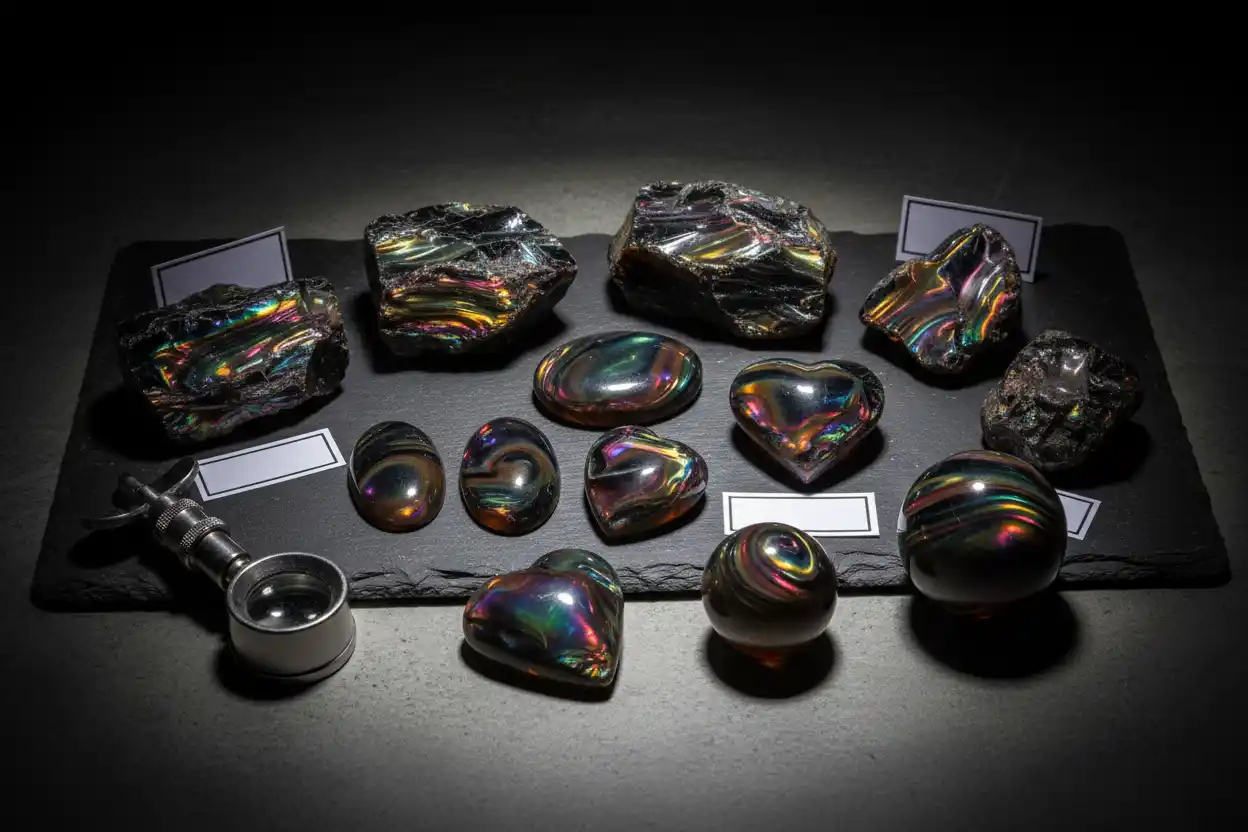
Real Rainbow Obsidian is natural volcanic glass containing thin internal flow layers that display green, purple, gold, blue, red or multicolored iridescence when cut and viewed from favorable directions.
Most rough looks black, smoky or dark brown until a polished window exposes the correct orientation. Consequently, skilled cutting contributes as much to the visible effect as raw size.
Rainbow Obsidian is commonly associated with Mexican volcanic deposits. However, the market also includes iridescent manufactured glass, dichroic glass, coated Black Obsidian, foil-backed cabochons, resin composites and ordinary Obsidian whose weak sheen has been exaggerated through lighting or image editing.
The Rainbow Obsidian meaning and properties guide covers its formation and traditional symbolism. This buying guide focuses on optical layers, sellers, natural-versus-applied color, source claims, cutting orientation and value.
Rainbow Obsidian Is Natural Volcanic Glass
Obsidian forms when silica-rich lava cools rapidly enough to prevent extensive crystal growth.
It is amorphous volcanic glass rather than a crystalline mineral species. The Obsidian meaning and properties guide provides the parent-material context, while the types of Obsidian guide separates black, mahogany, snowflake, golden-sheen, silver-sheen and rainbow varieties.
The dark glass can contain microscopic bubbles, mineral particles and flow structures. In Rainbow Obsidian, internal layers interact with light to create iridescent colors.
The effect is directional. It may remain invisible from one angle and become vivid after the stone turns only a few degrees.
Natural Iridescence Comes from Internal Layers
The colored effect does not normally come from pigment spread uniformly through the glass.
Instead, microscopic or nanoscale layers within the flowing volcanic glass create interference colors. Different layers may display different hues according to their thickness and orientation.
A polished cross-section can reveal several nested or parallel colors. Skilled lapidaries often orient cabochons, hearts or spheres so that these layers form rings, eyes, hearts or broad luminous bands.
The pattern should have depth. It should not peel, scratch off or remain fixed to the outer surface.
A spectacular design can be natural even when it looks unusually symmetrical because the cutter may center curved flow layers deliberately.
Choose the Product Form Before Shopping
| Rainbow Obsidian product | Best source | Main buying concern |
|---|---|---|
| Natural rough | Mexican Obsidian or lapidary specialist | Source, test windows and cutting orientation |
| Slab | Experienced optical-Obsidian cutter | Layer depth, fractures and surface coating |
| Cabochon | Specialist lapidary dealer | Centered colors, viewing angle and backing |
| Heart or eye carving | Skilled Obsidian cutter | Natural layered pattern versus foil or paint |
| Sphere | Experienced carving retailer | Total color coverage, seams and resin |
| Freeform | Specialist dealer | Optical orientation and damaged edges |
| Tower | Seller with exact-item video | Carved point, coating and weak reverse color |
| Bead strand | Established supplier | Coated glass, resin and drill-hole cracking |
| Pendant or earrings | Jeweler familiar with Obsidian | Backing, glue and edge protection |
| Ring stone | Specialist setting | Brittle edges and restricted viewing direction |
| Source specimen | Geological dealer | Mexican provenance and natural exterior |
Rainbow Obsidian should almost never be purchased from one still photograph. Movement reveals both optical quality and possible surface treatment.
Where to Buy Genuine Rainbow Obsidian
Specialist Mexican Obsidian dealers
A dealer connected to documented Mexican rough provides the strongest source evidence.
Ask for the state, volcanic area, supplier or collection history. Retain labels and invoices if geographic provenance affects price.
The seller should distinguish natural Rainbow Obsidian from Golden Sheen, Silver Sheen and generic iridescent glass.
Request photographs of the unpolished exterior and a polished test window.
Experienced lapidary cutters
Cutting orientation determines whether internal layers become visible.
A skilled cutter may show the rough, slab and final cabochon together. That sequence provides strong evidence that the color existed inside the natural glass.
Ask which lighting reveals the effect and how broad the usable viewing range is.
The cutter should disclose whether oil, resin, foil or backing contributes to the appearance.
Gem and mineral shows
Shows let you compare Rainbow Obsidian with Rainbow Moonstone, Labradorite, dichroic glass, coated Black Obsidian and rainbow Hematite.
Rotate the stone beneath one stationary white light. Natural colors should appear within the dark glass and move across internal layers.
Use a loupe to inspect scratches, coatings, seams, bubbles and sharp edge chips.
Do not scratch, strike or chip the object. Fresh Obsidian edges can become dangerously sharp.
Established online sellers
The online gemstone buying guide explains seller identity, protected payment methods and return rights.
Request a continuous rotation under one diffuse white light. The video should show the stone from black, nonreflective angles through its strongest color.
Ask whether multiple lights were used. Several moving lamps can exaggerate optical coverage.
Request neutral image processing. Increasing saturation can turn weak gray-green sheen into vivid purple, red and blue.
Jewelry specialists
A jeweler should show the loose stone before mounting.
Black backing may be visually neutral against Obsidian, but foil, reflective paint or colored adhesive can imitate stronger layers.
Inspect the girdle for a doublet seam. Ask whether the stone is one solid natural piece.
What Genuine Rainbow Obsidian Looks Like
The base usually appears black, charcoal, dark gray or smoky brown.
Internal colors may include:
- Green
- Purple
- Violet
- Blue
- Gold
- Bronze
- Red
- Pink
- Orange
- Several hues in layered sequence
Some pieces display broad luminous arcs. Others show narrow rings, eye patterns or multiple concentric hearts.
Color may appear from only one side because the internal layers have a preferred orientation.
The surface itself should remain black when the iridescence disappears. A persistent colorful skin can indicate coating or dichroic glass.
Thin edges may transmit smoky brown or gray light, consistent with natural Obsidian.
Rainbow Obsidian Versus Black Obsidian
Black Obsidian lacks the pronounced internal multicolored layers expected in Rainbow Obsidian.
The completed guide to buying real Black Obsidian owns general volcanic-glass, slag, resin and Onyx comparisons.
A plain black area does not make a Rainbow Obsidian piece fake. Most stones become dark when moved away from the correct optical angle.
However, weak material that shows only a faint gray reflection should not receive the highest rainbow-quality premium.
Rainbow Obsidian Versus Golden Obsidian
Golden Obsidian shows warm gold or bronze sheen, commonly from oriented internal features within the volcanic glass.
It may have one dominant golden effect rather than several interference colors.
One stone can show gold alongside purple, green or red layers. In that case, Rainbow Obsidian may be the more informative name.
Sellers should avoid stacking several variety names solely to increase perceived rarity.
Rainbow Obsidian Versus Silver Sheen Obsidian
Silver Sheen Obsidian shows cool silver, gray or white reflections.
Its sheen can appear broad and smoky rather than spectrally colored.
Rainbow Obsidian may contain silver areas, but green, purple, gold or other colors should contribute visibly to the design.
Rainbow Obsidian Versus Mahogany Obsidian
Mahogany Obsidian contains red-brown iron-rich areas within dark volcanic glass.
Its pattern remains visible as body color rather than appearing only through interference at one angle.
The completed guide to buying genuine Mahogany Obsidian owns red-brown glass, paint and Jasper comparisons.
A specimen can contain both mahogany coloration and subtle iridescence, but each feature should be described separately.
Rainbow Obsidian Versus Snowflake Obsidian
Snowflake Obsidian contains white or gray radiating cristobalite-rich structures.
The future guide to buying real Snowflake Obsidian will own painted snowflakes, glass imitations and spherulite quality.
Rainbow Obsidian is valued for internal colored layers rather than pale crystallized spots.
Rainbow Obsidian Versus Fire Obsidian
Fire Obsidian is a rare Oregon material whose extremely thin internal layers can display vivid spectral colors.
Its colors may appear especially brilliant, finely layered and metallic under suitable cutting and lighting.
Rainbow Obsidian is commonly associated with Mexican material and can show broader colored flow bands.
The two markets overlap visually, but a Fire Obsidian premium requires Oregon provenance and expert cutting rather than a generic rainbow appearance.
Rainbow Obsidian Versus Rainbow Moonstone
Rainbow Moonstone is transparent Labradorite feldspar. Rainbow Obsidian is amorphous volcanic glass.
Moonstone-related material usually has a white or colorless body with blue or multicolored labradorescence. Rainbow Obsidian has a dark body and internal iridescent flow layers.
The completed guide to buying real Rainbow Moonstone owns Labradorite identity, feldspar cleavage and Opalite imitation.
The optical effects can look similar in photographs, but body color, structure and gemological properties differ substantially.
Rainbow Obsidian Versus Labradorite
Labradorite is crystalline feldspar with labradorescence produced by microscopic intergrowths.
Rainbow Obsidian is volcanic glass whose iridescence relates to thin internal flow layers and nanoscale features.
The Labradorite buying guide covers broad feldspar flash, body color and treatment.
Labradorite commonly shows larger blue or rainbow plates within a gray body, while Obsidian’s colors appear through a black glassy background.
Rainbow Obsidian Versus Dichroic Glass
Dichroic glass contains engineered thin-film coatings that reflect strong metallic rainbow colors.
Its color can be extremely bright, uniform and mirror-like. Layers may sit close to the surface or between fused glass components.
Mold seams, smooth factory shapes, round bubbles and a fixed metallic film support manufacture.
Natural Rainbow Obsidian usually appears black from many angles, with colors emerging from internal flow structures.
Dichroic glass is a legitimate artistic material when labeled correctly.
Coated Black Obsidian
Genuine Black Obsidian can receive metallic, iridescent or aura-style coating.
The substrate remains natural volcanic glass, but the rainbow color is artificial.
Inspect scratches, high points, drill holes and the back. A coating can peel, fade or end abruptly.
Natural Rainbow Obsidian retains its internal effect beneath the polish and does not lose color after a shallow surface scratch.
The gemstone treatments guide explains coatings and surface films.
Foil-Backed Cabochons
A dark glass cabochon can be placed over colored foil or reflective film.
The color may look flat, highly metallic and restricted to one depth.
Inspect the girdle for a straight seam and adhesive bubbles. Closed-back settings can hide the backing entirely.
A foil-backed object can remain decorative, but it should not be sold as solid natural Rainbow Obsidian.
Manufactured Glass and Slag
Black manufactured glass can contain colored layers, metallic particles and swirls.
Industrial slag may also show iridescent surfaces and numerous bubbles.
Natural Obsidian can contain bubbles, so their presence alone is not proof of manufacture.
Instead, look for mold seams, factory repetition, unsupported source claims, chemical residues and color structures inconsistent with volcanic flow.
The glass-versus-crystal guide provides wider comparison methods.
Resin and Composite Products
Black resin can be mixed with iridescent film, pigment or mica flakes.
Casting seams, soft scratches, numerous bubbles and repeated patterns support polymer manufacture.
Crushed Obsidian can also be combined with binder. Such a product may contain natural fragments without being one continuous volcanic-glass piece.
Resin can additionally fill fractures in genuine natural material. Limited repair and complete reconstruction should be disclosed differently.
Glued Slabs and Assembled Objects
Two dark glass layers can be joined around a thin iridescent section.
Broken carvings may also be repaired with black or clear adhesive.
Inspect the full circumference for straight seams, bubbles and an abrupt change in pattern.
A repaired natural cabochon remains natural Obsidian, but extensive assembly affects value and care.
How to Evaluate Rough
Rainbow Obsidian rough often looks almost entirely black.
Request polished test windows from several orientations. One window may show strong color while another remains plain.
Inspect fractures and weathered areas. Obsidian can split unpredictably along curved paths.
Ask whether the seller has cut finished cabochons from the parcel and what percentage of the rough displayed useful iridescence.
Do not pay for weight alone. Optical yield determines value.
How to Evaluate Slabs
View each slab under diffuse reflected light rather than direct glare.
Tilt it slowly to locate all color layers. Determine whether they continue far enough for the intended cabochon or carving.
Compare both faces. A layer can appear strongly from one side and poorly from the reverse.
Inspect edges for glue, resin and coating.
How to Judge Cabochons and Hearts
The strongest cut centers the optical layers within the shape.
Concentric flow layers can form eyes or hearts when cut at carefully selected angles. Such symmetry can be natural and lapidary-created rather than printed.
The colors should activate sequentially as the stone moves. A flat permanently colorful surface suggests coating or engineered glass.
Inspect the girdle for edge chips, backing and assembly.
Buying Spheres
Request a complete rotation under one stationary white light.
Some spheres contain one concentrated rainbow window and large areas of plain Black Obsidian. Price should reflect the entire object.
A sphere should not show a straight equatorial seam.
Check beneath the stand for filler, cavities and unfinished sections.
Buying Towers and Carvings
Most Rainbow Obsidian towers are carved. Their points did not grow naturally.
A cutter may orient bands attractively along the faces, but sharp points and thin projections remain vulnerable.
Request close-ups of the tip for repairs and coating.
Deep recesses can conceal resin or polishing compound.
Buying Beads and Jewelry
Natural bead strands should show differences in flash direction, pattern and intensity.
Perfectly identical rainbow stripes across every bead suggest coating or manufactured glass.
Inspect drill holes for edge chips, filler and surface film.
Obsidian has moderate hardness but brittle glassy fracture. The gemstone hardness chart and toughness-versus-hardness guide explain why thin edges remain vulnerable.
Pendants and earrings are generally safer than exposed rings.
Mexican Provenance
Much commercial Rainbow Obsidian is associated with Mexico.
However, a black stone with purple-green sheen cannot prove one volcanic flow or state through appearance alone.
Ask for supplier information, original rough photographs and a documented Mexican supply chain.
A source premium should be supported by records rather than a generic label.
The ethical crystal sourcing guide provides practical questions about legal extraction, land access and lapidary labor.
Price and Value
Rainbow Obsidian value depends heavily on cutting orientation and optical display.
Important factors include:
- Number of colors
- Color brightness
- Pattern symmetry
- Viewing-angle range
- Layer depth
- Total surface coverage
- Polish
- Edge condition
- Solid construction
- Treatment disclosure
- Size
- Provenance
- Cutter skill
A small cabochon with a complete vivid multicolor heart can be more valuable than a large sphere with faint sheen on one side.
The gemstone pricing guide explains how skill, yield and documentation influence retail prices.
Questions to Ask the Seller
Ask whether the item is solid natural Rainbow Obsidian, coated Black Obsidian, dichroic glass, slag, resin or an assembled cabochon.
Request the locality and the evidence supporting Mexican origin.
Ask for photographs of the rough, slab or preform when available.
Confirm coating, foil, resin, backing, glue, filling and repair.
Obtain a continuous video under one white light and request front, back and girdle views.
Finally, confirm a return policy that permits magnified inspection.
Professional Identification
Microscopy can reveal internal flow structures, coatings, foil, resin, seams and manufactured-glass features.
Refractive index and specific gravity can support natural Obsidian identification, although some manufactured glasses overlap.
Chemical analysis can distinguish natural volcanic sources from many factory glasses.
Confirming natural Obsidian does not automatically establish Rainbow quality or Mexican provenance. Optical layers and source records must be evaluated separately.
Cleaning and Storage
Clean Rainbow Obsidian with lukewarm water, mild soap and a soft cloth.
Avoid abrasive cleaners that can dull the polish. Do not use ultrasonic or steam cleaning on fractured, filled or assembled objects.
Store the stone away from Quartz, Topaz and other harder gems.
Handle broken or rough material cautiously because fresh edges can be extremely sharp.
Frequently Asked Questions
1. Is Rainbow Obsidian naturally occurring?
Yes. Genuine Rainbow Obsidian is natural volcanic glass with internal iridescent layers.
2. What creates its rainbow colors?
Very thin internal flow layers and nanoscale structures produce interference colors when light reflects from them.
3. Why does the stone look black from some angles?
The iridescence is highly directional. Away from the correct angle, the dark volcanic-glass body dominates.
4. Is all Rainbow Obsidian from Mexico?
Mexico is the best-known commercial source, but geographic origin requires records rather than appearance alone.
5. Is Rainbow Obsidian the same as Fire Obsidian?
No. Fire Obsidian is a rare Oregon material with especially fine, vivid iridescent layers and a separate source market.
6. Is Rainbow Obsidian the same as Rainbow Moonstone?
No. Rainbow Moonstone is Labradorite feldspar, while Rainbow Obsidian is volcanic glass.
7. Can Black Obsidian be coated to look rainbow-colored?
Yes. Metallic or iridescent films can imitate the effect and should be disclosed.
8. Can dichroic glass imitate Rainbow Obsidian?
Yes. Engineered glass coatings can produce intense rainbow reflections.
9. Can Rainbow Obsidian contain resin?
Yes. Fractures may be filled, and fragments can be reconstructed with polymer.
10. Are heart and eye patterns natural?
The layers are natural, while a skilled cutter creates the centered heart or eye by choosing the correct orientation.
11. Is Rainbow Obsidian suitable for daily rings?
It can scratch and chip around exposed edges. Protected occasional-wear designs are more realistic.
12. What is the biggest warning sign in a listing?
Be cautious when a permanently metallic rainbow surface never turns black and the seller provides no edge view, moving-light video or natural rough evidence.
Buy Color That Emerges from Inside the Glass
Authentic Rainbow Obsidian reveals its color only when light reaches correctly oriented internal layers. Its appearance should change naturally from dark glass to vivid iridescence as the stone moves.
The rainbow crystals guide, rainbow gemstones guide, R crystal directory and R gemstone directory provide wider comparisons. Choose a piece whose internal layers, cutting history and source remain credible together.
Safety note: Freshly broken Obsidian can form extremely sharp edges. Wear cut-resistant gloves and eye protection when handling rough. Cutting and grinding require wet lapidary methods, secure guarding and effective control of glass fragments and mineral dust.