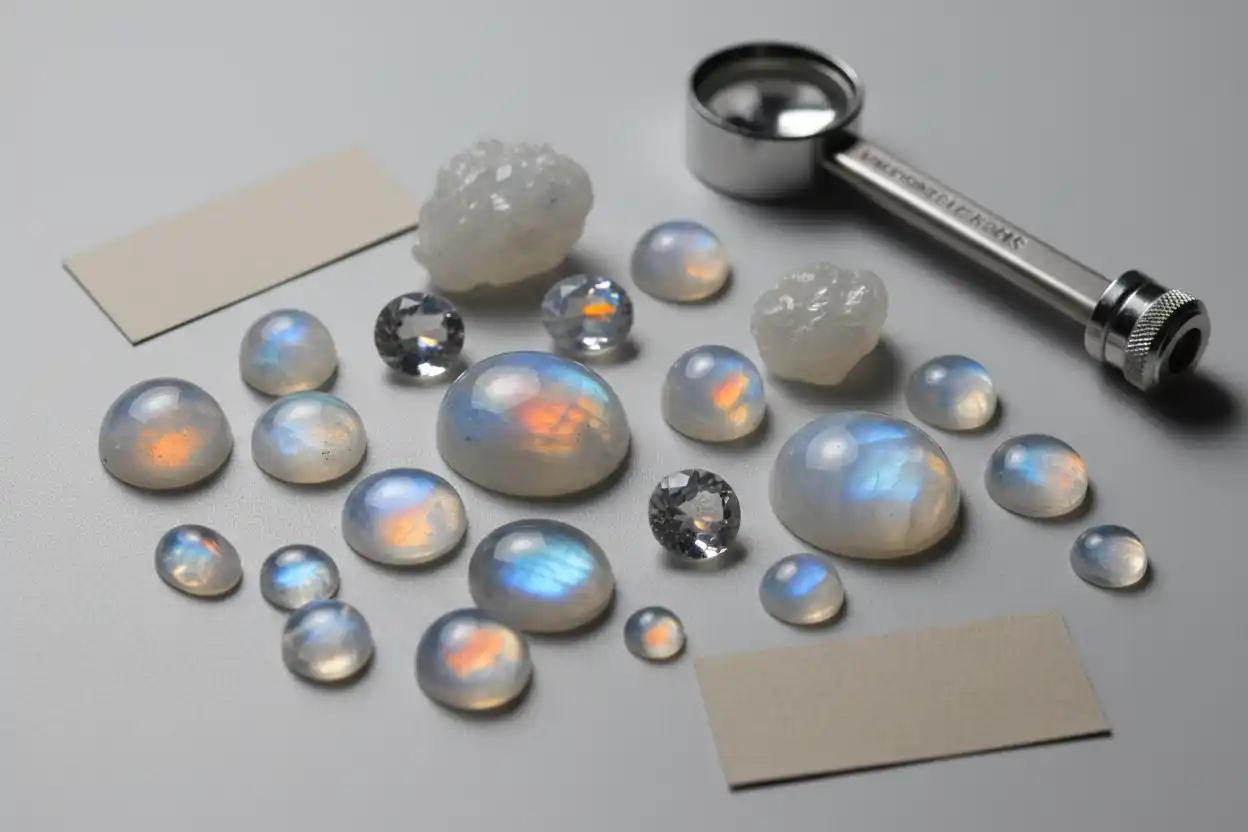
Where to Buy Real Rainbow Moonstone and Avoid Glass Fakes
Real Rainbow Moonstone is a transparent-to-translucent white or nearly colorless feldspar that displays blue, green, yellow, orange or multicolored flashes. Despite its accepted trade name, it is generally a transparent variety of Labradorite rather than traditional orthoclase Moonstone.
That distinction does not make Rainbow Moonstone fake. It is a genuine natural feldspar with an established identity in the gemstone market. However, sellers should disclose that the material belongs to the plagioclase feldspar series instead of describing it as the same mineral variety as classic orthoclase Moonstone.
Imitations include glass with reflective films, resin, coated feldspar, foil-backed cabochons, assembled stones and ordinary white Labradorite whose weak flash has been exaggerated through photography. Fracture filling can also improve the apparent clarity of heavily included beads and cabochons.
The Rainbow Moonstone meaning and properties guide covers its trade identity and traditional symbolism. This buying guide focuses on natural optical effects, treatment, seller evidence, cutting quality, durability and value.
Rainbow Moonstone Is Transparent Labradorite
Traditional Moonstone is usually described as an intergrowth of alkali feldspars, commonly orthoclase and albite, that produces a soft floating light known as adularescence.
Rainbow Moonstone belongs to the plagioclase feldspar group and is typically classified within the Labradorite composition range. Its internal feldspar layers produce blue or multicolored interference colors commonly called labradorescence.
The Labradorite meaning and properties guide provides the parent-material context. The Labradorite versus Moonstone guide explains the mineralogical and optical distinctions in greater detail.
Trade usage remains well established. Consequently, a seller can accurately use “Rainbow Moonstone” when the listing also identifies the stone as transparent Labradorite.
Adularescence and Labradorescence Are Related but Distinct
Both effects arise when light interacts with microscopic feldspar intergrowths.
Classic Moonstone usually shows a billowy white or blue light that appears to float beneath the surface. Rainbow Moonstone can display sharper blue, green, yellow, orange or spectral flashes.
The visual boundary is not always obvious. Highly transparent Rainbow Moonstone may show a soft blue sheen combined with stronger orange or multicolored reflections.
For buying purposes, focus on how much of the stone displays the effect, whether the flash moves naturally and whether the seller identifies the feldspar correctly.
A fixed white stripe or surface-colored patch is not sufficient evidence.
Choose the Product Form Before Shopping
| Rainbow Moonstone product | Best source | Main buying concern |
|---|---|---|
| Natural rough | Labradorite or feldspar specialist | Flash orientation, fractures and treatment |
| Slab or preform | Lapidary supplier | Optical yield, cleavage and backing |
| Cabochon | Specialist gem dealer | Centered flash, transparency and structural condition |
| Faceted gem | Collector-gem dealer | Color display, windowing and chipped facet edges |
| Bead strand | Established bead supplier | Filled fractures, glass and drill-hole cracking |
| Tumbled stone | Reputable crystal retailer | Weak white Labradorite, coating and resin |
| Sphere | Experienced carving retailer | Flash coverage, assembly and hidden fractures |
| Tower or carving | Seller with exact-item video | Carved point, resin and optical orientation |
| Ring stone | Jeweler familiar with feldspar | Cleavage, setting pressure and protection |
| Pendant or earrings | Independent jeweler | Backing, glue and whether the exact stone will ship |
A still photograph can show a Rainbow Moonstone at its brightest angle. A continuous video is therefore essential for evaluating usable optical coverage.
Where to Buy Genuine Rainbow Moonstone
Specialist Moonstone and Labradorite dealers
A knowledgeable dealer should state that Rainbow Moonstone is transparent Labradorite or plagioclase feldspar.
Request the dimensions, weight, country of origin, treatment and whether the stone is solid or assembled.
The seller should also distinguish the body color from the optical effect. “Colorless feldspar with blue and orange flash” is more useful than “rare rainbow crystal.”
Ask whether the gem was cut from natural rough and whether laboratory testing supports an unusual locality or composition claim.
Lapidary suppliers
Rainbow Moonstone rough often looks cloudy or plain until a polished window reveals the optical direction.
Request videos of test windows or cabochons cut from the same parcel. Those examples show whether the material can produce broad face-up flash.
Inspect cleavage and internal fractures carefully. Large rough can yield little usable material when cracks cross the feldspar layers.
Ask whether oil or resin was used to improve transparency.
Gem and mineral shows
Shows allow direct comparison with White Moonstone, Labradorite, Opalite glass, Rainbow Moonstone imitations and transparent Quartz.
Rotate the stone beneath one stationary white light. Natural labradorescence should appear to move within the gem rather than remaining fixed on the surface.
Use a loupe to inspect fractures, coating, foil, bubbles and assembly seams.
Do not scratch the stone. Feldspar is vulnerable to abrasion and cleavage, while a scratch result would not establish treatment or natural origin.
Established online sellers
The online gemstone buying guide covers seller identity, protected payment methods and return rights.
Request a continuous video against both white and dark backgrounds. A dark background can improve flash visibility, while a white background reveals body color and transparency.
Ask whether multiple lights were moved around the stone. Several changing light sources can make weak material appear to have much wider optical coverage.
The seller should identify any color, contrast or sharpening adjustments made to the images.
Independent jewelers
A jeweler should understand that Rainbow Moonstone is cleavable feldspar rather than a Sapphire-like daily-wear gem.
Ask to see the loose stone before mounting. Reflective foil, dark backing or colored adhesive can intensify weak flash.
For a premium ring, request written disclosure of filling, coating, backing and construction.
What Genuine Rainbow Moonstone Looks Like
The body is commonly colorless, white, milky white or slightly gray.
Some stones contain dark mineral grains, cloudy veils, cleavage fractures or internal stress features.
Natural flash can appear:
- Electric blue
- Pale blue
- Green
- Yellow
- Gold
- Orange
- Pinkish orange
- Violet
- Several colors in sequence
Blue remains the most familiar effect, while orange and multicolored flashes can add rarity and interest.
The phenomenon should come from inside the feldspar. As the stone rotates, the color can brighten, move, narrow, expand and disappear.
A high-quality cabochon usually shows its strongest flash across the crown rather than only along one girdle edge.
Body Transparency and Flash Depth
Transparent material can allow light to travel deeper before interacting with the feldspar layers. Consequently, its iridescence may appear farther beneath the surface.
Cloudier stones may show flash closer to the top because inclusions block deeper light transmission.
Neither appearance is automatically superior. Transparent material may produce a striking floating effect, while translucent stones can offer broad bright blue coverage.
Judge the actual optical display rather than assuming that complete transparency always indicates the highest quality.
A stone that looks clear but shows no useful flash should not receive a strong Rainbow Moonstone premium.
Rainbow Moonstone Versus Traditional Moonstone
Traditional Moonstone usually has softer white or blue adularescence over a colorless, cream, peach, gray or other body color.
Rainbow Moonstone generally shows sharper labradorescent colors and belongs to the plagioclase feldspar group.
The completed Moonstone buying guide owns general Moonstone quality and seller selection.
The types of Moonstone guide separates traditional orthoclase material from Rainbow Moonstone and other trade varieties.
A seller should not claim that Rainbow Moonstone is a rarer grade of orthoclase Moonstone without testing.
Rainbow Moonstone Versus White Moonstone
White Moonstone usually has a white, colorless or gray-white body with white, silver or blue adularescence.
Rainbow Moonstone is commonly more transparent and may display green, yellow, orange or multicolored flash.
The names can overlap in commercial listings, particularly when a white Labradorite cabochon shows only blue.
When exact identity matters, request gemological testing rather than choosing the name from one photograph.
Rainbow Moonstone Versus Peach Moonstone
Peach Moonstone has a warm peach, apricot or beige-pink body and commonly displays white or silver sheen.
The completed guide to buying genuine Peach Moonstone owns peach body color, coating and Orange Calcite confusion.
Rainbow Moonstone usually has a white or colorless body. An orange flash does not make it Peach Moonstone because the flash and the body color are separate features.
Rainbow Moonstone Versus Black Moonstone
Black Moonstone has a gray, dark brown or nearly black body with white, silver, peach or blue sheen.
The completed guide to buying real Black Moonstone covers dark-body feldspar and coating concerns.
Rainbow Moonstone is substantially lighter and more transparent. Both can belong to the wider feldspar trade, but their value factors differ.
Rainbow Moonstone Versus Labradorite
Rainbow Moonstone is a transparent-to-translucent Labradorite trade variety.
Ordinary Labradorite often has a darker gray, greenish or brown body with broad blue, green, gold or multicolored labradorescence.
The Labradorite buying guide owns general body color, flash coverage and treatment. The types of Labradorite guide covers transparent, dark-bodied and source-specific varieties.
The distinction is therefore commercial rather than a completely separate mineral identity.
Rainbow Moonstone Versus Spectrolite
Spectrolite is a trade name reserved for high-quality Finnish Labradorite with vivid spectral labradorescence over a dark body.
Rainbow Moonstone normally has a white or nearly colorless transparent body.
Both can display several flash colors, but their body tone, provenance and commercial identity differ.
A Finnish source claim should not be inferred merely because the stone has strong rainbow flash.
Rainbow Moonstone Versus Opalite Glass
Opalite is manufactured glass with a milky blue-white appearance and warm orange transmitted light.
Its color often remains diffuse throughout the object rather than forming a moving internal feldspar flash.
Round bubbles, mold seams and smooth glass flow can support Opalite identification.
Opalite commonly glows blue against a dark background and orange when strongly backlit. That predictable whole-body color shift differs from localized labradorescence.
The glass-versus-crystal guide provides wider identification context.
Rainbow Moonstone Versus Common Glass
Glass can be manufactured with iridescent films, reflective inclusions or layered color.
Round bubbles, flow lines, mold seams and conchoidal chips support glass, although bubble-free glass exists.
Natural Rainbow Moonstone should show feldspar-related optical structure and the correct refractive properties.
A fixed reflective layer that remains at one depth can indicate a glass assemblage or foil rather than natural labradorescence.
Coatings and Surface Films
Transparent pearly coatings can create blue, white or rainbow reflections on glass, Quartz or weak feldspar.
Inspect the girdle, back and worn edges for peeling, scratches and abrupt color loss.
Surface coating follows the outer polish. Natural labradorescence appears beneath the surface and changes with the internal feldspar orientation.
Aura-style metallic films should always be disclosed.
Foil-Backed and Assembled Stones
A thin transparent feldspar slice can be placed over reflective foil or another iridescent material.
Two clear components may also be joined around a colored film.
Inspect the girdle for straight seams, adhesive bubbles and a backing layer.
A backed or assembled cabochon can be attractive when disclosed, but it should not receive the value of one solid natural Rainbow Moonstone.
Closed settings can conceal these structures, making loose-stone inspection especially important.
Fracture Filling
Rainbow Moonstone can contain numerous cleavage fractures and internal stress cracks.
Clear polymer may enter those fractures and improve apparent transparency. Reflective filler can also create flash-like colors within individual cracks.
Under magnification, filler may show gas bubbles, flow structures or a distinct flash effect.
A small amount of filling does not make the feldspar artificial, but it affects value, durability and cleaning.
The gemstone treatments guide explains fracture filling and impregnation.
Resin and Molded Imitations
Resin can be mixed with pearly pigment and molded into cabochons, beads and carvings.
Casting seams, soft scratches, repeated optical patterns and numerous bubbles support polymer manufacture.
Some composites include crushed feldspar or mineral powder. Their natural content does not make the object one solid gem.
The fake-crystal buyer’s guide provides broader checks for polymer and glass.
How to Evaluate Rough
Ask for polished windows under one white light.
Determine whether the flash appears across an area large enough for the intended cabochon.
Inspect the rough from several directions. Feldspar optical effects depend strongly on orientation, so a promising surface may disappear after the material is cut incorrectly.
Check for cleavage and deep fractures. A large piece with extensive internal cracking can produce very little finished yield.
Ask whether resin, oil or another clarity enhancement was used.
How to Judge Cabochons
The strongest cabochon should show vivid flash across much of the crown.
The optical effect should remain visible over a useful viewing range rather than at one exact angle.
Inspect the body for distracting brown, yellow or gray areas unless those colors form part of the intended appearance.
The dome needs an even polish, while the girdle should have no major chips or surface-reaching fractures.
Check the back for filler, backing, foil and glue.
Buying Faceted Rainbow Moonstone
Highly transparent material can be faceted to display brilliance and internal color.
However, facet reflections can compete with labradorescence. A well-cut stone should preserve a recognizable flash face-up rather than showing it only from the pavilion.
Inspect facet junctions and the girdle for abrasion or cleavage chips.
A shallow cut may window, while a deep cut can add unnecessary weight without improving the phenomenon.
Request independent identification for expensive transparent material because Colorless Labradorite, Quartz, glass and other feldspars can overlap visually.
Buying Beads
Natural bead strands should vary in clarity, inclusion position and flash coverage.
Inspect drill holes for radial cracks, filler and a contrasting core.
Perfectly identical fixed blue stripes across every bead suggest coating, glass or assembled material.
Ask what percentage of the strand displays visible flash under ordinary lighting. A seller may photograph only the strongest beads.
Buying Rings and Other Jewelry
Feldspar has Mohs hardness around 6 to 6.5 but also has cleavage and relatively poor toughness.
The gemstone hardness chart, gemstone cleavage guide and toughness-versus-hardness guide explain why scratch resistance does not prevent splitting.
Pendants, earrings and brooches are safer than exposed rings.
For rings, choose a low bezel or protective halo. Avoid tension settings and designs that place concentrated pressure on the girdle.
The Moonstone ring guide and Labradorite ring guide provide form-specific construction context.
Locality and Provenance
Rainbow Moonstone has long been associated with India, while commercial material also comes from Madagascar, Zambia, Sri Lanka and other feldspar-producing regions.
Recent transparent Madagascan material has included notable blue and orange flash.
However, flash color cannot prove a country. Request supplier records when origin affects price.
The ethical gemstone sourcing guide provides questions about mining, cutting labor and traceability.
Price and Value
Rainbow Moonstone value depends on optical performance more than body size alone.
Important factors include:
- Strength of flash
- Number of visible colors
- Flash coverage
- Viewing-angle range
- Transparency
- Body color
- Cutting orientation
- Structural condition
- Treatment
- Size
- Provenance
A small transparent cabochon with centered blue-and-orange flash may be more valuable than a large cloudy stone whose effect appears only at the edge.
The Moonstone price guide and Labradorite price guide provide broader market context.
Avoid undefined “AAA” and “AAAA” grades. Ask the seller to describe measurable optical and condition factors instead.
Questions to Ask the Seller
Ask whether the stone is transparent Labradorite sold under the Rainbow Moonstone trade name.
Request a continuous video under one stationary white light.
Confirm coating, foil, backing, dye, oil, resin, fracture filling and assembly.
Ask for the body color without the flash and for the percentage of the crown that displays visible color.
Request front, back, girdle and drill-hole photographs as appropriate.
Finally, obtain a return policy that allows independent gemological testing.
Professional Identification
Refractive index, specific gravity, optic character and microscopy can identify plagioclase feldspar and separate it from glass, Quartz and traditional orthoclase Moonstone.
Microscopy may reveal feldspar inclusions, cleavage, coatings, filler and assembly seams.
Raman spectroscopy and chemical analysis can help position the material within the Labradorite composition range.
Confirming Labradorite does not automatically prove untreated construction or a specific geographic origin.
Cleaning and Storage
The completed Moonstone jewelry cleaning guide and Labradorite jewelry cleaning guide provide detailed care.
Use lukewarm water, mild soap and a soft cloth.
Avoid steam and ultrasonic cleaners. Do not soak filled, backed or glued stones.
Store Rainbow Moonstone separately from harder gems and remove rings before exercise, household work or rapid temperature changes.
Frequently Asked Questions
1. Is Rainbow Moonstone real Moonstone?
It is a genuine natural feldspar, but gemologically it is usually transparent Labradorite rather than traditional orthoclase Moonstone.
2. Is the Rainbow Moonstone name deceptive?
Not when the seller explains the accepted trade usage and identifies the stone as Labradorite.
3. What creates the rainbow flash?
Light interference within microscopic feldspar intergrowths produces blue and multicolored labradorescence.
4. Is Rainbow Moonstone the same as White Moonstone?
No. White Moonstone usually refers to traditional Moonstone with white or blue adularescence, while Rainbow Moonstone is transparent Labradorite.
5. Is Rainbow Moonstone the same as Opalite?
No. Opalite is manufactured glass with a diffuse blue-white glow and orange transmitted color.
6. Can Rainbow Moonstone contain orange flash?
Yes. Natural transparent Labradorite can show blue, orange and other iridescent colors.
7. Can Rainbow Moonstone be coated?
Yes. Pearly or iridescent coatings can imitate or strengthen the effect and should be disclosed.
8. Can it be fracture-filled?
Yes. Clear or reflective polymer can enter cleavage fractures in cabochons and beads.
9. Can Rainbow Moonstone be assembled?
Yes. Thin feldspar, glass, foil and adhesive can be combined into imitation cabochons.
10. Is Rainbow Moonstone suitable for daily rings?
It is vulnerable to scratching, cleavage and impact. Protected occasional-wear rings are safer than exposed daily settings.
11. Do ordinary cabochons need laboratory reports?
Usually not. Testing becomes more useful for expensive transparent gems, unusual treatments or disputed material identity.
12. What is the biggest warning sign in a listing?
Be cautious when a fixed surface stripe appears identical on every stone and the seller provides no continuous video, girdle view or Labradorite disclosure.
Buy the Internal Feldspar Flash, Not a Surface Reflection
Rainbow Moonstone earns its commercial identity through transparent Labradorite and moving internal color. The strongest purchase remains convincing under one light, across several viewing angles and from both sides.
The rainbow crystals guide, rainbow gemstones guide, R crystal directory and R gemstone directory provide wider comparisons. Choose a seller who explains the accepted trade name without obscuring the underlying mineral.
Safety note: Rainbow Moonstone can split along feldspar cleavage after impact or excessive setting pressure. Avoid steam and ultrasonic cleaning. Cutting and drilling feldspar should use wet methods, effective extraction and appropriate eye and respiratory protection.