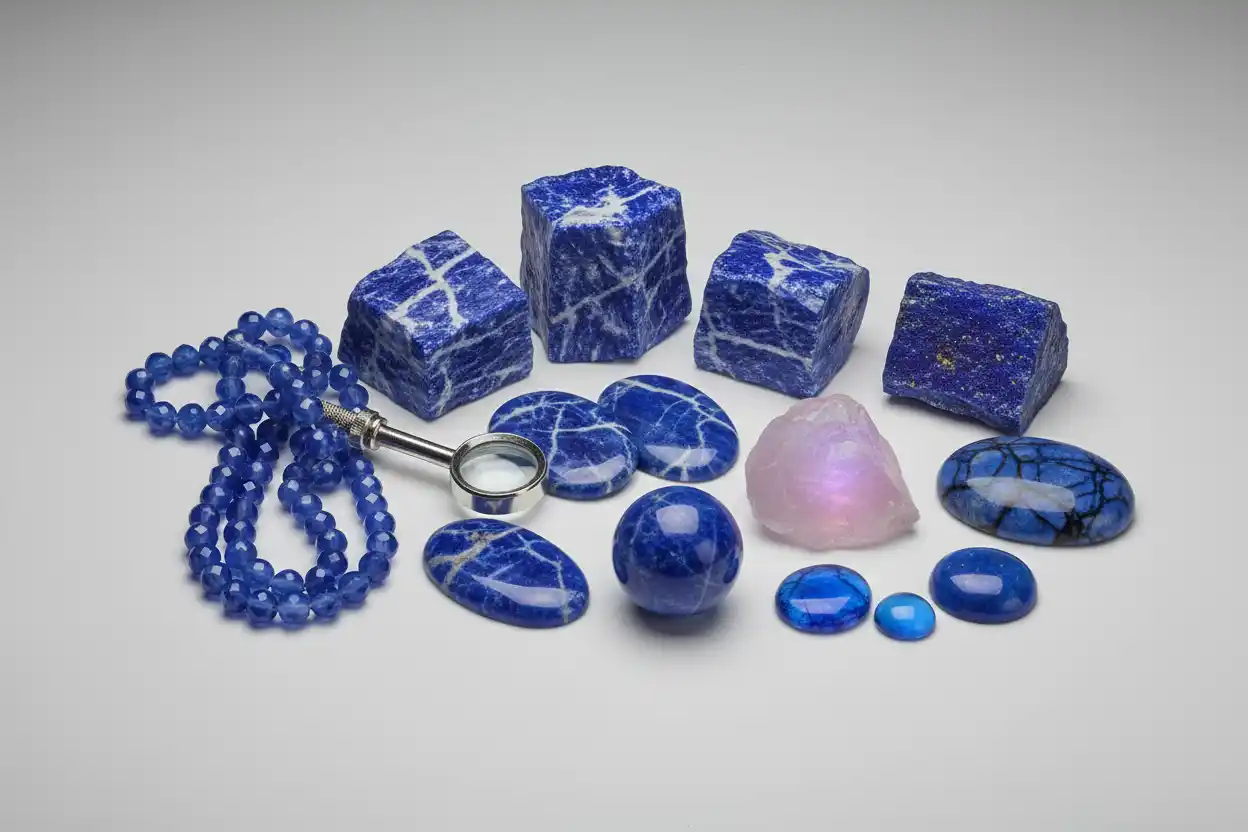
Where to Buy Real Sodalite and Avoid Dyed Blue Fakes
Real Sodalite is a sodium-rich feldspathoid mineral commonly sold as opaque royal-blue, navy, violet-blue or gray-blue material with irregular white, cream or gray mineral veining. It is used for cabochons, beads, spheres, carvings, decorative slabs and occasional faceted collector gems.
The familiar blue-and-white appearance is only one expression of the mineral. Sodalite can also be colorless, white, gray, greenish, yellowish or violet, while the tenebrescent variety known as Hackmanite may change color after exposure to ultraviolet light.
Most inexpensive Sodalite is genuine because the mineral is commercially available and relatively affordable. Nevertheless, buyers may encounter dyed Howlite, Magnesite, Calcite, Marble, blue glass, resin, reconstructed material and low-grade stone whose color has been intensified with dye or coating.
The Sodalite meaning and properties guide covers mineral identity and traditional symbolism. This buying guide focuses on sellers, blue color, white veining, Hackmanite, treatments, Lapis Lazuli confusion and practical value.
What Sodalite Is
Sodalite is a cubic sodium aluminosilicate containing chloride within its framework structure. It belongs to the Sodalite group of feldspathoid minerals.
Unlike Quartz, Sodalite forms in silica-undersaturated igneous environments. It commonly occurs in nepheline syenites and related alkaline rocks rather than conventional silica-rich veins.
Commercial lapidary material is often massive and intergrown with other minerals. Consequently, a polished Sodalite object may contain:
- White Calcite
- Nepheline
- Feldspar
- Cancrinite
- Pyroxene
- Amphibole
- Other Sodalite-group minerals
- Iron-rich or dark host minerals
One uniform chemical formula cannot describe every visible area in a multi-mineral carving or bead.
Sodalite usually has Mohs hardness around 5.5 to 6. Its toughness is fair for protected decorative use, although fractures, associated Calcite and grain boundaries can reduce durability.
Choose the Product Form Before Shopping
| Sodalite product | Best source | Main buying concern |
|---|---|---|
| Natural rough | Mineral or lapidary supplier | Color depth, white matrix and dye |
| Slab | Specialist lapidary dealer | Pattern continuity, resin and cutting yield |
| Cabochon | Independent cutter | Blue saturation, polish and backing |
| Bead strand | Established bead supplier | Dyed Howlite, glass and drill-hole fractures |
| Sphere | Experienced carving retailer | Total blue coverage, filler and assembly |
| Tower | Seller with exact-item video | Carved point, coating and pale reverse areas |
| Decorative carving | Skilled lapidary seller | Composite construction and soft Calcite zones |
| Transparent gem | Collector-gem dealer | Correct identity, treatment and rarity claims |
| Hackmanite specimen | Specialist mineral dealer | Tenebrescence, locality and testing |
| Jewelry | Jeweler with treatment disclosure | Glue, backing and realistic durability |
A blue carving should be evaluated for its complete construction. A Hackmanite crystal requires stronger mineralogical and locality evidence.
Where to Buy Genuine Sodalite
Specialist mineral dealers
A mineral dealer is the best source for natural crystals, unusual colors and Hackmanite.
The listing should include locality, dimensions, transparency, associated minerals and condition. Ask whether the identification came from crystal habit, spectroscopy or visual comparison alone.
Request ultraviolet-light photographs for a tenebrescence claim, but also ask for ordinary daylight images before and after exposure.
A transparent or unusually colored specimen should receive stronger evidence than an ordinary opaque blue carving.
Lapidary suppliers
Request dry photographs of the natural surface and several sawn faces.
Water and oil deepen blue color while temporarily concealing scratches and fractures. Therefore, wet photographs should supplement rather than replace dry views.
Ask whether the blue color continues through the block or concentrates near the weathered surface.
A large piece may contain extensive white Calcite, gray host rock or fractures that reduce usable blue yield.
Gem and mineral shows
Shows allow direct comparison with Lapis Lazuli, Azurite, Blue Calcite, dyed Howlite, glass and resin.
Use a loupe to inspect color concentrations, mineral boundaries, drill holes, bubbles and coatings.
Do not apply acid, scratch the object or use solvents. Sodalite products can contain Calcite and treated areas that would be damaged.
The crystal identification guide provides safer observational and instrumental approaches.
Established online stores
The online gemstone buying guide explains seller identity, protected payments and return policies.
Request exact-item photographs under neutral white light. Sodalite can appear substantially brighter after saturation and contrast editing.
Ask for the back, edges, base and drill holes. Those areas commonly reveal dye, filler, mixed rock and backing.
A listing should state whether the photographed sphere, carving or cabochon is the exact product that will ship.
What Genuine Blue Sodalite Looks Like
Natural commercial Sodalite may be:
- Royal blue
- Navy blue
- Violet-blue
- Denim blue
- Gray-blue
- Blue with white veins
- Blue with gray or black inclusions
- Mottled blue and cream
- Nearly uniform blue
- Blue with orange or yellow associated minerals
The material is usually opaque to semitranslucent. Thin edges may transmit blue or violet light.
White veining commonly consists of Calcite or other light-colored associated minerals. Veins may be broad, wispy, branching or irregular.
Natural color can vary within one sphere or slab. A bright blue face may grade into gray-blue or white matrix on the reverse.
Completely flawless uniform blue is possible in selected material, but a large object with no grain variation deserves closer inspection for glass, resin or intense image editing.
Sodalite Versus Lapis Lazuli
Lapis Lazuli is a multi-mineral rock rather than one mineral species.
Its blue component belongs to the Sodalite mineral group, but high-quality Lapis commonly includes Lazurite- or Haüyne-rich material together with Calcite, Pyrite and other minerals.
Sodalite is usually sold as a more uniform blue-and-white rock and commonly lacks the conspicuous golden Pyrite flecks associated with many Lapis specimens.
The dedicated Lapis Lazuli versus Sodalite guide owns the complete comparison.
The Lapis Lazuli buying guide covers Lapis-specific color, Pyrite, Calcite, dye and provenance.
Golden metallic specks support Lapis but do not prove it. Glitter can be added artificially, while natural Lapis can contain little visible Pyrite.
Sodalite Versus Azurite
Azurite is a copper carbonate with intense blue color.
It often occurs with Malachite and may form crystalline, nodular or earthy material. Its color can appear more saturated and electric than ordinary Sodalite.
The Sodalite versus Azurite guide owns the direct identification workflow.
The completed guide to buying genuine Azurite covers coatings, copper-mineral associations and reconstructed specimens.
Never use acid to distinguish them. Azurite and associated Calcite would be damaged.
Sodalite Versus Blue Calcite
Blue Calcite is a soft calcium carbonate that commonly appears pale sky blue, gray-blue or turquoise blue.
The completed guide to buying real Blue Calcite addresses dye, glass and carbonate care.
Blue Calcite often has a softer cloudy translucency and visible cleavage. Sodalite is generally darker, denser-looking and more granular.
However, pale polished spheres can overlap visually. Raman spectroscopy or refractive testing provides safer separation than scratching.
Sodalite Versus Blue Chalcedony
Blue Chalcedony is microcrystalline Quartz with a waxy, translucent appearance.
The completed guide to buying genuine Blue Chalcedony owns dye, glass and Agate-related distinctions.
Chalcedony is harder and normally lacks Sodalite’s white Calcite-like veining.
A uniformly translucent blue cabochon may require gemological testing because polished form removes useful crystal clues.
Sodalite Versus Blue Aventurine
Blue Aventurine is Quartz-rich material that may contain Dumortierite or other blue inclusions.
The completed guide to buying real Blue Aventurine covers quartz identity, glittering glass and dye.
Some Blue Aventurine displays fine sparkle, while Sodalite generally does not.
Non-sparkling Blue Aventurine can still resemble Sodalite, making hardness and spectroscopy useful.
Sodalite Versus Dumortierite
Dumortierite is an aluminum borosilicate mineral commonly occurring as blue fibrous or granular material in Quartz.
Dumortierite-bearing Quartz is generally harder and may show fibrous blue patches within a lighter Quartz host.
Sodalite often has broader royal-blue areas with white mineral veining.
A seller should avoid calling every blue Quartz-rich rock Sodalite merely because the color appears similar.
Sodalite Versus Howlite
Howlite is naturally white and commonly marked by gray or black webbing.
Because Howlite is porous, it is frequently dyed blue.
The completed guide to buying genuine Howlite covers dyed Turquoise substitutes and white-stone identification.
Dyed Howlite commonly shows unnaturally bright blue color concentrated in fractures and dark veins. Drill holes may reveal a pale white core.
Natural Sodalite usually has blue mineral body color with separate white matrix rather than blue dye flowing through a white network.
Sodalite Versus Dyed Magnesite
Magnesite is commonly white, cream or gray and may have a porous structure suitable for dyeing.
Blue-dyed Magnesite can resemble Sodalite or Turquoise.
Artificial color often concentrates in cracks, pores and drill holes. The material may also feel chalkier or display a more uniform granular body.
Raman spectroscopy separates Magnesite from Sodalite without destructive acid testing.
Sodalite Versus Blue Glass
Blue glass can imitate cabochons, beads, spheres and carvings.
Warning signs include:
- Round bubbles
- Mold seams
- Flow lines
- Conchoidal glass chips
- Uniform factory color
- Repeated patterns
- No natural mineral grains
- Perfectly identical beads
Bubble-free glass exists, while natural Sodalite can contain cavities. Therefore, one feature alone is not conclusive.
The glass-versus-crystal guide provides broader comparison methods.
Resin and Reconstructed Material
Blue resin can be molded with white pigment to imitate Sodalite veining.
Casting seams, soft scratches, numerous bubbles and repeated swirls support polymer manufacture.
Sodalite fragments or powder can also be mixed with binder and reconstructed into beads or carvings.
The product may contain natural mineral without being one solid piece.
A seller should distinguish natural stabilized rock from a heavily polymer-bound composite.
Dyed Sodalite
Pale or gray Sodalite can receive blue dye to increase saturation.
Artificial color may concentrate along fractures, grain boundaries, pores and drill holes.
A chipped edge can reveal a paler core. However, natural color can also vary across grains and mineral boundaries.
Compare multiple depths and ask for a written treatment statement.
Dyed Sodalite remains the same underlying mineral, but it should not receive an untreated-color premium.
Coatings, Oil and Wax
A clear coating can increase gloss and reduce surface porosity.
Blue lacquer may strengthen weak color, while oil or wax can deepen blue areas and conceal fine scratches temporarily.
Inspect high points, edges and drill holes for peeling or a change in luster.
The gemstone treatments guide explains dye, coating, filling and reconstruction.
Fracture Filling and Stabilization
Multi-mineral Sodalite rough can contain weak Calcite veins and fractures.
Clear or color-matched resin may improve polish and structural stability.
Under magnification, filler may show bubbles, glossy pools or a different reflection from surrounding mineral grains.
Limited stabilization can make a carving practical, but it should be disclosed.
Hackmanite
Hackmanite is a sulfur-bearing variety of Sodalite known for tenebrescence, a reversible color change caused by exposure to ultraviolet light.
Some specimens deepen from pale gray, pink or lavender to violet or purple under UV exposure and gradually fade afterward.
Not every fluorescent Sodalite is strongly tenebrescent. Fluorescence is emitted light, while tenebrescence is a temporary change in the material’s body color.
A seller should show:
- The stone before UV exposure
- The UV source used
- The stone immediately afterward
- The fading sequence
- Normal daylight color
- Locality and testing
Image editing or ultraviolet fluorescence alone can imitate a dramatic result.
Natural Versus Synthetic Sodalite
Synthetic Sodalite-related materials are produced for scientific, ceramic and pigment applications. However, ordinary blue retail imitations are more often glass, resin or dyed natural stone.
A seller claiming that every smooth blue imitation is synthetic Sodalite may be using the term too broadly.
Laboratory-grown material should be identified through structure and chemistry, not simply through uniform color.
For a high-value transparent stone, request a report that addresses both mineral identity and natural origin.
How to Evaluate Rough and Slabs
Request dry photographs of natural and cut surfaces.
Assess how much of the piece is blue Sodalite versus white Calcite, dark host rock and fractures.
Look for color that continues beyond the outer rind.
Ask whether representative cabochons have taken a good polish without excessive resin.
A smaller block with consistent blue yield may be more useful than a larger matrix-heavy piece.
How to Judge Cabochons
A strong cabochon should have attractive blue saturation, balanced white pattern and an even polish.
Some buyers prefer nearly uniform blue, while others favor dramatic white veining. Neither preference defines authenticity.
Inspect the girdle for open cracks and the back for dye, backing and resin.
A very thin blue layer over a white or black base may indicate a doublet.
Buying Beads and Bracelets
Natural strands should show reasonable variation in blue shade and white veining.
Inspect drill holes for pale cores, dye, filler and radial cracks.
Perfectly repeated veins across every bead suggest printed resin or reconstructed material.
Ask whether the strand contains only Sodalite or mixes Lapis Lazuli, dyed Howlite and glass.
Buying Spheres, Towers and Carvings
Request a complete rotation under neutral light.
One side may contain rich blue material while the reverse is dominated by white Calcite or gray matrix.
A sphere should not have a straight equatorial seam.
Most Sodalite towers are carved; their pointed shapes did not grow naturally.
Carvings should avoid thin details crossing weak white veins.
Buying Sodalite Jewelry
Sodalite is suitable for pendants, earrings, brooches and protected cabochon rings.
The gemstone hardness chart, gemstone cleavage guide and gemstone toughness-versus-hardness guide explain why fractures and softer associated minerals matter beyond nominal hardness.
A bezel protects edges better than narrow prongs.
Remove Sodalite jewelry before swimming, household cleaning or prolonged exposure to cosmetics.
Locality and Provenance
Important commercial Sodalite comes from Brazil, Canada, Namibia, Russia and other alkaline-rock regions.
Hackmanite and transparent Sodalite have also been reported from Afghanistan and Myanmar.
Appearance alone cannot establish a country. Request supplier records when locality affects value.
A Canadian or Afghan premium requires more than a color resemblance or copied locality description.
The ethical crystal sourcing guide provides broader questions about extraction, cutting labor and traceability.
Price and Value
Ordinary blue Sodalite is affordable.
Value depends on:
- Blue saturation
- Pattern balance
- Limited gray or brown matrix
- Polish
- Structural stability
- Size
- Treatment disclosure
- Cutting quality
- Transparent crystal rarity
- Hackmanite tenebrescence
- Locality
- Provenance
A small transparent Hackmanite crystal can be substantially more valuable than a large ordinary carving.
Undefined “AAA” grades offer little information. Ask how the seller evaluates blue color, matrix, treatment and condition.
The gemstone pricing guide explains how rarity, evidence and workmanship influence retail price.
Questions to Ask the Seller
Ask whether the item is natural Sodalite, Lapis Lazuli, dyed Howlite, Magnesite, glass, resin or a reconstructed product.
Request the country or deposit and the basis for that claim.
Confirm dye, coating, oil, wax, resin, backing and fracture filling.
For Hackmanite, request before-and-after ultraviolet photographs and a fading video.
For cabochons and beads, request back, edge and drill-hole views.
For spheres and carvings, obtain a complete rotation.
Finally, confirm that the return policy allows professional mineral identification.
Professional Identification
Refractive index, specific gravity, microscopy and spectroscopy can identify Sodalite.
Raman spectroscopy and X-ray diffraction separate it from Calcite, Howlite, Magnesite, glass and related minerals.
Microscopy can reveal dye, coating, filler and composite construction.
Ultraviolet testing helps document fluorescence and tenebrescence but should not replace mineral identification.
Several test points may be necessary because a polished object can contain Sodalite together with other minerals.
Cleaning and Storage
The completed Sodalite cleansing and charging guide offers non-destructive options for traditional practices.
For physical cleaning, use a slightly damp soft cloth followed by immediate drying.
Avoid acids, bleach, steam and ultrasonic cleaning.
Do not soak material containing Calcite, dye, resin, backing or glue.
Store Sodalite separately from Quartz and harder gemstones that can scratch its polish.
Frequently Asked Questions
1. Is Sodalite a mineral or a rock?
Sodalite is a mineral, although most commercial carvings consist of Sodalite intergrown with Calcite and other minerals.
2. Is genuine Sodalite always blue?
No. Sodalite can be colorless, white, gray, yellowish, greenish or violet as well as blue.
3. What are the white veins in Sodalite?
They commonly include Calcite or other light-colored minerals associated with the Sodalite-bearing rock.
4. Is Sodalite the same as Lapis Lazuli?
No. Lapis Lazuli is a multi-mineral rock commonly containing blue Sodalite-group minerals, Calcite and Pyrite.
5. Does genuine Sodalite contain gold-colored Pyrite?
It can occur with other minerals, but conspicuous Pyrite is more characteristic of many Lapis Lazuli products.
6. Can Sodalite be dyed?
Yes. Pale Sodalite and other porous blue-stone substitutes can receive dye.
7. Can Howlite be dyed to imitate Sodalite?
Yes. Blue dye can penetrate Howlite’s veins and pores, often leaving evidence in drill holes and chips.
8. Is Hackmanite a type of Sodalite?
Yes. Hackmanite is a sulfur-bearing tenebrescent variety of Sodalite.
9. Does fluorescence prove a stone is Hackmanite?
No. Hackmanite requires reversible body-color change, not fluorescence alone.
10. Can Sodalite contain resin?
Yes. Fractures may be filled, and fragments or powder can be reconstructed with polymer.
11. Is Sodalite suitable for daily rings?
Protected cabochons can be worn carefully, but fractures and softer associated minerals make exposed daily settings less practical.
12. What is the biggest warning sign in a listing?
Be cautious when perfectly uniform electric-blue objects have identical white veins and the seller provides no edge, drill-hole or treatment photographs.
Buy the Blue Feldspathoid, Not Merely a Blue-and-White Pattern
Genuine Sodalite should show natural mineral texture, color depth and plausible associated minerals. Its value should rise only when evidence supports stronger color, unusual transparency, tenebrescence or provenance.
The blue crystals guide, blue gemstones guide, S crystal directory and S gemstone directory provide wider comparisons. Choose a seller who identifies the mineral before selling the intensity of the blue.
Safety note: Sodalite and mixed Sodalite-bearing rock should not be ingested or placed in drinking water. Avoid acid testing because associated Calcite can be damaged. Cutting and grinding require wet methods, effective dust extraction and suitable respiratory and eye protection.