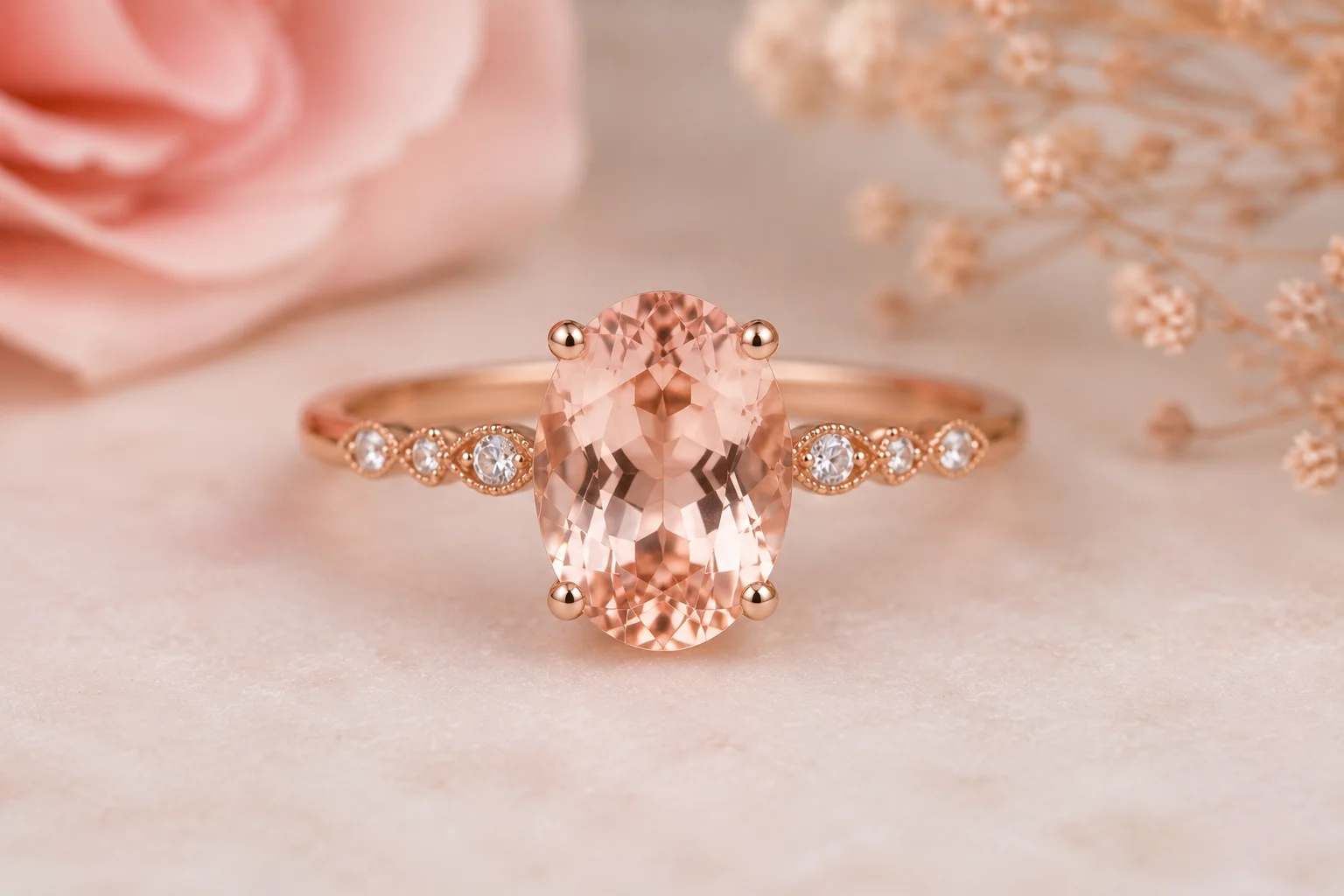
Morganite Rings: Styles and Buying Tips
Morganite rings combine pale pink, peach and salmon color with the clarity and durability of the beryl family. The gem can appear subtle in a small bezel ring or dramatic in a large cocktail design, particularly when warm metal reflects additional color into the stone.
Morganite ranks 7.5–8 on the Mohs scale and can be worn regularly with sensible care. It remains less resistant to scratching than Sapphire, Ruby, Moissanite and Diamond, while a severe blow can damage the gemstone or its setting.
This page focuses on general Morganite rings, including right-hand rings, anniversary styles, signets, bands and cocktail pieces. The dedicated Morganite engagement-ring guide owns bridal planning, wedding-band fit and proposal-specific considerations.
The broader Morganite gemstone guide owns the material’s geology, history and symbolism. Here, the focus remains on ring design, construction, fit, treatment, buying and care.
Morganite Rings at a Glance
| Feature | What to evaluate |
|---|---|
| Gem family | Beryl |
| Typical colors | Pale pink, peach, salmon, orangy pink and purplish pink |
| Mohs hardness | 7.5–8 |
| Most protective setting | Full or substantial partial bezel |
| Classic cut | Oval, round or cushion |
| Main visual concern | Adequate face-up color |
| Main structural concern | Exposed girdles, thin shanks and high settings |
| Common treatment | Heat to reduce orange or yellow components |
| Main disclosure concern | Origin and treatment |
| Main fit concern | Rotation from large top-heavy centers |
| Main maintenance concern | Prongs, pavé and residue beneath the gem |
| Safest cleaning | Lukewarm water, mild soap and a soft brush |
Is Morganite Suitable for Everyday Rings?
Morganite is durable enough for frequent ring wear, but it is not indestructible.
Its hardness provides better scratch resistance than Quartz, Moonstone, Opal and many ornamental stones. The Gemstone Hardness Chart shows its relative position.
A ring still receives concentrated impact from desks, tools, doorframes and exercise equipment. The metal may bend even when the gemstone remains intact.
The Gemstone Toughness vs Hardness guide explains why setting architecture and internal fractures matter alongside the Mohs number.
Morganite rings should be removed before mechanical work, heavy lifting, gardening, cleaning and contact sports.
Main Morganite Ring Styles
| Ring style | Main advantage | Main concern |
|---|---|---|
| Bezel solitaire | Strong protection and low snagging | More visible metal |
| Prong solitaire | Open and brilliant appearance | Exposed girdle |
| Three-stone ring | Balanced color composition | Matching and stone separation |
| Five-stone ring | Broad finger coverage | Side impact and settings |
| Halo ring | Enlarged apparent size | Numerous small prongs |
| Cluster ring | Wide pink display from smaller gems | Color consistency |
| Cocktail ring | Large dramatic center | Height and rotation |
| Signet ring | Low profile and substantial support | Correct stone depth |
| Half-eternity band | Pink line across upper finger | Pavé maintenance |
| Full-eternity band | Continuous color | Resizing and palm wear |
| Mixed-beryl ring | Morganite with Aquamarine or Emerald | Treatment and color balance |
| Carved or cabochon ring | Artistic and softer visual effect | Lower brilliance and surface wear |
Bezel-Set Morganite Rings
A bezel surrounds the gemstone with metal and provides the strongest general edge protection.
This setting reduces snagging and works well for active wearers, large centers and geometric cuts.
A full bezel covers a small portion of the girdle but does not prevent light from entering through the face. Morganite’s brilliance remains visible when the cut is good.
The metal should follow the stone evenly without gaps or ripples. A bezel that presses over a fracture may create damage during setting.
An opening behind the gem allows cleaning beneath the pavilion, where skin oil can make pale Morganite look nearly colorless.
Prong-Set Morganite Rings
Prong settings show more of the gem and create a lighter visual profile.
Four prongs suit many ovals, cushions and emerald cuts. Six prongs add redundancy around large round stones.
The Morganite should rest within a supportive basket rather than hang only between metal tips.
Pointed pears and marquises require V-shaped prongs or another protective cap over the tips.
Prongs should remain proportional to the stone. Extremely fine claws may look elegant but require closer inspection and can wear more quickly.
Three-Stone Morganite Rings
Three-stone rings may use a larger Morganite center with two smaller Morganites or contrasting gems.
Morganite side stones create a continuous blush palette. Diamond or Sapphire accents produce stronger contrast, while Aquamarine adds a related beryl-family color.
The side stones should not touch the center directly. Harder gems can scratch Morganite when their girdles rub.
Matching matters even when all three stones are Morganite. Hue, tone, cut and visible size should form a deliberate progression.
An unusual side-stone shape may be difficult to replace if one is lost.
Five-Stone and Anniversary Rings
Five-stone rings spread color across more of the finger without relying on one large center.
The gems may be equal in size or graduated toward the middle. A smooth progression generally looks more refined than abrupt jumps.
Each basket should sit at a similar height so one stone does not receive greater impact.
A five-stone ring can represent an anniversary or another milestone, but its symbolic interpretation comes from the wearer rather than the mineral.
A low setting reduces discomfort between adjacent fingers and limits snagging.
Halo and Cluster Rings
A halo surrounds one Morganite with smaller accent stones. A cluster uses several stones to create one larger shape.
Both formats can strengthen the visible presence of pale Morganite.
Diamond, Moissanite and white Sapphire accents create bright contrast. Their identities should be disclosed separately.
Hard accents must remain separated from Morganite by metal.
A halo or cluster introduces numerous small prongs. The ring requires closer maintenance than a simple bezel or solitaire.
A large outline can become top-heavy, so lower-shank width and ring size need careful planning.
Morganite Cocktail Rings
Morganite forms in sizes suitable for substantial statement rings.
Large ovals, cushions, pears and emerald cuts can display stronger color than small accents. They also create more leverage when the ring is struck.
A cocktail ring should sit securely without rotating constantly. A wider lower shank or sizing beads can improve balance.
High settings are best reserved for controlled occasions. A dramatic ring should not be worn during luggage handling, exercise or domestic work.
A large carat weight does not establish high value if the gemstone is very pale, heavily windowed or poorly set.
Morganite Signet Rings
A signet can place Morganite inside a broad bezel or recessed geometric setting.
The surrounding metal protects the stone and creates a lower profile than a conventional tall solitaire.
Emerald, cushion, oval and portrait-style cuts work especially well.
The signet face should contain enough metal beneath the gemstone to prevent flexing.
A closed back may conceal an excessively thin gem or a composite construction, so the seller should disclose what lies beneath the visible surface.
Signet design can be adapted for any wearer and should be assessed through proportion rather than gendered labeling.
Morganite Bands and Eternity Rings
Morganite bands may use pavé, shared prongs, bezels or channels.
A half-eternity design places stones across the visible upper section and leaves solid metal beneath the finger. It is generally easier to resize and repair.
A full-eternity ring continues settings around the complete circumference. It exposes stones and metal to palm-level wear and greatly restricts resizing.
Small Morganites can look very pale, especially in white metal. Rose gold may strengthen the overall pink impression even when the individual stones have weak saturation.
The band should feel smooth between adjacent fingers without exposed girdles or sharp prongs.
Cabochon and Carved Morganite Rings
Included or translucent Morganite may be cut as a cabochon or carving.
A cabochon emphasizes bodycolor and surface polish rather than brilliance. Rare stones may display chatoyancy or a star when inclusions are aligned appropriately.
Carved rings can use leaves, flowers, portraits or abstract forms.
Thin carved sections remain vulnerable even though Morganite has good hardness.
A bezel or broad signet construction usually provides better support than isolated prongs around an irregular carving.
Choosing Morganite Color
Morganite ranges from pale blush and peach to salmon, orangy pink and purplish pink.
Strong pure pink generally attracts the greatest demand, although attractive peach material remains popular.
The Pink Gemstones guide compares Morganite with other pink ring stones.
Color should be judged away from warm showroom lighting. Rose gold can reflect into the stone and make peach Morganite appear pinker.
White metal shows the gemstone’s independent color more clearly but can also make slight gray, yellow or brown components easier to see.
Size, Depth and Color
Larger Morganites often show stronger color.
This encourages cutters to retain depth, but excessive depth can hide weight below the setting without improving face-up size.
A broad window through the center reduces both color and brilliance.
Millimeter measurements are more useful than carat weight when comparing visual size.
A well-cut moderate gemstone can appear larger and more saturated than a heavier deep stone.
The complete loose-gem process belongs to the Morganite Buying Guide.
Cut Options
Round brilliant cuts provide balanced sparkle.
Ovals create greater length and remain among the most popular Morganite shapes. Cushions offer a softer outline, while radiant cuts create dense brilliance.
Emerald cuts produce broad step flashes and emphasize clarity. They also reveal weak color and windowing more readily.
Pears and marquises provide generous finger coverage but need protected points.
A fancy shape should be assessed for symmetry and outline, not merely the shape name printed in the listing.
Pleochroism and Orientation
Morganite can display different color strengths along different crystal directions.
A well-oriented stone presents the strongest attractive pink face-up.
Poor orientation may leave the ring looking pale from above even when deeper color is visible through the side.
The effect can become noticeable when the hand moves and the stone shifts between light sources.
Continuous video is more informative than one optimized photograph.
Clarity and Inclusions
Faceted Morganite is normally expected to appear eye-clean.
Liquid inclusions, tubes, crystals and fractures can occur.
A small internal inclusion away from the girdle may not affect wear. A surface-reaching fracture near a prong or pointed end creates greater risk.
Large stones reveal inclusions more readily because there is more volume to examine.
Residue under the gemstone can mimic cloudiness. Clean the ring before concluding that an apparent haze lies inside the Morganite.
Heat Treatment and Filling
Morganite is routinely heated to reduce yellow or orange components and produce a purer pink.
The treatment is considered stable during ordinary wear.
Known treatment should be disclosed, although laboratories may not always detect routine heating.
Rare fracture filling improves apparent clarity but creates stricter cleaning and repair limits.
The Treated Morganite guide owns these enhancement and disclosure boundaries.
Natural, Laboratory-Grown and Imitation Stones
Laboratory-grown pink beryl can have the essential Morganite structure but manufactured origin.
Synthetic origin must be disclosed.
Pink glass, Cubic Zirconia, synthetic Spinel, Kunzite, Rose Quartz, Pink Sapphire and Tourmaline may imitate Morganite’s appearance.
The Real vs Fake Morganite guide owns the authentication workflow.
The direct Morganite vs Rose Quartz and Kunzite vs Morganite pages separate two common lookalikes.
Choosing the Metal
Rose gold reinforces peach and pink tones through reflected color.
Yellow gold emphasizes warmth and can create a vintage appearance.
White gold and platinum provide greater contrast and suit cool purplish-pink Morganite.
Metal strength matters more than color alone. Shank thickness, prong dimensions, bezel fit and gallery support determine durability.
The Best Gemstones and Metals for Sensitive Skin guide explains alloy and nickel concerns.
Shank Width and Ring Balance
A very thin shank can make the gemstone appear larger, but it may bend during ordinary wear.
Large centers and broad halos need additional structural support.
A tapered shank can look delicate near the Morganite while retaining more metal beneath the finger.
Top-heavy rings rotate when the fit or lower-shank width is inadequate. Sizing beads may improve stability.
Ask for the ring’s total metal weight and shank measurements when comparing similar designs.
General Rings vs Engagement Rings
A fashion or cocktail ring may prioritize visual scale, occasional wear or unusual design.
An engagement ring must also account for continuous wear, wedding-band fit, replacement and long-term servicing.
Those bridal decisions belong to Morganite Engagement Rings.
A general Morganite ring can still carry strong personal or anniversary meaning. The distinction concerns intended use rather than emotional importance.
Price and Value
Current valuation belongs to the Morganite Price Guide.
Ring price reflects color, clarity, cut, size, treatment, metal weight, accent stones, workmanship and brand.
Morganite can form in large crystals, so size does not create rarity automatically.
A smaller strongly colored stone in substantial metal may offer greater value than a large pale gem in a thin setting.
Morganite should not be purchased through guaranteed investment or appreciation claims.
Buying Morganite Rings Online
Follow How to Buy Gemstones Online Without Getting Scammed.
Request continuous video of the exact ring under neutral light and from the side.
The listing should provide gemstone dimensions, ring size, shank width, setting height, metal weight, treatment, origin, accent identities, resizing limits and return terms.
A stock photograph cannot establish the color or inclusions of the actual center.
A laboratory report may be appropriate for a valuable gemstone or disputed origin. The Gemstone Certification guide explains report limitations.
Wearing and Coordinating Morganite Rings
A general Morganite ring can coordinate with Morganite earrings, a Morganite necklace or a Morganite bracelet through color and metal.
Avoid stacking Morganite directly beside rough Diamond or Sapphire settings that can scratch it.
A smooth spacer ring can reduce contact.
Remove Morganite rings before exercise, gardening, cleaning and mechanical work.
The general Crystal Rings guide provides broader ring-format context without replacing these material-specific concerns.
Cleaning and Maintenance
Follow How to Clean Morganite Jewelry Safely.
Use lukewarm water, mild dish soap and a soft brush. Clean beneath the center, where oil reduces brilliance.
Steam and ultrasonic cleaning should be avoided when fractures, liquid inclusions or filling are present.
Keep Morganite away from uncontrolled repair heat.
Store the ring separately from harder gemstones.
A moving center, catching prong, bent shank or lost pavé stone requires professional inspection before further wear.
Frequently Asked Questions
1. Is Morganite durable enough for everyday rings?
Yes, with sensible care. Its hardness is 7.5–8, although harder gems can scratch it and severe impacts can damage the setting.
2. What is the safest setting?
A full or substantial partial bezel provides strong edge protection and reduced snagging.
3. Is every Morganite ring an engagement ring?
No. Morganite is also used in cocktail rings, anniversary rings, signets, bands and right-hand designs.
4. Why are many Morganite rings rose gold?
Rose gold reflects warm pink into the gemstone and can strengthen the appearance of pale peach material.
5. What is the best Morganite color?
Strong pink or purplish pink generally receives the greatest demand, although clean peach and salmon stones also have distinct appeal.
6. Is Morganite usually heat-treated?
Yes. Heating commonly reduces yellow or orange components and produces a purer pink.
7. Is heated Morganite still natural?
Yes. The treatment changes color but not geological origin.
8. Can Morganite be laboratory-grown?
Yes. Laboratory-grown pink beryl exists and must be disclosed as manufactured.
9. Is Morganite harder than Rose Quartz?
Yes. Morganite ranks 7.5–8, while Rose Quartz ranks 7.
10. Can Morganite rings be resized?
Many can, but full-eternity bands, complex halos and some bezels limit safe resizing.
11. Can Morganite be cleaned ultrasonically?
Some sound stones may tolerate it, but hand cleaning is safer when fractures, liquid inclusions or filling may be present.
12. How often should the ring be inspected?
Frequently worn rings should be checked periodically and immediately whenever the stone moves, a prong catches or the shank bends.
Morganite rings succeed when their pastel appearance is supported by substantial construction. The stone may look delicate, but the bezel, prongs and shank should not be. A design that protects the girdle, controls rotation and presents genuine face-up color will remain more satisfying than one built only to make the center appear as large as possible.