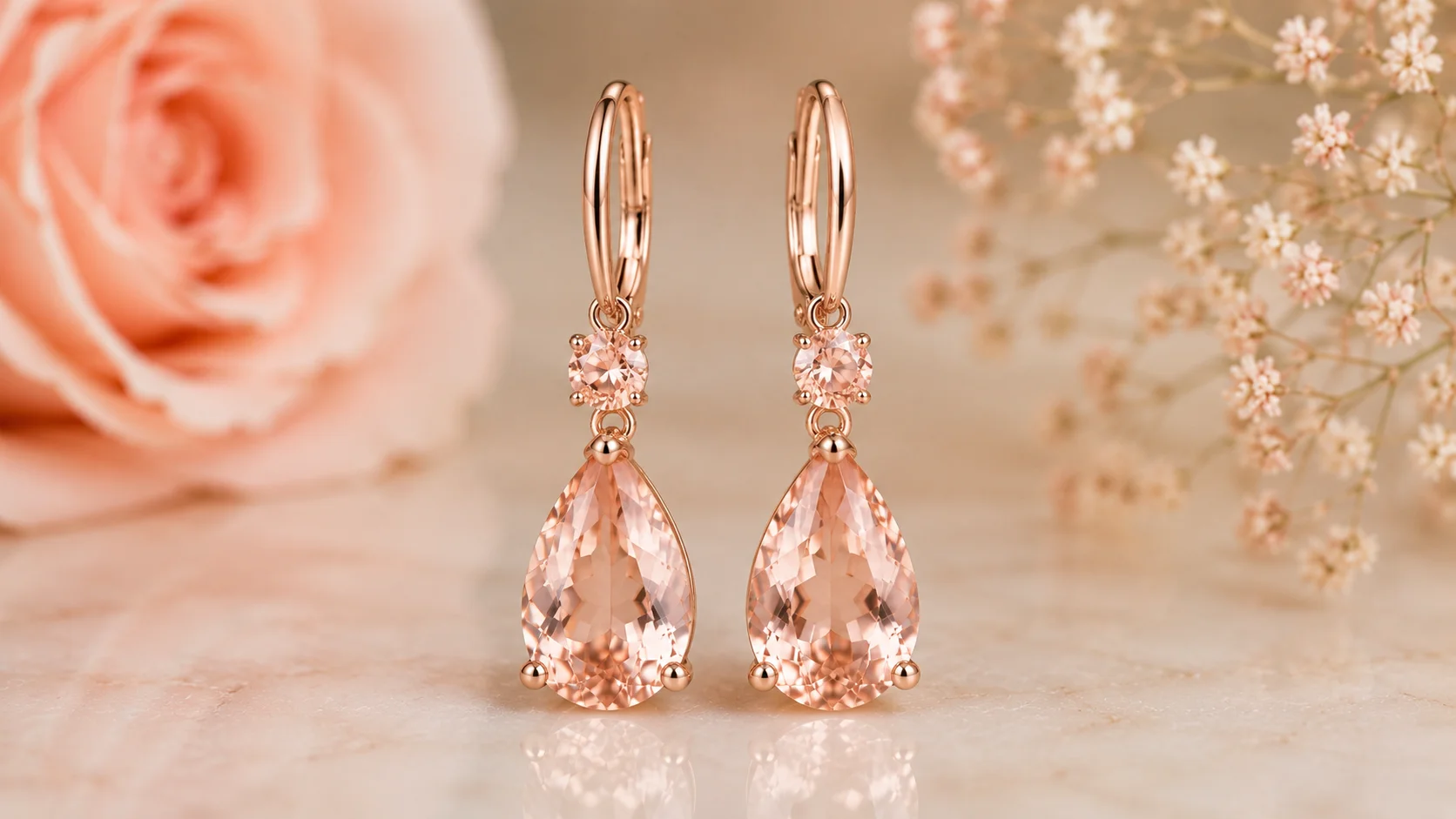
Morganite Earrings: A Style Guide
Morganite earrings display the gemstone’s pale pink, peach, salmon and purplish-pink colors beside the face, where surrounding skin tone, hair and metal all influence how the color appears. Small studs can look softly understated, while larger drops and halos reveal more saturation because Morganite often shows stronger color in larger stones.
The gemstone is the pink-to-orange-pink variety of beryl, the same mineral family that includes Aquamarine and Emerald. Its Mohs hardness of 7.5–8 makes it durable enough for regular earring wear, although hard blows, poorly positioned prongs and unprotected pointed cuts can still cause damage.
Pair matching creates the principal buying challenge. Two Morganites may have the same stated size and color grade yet differ in tone, pleochroism, cut depth, brilliance or visible warmth. A refined pair should look balanced under ordinary light rather than only under warm showroom illumination.
The complete Morganite gemstone guide owns the material’s geology, history and symbolism. This article focuses specifically on earrings, including style, pair matching, settings, comfort, treatments, metal and care.
Morganite Earrings at a Glance
| Feature | What to evaluate |
|---|---|
| Gem family | Beryl |
| Typical colors | Pale pink, peach, salmon, orangy pink and purplish pink |
| Main color cause | Manganese |
| Mohs hardness | 7.5–8 |
| Transparency | Usually transparent to translucent |
| Most versatile style | Round or oval solitaire studs |
| Most protective setting | Low bezel |
| Main pair-quality concern | Matching tone, saturation, dimensions and cutting |
| Common treatment | Heat to reduce orange or yellow components |
| Main comfort concern | Setting weight, post position and back size |
| Main disclosure concern | Natural or laboratory-grown origin and treatment |
| Routine care | Lukewarm water, mild soap and a soft brush |
Why Morganite Works Well in Earrings
Earrings protect Morganite better than rings and bracelets because they rarely strike hard surfaces. Even relatively large stones can be worn without exposing them to desk-level impact throughout the day.
Morganite also offers stronger scratch resistance than Moonstone, Opal, Pearl and Rose Quartz. Its position on the Gemstone Hardness Chart makes it appropriate for frequently worn studs and drops.
Nevertheless, the complete piece is only as durable as its metalwork. Posts can bend, prongs can loosen and delicate halo settings can catch hair or clothing.
The difference between gemstone hardness and complete-jewelry durability is explained in Gemstone Toughness vs Hardness.
Main Morganite Earring Styles
| Earring style | Visual character | Main advantage | Main concern |
|---|---|---|---|
| Solitaire stud | Clean and understated | Easy daily wear | Pale color in small stones |
| Bezel stud | Smooth framed outline | Protection and low snagging | More visible metal |
| Prong-set stud | Open and brilliant | Shows more gemstone | Exposed girdle |
| Halo stud | Larger apparent spread | Strong color contrast | Many small prongs |
| Cluster stud | Several small pink stones | Broad face-up coverage | Matching and maintenance |
| Short drop | Refined movement | Larger visible stone | Connector security |
| Long dangle | Formal and expressive | Strong color and brilliance | Weight and snagging |
| Huggie hoop | Compact contemporary style | Secure and wearable | Hinge and clasp wear |
| Hoop charm | Flexible and modern | Removable gemstone accent | Charm collision |
| Earring jacket | Convertible design | Several looks from one stud | Post length and alignment |
| Emerald-cut earring | Broad elegant flashes | Clean architectural appearance | Windowing and pale color |
| Mixed-gem earring | Morganite with Diamond or Aquamarine | Color contrast | Harder stones must remain separated |
Morganite Stud Earrings
Studs are the simplest and most versatile Morganite earrings.
Round brilliant stones return light efficiently and are relatively easy to match. Ovals provide greater apparent length and can show more color because they are often cut in larger dimensions.
Small Morganites may look nearly colorless at conversational distance. This does not automatically indicate poor quality, because the gemstone is naturally light-toned. However, a buyer seeking obvious pink should compare actual millimeter size and neutral-light video rather than relying on magnified product images.
A stud should sit upright instead of tilting toward the floor. Post position, stone weight, basket depth and back size all affect balance.
Large centers benefit from broad supportive backs that distribute weight across the earlobe.
Bezel-Set Morganite Studs
A bezel surrounds the gemstone with a continuous metal rim.
This construction protects the girdle, reduces snagging and creates a smooth outline. It is especially practical for people who wear earrings frequently or handle hair, scarves and knitwear throughout the day.
A rose-gold bezel can strengthen the visual warmth of pale Morganite by reflecting pink metal into the stone. White metal produces greater contrast and may make peach or yellow components easier to notice.
The bezel should follow the stone evenly. Gaps, rippled metal or visible adhesive indicate weak workmanship.
An opening behind the Morganite helps with cleaning, because skin oil and cosmetics can collect beneath the pavilion and make a pale stone appear cloudy.
Prong-Set Studs
Prong settings expose more of the Morganite and allow a lighter visual profile.
Four-prong baskets are common for rounds, cushions and ovals. Six prongs provide additional redundancy around larger round stones but create more visible metal.
The stone should sit securely in a supporting basket rather than balance between the prong tips alone.
Prongs should not rest over a visible fracture. Concentrated setting pressure can enlarge a weakness during tightening or later repair.
A prong-set stud offers an attractive balance of brilliance and security when it is inspected periodically.
Halo Morganite Earrings
Halo earrings surround a Morganite center with Diamond, laboratory-grown Diamond, Moissanite, Sapphire or Cubic Zirconia accents.
The bright border enlarges the visible outline and creates contrast around a pale center. Colorless accents can make Morganite appear warmer, while yellowish accents may create a softer transition.
Every accent material should be identified clearly on the invoice.
Hard accent stones must not touch the Morganite directly. Diamond, Sapphire and Moissanite can scratch beryl if their girdles rub against it.
A halo also introduces many small prongs. The setting should remain smooth around the perimeter so it does not catch hair.
Cluster Earrings
Cluster earrings use several Morganites rather than one center.
The stones may form flowers, stars, geometric arrangements or irregular organic shapes. A cluster can create broad pink coverage from smaller gems that would appear very pale individually.
Matching becomes important because one strongly orange, gray or windowed stone can interrupt the composition.
Shared prongs reduce visible metal but make neighboring gemstones dependent on the same small setting components.
A damaged shared prong may affect more than one stone, so cluster earrings require periodic inspection.
Morganite Drop Earrings
Drop earrings provide more space for substantial Morganites.
A round, oval, pear or cushion may hang beneath a simple post, halo or decorative metal element. Movement changes the viewing direction and can reveal the gemstone’s subtle pleochroism.
The connector should hold each stone face-forward. One earring should not rotate sideways while the other remains visible.
Short drops offer a strong balance between color display and comfort. They create movement without striking the shoulder or becoming caught in clothing as easily as long dangles.
Valuable drops should use locking backs, leverbacks or another secure closure.
Long Dangles and Chandelier Earrings
Long Morganite earrings can combine several stones, articulated links or mixed gemstones.
Request the weight per earring. Pale transparent gems can look visually light even when large stones and substantial metal make the complete design heavy.
The articulated sections should move without allowing stones to collide. Hard Diamond or Sapphire accents must remain separated from Morganite.
The lowest component should clear the shoulder during ordinary movement.
Long earrings should be removed before brushing long hair or changing tight-necked clothing, because sudden pulling can bend links or posts.
Morganite Huggies and Hoops
Huggies sit close to the earlobe and may contain a row of small Morganites, a suspended charm or one central cabochon.
Their compact profile works well for frequent wear. The hinge and clasp should operate independently from the stone-set section.
Hoop charms create greater movement, but the Morganite should not strike the hoop continuously.
Small pale stones in huggies may read as soft blush rather than obvious pink. Rose gold can strengthen their visible warmth.
Inside-out hoops use stones on the visible front and inner rear section, increasing brilliance while also increasing the number of settings that require maintenance.
Earring Jackets and Convertible Designs
An earring jacket sits behind a stud and adds a lower arc, halo or suspended drop.
This design allows a basic Morganite solitaire to be worn alone or expanded for formal occasions.
The post must be long enough to pass through the earlobe, jacket and back securely. A jacket designed for a small stone may sit unevenly beneath a larger center.
The two components should share compatible metal alloys and finishes. A plated jacket combined with solid-gold studs may age differently.
The Morganite should remain stable when the additional weight is attached.
Choosing Morganite Color
Morganite commonly appears pale pink, peach, salmon, orangy pink or purplish pink.
Strong pure pink receives high demand, but attractive peach material has its own market and should not be dismissed as inferior automatically.
Small stones may show less color than larger examples cut from similar rough. A pair of five-millimeter studs can look much paler than a ten-millimeter pendant from the same source.
Color should be viewed under neutral light, ordinary indoor lighting and against the wearer’s skin.
Warm store lamps and rose-gold reflections can make peach Morganite look pinker than it will appear in daylight.
The broader Pink Gemstones guide compares Morganite with Pink Sapphire, Spinel, Tourmaline, Kunzite and Rose Quartz.
Pleochroism and Pair Matching
Morganite is pleochroic, meaning its color can differ according to viewing direction.
One direction may appear pale pink, while another shows a deeper bluish or purplish pink. Cutters orient the rough to retain the most attractive face-up color.
Two earrings can therefore come from genuine Morganite yet appear mismatched if their optical directions differ.
Compare the pair while it is held upright, not only while lying flat.
The best match coordinates hue, tone, saturation, face-up dimensions, cut depth, brilliance and setting position. Exact internal features do not need to be identical.
Cut Quality
Round brilliants provide strong sparkle. Ovals, cushions and pears create larger face-up outlines, while emerald cuts produce broad flashes and an elegant architectural appearance.
Light Morganite may be cut slightly deep to strengthen apparent color. Excessive depth, however, hides weight without improving visible size.
A broad window through the center makes the gem look washed out and allows the setting or skin to show through too clearly.
Fancy-shape pairs must match in outline. One narrow oval beside one broad oval will look uneven even when their stated weights are equal.
The complete loose-stone evaluation belongs to the Morganite Buying Guide.
Morganite Clarity
Faceted Morganite is commonly expected to appear clean to the unaided eye.
Liquid inclusions, tubes, crystals and fractures can occur. A small internal feature away from the girdle may have little practical effect, while a surface-reaching fracture near a prong requires greater concern.
A visibly included stone can still work in artistic earrings when the inclusions create character and the price reflects them.
Cloudiness may also result from oil or cosmetic residue beneath the gemstone. Clean the pair before assuming the problem lies inside the Morganite.
Heat Treatment
Heat treatment is common in Morganite.
It generally reduces yellow or orange components, leaving a purer pink. The resulting color is considered stable under ordinary wear.
A heated Morganite remains natural beryl. Treatment and natural origin are separate questions.
Known treatment should be disclosed, particularly when it affects value or care. The complete enhancement boundary belongs to How to Spot Treated or Synthetic Morganite.
Rare fracture filling creates stricter cleaning requirements and should also be disclosed.
Laboratory-Grown Morganite and Imitations
Laboratory-grown pink beryl can have the same essential composition and structure as natural Morganite but forms through a controlled manufacturing process.
Its origin must be disclosed clearly.
Pink glass, Cubic Zirconia, synthetic Spinel, Kunzite, Rose Quartz and other gems may imitate Morganite’s color.
The complete authentication process belongs to Real vs Fake Morganite.
The direct Kunzite vs Morganite guide addresses a common transparent-pink comparison. Kunzite has stronger cleavage and greater light-sensitivity concerns.
Morganite vs Rose Quartz separates transparent beryl from the commonly translucent or cloudy quartz material.
Morganite and the Beryl Family
Morganite belongs to the Beryl family.
Aquamarine is the blue-to-greenish-blue variety, while Emerald is green beryl colored mainly by chromium, vanadium or both.
A mixed-beryl pair can combine Morganite and Aquamarine for pink-and-blue contrast. The stones share similar hardness but should still remain separated by metal.
Emerald requires more cautious treatment because natural fissures and clarity enhancement are common.
Choosing the Metal
Rose gold is strongly associated with Morganite because the metal reflects warm pink color into the stone.
Yellow gold strengthens peach and salmon components. White gold and platinum create a cooler contrast and can make a purplish-pink stone look cleaner.
Sterling silver offers an accessible option but may tarnish and require more maintenance.
Metal choice should also consider skin sensitivity. Posts, backs, solder and plating can cause irritation independently from the gemstone.
The Best Gemstones and Metals for Sensitive Skin guide explains nickel, alloy and plating concerns.
Posts, Backs and Comfort
Small studs commonly use friction backs. The back should grip the post firmly without requiring excessive force.
Screw backs provide additional security but can be slower to use and may irritate some piercings.
Locking backs combine convenience with mechanical security. Large studs benefit from broad support disks that reduce forward tilt.
The post should connect to a substantial part of the setting rather than a thin decorative edge.
For drops, leverbacks and locking posts generally provide stronger protection from loss than open hooks.
Styling Morganite Earrings
Morganite works well with white, cream, gray, navy, brown and soft earth tones.
Peach stones complement warm neutrals and rose gold, while purplish-pink Morganite can create stronger contrast with white metal.
A Morganite bracelet can coordinate through color and metal without matching the earrings stone for stone.
A Morganite engagement ring may guide the preferred cut, while future Morganite necklaces and Morganite rings can repeat the general color direction.
A complete set usually looks more natural when it shares metal and hue rather than identical oversized designs.
Buying Morganite Earrings Online
Follow How to Buy Gemstones Online Without Getting Scammed.
Request continuous video showing both earrings together under neutral light and in the approximate wearing position.
The listing should state stone dimensions, weight per earring, metal alloy, closure type, treatment, natural or laboratory origin and return terms.
Separate optimized photographs can conceal color differences. One continuous view provides stronger evidence of matching.
A laboratory report is rarely necessary for small commercial studs but may be useful for large expensive centers or a disputed natural-origin claim. The Gemstone Certification guide explains when documentation is proportionate.
Cleaning and Storage
Follow How to Clean Morganite Jewelry Safely.
Use lukewarm water, mild dish soap and a soft brush. Clean behind each stone, where skin oil and cosmetics reduce brilliance.
Warm soapy water is the safest universal method. Steam and ultrasonic cleaning should be avoided when the Morganite has fractures, liquid inclusions or filling.
Heat exposure during repair should be controlled carefully.
Store each earring separately so the post, back or hard accent stones do not scratch the other Morganite.
Frequently Asked Questions
1. Is Morganite suitable for everyday earrings?
Yes. Its hardness of 7.5–8 makes it durable enough for regular earring wear when the settings are secure.
2. Why do small Morganite studs look very pale?
Morganite is commonly light-toned, and larger stones usually show stronger color than small accents.
3. What is the best Morganite earring setting?
A low bezel provides the strongest edge protection and reduced snagging. A well-made basket setting also works well.
4. Is rose gold necessary for Morganite?
No. Rose gold strengthens warmth, while white and yellow metals create different but equally valid effects.
5. Should Morganite earrings match exactly?
Natural stones rarely match perfectly, but the pair should coordinate in color, dimensions, cutting and face-up brilliance.
6. Is Morganite usually heated?
Heat treatment is common and generally removes orange or yellow components to produce a purer pink.
7. Is heated Morganite still natural?
Yes. Heating changes color but does not change the stone’s natural geological origin.
8. Can Morganite be laboratory-grown?
Yes. Laboratory-grown pink beryl exists and must be disclosed as laboratory-created.
9. Is Morganite the same as Kunzite?
No. Morganite is beryl; Kunzite is spodumene and has different cleavage, optical and care properties.
10. Are Morganite earrings heavy?
Small studs are usually comfortable, but large centers, halos and substantial gold drops can become heavy. Request weight per earring.
11. Can Morganite earrings be cleaned ultrasonically?
Some sound untreated stones may tolerate it, but hand cleaning is safer when fractures, liquid inclusions or filling may be present.
12. What should I do if a Morganite becomes loose?
Stop wearing the earring and store the pair separately until a jeweler inspects the prongs, bezel or basket.
Morganite earrings look their best when color and construction are evaluated together. The stones must match under ordinary light, while the settings must keep them upright, comfortable and secure. A slightly smaller pair with consistent pink and reliable backs often provides more lasting satisfaction than larger pale stones mounted only for photographic impact.