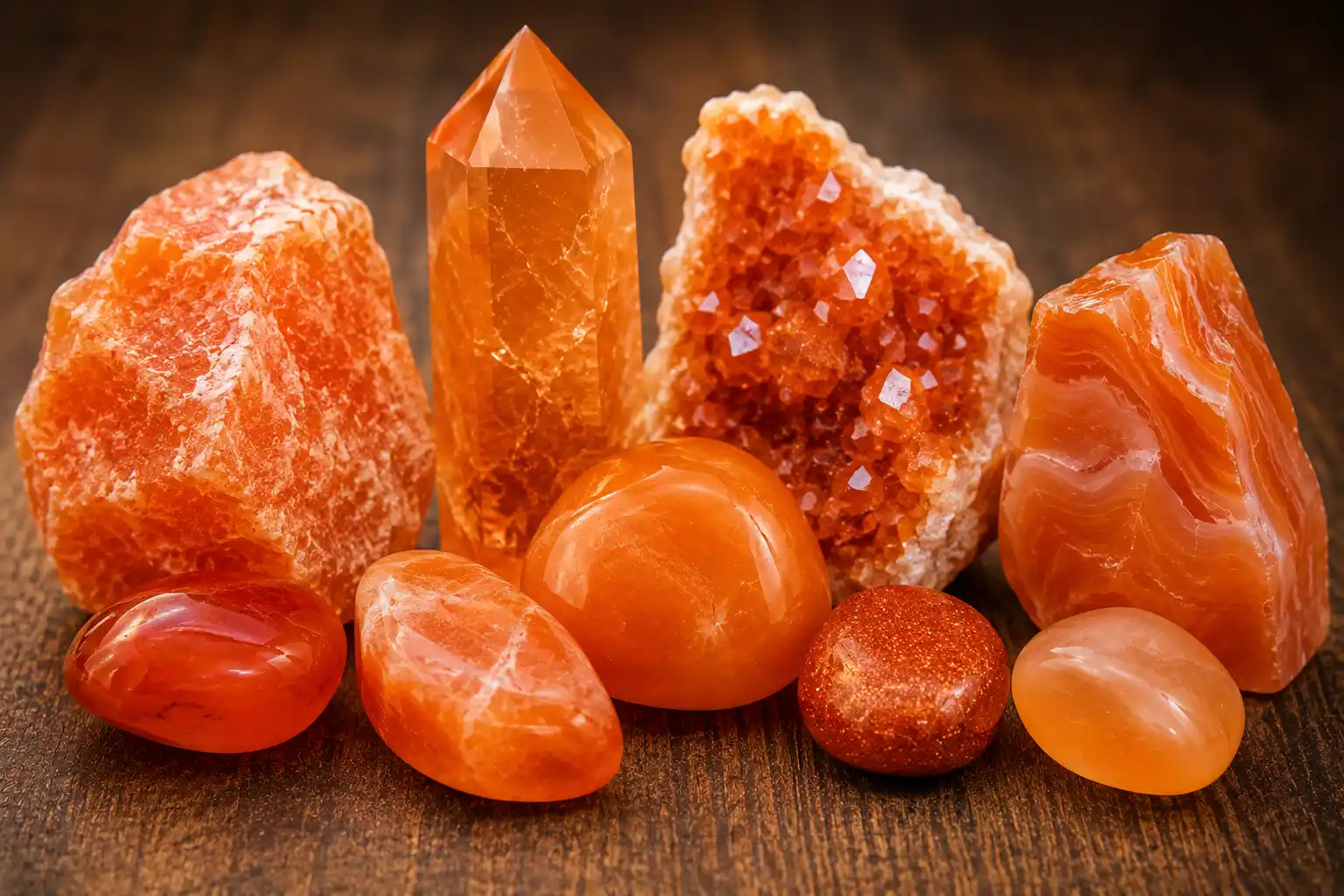
Sacral Chakra Crystals: 15 Best Stones for Creativity
Sacral chakra crystals are stones used symbolically in practices involving creativity, pleasure, emotional movement, sexuality, adaptability and relationships. Orange is the dominant modern color, so carnelian, orange calcite and sunstone lead most lists. Peach, gold, red-orange and lunar stones also appear when their traditional meanings fit the intention.
These associations do not come from a shared mineral property. Carnelian is chalcedony, orange calcite is a soft carbonate, sunstone is feldspar and amber is fossilized organic resin. Their hardness, stability, water safety and care requirements differ substantially.
The spiritual framework appears in the complete Sacral Chakra guide. This page focuses on choosing stones, comparing their symbolic roles, combining them and using them without ignoring mineral safety.
Best Sacral Chakra Crystals at a Glance
| Crystal | Traditional sacral role | Physical note |
|---|---|---|
| Carnelian | Motivation, creativity and participation | Durable chalcedony; heat and dye are common market issues |
| Orange calcite | Emotional movement and gentle pleasure | Very soft and acid-sensitive |
| Sunstone | Confidence, enjoyment and visibility | Cleavable feldspar requiring impact protection |
| Peach moonstone | Emotional receptivity and new beginnings | Feldspar with cleavage and surface-wear risk |
| Moonstone | Cycles, reflection and emotional awareness | Adularescent feldspar requiring gentle handling |
| Amber | Warmth, play and connection with the past | Soft organic material damaged by heat and chemicals |
| Red tiger’s eye | Focused passion and directed action | Quartz aggregate; much red material is heated |
| Tiger’s eye | Confidence joined with practical focus | Durable quartz aggregate with chatoyancy |
| Red jasper | Steady creative work and embodied action | Tough quartz-rich material suitable for handling |
| Mookaite | Exploration, choice and adaptable confidence | Jasper-like silica-rich material with variable composition |
| Fire agate | Protective creativity and internal fire | Durable chalcedony with layered optical color |
| Fire opal | Expression, spontaneity and emotional intensity | Softer, water-bearing opal requiring careful wear |
| Spessartite garnet | Enthusiasm, courage and social confidence | Durable garnet, usually transparent and faceted |
| Citrine | Optimism, confidence and productive creativity | Quartz; most market citrine is heat-treated amethyst |
| Coral | Life, relationship and ocean symbolism | Organic gem with major ethical and care considerations |
How Sacral Chakra Crystals Are Chosen
Modern sacral-chakra lists rely mainly on color and symbolic association.
Orange represents warmth, creative movement, appetite and participation.
Peach stones are often interpreted more gently, emphasizing receptivity and emotional comfort.
Red-orange stones connect sacral themes with the root chakra’s embodiment and action.
Gold and yellow-orange stones introduce confidence from the neighboring solar-plexus framework.
White or lunar stones appear because Svadhisthana has traditional water and crescent symbolism that predates the standardized orange rainbow scheme.
The stones are therefore selected by spiritual metaphor rather than one measurable energy frequency.
Carnelian
Carnelian is the best-known sacral chakra crystal.
Its translucent orange-to-red chalcedony body is associated with motivation, creativity, sensuality and participation.
Carnelian suits someone who has ideas but hesitates to begin.
A polished stone can sit beside art materials, a notebook or a project schedule as a reminder to produce an imperfect first attempt.
Its symbolism is active rather than reflective.
Because carnelian is relatively durable, it works well in jewelry and pocket stones. However, heated and dyed material is common, so natural-origin and treatment claims should remain realistic.
The separate Carnelian Healing Properties guide owns its broader belief-based practices.
Orange Calcite
Orange Calcite is associated with gentle emotional movement, enjoyment and creative release.
Its translucent orange body often looks softer than carnelian, which supports a less forceful symbolic style.
Orange calcite may suit a person who needs permission to explore rather than pressure to perform.
It can be placed in a stable meditation area or beside a journal.
Physically, calcite is soft, cleavable and acid-sensitive. It should not be soaked, placed in drinking water or carried loose with harder stones.
A chipped or scratched calcite piece remains usable symbolically, but its care needs differ sharply from quartz.
Sunstone
Sunstone is associated with confidence, participation, warmth and the willingness to be seen.
Its reflective inclusions can produce aventurescence, creating an active flashing appearance.
Sunstone fits sacral work involving creative visibility, performance or enjoyment without apology.
A person might wear it before sharing artwork, attending a social event or presenting an idea.
Feldspar has good hardness but important cleavage. Rings and bracelets need more care than pendants.
The distinct copper-bearing variety is covered in Oregon Sunstone.
Peach Moonstone
Peach Moonstone combines warm sacral color with moonstone’s reflective symbolism.
It is commonly chosen for emotional awareness, gentleness and beginnings that do not require immediate certainty.
The stone may suit creative work that needs patience rather than urgency.
Its feldspar structure can show a soft glow or sheen, although commercial material varies greatly.
Moonstone has cleavage and can abrade under frequent ring wear.
A palm stone or pendant usually provides safer handling than a high exposed setting.
Moonstone
Moonstone appears in sacral practice because of its associations with cycles, water, reflection and emotional change.
Its bodycolor need not be orange.
White, cream and rainbow moonstone can support the chakra’s lunar symbolism rather than the modern color rule.
Moonstone suits journaling, emotional observation and practices involving recurring patterns.
It should not be used to make medical claims about menstruation, pregnancy or fertility.
The stone’s cleavage and surface sensitivity require gentle cleaning and protected storage.
Amber
Amber is fossilized organic resin rather than a mineral crystal.
Its honey, cognac and orange colors create a warm sacral association with play, memory and preserved life.
Amber may suit practices involving reconnecting with enjoyable activities from an earlier period.
Because it is lightweight, it works comfortably in beads and pendants.
It is also soft and vulnerable to heat, perfume, alcohol and household chemicals.
Ethical and authenticity questions differ from those surrounding mined minerals, so amber should not be treated as simply another quartz-like stone.
Red Tiger’s Eye
Red Tiger’s Eye combines red-brown color with a moving chatoyant band.
It is traditionally associated with focused desire, confidence and directed action.
The stone may suit a person who has strong motivation but needs to channel it toward one goal.
Much commercial red tiger’s eye is produced by heating golden or brown material. The treatment is usually stable but should be understood when sellers claim rare natural red color.
Its quartz-rich structure is suitable for jewelry, though fractures and beads still require ordinary care.
Tiger’s Eye
Tiger’s Eye provides a more golden-brown approach to sacral work.
Its symbolism combines confidence with observation and practical judgment.
Where carnelian encourages beginning, tiger’s eye may help represent pacing and direction.
The moving band can be used as a meditation focus during decision-making.
It overlaps with solar-plexus traditions, demonstrating that chakra assignments are flexible rather than absolute.
Red Jasper
Red Jasper is traditionally linked more strongly with the root chakra, but it can support sacral practices that require sustained physical action.
Its opaque earthy red appearance symbolizes endurance and routine.
Red jasper suits someone who begins creative projects enthusiastically but struggles to continue.
It can be placed beside a schedule, workbench or long-term project.
The stone’s role is steadying rather than intensely stimulating.
Mookaite
Mookaite displays combinations of red, yellow, cream, brown and purple.
Its varied colors have inspired symbolism involving exploration, choice and adaptability.
Mookaite can support sacral work centered on trying unfamiliar approaches without abandoning practical judgment.
It is commonly cut into tumbled stones, beads and cabochons.
The commercial material is a silica-rich radiolarian rock rather than one chemically uniform crystal, so texture and durability vary among pieces.
Fire Agate
Fire Agate is chalcedony containing layered iron oxides that produce iridescent flashes.
Its color may include orange, gold, red, green and brown.
Fire agate is associated with protective creativity and confidence that develops from within rather than from external approval.
The stone can suit a person preparing to show highly personal work.
Its optical effect depends on skilled cutting. Overcutting can remove the color layers entirely.
The chalcedony body is durable, but irregular carvings and thin color layers still need protection.
Fire Opal
Fire Opal ranges from yellow and orange to vivid red-orange.
It may be transparent, translucent or opaque and can occur with or without play-of-color.
Its intense appearance supports symbolism involving spontaneity, emotional expression and creative risk.
Fire opal is less durable than quartz and can contain meaningful water content.
It should not be soaked, exposed to sudden temperature changes or used casually in high-impact jewelry.
The stone suits occasional ritual or protected jewelry rather than rough daily handling.
Spessartite Garnet
Spessartite Garnet is an orange-to-red-orange garnet associated with enthusiasm, social confidence and expressive creativity.
Transparent faceted material can show intense mandarin, reddish-orange or brownish-orange color.
Its durability makes it suitable for most jewelry forms, though exposed rings still need impact protection.
Spessartite may appeal to someone who wants a brighter and more outwardly expressive stone than red jasper or moonstone.
It belongs to the garnet family but occupies a distinct symbolic and visual role.
Citrine
Citrine is yellow-to-orange quartz associated with optimism, productivity and confident expression.
It is more commonly assigned to the solar plexus, but orange-brown material can bridge sacral and solar themes.
Citrine suits creative work that needs organization, completion or commercial presentation.
Most affordable market citrine is heat-treated amethyst. The treatment is stable but should not be confused with naturally colored rarity.
Its quartz hardness supports regular handling.
Coral
Coral appears in some sacral lists because of its red-orange color, ocean origin and historic relationship symbolism.
It is an organic skeletal material rather than a crystal.
Modern use requires substantial ethical caution because coral ecosystems face environmental pressure and trade restrictions.
Antique, inherited, legally sourced or verified sustainable material may be approached differently from newly harvested reef coral.
The completed Coral in Jewelry: The Ethics Problem owns the full environmental boundary.
Coral is soft and chemically sensitive, making it unsuitable for water rituals despite its marine origin.
Best Crystal for Sacral Chakra Creativity
Carnelian is the strongest general choice.
Its orange-red color, durability and active symbolism fit the transition from idea to first action.
Sunstone is useful when creativity needs visibility or confidence.
Orange calcite suits experimentation without pressure.
Peach moonstone supports reflective, intuitive or emotionally sensitive work.
The broader comparative intent appears in Best Crystals for Creativity.
Best Sacral Crystal for Passion
Spessartite garnet, fire opal and carnelian offer the most intense visual symbolism.
Spessartite represents enthusiasm with durability.
Fire opal represents spontaneity and emotional intensity but requires greater physical care.
Carnelian provides a more accessible and balanced option.
Passion should be directed toward a chosen activity or relationship value rather than treated as constant high energy.
Best Sacral Crystal for Emotional Balance
Peach moonstone and ordinary moonstone provide the most reflective approach.
Orange calcite offers a gentle visual symbol for allowing emotion to move.
Red jasper can help represent stability when feelings become overwhelming.
No stone treats a mood disorder or trauma.
The best choice is the one that supports a useful reflective practice without encouraging avoidance of professional help.
Best Sacral Crystal for Confidence
Sunstone and spessartite garnet are strong choices for visible confidence.
Red tiger’s eye suits focused action.
Citrine can represent the organization needed to present creative work.
The broader comparison belongs in Best Crystals for Confidence and Self-Esteem.
Best Sacral Crystal for Motivation
Carnelian represents starting.
Red tiger’s eye represents directing effort.
Red jasper represents continuing.
Citrine represents completing and organizing.
The broader roundup in Best Crystals for Motivation compares these roles outside the chakra framework.
Sacral Chakra Crystal Combinations
Carnelian and Orange Calcite
Carnelian brings active symbolism, while orange calcite introduces gentleness and experimentation.
The pair suits beginning a creative practice without demanding immediate excellence.
Sunstone and Peach Moonstone
Sunstone represents visibility and participation. Peach moonstone represents reflection and emotional pacing.
Together, they symbolize alternating expression with rest.
Red Jasper and Carnelian
Carnelian represents the first step, while red jasper represents repetition and completion.
This combination suits long projects that need both enthusiasm and structure.
Moonstone and Amber
Moonstone carries cyclical and lunar symbolism. Amber contributes warmth, memory and play.
Because amber is much softer and chemically sensitive, the stones should be stored separately.
Fire Agate and Tiger’s Eye
Both show moving optical effects.
Fire agate represents internal creative fire, while tiger’s eye represents judgment and direction.
Using more stones does not create a stronger practice automatically. One deliberate combination is usually clearer than an entire mixed collection.
The broader compatibility framework appears in Crystal Pairings.
How to Choose a Sacral Chakra Crystal
Begin with the intended behavior.
Choose carnelian when the challenge is starting.
Select orange calcite when experimentation feels unsafe or overly serious.
Use sunstone when work needs to be shared.
Choose moonstone when emotional observation matters more than immediate action.
Next, consider the physical use. A pocket stone needs greater toughness than a display specimen. A ring faces more impact than a pendant.
Finally, confirm the material and treatment rather than buying by color alone.
How to Meditate With Sacral Crystals
Choose one stone and place it in the hand or on a stable surface.
Notice its color, weight and texture.
Bring attention to one emotion or creative intention.
Ask what movement is needed: beginning, pausing, expressing, adapting or setting a boundary.
Write one next step.
The stone should support attention rather than become an object that must produce warmth, vibration or visions.
Wearing Sacral Chakra Crystals
Carnelian, tiger’s eye, jasper, garnet and many quartz-based stones work well in jewelry.
Moonstone, sunstone and fire opal need greater protection because of cleavage or lower toughness.
Amber and coral require especially gentle handling.
Bracelets keep the stone visible but expose it to impact.
Pendants and earrings protect softer materials.
Remove all crystal jewelry before exercise, swimming, bathing and household cleaning.
Where to Place Sacral Chakra Stones
A stone can be placed beside art supplies, a musical instrument, journal or project board.
In a living area, it can mark a place intended for enjoyment or conversation.
A crystal should not be placed where it creates a trip hazard or where children or pets can swallow it.
Soft stones should not sit on abrasive surfaces.
Placement is symbolic. The object does not create a measurable energy field around the room.
Cleansing Sacral Chakra Crystals
No single method is safe for every material.
Carnelian and jasper tolerate different conditions from calcite, amber, coral, moonstone and opal.
Gentle wiping, intention-setting and sound used at a distance avoid many risks.
The completed How to Cleanse Crystals guide explains material-aware methods.
Do not use salt, heat or prolonged sunlight without checking the specific stone.
Water Safety
Orange color does not indicate water compatibility.
Quartz-based carnelian and jasper tolerate brief washing more readily than calcite, amber, coral or fire opal.
Moonstone and sunstone may contain cleavage or fractures that make soaking unnecessary.
The crystal water-safety guide explains the distinction between cleaning and direct elixir preparation.
Do not place mixed collections or unknown stones in drinking water.
Hardness and Storage
The stones in this list range from soft organic materials to durable quartz and garnet.
Use the gemstone hardness chart before storing them together.
Hard carnelian, tiger’s eye and garnet can scratch amber, coral, calcite, moonstone and opal.
Hardness also does not prevent chipping or cleavage, as explained in Gemstone Toughness vs Hardness.
Individual pouches or divided compartments provide the safest storage.
Frequently Asked Questions
1. What is the best crystal for the sacral chakra?
Carnelian is the most widely used general choice for creativity, motivation and participation.
2. Are all sacral chakra crystals orange?
No. Orange dominates modern lists, but peach, red, gold, white and lunar stones also appear.
3. Is orange calcite safe in water?
No prolonged soaking is recommended. Calcite is soft and reacts with acids.
4. Is moonstone a sacral chakra crystal?
Yes. It is used for emotional awareness, cycles and water or lunar symbolism.
5. Is sunstone linked with the sacral or solar plexus chakra?
It appears in both systems. Sacral use emphasizes enjoyment and creativity, while solar-plexus use emphasizes confidence.
6. Can red jasper be used for the sacral chakra?
Yes. It is useful when creativity needs steadiness, embodiment and sustained action.
7. Is amber a crystal?
No. Amber is fossilized organic resin, although it is included in many spiritual gemstone lists.
8. Can sacral crystals improve fertility or sexual health?
No. They do not diagnose or treat reproductive, hormonal or sexual-health conditions.
9. How many sacral chakra crystals should I use?
One clearly chosen stone is enough. More stones do not create a stronger effect automatically.
10. Where should sacral chakra crystals be placed?
They can sit beside creative tools, a journal or a meditation area as symbolic reminders.
11. Can all sacral chakra crystals be cleansed together?
No. Their hardness, porosity, chemical stability and response to water differ.
12. How should I choose the right sacral crystal?
Define the action or emotional theme first, then choose a stone whose symbolism and physical care fit the intended use.
Sacral chakra crystals become most useful when each stone has a specific role. Carnelian can mark the decision to begin, moonstone can support observation, red jasper can represent continuity and sunstone can accompany visible expression. The mineral supplies a symbol; creativity, pleasure and healthy connection develop through choices, practice, consent and support.
Related chakra frameworks include Root Chakra Crystals and Solar Plexus Chakra Crystals.
Sacral chakra and crystal associations are spiritual beliefs, not medical or psychological treatment. Do not ingest minerals, prepare direct elixirs from unknown stones or use crystals in place of reproductive healthcare, mental-health care or consent.