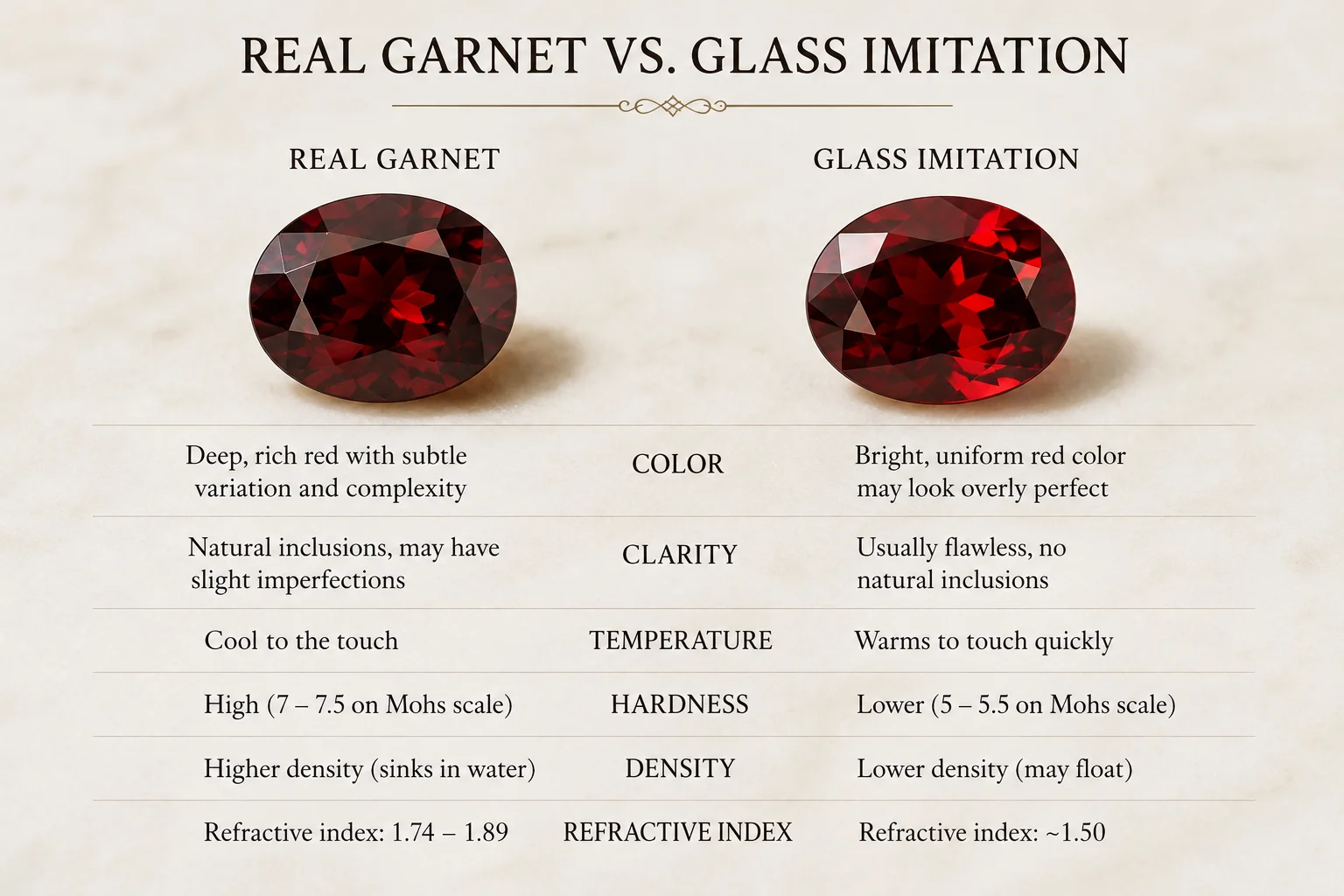
Real vs Fake Garnet: Identification Tests for Every Color
Garnet is a mineral group rather than one red gemstone. Natural garnets occur in red, orange, yellow, green, purple, pink, brown, black, colorless and color-changing varieties.
This diversity complicates identification. A dark red almandine, bright orange spessartine, vivid green tsavorite and brilliant demantoid do not share one narrow refractive index, density or inclusion pattern.
Common imitations include glass, synthetic spinel, cubic zirconia, synthetic corundum and assembled products. Materials such as YAG and GGG possess garnet-like cubic structures but do not match the chemistry of naturally occurring gem garnets and should not be represented as synthetic versions of ordinary natural garnet varieties.
A natural red stone can also be ruby, spinel, tourmaline or zircon rather than garnet. Consequently, color alone has almost no diagnostic value.
This page owns the direct authenticity workflow across the garnet group. The completed garnet buying guide retains quality and purchase selection.
Natural Garnet vs Common Imitations
| Feature | Natural garnet | Glass imitation | Synthetic spinel or corundum | YAG, GGG or other manufactured garnet-structure material |
|---|---|---|---|---|
| Material | Natural garnet-group silicate | Manufactured amorphous glass | Manufactured spinel or corundum | Manufactured crystal with garnet-type structure |
| Color range | Nearly every color | Any manufactured color | Any selected color | Colorless or many manufactured colors |
| Refraction | Singly refractive, with possible anomalous strain | Singly refractive | Spinel singly refractive; corundum doubly refractive | Generally singly refractive |
| Refractive index | Broadly about 1.714–1.888 | Usually lower, though glass varies | Material-dependent | Commonly different from natural garnet species |
| Specific gravity | Broadly about 3.47–4.15 | Variable | Material-dependent | Often distinctive |
| Mohs hardness | Approximately 6.5–7.5 | Commonly about 5–6 | Spinel about 8; corundum 9 | Commonly around 8 or otherwise product-dependent |
| Typical inclusions | Species- and locality-dependent crystals, needles, fingerprints and growth features | Round bubbles and flow lines | Synthetic growth features | Laboratory-growth inclusions |
| Best confirmation | Refractive index, spectrum, density, microscopy and chemistry | Standard gem testing | Standard gem testing | Instrumental identification |
The wide natural-garnet ranges make identification more complex than checking one expected number.
What Is Genuine Garnet?
The garnet meaning guide owns the group’s geology, symbolism and general structure.
Natural garnets share a common structural framework but vary chemically. Important end members include pyrope, almandine, spessartine, grossular, andradite and uvarovite.
Most faceted gems contain mixtures of more than one end-member composition. Rhodolite, for example, commonly belongs to the pyrope–almandine series rather than representing a separate mineral species.
The types-of-garnet guide owns the complete color and variety taxonomy.
Because chemistry varies continuously, gemologists often combine refractive index, absorption spectrum, density and color to classify a garnet.
Garnet Is Not Always Red
Red almandine and pyrope dominate inexpensive jewelry, which created the popular assumption that garnet must be dark red.
Spessartite garnet can be vivid orange. Grossular garnet includes green tsavorite, orange hessonite and pale colors.
Demantoid garnet is green andradite with strong dispersion. Uvarovite garnet usually forms small green crystals on matrix.
Purple, pink and color-change garnets also occur.
A stone does not become fake because it lacks the classic wine-red appearance.
Red Almandine Garnet
Almandine garnet commonly appears dark red, brownish red or purplish red.
It is relatively dense and often has a high refractive index that may exceed the range of standard refractometer fluids.
Natural inclusions can include rutile needles, mineral crystals, fingerprints and iron-stained fractures.
Very dark stones may transmit red light mainly around thin edges. That darkness is a quality issue rather than proof of imitation.
Pyrope Garnet
Pyrope garnet ranges from deep red to purplish red and can overlap ruby and red spinel visually.
Pure pyrope is uncommon in nature; commercial gems commonly contain almandine or spessartine components.
Chrome pyrope may show particularly strong red.
Refractive index, spectrum and density help separate pyrope-rich garnet from ruby or spinel.
Rhodolite Garnet
Rhodolite garnet is generally a purplish-red, raspberry or rose-purple pyrope–almandine garnet.
Its brighter color and fewer brown modifiers distinguish fine rhodolite from darker commercial red garnet.
The name is a trade variety rather than one strict mineral composition.
A seller should not use rhodolite for every pale red or purple garnet without supporting gemological properties.
The completed rhodolite garnet buying guide owns color and quality evaluation.
Spessartite Garnet
Spessartite contains manganese and commonly appears orange, reddish orange or brownish orange.
Vivid material may be sold as mandarin garnet, though the term should describe color quality rather than guarantee locality.
The spessartite garnet buying guide owns purchase criteria.
Orange glass, synthetic sapphire and zircon can imitate it. Refractive index, single refraction and absorption features support identification.
Hessonite Garnet
Hessonite garnet is an orange, brownish orange or reddish grossular variety.
Its interior may show a roiled, granular or heat-wave-like appearance sometimes described as treacly.
That characteristic can support identification but is not present equally in every stone.
Glass flow may appear superficially similar. A complete optical examination remains necessary.
Tsavorite Garnet
Tsavorite is vivid green grossular garnet colored principally by vanadium and chromium.
It is commonly cleaner and more brilliant than emerald and is not routinely filled with oil.
Green glass, synthetic spinel and other manufactured materials can imitate it.
The tsavorite-versus-emerald guide owns the complete distinction from emerald.
A fine green color alone does not prove tsavorite identity.
Demantoid Garnet
Demantoid is green andradite garnet and has exceptional dispersion.
Some Russian material contains radiating horsetail inclusions associated with chrysotile fibers. These inclusions can support origin and variety conclusions.
However, not every genuine demantoid has a horsetail. Similar-looking inclusions have also been imitated in manufactured glass.
The completed demantoid garnet buying guide owns variety-specific authenticity and value.
The completed sphene-versus-demantoid comparison separates two highly dispersive green gems.
Uvarovite Garnet
Uvarovite is chromium-rich green garnet that commonly forms small crystals coating a matrix.
Facetable crystals are extremely uncommon because individual crystals are usually tiny.
Large transparent green stones sold as uvarovite should be treated skeptically.
A bright green druzy surface may be natural uvarovite, dyed material or an assembled specimen. Matrix and crystal attachment deserve close inspection.
Purple and Color-Change Garnet
Purple garnet can involve pyrope–spessartine or other mixed compositions.
Color-change garnet may shift between greenish, gray, blue-green, purple and red under different light sources.
The phenomenon can resemble alexandrite, but garnet is singly refractive and has different density, refractive index and spectra.
A dramatic color change proves neither alexandrite nor garnet by itself.
Glass Imitations
Glass can imitate red, orange, green and purple garnet.
Round gas bubbles, curved flow lines, mold seams and a homogeneous interior are common clues.
Dark red glass may appear convincing because both glass and garnet can look almost black through the center.
Glass generally has lower hardness, lower density than many garnets and a different refractive index.
A deliberate scratch test remains destructive and unnecessary.
Synthetic Spinel and Synthetic Corundum
Synthetic spinel can imitate red, orange, green and colorless garnets. Synthetic corundum can reproduce red or orange shades.
Spinel is singly refractive like garnet, while corundum is doubly refractive.
Both materials have different refractive indices and densities.
Curved growth lines, gas bubbles and synthetic fluorescence may support manufacture, though modern material can be clean.
These are simulants, not synthetic natural-garnet counterparts.
YAG and GGG
Yttrium aluminum garnet and gadolinium gallium garnet crystallize in garnet-type structures.
They became important diamond simulants and have also been manufactured in several colors.
Despite their names, they do not match the chemistry of naturally occurring gem garnet species. Therefore, YAG should be described as YAG rather than synthetic pyrope, synthetic grossular or generic natural garnet.
YAG is relatively hard and brilliant. GGG is much denser.
Standard measurements commonly distinguish them from natural garnets.
Does Synthetic Garnet Exist?
Manufactured materials with garnet structures certainly exist, including YAG, GGG and specialized industrial crystals.
However, the phrase synthetic garnet is often used too loosely in jewelry descriptions. It may refer to a garnet-structure material that is not a laboratory-grown counterpart of any common natural gem garnet.
A seller should name the manufactured substance exactly.
The term laboratory-grown should not be used to imply equivalence with natural almandine, pyrope, grossular or spessartine unless the chemistry genuinely corresponds and the product is documented accordingly.
Garnet Doublets and Composites
Assembled stones can combine a natural garnet crown with colored glass or another material beneath it.
Historically, garnet-and-glass doublets were used to imitate ruby, sapphire and emerald.
A red garnet top can contribute hardness and luster while the colored cement or glass pavilion controls the face-up color.
Inspect the girdle for a join line, flattened bubbles and an abrupt change in inclusions.
Closed settings may conceal the assembly.
Ruby, Spinel and Garnet
Red garnet, ruby and spinel overlap visually.
Ruby is corundum with Mohs hardness 9 and double refraction. Spinel is cubic and commonly has a refractive index around 1.72, depending on composition.
Garnet is also cubic but spans a wide refractive-index and density range.
The planned ruby-versus-garnet-versus-spinel guide owns the full comparison.
Color and price cannot identify these materials safely.
Natural Zircon Versus Garnet
Red, orange and brown zircon can resemble garnet.
Zircon is doubly refractive and may show clearly doubled rear facet junctions.
Its density, refractive index and dispersion differ from most garnets.
The name zircon must not be confused with cubic zirconia, which is manufactured.
Single Refraction
Natural garnets crystallize in the cubic system and are normally singly refractive.
Under a polariscope, a garnet commonly remains dark through rotation.
Internal strain can produce anomalous double refraction, particularly in grossular and some other compositions.
Therefore, a light reaction does not automatically disprove garnet. Gemologists examine the pattern and combine it with other tests.
Refractive Index
Garnet’s refractive index spans roughly 1.714–1.888 across the group.
Lower-index measurements may indicate grossular- or pyrope-rich material, while andradite can exceed standard refractometer limits.
A single reading may classify the stone broadly but not provide an exact chemical composition.
Color and absorption spectrum help refine the conclusion.
Glass and many synthetic simulants fall outside the expected combination of refractive index, density and spectrum.
Specific Gravity
Garnet density varies widely.
Pyrope-rich material is generally lighter than iron-rich almandine or andradite. Grossular occupies another range.
This variation makes a universal home heft test useless.
Hydrostatic measurement on a loose stone can be highly informative when paired with refractive index.
Mounted stones cannot be tested accurately because metal contributes to the weight.
Absorption Spectrum
A handheld spectroscope can be valuable for garnet identification.
Almandine commonly shows iron-related absorption bands. Spessartine, pyrope, grossular and andradite display different patterns according to their chemistry.
Spectrum, refractive index and color form a traditional garnet-classification workflow.
Interpretation requires practice, suitable illumination and sufficient stone size.
Magnetism
Many iron- and manganese-bearing garnets respond to a strong magnet.
The strength varies with composition. Almandine and spessartine may show greater attraction than some grossular or pyrope-rich stones.
Magnetic response can support classification but cannot authenticate every garnet. Metal settings, nearby objects and magnet strength affect the test.
Glass and manufactured materials may also contain magnetic components.
Natural Inclusions
Inclusions vary by garnet type.
Demantoid may show horsetails. Almandine may contain rutile needles. Hessonite can display roiled structure. Spessartite may contain crystals, fingerprints and growth features.
A clean garnet is still possible.
Imitations can contain deliberately created internal features. Consequently, one expected inclusion should not become the entire conclusion.
Treatments
Most garnets are not routinely treated in the same way as sapphire, emerald or topaz.
However, heating, fracture filling, coating, dyeing, irradiation and other experiments or commercial treatments have been documented in selected material.
Reconstructed specimens and assembled products also occur.
A claim that garnet is never treated is therefore too absolute.
A laboratory report should be considered when treatment or rare-variety identity affects price materially.
Hardness and Durability
Garnet generally ranges from 6.5 to 7.5 on the gemstone hardness chart.
Most varieties lack cleavage and perform well in jewelry.
The completed garnet durability guide owns daily-wear decisions.
The completed garnet water-and-sunlight guide covers environmental care and treatment-dependent exceptions.
Hardness cannot separate natural garnet from harder simulants without damaging the stone.
Buying Real Garnet
The completed garnet buying guide should be used alongside the planned garnet quality and grading guide.
The garnet price guide owns broad values, while garnet price per carat retains size-based pricing.
Ask for the exact variety rather than accepting red garnet or green garnet as a complete description.
A high-value demantoid, tsavorite, color-change garnet or unusual purple garnet may justify laboratory testing.
For remote purchases, follow how to buy gemstones online.
Laboratory Reports
The gemstone-certification guide explains identification reports and their limits.
A laboratory can confirm garnet-group identity, classify the variety where possible and detect many simulants or assembled constructions.
Some mixed compositions do not fit one rigid species label, so reports may use variety or group terminology.
Use how to read a gem lab report to compare measurements, color and treatment wording with the actual stone.
Jewelry and Care
A garnet ring can perform well when the stone is secure and free from durability-threatening fractures.
A garnet bracelet faces more impact than garnet earrings or a garnet necklace.
Use the completed garnet jewelry cleaning guide for physical care.
Garnet’s calendar role remains within the January birthstone guide.
A Safe Home Screening Sequence
Observe the stone under neutral and warm light. Record its actual color rather than assuming garnet must be red.
Use a loupe to inspect inclusions, bubbles, flow lines and potential assembly planes.
A polariscope can test whether the stone is singly refractive, though anomalous strain must be considered.
Professional refractive-index, specific-gravity and spectroscope tests provide a much stronger classification.
Do not scratch the stone or rely on magnetic attraction alone.
For a rare or expensive variety, obtain an independent laboratory report.
Frequently Asked Questions
1. What is real garnet?
Real garnet is a naturally formed member of the garnet mineral group, which includes several species and mixed compositions.
2. Is every garnet red?
No. Natural garnet occurs in orange, green, yellow, pink, purple, brown, black, colorless and color-changing varieties.
3. Do synthetic garnets exist?
Manufactured garnet-structure crystals such as YAG and GGG exist, but they are not laboratory-grown equivalents of common natural pyrope, almandine or grossular garnets.
4. Are bubbles proof of fake garnet?
Round gas bubbles within homogeneous material strongly suggest glass, but one circular inclusion should be interpreted in context.
5. Can a real garnet be flawless?
Yes. Natural garnet can be eye-clean, especially in selected varieties and smaller sizes.
6. Is garnet always singly refractive?
Normally yes, because garnets are cubic. Internal strain can produce anomalous double-refraction patterns.
7. Can a scratch test authenticate garnet?
No. It can damage the stone and cannot classify the many garnet varieties accurately.
8. How can garnet be distinguished from ruby?
Ruby is doubly refractive corundum with greater hardness, while garnet is singly refractive and has different spectra, density and refractive index.
9. How can garnet be distinguished from glass?
Glass commonly has lower hardness, different density and round bubbles or curved flow. Instrument testing confirms the difference.
10. Are natural garnets treated?
Most are sold without routine enhancement, but treatments and assembled products do occur. Absolute untreated claims should not replace testing.
11. Does a horsetail inclusion prove Russian demantoid?
It can support a demantoid conclusion, but not every demantoid has one and convincing imitations have been manufactured.
12. When should garnet receive a laboratory report?
Testing is worthwhile for demantoid, tsavorite, color-change, large purple or unusually expensive stones whose precise identity affects value.
Garnet authenticity cannot be reduced to finding a heavy dark-red stone. The group spans multiple species, nearly every color and a broad range of optical properties. Reliable identification starts by confirming garnet-group behavior, then uses refractive index, density, spectrum and inclusions to determine which part of the group the stone occupies.
Garnet appears in Crystals That Start With G and Gemstones That Start With G.