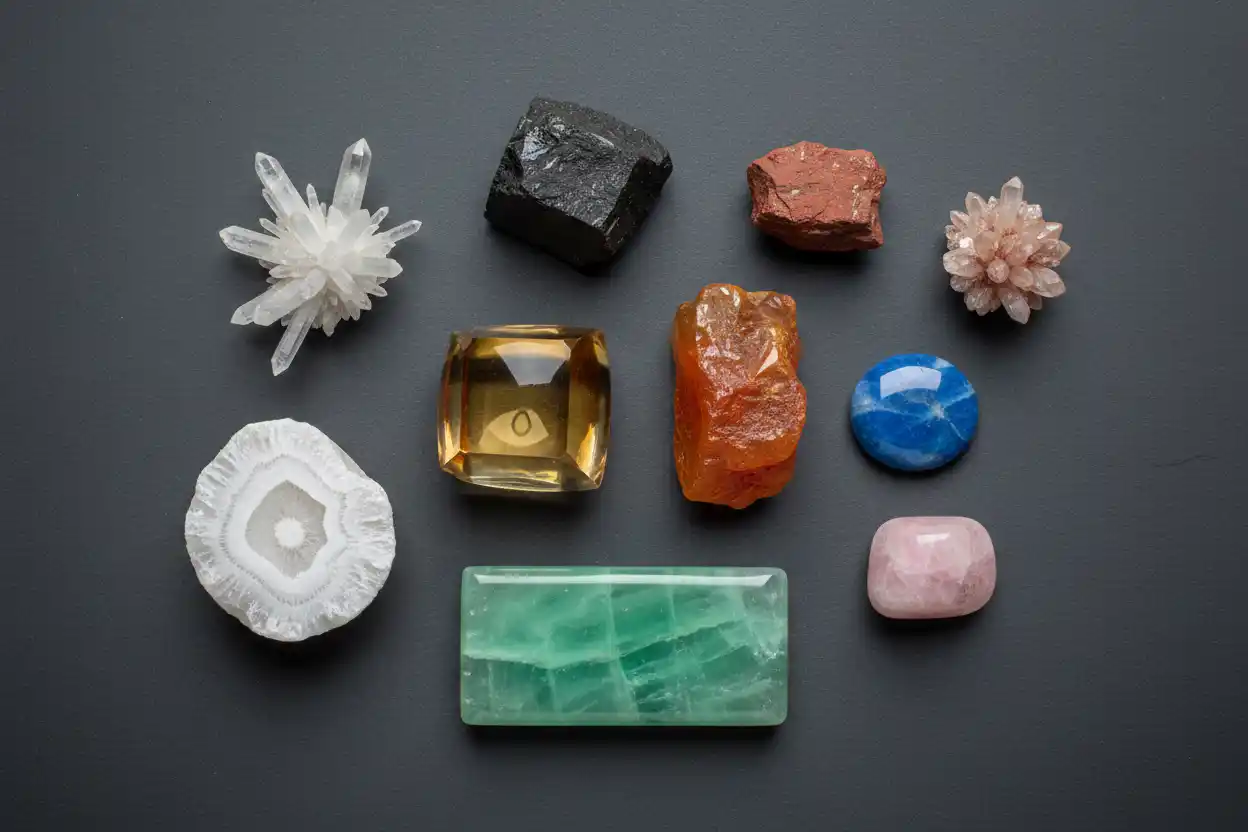
Types of Calcite: Colors and Varieties Explained
Calcite is one of Earth’s most abundant and visually diverse minerals. The same calcium carbonate composition can produce transparent optical crystals, sharp dogtooth points, cave formations, massive carving material, and colorful specimens ranging from white and honey-yellow to blue, green, orange, red, and vivid pink.
Most types of calcite are not separate mineral species. They are color varieties, crystal habits, textures, inclusion-rich materials, or trade names within the mineral described in the main calcite meaning and properties guide.
Calcite at a Glance
| Property | Calcite |
|---|---|
| Composition | Calcium carbonate, CaCO₃ |
| Mineral group | Calcite group; carbonate mineral |
| Main colors | Colorless, white, cream, yellow, honey, orange, red, pink, green, blue, brown, gray, and black |
| Crystal system | Trigonal |
| Typical habit | Rhombohedral, scalenohedral, prismatic, tabular, fibrous, stalactitic, botryoidal, and massive |
| Luster | Vitreous on crystal faces; pearly on cleavage surfaces; dull to waxy in massive material |
| Transparency | Transparent to opaque |
| Mohs hardness | 3 |
| Cleavage | Perfect rhombohedral cleavage in three directions |
| Tenacity | Brittle |
| Common uses | Mineral specimens, carvings, cabochons, optical demonstrations, decorative stone, and industrial raw material |
| Main care concern | Scratching, cleavage, acids, prolonged moisture, and damage from ultrasonic or steam cleaning |
How Calcite Types Are Classified
Calcite varieties are usually classified in four overlapping ways:
Color names such as blue calcite or orange calcite describe appearance. Chemical names such as cobaltocalcite indicate a trace element substituting into the crystal structure. Habit names such as dogtooth spar describe crystal shape. Trade names such as zebra calcite describe a visual pattern and may cover more than one mineralogical composition.
These categories should not be confused with different calcium carbonate polymorphs. Aragonite has the same chemical formula as calcite but a different crystal structure. Vaterite is another, much less stable polymorph. They are related minerals rather than calcite colors.
Likewise, dolomite and barytocalcite are distinct carbonate minerals with different compositions.
Colorless Calcite and Iceland Spar
Transparent colorless calcite is best known for strong double refraction. When a clear rhombohedron is placed over printed text, two images may appear because light splits into two rays traveling at different velocities through the crystal.
Historically, especially clear optical material became associated with Iceland spar. The term is now used more broadly for transparent, strongly birefringent calcite suitable for optical demonstrations, regardless of whether it came from Iceland.
Fine optical calcite should be transparent enough to show distinct image doubling. Internal fractures, cloudy zones, cleavage steps, and surface abrasion reduce both optical performance and value.
Although collectors prize clear crystals, calcite’s perfect cleavage makes faceting difficult. A cutter must work around three cleavage directions while preserving enough depth for light return.
White and Milky Calcite
White calcite is among the most widespread forms. It ranges from translucent crystals to opaque massive material, chalky aggregates, vein fillings, and portions of limestone or marble.
Milky appearance commonly results from microscopic inclusions, internal fractures, porosity, or extremely fine crystal texture. Snow-white calcite may be carved into spheres, towers, figurines, bowls, and decorative objects, although its softness means polished surfaces scratch readily.
The dedicated white calcite guide covers the white variety’s symbolism and material-specific appearance without turning every pale carbonate rock into calcite.
Calcite is also the main mineral in many limestones and in metamorphosed carbonate rock. The marble guide explains why a rock composed largely of calcite is not the same thing as a single calcite crystal.
Yellow Calcite
Yellow calcite ranges from pale lemon and cream-yellow to warm golden tones. Iron-bearing compounds, included minerals, organic matter, radiation-related color centers, or combinations of these factors may contribute to its color.
Translucent yellow material is commonly fashioned into palm stones, carvings, beads, and cabochons. Transparent crystals can be faceted as collector gems, although the finished stones require careful handling.
Commercial labels are inconsistent. Some sellers call nearly every yellow calcite “honey calcite,” while others reserve that term for deeper amber or golden material. The yellow calcite guide covers the broader yellow range.
Honey Calcite
Honey calcite normally describes translucent yellow, amber, caramel, or golden-brown calcite with a warm, syrup-like appearance. Many pieces show internal veils, cleavage flashes, and color zoning.
Mexico supplies much of the honey-colored carving and lapidary material seen in the retail market, although similar calcite occurs elsewhere. It is commonly cut into polished freeforms, spheres, obelisks, and cabochons rather than everyday ring stones.
Honey calcite is not defined by a fixed chemical threshold. Consequently, the boundary between honey, yellow, amber, and orange calcite depends partly on trade usage. The dedicated honey calcite guide retains the specific search intent for that name.
Orange Calcite
Orange calcite covers pale peach, apricot, tangerine, and saturated orange material. Iron-bearing inclusions and dispersed pigments commonly contribute to the color.
Most commercial orange calcite is translucent to opaque and massive. It accepts a good polish but can show scratches, cleavage bruises, or undercut areas if the texture is uneven.
Bright, evenly colored material is popular for carvings and decorative pieces. However, buyers should distinguish natural orange coloration from dyed or coated material, particularly when the color appears unnaturally concentrated in cracks.
The mineral-specific symbolism and care boundaries are discussed in the orange calcite guide.
Red Calcite
Red calcite ranges from muted brick-red and salmon to deeper reddish brown. Fine disseminated hematite or other iron-bearing phases often create the red color, although exact causes vary by deposit.
Most red material is massive and included rather than transparent. It may contain white calcite veins, darker matrix, or irregular color patches. These features are natural geological textures rather than automatically signs of poor quality.
The red calcite guide focuses on this variety, while a types article should only position it within the broader calcite color spectrum.
Pink Calcite
“Pink calcite” is a broad commercial description rather than one uniform variety. It may include pale manganese-bearing calcite, deeper cobalt-bearing material, pink massive calcite, or even mislabeled aragonite and carbonate rock.
A useful identification begins with tone and geological texture. Manganese-bearing calcite is often pale pink to blush, while cobalt-rich calcite can be vivid hot pink or magenta. Nevertheless, color alone cannot establish which trace element is present.
Some pink calcites fluoresce strongly under ultraviolet light, especially manganese-bearing material. Fluorescence supports identification but does not replace chemical or spectroscopic testing.
Mangano Calcite
Mangano calcite, also called manganocalcite in some contexts, contains manganese substituting for part of the calcium. It is commonly pale pink, rose, peach-pink, or nearly white.
Many specimens fluoresce pink, orange, or red under ultraviolet light because manganese can act as a luminescent activator. However, fluorescence intensity depends on composition and impurities.
Massive mangano calcite is used for carvings and polished pieces, while sharp crystals are retained as specimens. The mangano calcite guide owns the detailed discussion of its appearance, handling, and symbolism.
Cobaltocalcite
Cobaltocalcite is cobalt-bearing calcite, usually recognized by saturated pink, rose-red, crimson, or magenta colors. The cobalt substitutes for calcium within the calcite structure.
The finest collector specimens may display vivid crystals on contrasting matrix. Material from the Democratic Republic of the Congo has become especially prominent, although cobalt-bearing calcite occurs in other mining districts.
Because color and crystal quality vary widely, “cobaltocalcite” should not be applied to every bright pink carbonate without evidence. Dealers may also use “cobalto calcite” as a spaced trade spelling.
The dedicated cobaltocalcite guide covers this chemically defined variety in greater depth.
Blue Calcite
Blue calcite ranges from pale powder blue to gray-blue and more saturated sky-blue. Most material is translucent or massive rather than transparent.
Its color may relate to microscopic inclusions, lattice defects, trace impurities, or light scattering from its fine internal texture. Some commercial material contains white veining or brown matrix.
Blue calcite commonly comes from Mexico, Madagascar, and other carbonate-producing regions. However, locality claims should be supported by seller documentation rather than assumed from color.
The blue calcite guide retains the variety-specific meaning, identification, and buying discussion.
Green Calcite
Green calcite can be pale mint, yellow-green, gray-green, or deeper grassy green. Color may come from included chlorite, iron-bearing phases, nickel-bearing material, or other trace components depending on the deposit.
Most green calcite is massive and translucent. It often shows cloudy areas, white veining, cleavage flashes, and uneven saturation.
Strongly colored green material should be inspected for dye concentration in fractures and pores. The dedicated green calcite guide discusses the variety without duplicating the broader classification covered here.
Gray, Brown, and Black Calcite
Gray and brown calcite may owe their appearance to clay, organic matter, iron oxides, sulfides, hydrocarbons, or mixed mineral inclusions. Some pieces show attractive banding or smoky translucency.
Black calcite can contain finely dispersed manganese oxides, metallic minerals, carbonaceous matter, or other dark inclusions. Because several unrelated materials receive black-calcite trade labels, laboratory confirmation may be necessary for expensive or unusual specimens.
Dark calcite rarely enters fine jewelry, but distinctive crystals and mining-district specimens can have strong collector appeal.
Zebra Calcite and Banded Trade Material
Zebra calcite is a trade name for strongly banded material with alternating pale and dark layers. Cream, tan, brown, gray, black, and yellow bands are common.
Not every piece sold under this name is pure calcite. Some material may include aragonite, limestone, iron-rich carbonate layers, or other minerals. Sellers should avoid making precise mineralogical claims without testing.
The zebra calcite guide focuses on that market name and its variable composition.
Other banded carbonate materials may be sold as “onyx marble,” “Mexican onyx,” or “Pakistan onyx.” Those names usually refer to banded calcite or aragonite rather than true quartz onyx.
Calcite Crystal Habits
Color is only one way to classify calcite. The mineral produces hundreds of reported crystal forms and combinations, making habit especially important to collectors.
Rhombohedral Calcite
Rhombohedrons have slanted parallelogram faces and reflect calcite’s cleavage geometry. Even an irregular crystal can break into rhombohedral fragments because of its three perfect cleavage directions.
Dogtooth Spar
Dogtooth spar consists of sharp scalenohedral crystals that resemble canine teeth. These crystals commonly line cavities and hydrothermal veins.
Nailhead Calcite
Nailhead calcite has broad, flattened terminations on narrower stems. Individual crystals may resemble old-fashioned nails or mushroom-like caps.
Prismatic and Tabular Calcite
Prismatic crystals are elongated, while tabular examples are flattened. Both may combine with rhombohedral or scalenohedral faces.
Stalactitic and Botryoidal Calcite
Stalactitic calcite grows in hanging or columnar forms as mineral-rich water deposits calcium carbonate. Botryoidal surfaces resemble clusters of grapes or rounded bubbles.
Cave calcite, travertine, vein calcite, and hydrothermal crystals all record different fluid environments. Their form is geological evidence, not merely decoration.
Formation and Geological Environments
Calcite forms through many geological processes. Marine organisms build calcium carbonate shells and skeletons, which can accumulate into limestone. Metamorphism recrystallizes limestone into marble. Groundwater deposits calcite in caves, while hot springs build travertine terraces.
Hydrothermal fluids deposit calcite in veins alongside metallic ores, quartz, fluorite, barite, and sulfide minerals. Calcite also fills fractures and pore spaces in sedimentary rocks.
Because it dissolves and precipitates readily under near-surface conditions, calcite participates actively in the carbon cycle and groundwater chemistry. Its abundance contrasts sharply with the rarity of exceptionally transparent, colorful, or sculptural collector specimens.
Inclusions and Optical Effects
Calcite may contain fluid inclusions, gas bubbles, clay, hematite, manganese oxides, sulfides, hydrocarbons, plant-related organic matter, or other minerals.
Transparent calcite’s strongest optical effect is double refraction. In included material, internal veils and cleavage reflections may produce bright flashes, but these are not the same as adularescence or labradorescence.
Fibrous or included calcite can occasionally show chatoyancy, although such stones are uncommon. Attractive patterns may also result from zoning, phantom growth, included sand, or intergrowth with other minerals.
Calcite Lookalikes
Calcite can resemble aragonite, dolomite, gypsum, fluorite, barite, quartz, feldspar, and several soft carving materials.
Hardness provides a useful first distinction. Calcite defines Mohs hardness 3 and can be scratched by a copper coin or steel tool, although destructive tests should not be used on finished pieces. The gemstone hardness chart places calcite among the softer jewelry materials.
Calcite’s perfect cleavage separates it from quartz, which has no cleavage. The gemstone cleavage guide explains why rhombohedral fragments are diagnostically useful.
Reaction with dilute acid is another classic test, but acids permanently etch polished calcite. Buyers should rely on a gemologist or mineral laboratory rather than performing acid tests on valuable objects. The general crystal identification guide covers safer observation methods.
Treatments, Synthetics, and Imitations
Dyeing is the most relevant calcite treatment. Porous massive material and fracture-rich crystals can absorb vivid blue, green, pink, purple, or orange dyes. Color may concentrate along cracks, cavities, drill holes, and surface-reaching pores.
Wax, resin, oil, or clear coatings may improve polish or temporarily hide surface dryness. Fracture filling is possible but should be disclosed when it materially affects stability.
Synthetic calcite is produced for industrial, optical, and scientific purposes, yet it is not a major substitute in ordinary gemstone jewelry because natural calcite is abundant and inexpensive. Glass, resin, dyed gypsum, aragonite, and reconstructed carbonate material are more likely imitations.
Treatment terminology and disclosure standards are explained in the broader gemstone treatments guide.
Cutting Behavior
Calcite is challenging to facet because its hardness is only 3 and it has perfect cleavage in three directions. A lapidary must orient the rough carefully, use light pressure, and avoid generating heat or vibration.
Transparent material can produce bright collector gems with visible double refraction. However, facet edges abrade quickly, and finished stones are unsuitable for exposed daily-wear rings.
Massive calcite is easier to shape into cabochons and carvings, but hidden cleavage planes can cause sudden breaks. Uneven textures may also undercut during polishing, leaving soft areas lower than surrounding material.
Durability and Jewelry Suitability
Calcite scratches easily in normal wear. Household dust commonly contains quartz particles that are much harder than calcite, so even wiping a dusty surface can create fine scratches.
Perfect cleavage also allows a sharp blow to split the stone. The difference between scratching and breaking is covered in gemstone toughness versus hardness.
Calcite works best in pendants, earrings, brooches, beads, carvings, and display pieces. A protected ring can be worn occasionally, but replacing a scratched or cleaved stone may be more practical than repolishing it.
Calcite Prices in 2026
Most calcite is affordable, but price depends more on color, crystal form, locality, aesthetics, and specimen quality than on weight alone.
Small tumbled pieces and ordinary rough commonly retail for $2–$15. Polished palm stones, spheres, carvings, and ordinary cabochons often range from $8–$60, depending on size and finish.
Current cabochon listings show many large calcites priced around $8–$25 per stone, often well below $1 per carat. Transparent faceted collector stones may cost approximately $20–$150, while unusually clean, large, or expertly cut examples can sell for more.
Collector specimens commonly range from $20 to several hundred dollars. Exceptional cobaltocalcite, classic mining-locality crystals, large optical rhombohedrons, dramatic inclusions, and aesthetic combinations with other minerals may reach the high hundreds or thousands.
The general gemstone pricing guide explains why specimen aesthetics and provenance can outweigh carat weight.
Buying Guidance
First determine whether the piece is a mineral specimen, carving, cabochon, faceted collector gem, or trade-name decorative stone. Each category requires a different quality assessment.
For crystals, check terminations, luster, contact damage, repairs, and matrix stability. For carvings and cabochons, examine the polish under side lighting to reveal scratches, wax, pits, and undercut areas.
Ask whether vivid color is natural, dyed, coated, or unknown. A seller should also disclose repairs, glue, resin stabilization, and any uncertainty about trade names such as zebra calcite or onyx marble.
The dedicated calcite buying guide owns detailed seller checks and counterfeit warnings.
Cleaning Calcite
Use a dry microfiber cloth or a brief wash with lukewarm water and mild soap. Apply almost no pressure and dry the piece immediately.
Avoid vinegar, lemon juice, bathroom cleaner, descaling products, bleach, and acidic jewelry solutions. Even mild acids can etch calcite and destroy its polish.
Prolonged soaking is unnecessary. The general guide to crystals in water explains why mineral stability depends on more than whether a stone dissolves instantly.
Steam and ultrasonic cleaning are poor choices for calcite because heat, vibration, cleavage, repairs, and included zones create avoidable risks. Check the guide to ultrasonic-safe gemstones before using any machine.
Sunlight and Storage
Natural calcite may tolerate ordinary room light, but strong direct sunlight can overheat specimens and may fade dyes or unstable color components. The guide to crystals that fade in sunlight covers broader light-sensitivity considerations.
Store calcite in a padded compartment away from quartz, topaz, sapphire, and metal jewelry. Do not stack heavy specimens on delicate dogtooth clusters.
Spiritual cleansing practices should avoid salt, acids, prolonged water, smoke residue, and windowsill heat. Safer non-contact options are summarized in the dedicated guide to cleansing calcite.
Meaning and Symbolism
Calcite has acquired different symbolic associations according to color. Clear material is often linked with clarity, white with simplicity, yellow and honey tones with confidence, orange with creativity, pink with compassion, green with renewal, and blue with calm communication.
These interpretations come from modern spiritual traditions, color symbolism, and personal practice. They do not arise from measurable mineralogical differences beyond the chemistry or inclusions that create color.
The dedicated calcite color meaning guide owns the detailed symbolic comparison among colors.
Frequently Asked Questions
1. How many types of calcite are there?
There is no fixed number. Calcite has many color varieties, trace-element varieties, crystal habits, textures, locality names, and trade labels, but they share the same basic calcium carbonate structure.
2. Is Iceland spar a different mineral from calcite?
No. Iceland spar is exceptionally transparent optical calcite, traditionally associated with Iceland and valued for clearly displaying double refraction.
3. What is the difference between honey calcite and yellow calcite?
Honey calcite usually describes warmer amber, caramel, or golden material. Yellow calcite is the broader color category, and sellers do not apply the boundary consistently.
4. Is mangano calcite the same as cobaltocalcite?
No. Mangano calcite contains manganese and is commonly pale pink. Cobaltocalcite contains cobalt and can show much stronger rose, magenta, or crimson colors.
5. Is blue calcite naturally blue?
Natural blue calcite exists, although dyed material also enters the market. Natural pieces usually show variable saturation, inclusions, and geological texture rather than concentrated dye in fractures.
6. Is zebra calcite a formally defined variety?
No. Zebra calcite is a trade name for banded material. Some pieces may include aragonite, limestone, iron-rich layers, or other carbonate minerals.
7. How is calcite different from aragonite?
Both have the formula CaCO₃, but their atoms are arranged in different crystal structures. Calcite is trigonal, whereas aragonite is orthorhombic.
8. Can transparent calcite be faceted?
Yes, but its softness and three perfect cleavage directions make cutting difficult. Faceted calcite is primarily a collector gem rather than a durable everyday jewelry stone.
9. Why does calcite fizz in acid?
Acid reacts with carbonate in the mineral and releases carbon dioxide gas. Because this reaction damages the surface, acid testing should not be performed on polished or valuable pieces.
10. Can calcite go in water?
Brief contact with clean lukewarm water is usually manageable, but prolonged soaking, acidic water, saltwater, and hot water can dull, etch, or weaken the surface.
11. Is dyed calcite common?
Yes. Porous and fracture-rich calcite accepts dye readily. Concentrated color in cracks, drill holes, and surface pits can indicate treatment.
12. Which calcite type is most valuable?
Exceptional collector specimens—especially vivid cobaltocalcite, classic locality crystals, large optical calcite, and aesthetic mineral combinations—can be far more valuable than ordinary polished material.
Calcite’s remarkable range comes from color-producing impurities, inclusions, crystal growth, geological environment, and trade naming rather than dozens of unrelated minerals. Learning to separate true chemical varieties from colors, habits, rocks, and marketing labels makes the entire family easier to understand. Additional C entries appear in the crystals that start with C directory and the gemstones that start with C guide.