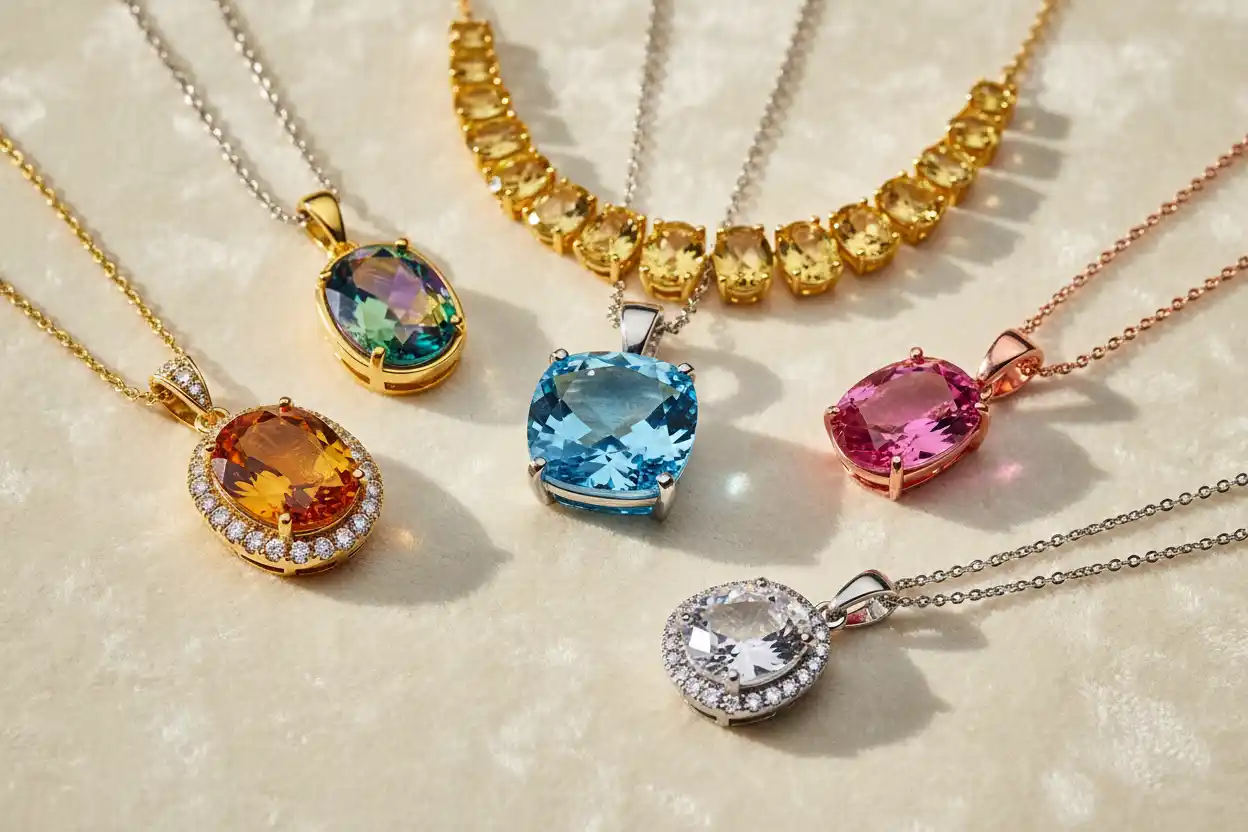
Topaz Necklaces and Pendants Guide
Topaz necklaces can showcase large, clean gemstones in colors ranging from colorless and blue to yellow, peach, orange, pink, red-brown and iridescent rainbow. Because substantial Topaz crystals are available, pendants often offer more visible size than comparable jewelry made with rarer colored gems.
Necklaces are also physically well suited to Topaz. The gemstone has strong scratch resistance but poor toughness because of cleavage. Keeping it away from the hands reduces impact risk, provided the setting, bail, chain and clasp can safely support the stone.
Topaz Necklaces at a Glance
| Feature | What to Consider |
|---|---|
| Mineral | Topaz |
| Composition | Aluminum fluorosilicate |
| Colors | Colorless, blue, yellow, brown, orange, pink and red |
| Mohs hardness | 8 |
| Toughness | Poor because of cleavage |
| Popular formats | Solitaire pendant, halo, station, lariat and graduated necklace |
| Best setting | Low bezel or substantial protected prongs |
| Most common treatment | Irradiation and heat for blue Topaz |
| Coated material | Mystic Topaz |
| Main construction concern | Bail and chain strength |
| Safe cleaning | Warm water, mild soap and a soft brush |
| Main necklace advantage | Large visible stones with relatively low impact |
Why Necklaces Suit Topaz
Topaz takes a crisp polish and often occurs in large transparent crystals. This makes it especially attractive for pendants, where visible size can be enjoyed without placing the gemstone on the hand.
A necklace also limits the effect of the gem’s cleavage weakness. The stone remains less likely to strike desks, tools and hard countertops than it would in a ring or bracelet.
Long pendants still need care because they can swing against sinks, tables or seat belts. A secure, well-positioned setting remains important.
The completed Topaz meaning guide owns the mineral’s general formation and properties. This page concentrates on necklace design, buying and wear.
Solitaire Topaz Pendants
A solitaire pendant places one Topaz at the center of the design.
Ovals and cushions are common because they use the rough efficiently. Pear cuts create a natural vertical drop, while rounds provide symmetry.
Emerald and step cuts can look especially clean in colorless, blue and pale warm material. Their broad facets also reveal windowing and inclusions clearly.
The setting should remain proportionate to the stone. A large Topaz on a very fine chain may look elegant but create an obvious structural weak point.
A pendant should hang flat rather than turning constantly sideways.
Bezel-Set Pendants
A bezel surrounds most or all of the Topaz girdle with metal.
It offers strong edge protection and reduces snagging. The setting can be especially valuable for pointed or step-cut stones whose corners require additional care.
Closing a bezel around Topaz demands skill. Excessive pressure can interact with the mineral’s cleavage and cause breakage.
A full bezel creates a clean modern outline. A partial bezel admits more visual space while protecting selected sides.
The metal border may slightly reduce apparent size, but the durability benefit is often worthwhile.
Prong-Set Pendants
Prongs expose more of the gemstone and allow easy cleaning around the sides.
Four-prong settings create an open appearance but provide less redundancy. Six-prong designs offer added security for larger round or oval stones.
The prongs should not rest directly over surface-reaching fractures.
Pear and marquise cuts need V-shaped protection at their points.
A low basket is safer than a high projecting setting. Because Topaz can be large and heavy, every prong must remain proportionate to the stone.
Halo Pendants
A halo surrounds the center Topaz with smaller gems.
Diamond, white Sapphire and colorless Zircon can brighten Blue, Imperial or pink Topaz. A halo also increases the complete visible outline without requiring the largest possible center.
The harder accent stones must remain separated from the Topaz girdle.
Multiple small settings collect cosmetics and residue, so access for cleaning matters.
A compact single halo generally offers a better balance of protection, weight and maintenance than a high double halo.
The center stone should remain visually dominant.
Topaz Station Necklaces
Station necklaces place several Topaz gems at intervals along a chain.
This design uses fewer stones than a complete line necklace and creates a lighter appearance.
Bezel stations protect individual gems and help keep them facing forward.
The chain connections should remain substantial enough for the gemstone weight. Thin solder joints may fail before the stones show damage.
Color can remain uniform or progress intentionally from pale to dark. Random differences in treatment or tone may look accidental.
Graduated Topaz Necklaces
A graduated necklace places larger gems near the center and progressively smaller stones toward the clasp.
Blue and colorless material is readily available in calibrated suites. Matching natural Imperial, pink or red Topaz is much more difficult.
The progression should remain smooth in size, color and cutting.
One heavily windowed or unusually dark stone can disrupt the complete line.
A valuable graduated necklace benefits from a box clasp with a secondary safety mechanism and, when practical, one or two retained replacement stones.
Topaz Lariats and Y-Necklaces
Lariat and Y-necklace designs create a vertical drop below the neckline.
Pear-shaped and elongated Topaz cuts suit this structure.
A long drop moves more than a short pendant, helping the facets catch light while increasing the risk of impact.
The slider or adjustment mechanism must hold securely.
Two gemstone ends should not strike each other. Their lengths and attachment points should create separation.
Remove a long lariat before leaning over hard work surfaces.
Blue Topaz Necklaces
Blue Topaz pendants are widely available in large sizes.
Most commercial material is irradiated and heated. The process produces shades commonly marketed as Sky, Swiss and London Blue.
Pale blue can look delicate in white metal. Bright Swiss-type colors create stronger visual presence, while darker London Blue may appear more formal.
The completed London Blue Topaz guide covers the darker trade variety.
The Aquamarine versus Blue Topaz guide explains why the two gems differ in composition, density, treatment and color character. A broader comparison appears in Aquamarine versus Topaz.
Other blue alternatives appear in the blue gemstones guide.
Imperial Topaz Necklaces
Imperial Topaz occupies the prized warm-color range.
Commercial definitions differ, but the term is commonly used for yellow-orange, peach, orange, pinkish-orange and reddish material.
A pendant is an excellent format for fine Imperial Topaz because it can display a larger gemstone without exposing it to ring-level impact.
Saturated red and pink modifiers can increase rarity and value.
Yellow and rose gold complement the warm palette. White metal creates stronger separation.
A significant natural-color stone may justify an independent laboratory report.
Pink and Red Topaz Necklaces
Natural pink and red Topaz is uncommon and can be valuable.
Small stones may appear pale, while a larger pendant can display stronger saturation.
Treated or coated pink material also exists. Written disclosure becomes important when the price depends on natural color.
A halo may define a light pink center, but the accents should not press against the Topaz.
The pink gemstones guide provides alternative stones, while reddish-orange gems can be compared through the orange gemstones guide.
Yellow and Golden Topaz Necklaces
Yellow Topaz can appear pale straw, golden yellow, brownish yellow or orange-yellow.
It is one of the traditional November birthstone choices and may be confused with Citrine.
The completed Citrine versus Yellow Topaz comparison explains their different mineral identities.
The Yellow Topaz guide focuses on the variety itself. The yellow gemstones guide provides broader color options.
Yellow gold produces a harmonious appearance, while white metal can make the warm color more distinct.
White Topaz Necklaces
White Topaz offers a colorless appearance and can be cut into substantial pendants.
Its brilliance depends heavily on cut and cleanliness. Skin oil, lotion and soap residue quickly reduce the effect.
White Topaz is not a form of Diamond and should not be marketed as equivalent.
The completed White Topaz guide explains its identity.
The white gemstones guide compares colorless Topaz with Sapphire, Zircon, Quartz and other transparent options.
A pendant is practical because it protects facet edges better than a daily ring.
Mystic Topaz Necklaces
Mystic Topaz receives a thin surface coating that creates an iridescent rainbow effect.
Pendants and earrings are generally safer for this material than bracelets and rings because the coating receives less abrasion.
The back and edges may remain vulnerable during setting, repair and cleaning.
Abrasive compounds, polishing wheels and harsh cleaners can remove or scratch the color layer.
Store the pendant separately and inform any jeweler that the gem is coated before repair.
Evaluating Color
Examine the gemstone in more than one lighting environment.
Pale Blue Topaz may appear almost colorless in bright light. Dark London Blue can reveal gray or green modifiers indoors.
Warm natural colors may show pleochroism, meaning the hue changes slightly with direction.
Color should remain attractive when the pendant hangs naturally, not only when it is tilted beneath a display lamp.
The planned Topaz color meaning guide will own symbolism by shade, while the completed types of Topaz guide explains gem varieties and trade descriptions.
Evaluating Clarity
Blue, White and much yellow Topaz is commonly eye-clean.
Visible fractures and inclusions matter more in high-value warm colors when they affect beauty or structural condition.
Inspect the stone from the side and back. A mounting can conceal fractures near the girdle.
A large clean stone is not automatically rare when it is treated Blue or White Topaz. Color origin and treatment have a substantial effect on value.
Filling or coating should be disclosed.
Evaluating Cut
A well-cut Topaz should return light evenly and present an attractive face-up size.
A shallow stone may show a transparent window through its center. Excessive depth preserves weight while making the gem look smaller.
Dark extinction can affect strongly saturated material.
Facet junctions should remain crisp. Chipped corners and abraded girdles indicate wear or weak protection.
The bail and setting should hold the stone straight so the cut remains symmetrical when worn.
Carat Weight and Dimensions
Topaz can occur in very large crystals, so substantial carat weights are not necessarily rare in common colors.
Compare length, width and depth in millimeters rather than judging by weight alone.
A deep 20-carat stone may appear less impressive than a well-proportioned lighter gem.
The complete pendant weight also affects chain selection. Metal, accents and bail construction add to the load.
Large size should not compensate for poor cutting, weak color or structural fractures.
Treatments and Imitations
Most Blue Topaz is irradiated and heated. Mystic Topaz receives a coating.
Other colors may be heated, coated or otherwise modified.
The planned treated or synthetic Topaz guide owns the full treatment intent.
Glass, cubic zirconia, synthetic materials and other natural gems can imitate Topaz. The completed real-versus-fake Topaz guide explains identification limitations.
A substantial natural pink, red or Imperial pendant deserves stronger documentation than a routine mass-market Blue Topaz piece.
Necklace Length
A collarbone-length chain works well for many solitaire pendants.
Longer chains suit high necklines and large statement stones but allow greater swinging.
An adjustable chain provides flexibility when the wearer’s preferred position is uncertain.
Measure an existing necklace rather than depending solely on labels such as princess or matinee.
Large pendants may require slightly more length to lie flat and avoid crowding the neckline.
Choosing the Chain
Cable chains provide a simple and reliable foundation.
Box and wheat chains offer more structural substance for large Topaz pendants.
Snake chains create a smooth appearance but can kink when stored incorrectly. Rope chains add texture that may compete with a complex setting.
The chain should support the complete pendant weight with a reasonable safety margin.
Confirm whether the advertised pendant price includes the chain.
Bail Construction
The bail carries the entire pendant weight.
A fixed bail controls orientation but limits chain compatibility. A hinged bail provides movement and may help the stone settle flat.
Hidden bails create a seamless appearance. Enhancer bails attach to pearls or thicker necklaces but require secure hinges.
The chain must pass through without binding.
A large Topaz should not depend on a thin, decorative bail that cannot support repeated movement.
Clasp Security
Lobster clasps suit many pendant chains.
Graduated and line necklaces benefit from box clasps with secondary safety mechanisms.
Magnetic clasps may release unexpectedly and are rarely ideal for valuable Topaz.
Connecting rings should be soldered or sufficiently strong.
Test the clasp several times before purchase. It should engage positively without gaps or sharp edges.
Choosing the Metal
White gold and platinum emphasize Blue and White Topaz.
Yellow gold complements Imperial, yellow, brown and orange material.
Rose gold suits pink and peach colors.
Sterling silver is widely used for affordable Blue Topaz, but the chain, bail and prongs still need appropriate strength.
Metal sensitivity and maintenance requirements should be considered alongside appearance.
November Birthstone Necklaces
Topaz is one of November’s birthstones, together with Citrine.
The completed November birthstone guide explains the history and alternatives.
An adjustable pendant is a practical birthstone gift because it avoids ring and wrist sizing.
Blue Topaz provides a modern cool-colored choice, while yellow and Imperial shades create a warmer seasonal appearance.
The completed November birthstone jewelry guide compares necklace gifts with other formats.
Comparing Other Topaz Jewelry
Topaz earrings offer similarly low impact and avoid chain-length decisions.
A Topaz bracelet displays several stones but receives more desk contact.
A Topaz ring places the gem in the most visible position while demanding stronger protection.
A necklace is generally the best format for an unusually large, valuable or surface-coated Topaz.
Price and Documentation
Color, treatment, clarity, cut, size and craftsmanship affect price.
Commercial Blue and White Topaz is often affordable even in large sizes. Fine natural pink, red and Imperial Topaz can be much more valuable.
The completed Topaz price guide provides detailed value context.
A laboratory report can identify the material as natural or laboratory-grown and state detectable treatments. It does not assign a standardized Topaz quality grade.
An appraisal documents the complete necklace and replacement value but serves a different purpose.
Cleaning
Clean Topaz with warm water, mild soap and a soft brush.
Support a heavy pendant over a bowl or closed drain. Work gently around the bail, gallery and chain links.
Rinse briefly and dry completely.
Avoid steam, ultrasonic equipment, high heat and thermal shock.
Mystic Topaz requires particularly gentle treatment because abrasives and polishing can damage its coating.
The completed guide to cleaning Topaz jewelry provides detailed instructions.
Storage
Fasten the clasp before storage to reduce tangling.
Lay long necklaces flat or hang them from an appropriate organizer. Prevent heavy pendants from swinging inside a travel case.
Keep Topaz separate from Diamond and Sapphire. It can also scratch Quartz, feldspar and softer gemstones.
Protect coated surfaces from rubbing against metal.
Topaz appears in the crystals beginning with T and gemstones beginning with T directories.
Final Perspective
Topaz necklaces allow the mineral’s clarity, color range and naturally large crystal sizes to be used with less impact risk than hand jewelry. The format is especially effective for Blue, White, Imperial and coated Mystic Topaz.
A good purchase still depends on construction. The chain, clasp and bail must support the total weight, while the setting should protect cleavage-sensitive edges. Once those requirements are met, color and cutting can determine the final style.
Frequently Asked Questions
1. Is Topaz suitable for necklaces?
Yes. Necklaces protect Topaz from much of the impact experienced by rings and bracelets, making them one of its safest formats.
2. Which pendant setting protects Topaz best?
A low full or partial bezel provides strong edge protection. Substantial prongs can also work when correctly positioned.
3. Are most Blue Topaz pendants treated?
Yes. Most Blue Topaz has been irradiated and heated to create or strengthen the color.
4. Is irradiated Topaz safe to wear?
Properly processed and legally released irradiated Topaz is considered safe for ordinary jewelry use.
5. What is the best chain for a large Topaz pendant?
A properly proportioned cable, box or wheat chain can work well. The bail and clasp must also support the weight.
6. Is Imperial Topaz naturally colored?
Fine natural Imperial-colored material exists. Because trade definitions and treatments vary, valuable stones deserve clear disclosure.
7. Is Mystic Topaz suitable for necklaces?
Yes. Necklaces protect the surface coating better than rings and bracelets, although abrasive cleaning and polishing must still be avoided.
8. Is White Topaz a Diamond substitute?
It can provide a colorless appearance at lower cost, but it differs from Diamond in hardness, dispersion, durability and value.
9. How can Topaz be distinguished from Aquamarine?
They differ in composition, density, optical properties and treatment. Professional testing is safest for valuable stones.
10. Does a Topaz pendant need a laboratory report?
Routine Blue or White Topaz may not. Reports become more useful for expensive pink, red, Imperial or unusually represented stones.
11. Can Topaz necklaces be cleaned ultrasonically?
No. Warm soapy water is recommended because heat and vibration can damage cleavage-prone Topaz.
12. How should a Topaz necklace be stored?
Fasten the chain and place it in a padded compartment away from harder gemstones and heavy jewelry.