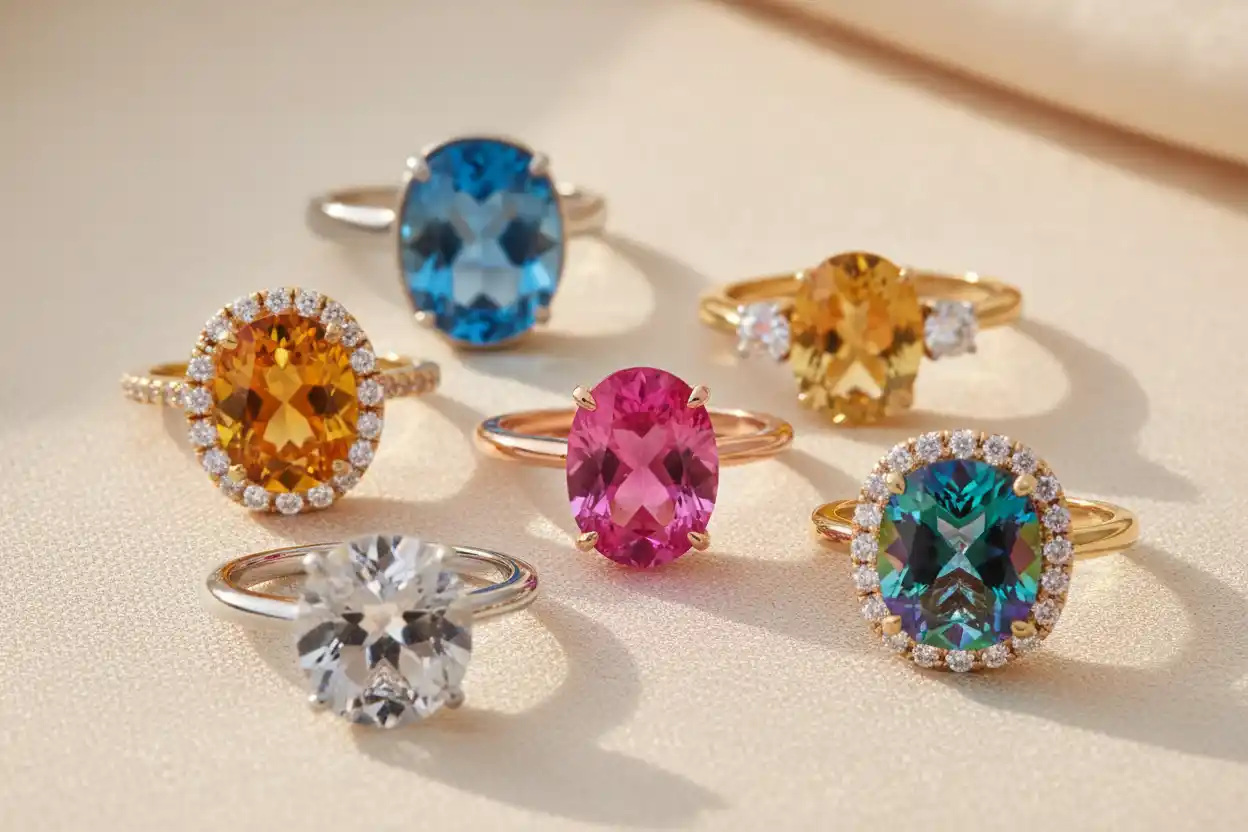
Topaz Rings: Styles and Buying Tips
Topaz rings combine crisp brilliance with colors ranging from icy colorless and bright blue to yellow, orange, peach, pink, red-brown and rainbow-coated. Large stones are readily available in several common colors, making Topaz attractive for statement rings and substantial center-stone designs.
The mineral’s durability requires careful explanation. Topaz ranks 8 on the Mohs scale and resists many scratches, but it has strong cleavage and poor toughness. A ring can therefore retain sharp facets yet split after a concentrated blow or excessive setting pressure.
Protective design, sensible wear and accurate treatment disclosure are more important than hardness alone.
Topaz Rings at a Glance
| Feature | What to Consider |
|---|---|
| Mineral | Topaz |
| Composition | Aluminum fluorosilicate |
| Common colors | Colorless, blue, yellow, brown, orange, pink and red |
| Mohs hardness | 8 |
| Toughness | Poor because of cleavage |
| Best settings | Low bezel, protective halo and substantial prongs |
| Popular ring styles | Solitaire, halo, three-stone, cluster and cocktail |
| Most common treatment | Irradiation and heat for blue Topaz |
| Coated variety | Mystic Topaz |
| Daily-wear suitability | Careful wear with a protective setting |
| Safest cleaning | Warm water, mild soap and a soft brush |
| Main risk | Cleavage damage from impact or pressure |
Is Topaz Suitable for Rings?
Topaz can be worn in rings, but the setting and wearer must account for its cleavage.
The gem’s Mohs hardness of 8 helps preserve polish and facet edges against many ordinary materials. It is harder than Quartz, feldspar and most glass.
However, a hard strike from the wrong direction can split it. This makes toughness—not surface hardness—the principal ring concern.
A low protected design may tolerate careful regular wear. High projecting stones, long exposed points and large cocktail settings are safer for occasional use.
The completed Topaz meaning guide owns the mineral’s geology and broad properties. This page focuses on ring style, durability and buying.
Topaz Solitaire Rings
A solitaire places one Topaz at the center of the ring.
Ovals and cushions are common because they preserve rough and provide substantial face-up size. Rounds create symmetry, while pears and emerald cuts offer distinctive shapes.
A high basket admits more side light but increases snagging and impact risk.
A low setting keeps the gem closer to the finger and is generally more practical.
The shank should remain wide enough to stabilize a large center. Top-heavy rings can rotate constantly, exposing the gemstone to additional impact.
Bezel-Set Topaz Rings
A bezel surrounds most or all of the girdle with metal.
It provides strong edge protection and creates a smooth profile. This makes it one of the best settings for a cleavage-prone Topaz ring.
Setting pressure must be controlled carefully. The jeweler should not force metal over a fracture or vulnerable cleavage direction.
Full bezels offer maximum protection. Partial bezels reveal more of the stone but leave selected edges exposed.
A bezel may make the center appear slightly smaller, yet the durability benefit often outweighs that visual difference.
Prong-Set Rings
Prongs expose more of the gemstone.
Four-prong settings create an open appearance but provide less redundancy. Six prongs can offer better retention for round and oval stones.
Every prong should contact the stone evenly. Excess pressure at one point can be dangerous.
Pear and marquise cuts require V-shaped protection over their tips. Emerald-cut corners also need substantial support.
Low baskets are preferable for frequent wear. Thin high claws are more likely to bend or catch.
Halo Rings
A halo surrounds Topaz with smaller accent stones.
The design enlarges the overall outline and can strengthen contrast around Blue, Imperial, pink or White Topaz.
A low halo may also protect portions of the center stone’s edge.
Diamond and Sapphire accents are harder than Topaz. Their girdles should not touch the center gem directly.
A compact single halo is easier to clean and less exposed than a tall double halo.
The ring should remain balanced rather than relying on an oversized surround to compensate for weak center-stone color.
Three-Stone Rings
Three-stone designs may combine Topaz with Diamond, Sapphire or other Topaz colors.
Tapered baguette or pear-shaped side stones frame an oval or cushion center effectively.
Hard side stones need sufficient separation from the Topaz.
A trio of Topaz gems requires careful matching in cut, tone and treatment. A blue center with White Topaz sides can create contrast at a lower price than Diamond accents.
The complete setting should remain comfortable between adjacent fingers.
Cluster Rings
Cluster rings use several small Topaz gems to create a broad decorative surface.
Blue and White Topaz clusters are common because calibrated stones are widely available.
Natural Imperial, pink or red clusters are rarer and may show more color variation.
Every small prong creates a maintenance point. The structure beneath the cluster should remain strong and accessible for cleaning.
Large raised clusters are better suited to occasional wear because they strike surrounding objects more easily.
Cocktail Rings
Topaz is particularly well suited to visually large cocktail rings because common colors occur in substantial crystal sizes.
A large London Blue, White or golden stone can create dramatic finger coverage without the cost associated with rarer gems of similar size.
The setting should not assume that size and hardness make the stone rugged. A broad exposed girdle remains vulnerable to impact.
Low bezels and substantial galleries improve security.
Cocktail rings should usually be removed before work, exercise and household activity.
Blue Topaz Rings
Blue Topaz is the most common commercial ring variety.
Most material has been irradiated and heated. Natural blue exists but is uncommon.
Sky Blue provides a pale look, Swiss Blue creates bright saturated cyan, and London Blue appears darker with gray or greenish modifiers.
The London Blue Topaz guide explains the darker trade variety.
The completed Aquamarine versus Blue Topaz guide compares two popular blue ring stones. A broader mineral comparison appears in Aquamarine versus Topaz.
Other alternatives appear in the blue gemstones guide.
Imperial Topaz Rings
Imperial Topaz includes prized warm-colored material, although commercial definitions vary.
Yellow-orange, peach, orange, pinkish-orange and reddish shades may receive the name.
Fine saturated natural colors are much rarer than treated Blue Topaz.
A ring should use a protective setting, particularly when the stone has significant value.
Yellow and rose gold emphasize warmth. White metal creates a sharper outline.
Strong natural-color and treatment claims may justify independent documentation.
Pink and Red Topaz Rings
Natural pink and red Topaz is rare.
Chromium may contribute to the color, while treated and coated products also occur.
A pale pink center can appear more defined in a halo. Strong red or purplish-red material may carry considerable value.
Surface-only color, unusual flashes and treatment language should be investigated.
The pink gemstones guide provides alternatives, while orange-red material can be compared through the orange gemstones guide.
Valuable stones need protective settings and disciplined wear.
Yellow Topaz Rings
Yellow Topaz can range from pale straw to gold and brownish yellow.
It is often compared or confused with Citrine.
The completed Citrine versus Yellow Topaz guide explains composition and durability differences.
The Yellow Topaz guide covers the variety, while the yellow gemstones guide compares broader options.
Yellow gold creates a tonal setting. White metal can make a pale stone appear more distinct.
White Topaz Rings
White Topaz is transparent colorless material.
It can be used as a center stone or Diamond alternative in fashion jewelry, but it has lower hardness, dispersion, toughness and market value than Diamond.
A clean, well-cut White Topaz can still look bright when regularly cleaned.
The completed White Topaz guide explains its identity.
The white gemstones guide compares it with colorless Sapphire, Zircon, Quartz and other materials.
White Topaz should be represented accurately rather than described in language that implies Diamond equivalence.
Mystic Topaz Rings
Mystic Topaz receives a thin iridescent coating.
The surface can display purple, green, blue, pink and gold.
Rings are a demanding format for the coating because they encounter abrasion and cleaning more frequently than earrings or pendants.
A low protected setting reduces contact, but it cannot make the coating permanent.
Avoid polishing, abrasive cleaners and repair procedures that affect the surface. Mystic Topaz is better treated as occasional fashion jewelry than as a rugged daily ring.
Evaluating Topaz Color
Color should be examined in daylight-equivalent, ordinary indoor and warm evening light.
Blue Topaz may shift toward gray or green depending on the shade and environment.
Warm natural Topaz can be pleochroic, showing different color strength along different directions.
A dark stone should remain lively rather than becoming nearly black.
The planned Topaz color meaning guide will handle color symbolism. The completed types of Topaz guide explains the material’s varieties and trade names.
Evaluating Clarity
Blue, colorless and yellow Topaz is commonly eye-clean.
Fine natural pink, red and Imperial material may contain more visible inclusions.
A surface-reaching fracture near a prong or corner is more important than a small internal inclusion.
Inspect the gem from the side and beneath the setting.
A large clean Blue Topaz is not automatically rare because treatment has made this material abundant.
Clarity should be judged together with color origin, cut and structural condition.
Evaluating Cut
A well-cut Topaz should return light evenly across the face.
A shallow gem may show a transparent window. Excessive depth produces unnecessary weight and a smaller visible outline.
Dark extinction can affect strongly saturated stones.
Facet junctions should be crisp and free of chips.
Pointed shapes require added protection. Step cuts reveal imperfections and windowing more clearly than busy brilliant patterns.
The center should sit straight rather than leaning within the setting.
Carat Weight and Face-Up Size
Topaz often occurs in large crystals, so high carat weight is common in Blue, White and some pale colors.
Compare millimeter dimensions, depth and cutting proportions.
A deep 15-carat stone may look smaller than a well-proportioned 10-carat gem.
Larger stones also create a taller, heavier ring unless the design spreads weight across the shank.
Size should not compensate for weak color, windowing or fractures.
Treatments and Imitations
Most Blue Topaz is irradiated and heated. Mystic Topaz is coated.
Pink and other unusual appearances may also be treated.
The planned treated or synthetic Topaz guide owns the full treatment discussion.
The completed real-versus-fake Topaz guide covers glass, cubic zirconia and other imitations.
Natural versus laboratory-grown origin is explained more broadly in the lab-grown versus natural gemstones guide.
Ask for written identification and treatment disclosure when these factors materially affect price.
Topaz Engagement Rings
Topaz can be used in an engagement ring, but it is not a maintenance-free daily-wear stone.
Its scratch resistance is useful, yet cleavage creates a greater breakage risk than Sapphire or Diamond.
A low bezel or protective halo is preferable. Long exposed points and tension-style pressure should be avoided.
Blue, Imperial and White Topaz can all create distinctive engagement designs.
The couple should understand that repolishing, resetting or replacement may eventually be needed.
A second ring may be useful for exercise, travel and manual activity.
Topaz Versus Aquamarine Rings
Blue Topaz and Aquamarine can overlap in color.
Aquamarine belongs to the Beryl family and commonly shows pale blue to greenish blue. Treated Blue Topaz can reach brighter or darker saturation at a lower typical price.
Topaz is harder on the Mohs scale but has stronger cleavage and poorer toughness.
The completed Aquamarine versus Blue Topaz guide owns the direct comparison.
The best choice depends on preferred color, treatment expectations and setting.
Ring Setting Pressure
Setting pressure is a major concern because of Topaz cleavage.
A jeweler should avoid forcing prongs or bezel metal over vulnerable areas.
Tension settings are generally risky because they depend on pressure against the gemstone.
Channel and flush-style settings also require careful design and execution.
Protective does not mean tight enough to strain the stone. The ideal setting separates it from impact while holding it evenly.
Choosing the Metal
White gold and platinum complement Blue and White Topaz.
Yellow gold emphasizes Imperial, yellow and orange stones.
Rose gold suits pink and peach material.
Sterling silver is common with affordable Blue Topaz, although thin silver prongs may not protect a large center adequately.
Metal allergy, maintenance, setting strength and resizing potential should guide the choice.
Ring Size and Comfort
Obtain an accurate finger measurement before purchase.
Wide bands fit more tightly than narrow shanks. Finger size also changes with temperature and activity.
A large Topaz center may rotate unless the shank is sufficiently broad.
Sizing beads or an internal sizing bar can improve stability.
Try ordinary movements such as typing and gripping a cup. The setting should not press painfully against neighboring fingers.
Resizing and Repair
Simple metal shanks can often be resized.
Full eternity designs, complex halos and heavily decorated shoulders may have limited adjustment ranges.
Repair heat can damage Topaz or its treatment. The gemstone may need to be removed before torch work.
Mystic Topaz coatings are especially vulnerable to polishing and repair processes.
Discuss resizing limits before purchase rather than assuming any ring can be altered later.
November Birthstone Rings
Topaz is one of November’s birthstones, alongside Citrine.
The completed November birthstone guide explains the tradition.
Blue Topaz creates a modern birthstone ring, while yellow or Imperial material offers a warmer historical palette.
The completed November birthstone jewelry guide compares ring options with necklaces, earrings and bracelets.
A birthstone association does not remove the need for protective design.
Comparing Other Topaz Jewelry
Topaz earrings provide high visibility with less impact.
A Topaz necklace accommodates large gems and surface-coated material more safely.
A Topaz bracelet creates repeated color but experiences considerable surface contact.
Rings provide maximum visibility to the wearer and demand the strongest protection.
Daily Wear
A low protected Topaz ring may be worn carefully and regularly.
Remove it before weightlifting, gardening, household cleaning, cooking with heavy equipment and working with tools.
Avoid striking the stone against ceramic, metal or stone surfaces.
Do not stack it directly beside Diamond or Sapphire bands.
The completed gemstone hardness chart provides wider durability context.
Cleaning
Clean the ring with warm water, mild soap and a soft brush.
Work gently beneath the setting, where lotion and soap collect.
Rinse briefly and dry completely.
Do not use steam or ultrasonic equipment. Avoid high heat and sudden temperature changes.
Mystic Topaz should not be polished or cleaned abrasively.
The completed guide to cleaning Topaz jewelry provides complete care instructions.
Storage
Keep the ring in a separate padded compartment.
Diamond and Sapphire can scratch Topaz. Topaz can also scratch Quartz, feldspar and softer gemstones.
Do not drop several rings into one hard container.
Protect Mystic Topaz from rubbing against metal or other stones.
Topaz appears in the crystals beginning with T and gemstones beginning with T directories.
Final Perspective
Topaz rings demonstrate why hardness cannot be used as the only measure of gemstone durability. The mineral retains an excellent polish, yet its cleavage makes concentrated pressure and impact potentially destructive.
A successful design keeps the stone low, supports it evenly and protects exposed edges. Once the structure is appropriate, buyers can choose among affordable treated blues, bright colorless material, warm Imperial shades or rare natural pink and red Topaz according to taste and documentation.
Frequently Asked Questions
1. Is Topaz durable enough for a ring?
It can be worn in rings, but its strong cleavage and poor toughness require a protective setting and careful habits.
2. Which ring setting protects Topaz best?
A low full or partial bezel provides strong protection. Low halos and substantial prongs can also work.
3. Can a Topaz ring be worn every day?
Careful regular wear is possible, although it should be removed for physical work, exercise and cleaning.
4. Is Blue Topaz suitable for an engagement ring?
Yes, when the wearer accepts its treatment and cleavage-related maintenance needs. Sapphire is a tougher blue alternative.
5. Is irradiated Blue Topaz safe?
Properly treated and legally released irradiated Topaz is considered safe for normal jewelry use.
6. Is Imperial Topaz suitable for rings?
Yes, but valuable Imperial Topaz deserves a protective setting and cautious wear.
7. Is Mystic Topaz good for daily rings?
It is better for occasional wear because its surface coating can scratch or be removed by polishing.
8. Is White Topaz a good Diamond alternative?
It offers a colorless appearance at a lower cost but has less hardness, toughness, dispersion and long-term value than Diamond.
9. Why can Topaz break despite being hard?
Hardness measures scratch resistance. Topaz has strong cleavage, so a concentrated blow can split it along a weak structural direction.
10. Can Topaz rings be resized?
Many simple bands can be resized, but the gemstone may need removal to protect it from heat and pressure.
11. Can Topaz be cleaned ultrasonically?
No. Warm soapy water is recommended because vibration and heat can cause damage.
12. How should a Topaz ring be stored?
Keep it separately in a padded compartment away from harder gemstones and abrasive surfaces.