Real vs Fake Citrine: Natural Citrine or Heated Amethyst?
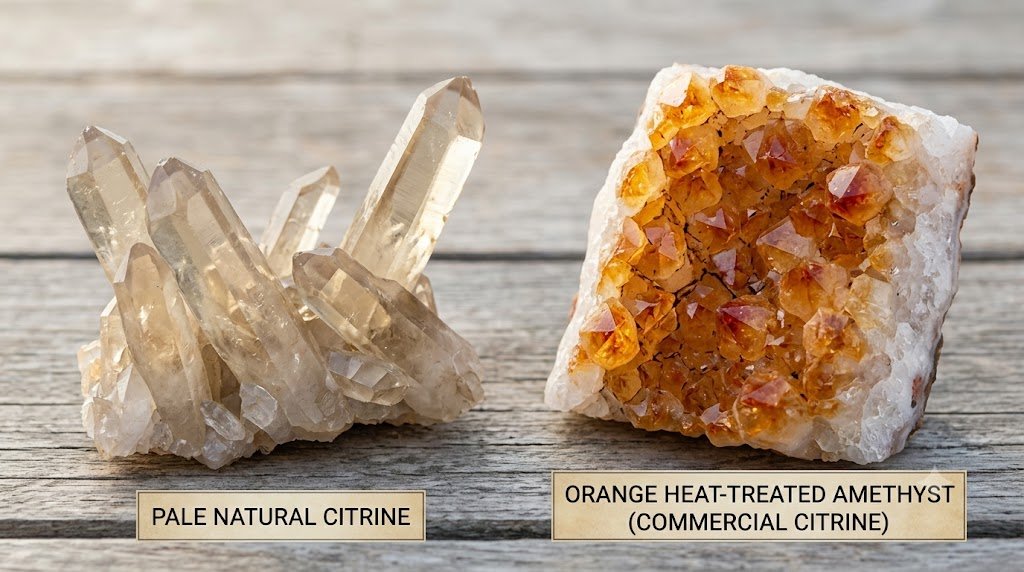
Natural citrine is transparent yellow-to-orange quartz whose color developed through geological processes. It is uncommon compared with the large volume of commercial citrine produced by heating suitable amethyst or smoky quartz.
Heat-treated amethyst is still genuine natural quartz. It is not glass, plastic or a synthetic gemstone. However, its yellow or orange color was created by human treatment, so it should not be represented or priced as rare natural-color citrine.
The market also includes hydrothermal synthetic citrine, irradiated quartz, coated material, yellow glass and unrelated yellow gemstones sold under the citrine name. Consequently, identification requires two separate conclusions: whether the material is quartz and whether its finished color is natural, treated or laboratory-grown.
This page owns the direct authenticity and natural-versus-heated-amethyst workflow. The completed treated-citrine guide retains the detailed treatment processes, laboratory detection and disclosure rules.
Natural Citrine vs Heated Amethyst and Imitations
| Feature | Natural-color citrine | Heat-treated amethyst | Hydrothermal synthetic citrine | Yellow glass |
|---|---|---|---|---|
| Material | Naturally formed quartz | Naturally formed quartz whose color was altered by heat | Laboratory-grown quartz | Manufactured glass |
| Typical color | Pale yellow, smoky yellow, honey, champagne or subdued orange | Golden yellow, orange, reddish orange or brown-orange | Yellow to orange, often clean and even | Any yellow or orange shade |
| Color distribution | Often comparatively even or softly zoned | Strong concentration at crystal tips or sectors is common in clusters | Growth-related zoning may occur | Usually uniform or arranged in curved flow |
| Crystal base | Commonly remains yellow or smoky throughout | White or pale base beneath orange tips is common in heated clusters | Seed-related growth may be present | Molded or broken glass form |
| Mohs hardness | 7 | 7 | 7 | Commonly around 5–6 |
| Refractive index | Approximately 1.544–1.553 | Same quartz range | Same quartz range | Variable |
| Specific gravity | About 2.66 | About 2.66 | About 2.66 | Variable |
| Common internal clues | Natural fluid inclusions, growth features and occasional zoning | Heat-altered fractures or inclusions may occur | Hydrothermal growth and seed-related features | Round bubbles and curved flow lines |
| Main identification challenge | Proving natural color | Distinguishing treatment from geological heating | Separating natural from laboratory growth | Confirming the object is not quartz |
| Correct disclosure | Natural citrine | Heat-treated natural quartz or heat-treated amethyst sold as citrine | Laboratory-grown or synthetic citrine | Yellow glass imitation |
The visual tendencies in this table are not universal. A faceted stone may lose the rough crystal features that would have made heating easier to suspect.
What Is Genuine Citrine?
Citrine is the transparent yellow-to-orange color variety of quartz.
Quartz consists of silicon dioxide and ranks 7 on the Mohs scale. Citrine shares the same basic physical properties as amethyst, smoky quartz, clear quartz and prasiolite because all belong to macrocrystalline quartz.
Its color is associated with iron-related defects and color centers within the crystal. The precise natural process varies with chemistry, radiation exposure and geological temperature history.
Natural citrine generally occurs in restrained colors. Pale yellow, smoky yellow, honey, champagne and subdued orange are common descriptions. Strong reddish-orange natural material exists but is considerably less common than commercial heat-treated quartz with a similar appearance.
Why Most Commercial Citrine Is Heated Amethyst
Natural citrine is scarce relative to market demand. Amethyst is much more abundant and can respond predictably to controlled heating when its chemistry is suitable.
Heating modifies iron-related color centers. Depending on the original amethyst and the temperature used, the stone may become yellow, golden, orange, reddish brown, green or colorless.
The treatment does not change quartz into another mineral. The finished product retains quartz hardness, refractive index, density and crystal structure.
Commercial language often calls the result citrine because its finished color falls within the yellow-to-orange quartz range. A precise description would disclose that the stone is heat-treated natural quartz or heat-treated amethyst.
The completed treated-amethyst guide explains how one starting material can become several commercial quartz colors.
Is Heat-Treated Amethyst Fake Citrine?
Calling all heat-treated amethyst fake citrine creates more confusion than clarity.
The base material is genuine natural quartz. The yellow or orange color, however, did not develop entirely through natural geological processes.
Therefore, it is treated citrine-colored quartz, not natural-color citrine. It becomes deceptive when a seller claims it is untreated, rare natural citrine or a naturally orange crystal without qualification.
Treatment disclosure matters because natural-color material is scarcer and may command a premium. The distinction also affects collecting interest, even when both materials look attractive in jewelry.
Color Clues in Natural Citrine
Natural citrine frequently appears lighter and less fiery than heavily heated amethyst.
Common shades include pale lemon, smoky champagne, yellow-brown and soft honey. Some crystals show a subtle smoky modifier rather than a vivid orange body.
The color may remain comparatively even through the crystal, although natural zoning can occur. A transparent point that stays pale yellow from base to termination is more consistent with natural-color citrine than a white crystal whose tips turn dark burnt orange.
Nevertheless, color alone cannot prove natural origin. Heating can create pale yellow material, while geological heating can create colors resembling furnace-treated quartz.
The types-of-citrine guide explains the range of natural, treated and trade-name color categories.
Typical Appearance of Heated Amethyst Clusters
Heat-treated amethyst clusters often retain the original geode or crystal-cluster form.
Individual points may show dark orange, reddish-brown or burnt-yellow terminations above white or colorless bases. The color can look concentrated in triangular growth sectors near the tips.
The crystal surfaces may appear matte, cracked or weakened if treatment was excessive. Some clusters develop pale, chalky or opaque areas.
These features are strong treatment clues when they appear together. However, no single orange tip or white base proves artificial heating because natural growth and weathering can also create uneven color.
A large cathedral-shaped geode with dark orange tips is far more likely to be heated amethyst than a naturally formed citrine geode. Natural citrine does not commonly occur in the enormous commercial geodes associated with Brazilian and Uruguayan amethyst.
Faceted Citrine Is Harder to Judge
Cutting removes crystal bases, terminations and much of the original growth context.
A faceted natural citrine and a faceted heated-amethyst citrine can share the same color, clarity, hardness, refractive index and density. Both may be eye-clean.
Heat-altered inclusions can occasionally support treatment detection, but many citrines contain too few useful inclusions for a clear result.
A laboratory may describe the stone simply as natural quartz or citrine without determining whether geological or deliberate heating caused the color.
Therefore, claims of untreated natural color should be supported cautiously rather than inferred from a clean appearance.
Madeira Citrine
Madeira citrine is a commercial color description for strongly saturated orange, reddish-orange or brownish-orange quartz.
The name refers to the color’s resemblance to Madeira wine, not to a mine locality.
Most market material with this appearance is heat-treated amethyst. Fine natural-color quartz can occasionally approach the shade, but the trade term does not certify untreated origin.
The deep color can become too dark in poorly cut stones. Evaluate face-up brightness under ordinary indoor light rather than accepting the Madeira label as a quality grade.
Lemon Quartz
Lemon quartz is a commercial name used inconsistently for bright yellow or greenish-yellow quartz.
Its color may result from irradiation, heating, a combination of treatments or natural processes. Some material is closer to treated smoky quartz than to conventional citrine.
The yellow-quartz guide owns the distinction among citrine, lemon quartz and iron-stained quartz.
A seller should not use lemon citrine or lemon quartz as though the names guarantee natural color.
Citrine from Smoky Quartz
Heating some smoky quartz can create yellow, greenish-yellow or lime-colored quartz.
This pathway differs from heating purple amethyst, although the finished material may still be marketed as citrine.
The dedicated smoky-quartz-versus-citrine guide explains how smoky color, yellow color and transitional material overlap.
Natural smoky-yellow quartz also exists. Without laboratory evidence or reliable treatment history, a confident claim about the exact starting material may be impossible.
Hydrothermal Synthetic Citrine
Quartz is grown commercially through hydrothermal methods for electronics, optics and gem use.
Synthetic citrine has essentially the same silicon-dioxide composition, hardness, density and refractive properties as natural quartz.
It may grow from a seed plate inside a high-pressure vessel. Growth zoning, seed-related boundaries and synthetic inclusions can provide clues, but modern material may be extremely clean.
Natural-versus-synthetic separation may require microscopy, polarized-light examination, infrared spectroscopy and trace-element analysis.
A disclosed synthetic citrine is a legitimate laboratory-grown gemstone. It should not be sold as mined natural citrine.
Glass Imitations
Yellow glass can imitate citrine beads, cabochons and faceted stones.
Round gas bubbles, curved flow lines, molded seams and an unusually homogeneous interior suggest glass. However, bubble-free glass exists, and natural quartz can contain rounded fluid-inclusion cavities.
Glass is usually softer than quartz and singly refractive. Quartz is doubly refractive, although its birefringence is weak.
The broader glass-versus-crystal guide explains why appearance and temperature tests alone do not establish identity.
A deliberate scratch test is unnecessary and can damage both the stone and its setting.
Citrine Versus Yellow Topaz
Yellow topaz may overlap with citrine in pale yellow, golden and orange colors.
Topaz is denser and has a higher refractive index. It also has perfect cleavage and commonly produces stronger brilliance.
The complete separation belongs in citrine versus yellow topaz.
A large yellow stone should not be called citrine solely because it is affordable. Likewise, topaz identity does not automatically make it more valuable.
Citrine Versus Yellow Sapphire
Yellow sapphire is corundum with a Mohs hardness of 9, compared with citrine’s hardness of 7.
Sapphire has higher density, stronger refractive properties and different inclusions. Natural, heated, diffusion-treated and synthetic yellow sapphires also occur.
Use the dedicated citrine-versus-yellow-sapphire guide for the complete comparison.
Scratch testing remains inappropriate despite the substantial hardness difference.
Citrine Versus Heliodor
Heliodor is yellow-to-golden beryl. It can resemble pale citrine in faceted form.
Beryl has different refractive properties, density and crystal habit. It may also show directional color and characteristic tubular inclusions.
The full identification belongs in heliodor versus citrine.
Color descriptions such as golden beryl and golden citrine should not be treated as mineral identities.
Heat-Related Surface and Inclusion Clues
Excessive heating can produce fractures, chalky surfaces, weakened points and altered internal inclusions.
Some original fluid inclusions may expand, rupture or develop stress halos. Iron-bearing inclusions may also change color.
These signs can support a treatment conclusion, but they are not guaranteed. Carefully controlled heating may leave few obvious microscopic traces.
Mining, cleaning and natural temperature changes can create fractures too. Treatment should be concluded from a consistent group of features rather than one crack.
Color Zoning Under Polarized Light
Quartz zoning may become easier to see through immersion or polarized illumination.
Natural citrine can show growth sectors and subtle bands. Heated amethyst may retain sectoral patterns inherited from the original purple crystal.
Synthetic quartz can also display growth-related zoning.
The pattern therefore helps reconstruct growth and treatment history but cannot produce a universal natural-citrine test.
Refractive Index and Specific Gravity
Natural citrine, heated amethyst and synthetic citrine all have quartz-range refractive index and density.
These measurements confirm quartz identity but generally cannot determine color origin.
Glass, topaz, sapphire and beryl show different combinations of values and can often be excluded efficiently.
A refractometer requires a clean polished facet. Hydrostatic weighing requires a loose stone and a precise scale.
Ultraviolet Light
Citrine’s ultraviolet response varies with impurities, treatment and locality.
Natural, heated and synthetic quartz may all be inert or weakly fluorescent. Glass and other imitations may also show variable reactions.
Consequently, ultraviolet light is a supporting observation rather than a reliable natural-versus-heated test.
Scratch and Heat Tests
Do not scratch citrine against glass or steel.
The test cannot separate natural citrine from heated amethyst or synthetic quartz because all are quartz with the same hardness.
Do not heat a suspected stone to see whether its color changes. Heating can fracture quartz, alter the color permanently and damage a setting.
Flame, acid and hot-needle tests provide no useful citrine conclusion and can create safety risks.
Buying Natural Citrine
The citrine buying guide owns the full color, clarity, cut and seller workflow.
Ask the seller to distinguish among natural-color citrine, heat-treated amethyst, heat-treated smoky quartz, irradiated quartz and synthetic quartz.
A vague answer such as completely natural crystal may refer only to the base material rather than the color.
The citrine price guide explains why commercial treated quartz should not receive the same scarcity premium as documented natural-color material.
For remote purchases, follow how to buy gemstones online and retain a meaningful inspection period.
Reports and Documentation
A report can confirm that a stone is quartz and may describe its color variety.
Determining natural versus synthetic origin is possible in many cases through microscopy, twinning, spectroscopy and chemistry.
Separating natural geological heating from deliberate treatment may be more difficult or impossible in some specimens.
The gemstone-certification guide explains report scope. Use how to read a gem lab report to identify whether treatment origin was addressed or merely omitted.
An appraisal value is not proof of natural color.
Citrine Jewelry and Care
A citrine ring can be worn regularly with ordinary quartz precautions.
Citrine earrings and a citrine necklace face less impact, while a citrine bracelet receives more surface contact.
Clean citrine with warm soapy water and a soft brush. Avoid abrupt temperature changes, high heat and prolonged intense light when the treatment history is unknown.
The full physical-care process appears in how to clean citrine jewelry safely. Belief-based practices remain within how to cleanse and charge citrine.
Citrine’s calendar role is explained in the November birthstone guide.
A Safe Home Screening Sequence
Begin with the seller’s disclosure. Determine whether the claim concerns quartz identity, natural geological color or merely untreated appearance.
Inspect rough clusters for dark orange terminations, white bases, concentrated tip color and heat-related surface damage.
View faceted stones under neutral light and magnification. Look for glass bubbles, coatings, dye concentrations and unusual assembled construction.
Confirm quartz identity through professional refractive-index or density testing when necessary.
Do not expect a home test to separate every natural citrine from heated amethyst. If an untreated premium matters, obtain a laboratory report and accept that some color-origin questions may remain inconclusive.
Frequently Asked Questions
1. Is most citrine actually heated amethyst?
Yes. Natural citrine is uncommon, and much commercial yellow-to-orange quartz is produced by heating suitable amethyst.
2. Is heat-treated amethyst fake citrine?
It is genuine natural quartz with treated color. It should be disclosed as heat-treated rather than sold as rare natural-color citrine.
3. What color is natural citrine?
Natural material commonly appears pale yellow, smoky yellow, honey, champagne or subdued orange-brown.
4. Do white crystal bases prove citrine was heated?
White bases beneath dark orange tips are a strong clue in commercial clusters, but one feature alone is not conclusive.
5. Can naturally occurring citrine be dark orange?
It can, but strongly saturated orange and reddish-orange commercial material is commonly heat-treated amethyst.
6. Is Madeira citrine always natural?
No. Madeira is a color trade term, and most material with that intense orange-brown appearance is treated.
7. Does synthetic citrine exist?
Yes. Hydrothermal laboratory-grown quartz can be produced in yellow and orange colors.
8. Can a scratch test identify natural citrine?
No. Natural citrine, heated amethyst and synthetic citrine all have quartz hardness.
9. Can a gemologist always detect heating?
No. Treatment may be suspected or supported, but geological and deliberate heating can produce overlapping results.
10. How can I distinguish citrine from yellow glass?
Quartz is doubly refractive, harder and has different density and internal structure. Glass may show round bubbles and curved flow lines.
11. Does a certificate prove citrine has natural color?
Only when the report specifically addresses color origin. A document identifying quartz alone does not prove untreated color.
12. Which citrine should I buy?
Choose an attractive, well-cut stone with honest disclosure. Pay a natural-color premium only when documentation and seller credibility justify it.
Citrine authentication is not a contest between “real stone” and “fake stone” alone. Natural citrine, heated amethyst and hydrothermal synthetic citrine can all be genuine quartz, while their growth and color histories differ substantially. The most accurate purchase identifies the quartz first, states how its color probably formed and prices it according to that disclosure.