Where to Buy Real Green Fluorite and Avoid Dyed Glass Fakes
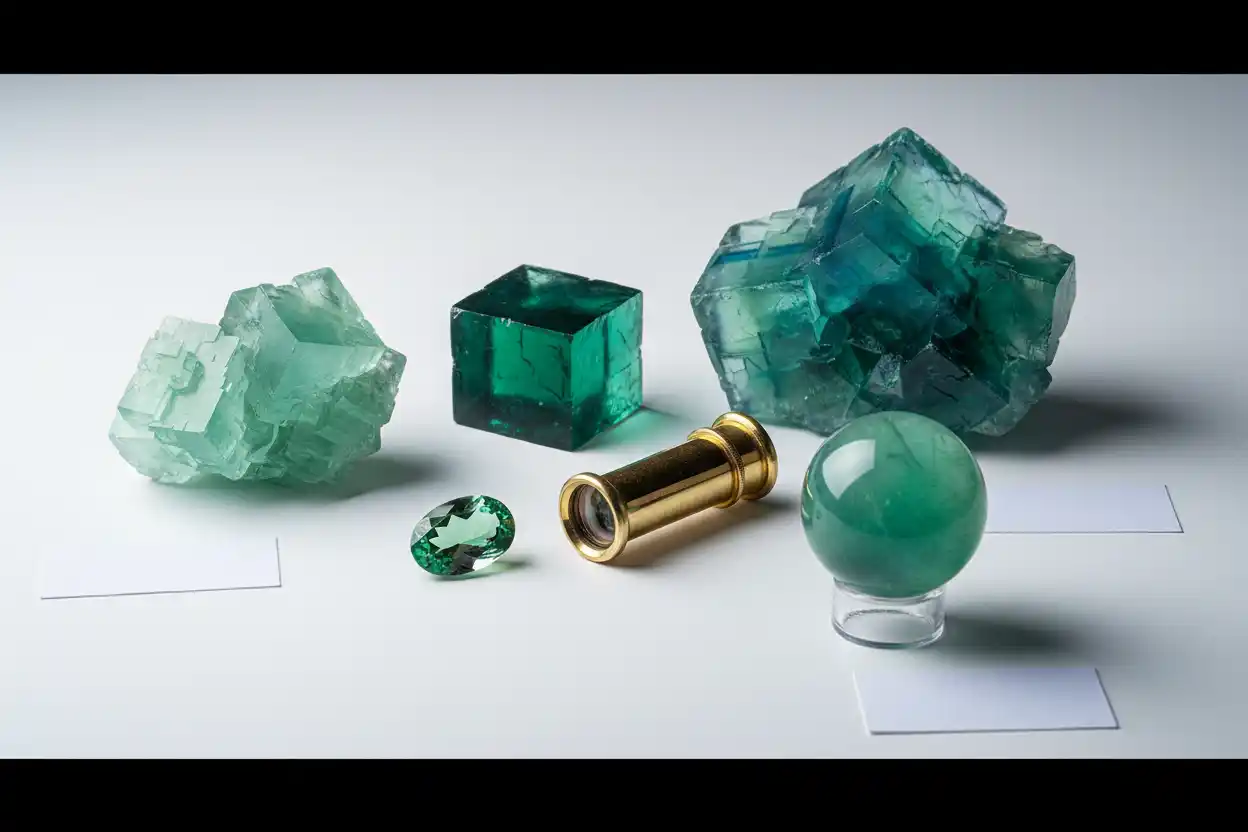
Real Green Fluorite ranges from nearly colorless mint through grass green, blue-green, yellow-green and deep emerald-like shades. It may occur as transparent cubes, octahedral cleavage pieces, zoned clusters, massive rough, spheres, carvings and fragile faceted collector gems.
Its natural color can be remarkably vivid, so saturation alone does not prove treatment. Nevertheless, buyers may encounter dyed fracture networks, irradiated material, coated crystals, green glass, resin carvings, reconstructed clusters and ordinary pale Fluorite photographed under heavily altered lighting.
Green Fluorite also requires realistic durability expectations. It has Mohs hardness 4, brittle tenacity and perfect octahedral cleavage. Therefore, even an authentic specimen can chip or split if handled like quartz.
The Green Fluorite meaning and properties guide covers the color variety’s identity and traditional symbolism. This buying guide concentrates on sellers, natural color, treatment, crystal condition, lookalikes and safe ownership without duplicating the broader Fluorite buying guide.
Understand Green Fluorite Before Comparing Prices
Fluorite is calcium fluoride, CaF2, and crystallizes in the cubic system. Green is one of its many natural colors rather than a separate mineral species.
The Fluorite family guide explains its fundamental structure. The types of Fluorite guide separates green, purple, yellow, rainbow-zoned and composition-related varieties.
Color in Fluorite can arise through several mechanisms, including structural defects, natural irradiation and trace or rare-earth-related components. Consequently, two naturally green specimens can owe their appearance to different combinations of factors.
Green color may fill an entire crystal, form zones parallel to cube faces or alternate with purple, colorless, blue or yellow layers. A zoned specimen can still be sold accurately as Green Fluorite when green dominates its visual identity.
Choose the Product Form First
| Green Fluorite product | Best source | Main buying concern |
|---|---|---|
| Natural cube or cluster | Specialist mineral dealer | Cleavage, repaired crystals, coating and locality |
| Matrix specimen | Mineral dealer | Glued crystals, unstable matrix and associated-mineral identification |
| Cleavage octahedron | Educational mineral supplier | Correct labeling as cleaved rather than naturally grown |
| Massive rough | Lapidary supplier | Internal cleavage, dye and poor carving yield |
| Sphere | Experienced carving retailer | Filled fractures, glass and color editing |
| Tower or carving | Specialist stone seller | Repaired tips, coating and resin stabilization |
| Faceting rough | Rare-gem dealer | Cleavage, transparency and cutting loss |
| Faceted gem | Collector-gem specialist | Identity, chips and treatment |
| Bead strand | Established supplier | Glass, dye, resin and drill-hole failure |
| Pendant or earrings | Jeweler familiar with Fluorite | Protected setting and realistic wear advice |
Collectors should prioritize natural growth, condition and provenance. Decorative buyers should focus on structural soundness, treatment and whether photographs represent the exact item.
Where to Buy Genuine Green Fluorite
Specialist mineral dealers
A mineral dealer is the strongest source for natural cubes, phantoms, twins and locality specimens.
Listings should include dimensions, weight, locality, crystal condition, associated minerals and restoration. Request photographs of the reverse, base and every important crystal edge.
A seller should distinguish natural contacts from fresh cleavage. Fluorite commonly grows in clusters, so one incomplete face may have touched another mineral rather than being recently broken.
Ask whether crystals were reattached or transferred to a different matrix. Repairs can be acceptable when clearly disclosed.
Gem and mineral shows
Shows allow direct comparison with Green Calcite, Prehnite, glass and green quartz.
Use a loupe to inspect cube faces, color zoning, cleavage cracks and adhesive. Natural crystal surfaces may show stepped growth, etching and irregularities rather than perfectly smooth molded planes.
Do not scratch the stone. Fluorite’s softness makes destructive testing especially inappropriate.
Place a pale crystal over white paper, then view it under neutral and warm light. Some green material becomes substantially yellower or bluer under different illumination.
Lapidary suppliers
Fluorite rough should be purchased from a supplier who understands its cleavage. A large block may look ideal for carving but separate along hidden octahedral planes during cutting.
Request dry images. Water and oil deepen color and conceal scratches and incipient cracks.
Ask whether similar material has produced successful spheres or carvings. Sample finished objects reveal more about stability than one polished window.
Established online sellers
The online gemstone buying guide explains payment protection, seller identity and return terms.
For Green Fluorite, exact-item photography is essential. Request a full rotation in daylight-equivalent illumination and ordinary indoor light.
Strong white-balance changes can make pale mint Fluorite appear emerald green. Ask whether saturation, hue or background replacement was adjusted.
Specialist gem dealers
Transparent faceted Green Fluorite belongs to the collector-gem market. Its low hardness and cleavage make it unsuitable for conventional daily-wear expectations.
Request a gemological report for an expensive loose stone. Macro photographs should show the girdle, facet junctions and any internal cleavage.
What Genuine Green Fluorite Looks Like
Natural Green Fluorite may be pale mint, celadon, yellow-green, grass green, emerald-like green or blue-green.
The body can be transparent, translucent or opaque. Some crystals have clear centers and green outer zones, while others reverse that arrangement.
Cube-parallel zoning can form nested internal squares or phantom-like bands. Multicolored specimens may alternate green with purple, blue, yellow or colorless Fluorite.
Luster is vitreous. Fresh cleavage surfaces can look especially smooth and reflective.
Natural crystals may contain fluid inclusions, mineral inclusions, veils, color centers and healed fractures. A flawless body is possible, but it is not required for authenticity.
Strong fluorescence is not mandatory. Some genuine Green Fluorite responds under ultraviolet light, while other specimens show weak or negligible fluorescence.
Green Fluorite Versus Purple and Rainbow Fluorite
Purple Fluorite is defined by violet or lavender dominance. Its future dedicated buying guide owns purple dye, Amethyst confusion and color stability.
Rainbow Fluorite contains several prominent colors or bands. Its planned buying guide owns multicolor pattern, digital editing and carving-quality concerns.
A mostly green crystal with one purple edge can remain Green Fluorite. A sphere with broad alternating purple, green and colorless bands belongs more naturally in the rainbow-zoned market.
Green Fluorite Versus Green Calcite
Green Calcite is calcium carbonate with Mohs hardness 3, rhombohedral cleavage and strong birefringence.
Fluorite has Mohs hardness 4 and perfect octahedral cleavage. Natural Fluorite cubes also differ from Calcite’s trigonal crystal habits.
The completed guide to buying genuine Green Calcite covers dye, carbonate naming and acid sensitivity.
Never use vinegar or another acid to distinguish the materials. It permanently damages Calcite and can affect mixed specimens.
Green Fluorite Versus Green Aventurine
Green Aventurine is quartz-rich and commonly contains reflective Fuchsite mica.
Its sparkle appears as numerous platy reflections, whereas Fluorite usually has a cleaner vitreous body, cubic zoning and cleavage reflections.
The completed guide to buying Green Aventurine covers polymer impregnation, aventurine glass and jade-related mislabeling.
Green Fluorite Versus Prehnite
Prehnite can show pale mint, yellow-green and apple-green color. It often forms botryoidal aggregates or cloudy cabochons.
Green Fluorite more commonly displays cubic or octahedral geometry and sharper internal color zoning.
Polished objects may remain difficult to separate visually. Refractive index, specific gravity and Raman spectroscopy provide safer identification.
Green Fluorite Versus Prasiolite
Prasiolite is transparent green quartz, often produced through heat treatment or irradiation of suitable quartz material.
Prasiolite is much harder and lacks Fluorite’s perfect octahedral cleavage. It also belongs to the trigonal quartz system rather than the cubic Fluorite system.
The completed Prasiolite buying guide covers treated green quartz and faceted quality.
Green Fluorite Versus Emerald and Green Glass
Emerald is green beryl with substantially greater hardness and different refractive properties. A transparent Green Fluorite gem should not be marketed as “soft Emerald” without explaining that the phrase is merely descriptive.
Green glass can imitate cubes, spheres, faceted stones and polished towers. Round bubbles, flow lines, mold seams and conchoidal chips support glass.
However, some glass is free of visible bubbles, while natural Fluorite can contain rounded fluid inclusions. Professional testing is more reliable than one visual sign.
The glass-versus-crystal guide provides the broader distinction.
Dyed Green Fluorite
Pale or colorless Fluorite can be dyed. Artificial color commonly follows surface-reaching fractures and cleavage planes.
Inspect cracks under diffused light. Dye may appear more saturated along the fracture than within unbroken crystal.
Drill holes and chipped edges can also expose color concentrations. Nevertheless, natural zoning can produce strong color boundaries, so distribution must be interpreted carefully.
A dyed stone remains Fluorite, but it should not receive a rare natural-color premium.
Irradiation and Color Centers
Natural radiation contributes to color centers in some Fluorite. Artificial irradiation can also create or intensify color.
Green, blue, purple and other shades may involve radiation-related defects, although the exact mechanism varies by specimen.
Laboratory treatment detection can be difficult because natural and artificial radiation may affect similar structural centers.
Therefore, seller disclosure and treatment history matter. A laboratory may confirm Fluorite while remaining cautious about whether color was naturally or artificially induced.
Coatings, Oil and Resin
A surface coating can intensify green color or create iridescence. Look for peeling, color loss at edges and a different surface luster.
Oil may temporarily reduce the visibility of fractures. Resin can fill cleavage cracks or stabilize carvings.
Large spheres and towers deserve particular scrutiny because producing them intact from cleavable rough can require filler.
The gemstone treatments guide explains coating, filling, impregnation and assembly terminology.
Glued and Reconstructed Specimens
Separate natural cubes may be attached to matrix or arranged into artificial clusters.
Inspect the crystal-to-matrix contact. Glossy adhesive, smooth filler and crystals sitting in unnaturally shaped sockets suggest assembly.
A natural cluster repaired after extraction is different from a fabricated association, but both require disclosure.
Ask separately about crystal repair and matrix repair. A specimen can have untouched green cubes on a heavily reconstructed base.
Cleaved Octahedra
Fluorite splits readily along octahedral planes. Commercial sellers often create octahedra by cleaving larger cubes or massive material.
These objects are genuine Fluorite, but the triangular faces are cleavage surfaces rather than natural growth faces.
Natural octahedral crystals do occur. They should display growth features and credible provenance.
Accurate listings use terms such as “hand-cleaved Green Fluorite octahedron” rather than implying natural crystallization.
How to Evaluate a Crystal Specimen
Color
Assess hue and saturation under neutral light. A strongly edited photograph should not determine the purchase.
Zoning
Look for coherent bands parallel to crystal growth. Natural zoning can add depth and collector value.
Crystal form
Cubes, octahedra and combinations should show plausible isometric geometry rather than mold seams.
Condition
Inspect corners for bruising, chips and cleavage. Fresh pale breaks reduce value.
Luster
Good crystals show vitreous reflections. Dullness can result from natural etching, weathering, coating or handling.
Matrix
Calcite, quartz, sulfides, Barite and other minerals may accompany Fluorite. The association should appear geologically coherent.
Repairs
Request close-ups of every major crystal base. Restoration should appear in the invoice description.
How to Evaluate Rough
Ask for dry photographs from every side. Internal cleavage can be almost invisible under water or oil.
A large intensely green block may still have poor carving yield if cleavage planes cross throughout it.
Look for whether color penetrates the material or follows only open cracks. Dye frequently uses those pathways.
Ask whether test pieces from the parcel survived cutting and whether resin was used.
Buying Spheres, Towers and Carvings
Request a complete rotation. Color zoning and fracture density can differ dramatically between the display face and reverse.
A sphere should have no glued equatorial seam or resin-filled cavity hidden beneath its stand.
Towers require stable bases and sound tips. A point intersected by cleavage can break from a minor fall.
Carvings should avoid very thin details. Mohs hardness 4 means surface polish also scratches more readily than quartz.
Buying Faceted Green Fluorite
Fine faceted Fluorite may show attractive color, transparency and dispersion. However, it remains a collector gem.
Inspect facet junctions and the girdle for chips. Flat internal reflections may indicate cleavage.
A dark stone can appear almost black if cut too deeply. Conversely, an overly shallow cut can create a large transparent window.
Protected pendants or display jewelry are more realistic than exposed rings.
Buying Beads and Jewelry
Fluorite beads are vulnerable around drill holes. Ask for close-up photographs of cracking and resin.
Natural strands may show slight color and zoning variation. Perfectly identical green beads can indicate glass, resin or extremely selective manufacturing.
The gemstone hardness chart, gemstone cleavage guide and toughness-versus-hardness guide explain why Fluorite is unsuitable for rough everyday wear.
Pendants, earrings and protected brooches are usually safer than rings and bracelets.
Locality and Provenance
Important Green Fluorite has come from China, England, Spain, Namibia, Morocco, Mexico, Pakistan and the United States, among other regions.
Different localities produce distinctive combinations of color, zoning, crystal form and associated minerals. However, appearance cannot prove a mine.
A classic-locality premium requires an original label, collection record or reliable dealer chain.
The ethical crystal sourcing guide provides questions about legal collection, labor and provenance.
Price and Value
Common Green Fluorite carvings and small crystals are affordable. Fine transparent cubes, unusual phantoms, classic-locality specimens and large clean crystals can cost considerably more.
Value depends on color, zoning, transparency, crystal form, luster, condition, matrix, locality, treatment and restoration.
A smaller undamaged cube may be more desirable than a large sphere containing several filled cleavage cracks.
Faceted stones gain value from successful cutting but remain constrained by fragility.
The gemstone pricing guide explains how rarity, usable yield and documentation affect retail price.
Questions to Ask the Seller
Ask whether the item is natural-color Green Fluorite, dyed Fluorite, irradiated material, glass, resin or composite.
Determine whether an octahedron is naturally grown or cleaved. Request disclosure of oil, coating, resin, backing and repair.
For specimens, request the reverse, base and crystal contacts. For spheres and towers, obtain a complete rotation under neutral light.
Ask for the locality and the basis for that claim. Finally, confirm a return policy that permits magnified inspection.
Professional Identification
Refractive index, specific gravity, optic character and microscopy can distinguish Fluorite from glass, quartz, Calcite and many other green stones.
Raman spectroscopy and X-ray diffraction confirm mineral identity. Microscopy may reveal dye-filled fractures, coating, resin and reconstructed contacts.
Determining natural versus artificial irradiation can be more difficult than confirming the mineral itself. Treatment conclusions should therefore be stated cautiously.
Cleaning and Storage
Clean Green Fluorite with a soft dry cloth or a barely damp cloth followed by prompt drying.
Do not soak matrix specimens, glued pieces or heavily fractured carvings. Avoid steam and ultrasonic equipment.
The completed Fluorite cleansing and charging guide provides non-destructive options for traditional practices.
Prolonged heat and intense light may alter some color centers. Store prized specimens away from hot windows and protect them from harder minerals.
Frequently Asked Questions
1. Is Green Fluorite naturally occurring?
Yes. Fluorite naturally occurs in many green shades, including mint, grass green, emerald-like green and blue-green.
2. What causes the green color?
Color can involve structural defects, natural irradiation and trace or rare-earth-related components. The exact cause varies between specimens.
3. Can Green Fluorite be dyed?
Yes. Dye may concentrate along fractures and cleavage planes within pale Fluorite.
4. Can Green Fluorite be irradiated?
Yes. Artificial irradiation can create or intensify color centers, although distinguishing it from natural irradiation may be difficult.
5. Is a Green Fluorite octahedron naturally grown?
Not necessarily. Many retail octahedra are produced by cleaving larger Fluorite pieces.
6. How is Green Fluorite different from Green Calcite?
Fluorite is harder, has octahedral cleavage and crystallizes cubically. Calcite has rhombohedral cleavage and strong birefringence.
7. Is Green Fluorite the same as Prasiolite?
No. Prasiolite is green quartz, while Green Fluorite is calcium fluoride.
8. Does strong fluorescence prove authenticity?
No. Genuine Fluorite can fluoresce strongly, weakly or not noticeably, and other materials may fluoresce too.
9. Can Green Fluorite contain resin?
Yes. Fractures in carvings, spheres and beads can be filled or stabilized.
10. Is Green Fluorite suitable for everyday rings?
Generally, no. Its low hardness and perfect cleavage make exposed rings vulnerable.
11. Do ordinary specimens need laboratory reports?
Usually not. Testing becomes more useful for expensive faceted gems, disputed treatment or high-value locality specimens.
12. What is the biggest warning sign in a listing?
Be cautious when a flawless emerald-green carving has no cleavage, treatment, neutral-light or reverse-view information.
Buy Green Color with an Honest Condition Report
Green Fluorite can be naturally vivid, so the strongest purchase is not automatically the palest stone. Instead, look for coherent color zoning, credible crystal structure and full disclosure of every fracture, repair and treatment.
The G crystal directory, G gemstone directory and visual gemstone guide provide broader comparisons. Choose the piece whose beauty remains credible after its cleavage and preparation history are explained.
Safety note: Intact Fluorite can be handled normally, but it should not be ingested, burned or deliberately heated. Cutting, drilling, grinding or sanding can create mineral dust and should use professional wet methods, effective extraction and suitable eye and respiratory protection.