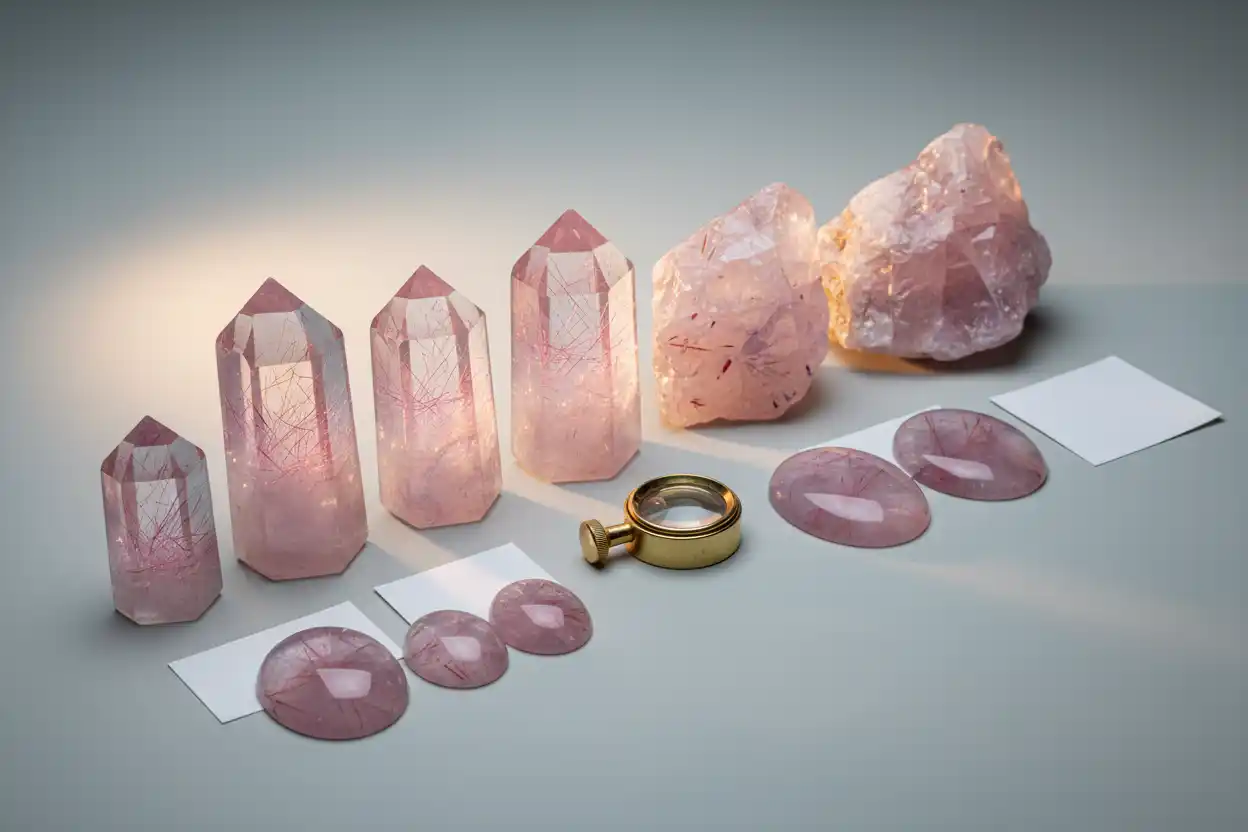
Where to Buy Real Lithium Quartz and Avoid Misleading Fakes
Lithium Quartz is a loosely defined commercial name used for translucent-to-opaque quartz with pink, lavender, mauve, reddish, gray or purple inclusions. Sellers commonly attribute those colors to lithium-bearing minerals, but appearance alone cannot establish that lithium is present.
Unlike Amethyst, Rose Quartz or Smoky Quartz, Lithium Quartz does not have a universally accepted color mechanism or formal mineralogical definition. Different retail parcels may contain quartz with Lepidolite, Tourmaline, iron oxides, clay minerals, unidentified inclusions or no demonstrated lithium-bearing phase at all.
Consequently, the strongest purchase is not the stone with the most elaborate lithium claim. It is the quartz whose host, inclusions, treatment, source and preparation have been described accurately.
The Lithium Quartz meaning and properties guide covers the trade name and traditional symbolism. This guide focuses on seller evidence, inclusion identification, misleading chemical claims, treatments and buying natural quartz without confusing color with laboratory proof.
Lithium Quartz Is a Trade Name
Quartz is silicon dioxide, SiO2. Lithium is not normally a major component of the quartz crystal structure.
When genuine lithium-bearing material occurs with quartz, it is more likely to appear as an included or associated mineral than as enough lithium dissolved within the quartz to justify an exact chemical claim.
Possible associated minerals include lithium-rich mica, Tourmaline, spodumene-related minerals and other pegmatite species. However, each inclusion must be identified rather than assumed.
The quartz family guide explains the host mineral. The types of Clear Quartz guide separates included, phantom, synthetic and trade-named forms.
A responsible listing might state:
“Natural included quartz sold under the Lithium Quartz trade name. The pink-lavender inclusions have not been chemically analyzed.”
That description is more credible than claiming a precise lithium percentage based on color.
Choose the Product Form Before Shopping
| Product form | Best source | Main buying concern |
|---|---|---|
| Natural crystal point | Specialist mineral dealer | Natural termination, inclusion identity, coating and locality |
| Included rough | Lapidary supplier | Quartz content, fractures, dye and cutting yield |
| Cabochon | Included-quartz specialist | Natural inclusions, filler, backing and polish |
| Tumbled stone | Reputable crystal seller | Dyed quartz, Rose Quartz substitution and resin |
| Sphere | Experienced lapidary retailer | Glass, assembly, artificial inclusions and fracture filling |
| Carved tower | Seller with exact-item video | Natural quartz versus carved shape and introduced color |
| Bead strand | Established bead supplier | Dye, synthetic quartz, glass and drill-hole fractures |
| Pendant | Independent jeweler | Drilling, glue, backing and treatment |
| Mineral-association specimen | Specialist pegmatite dealer | Correct identification of Lepidolite, Tourmaline or other inclusions |
| High-lithium commercial claim | Requires laboratory evidence | Chemical analysis rather than marketing language |
A natural quartz point and a polished sphere require different evidence. The point must preserve credible growth surfaces, while the sphere must be inspected for seams, filler and artificial inclusion material.
Where to Buy Genuine Natural Material
Specialist mineral dealers
A mineral dealer should identify the host as quartz before applying a commercial variety name.
Request the locality, crystal habit, inclusion description and condition. Ask whether Raman spectroscopy, chemical analysis or another test identified the included mineral.
A cautious dealer may describe an inclusion as “mica-like,” “iron-rich” or “unidentified pink mineral.” That language is preferable to invented precision.
Request photographs of the termination, prism faces, base and every significant fracture.
Included-quartz specialists
Dealers who work with Garden Quartz, Phantom Quartz, Rutilated Quartz and Tourmalinated Quartz may understand inclusion geometry better than general crystal retailers.
They should explain whether color comes from suspended crystals, clouds, coatings, fracture staining or the quartz body itself.
The completed guide to buying genuine Garden Quartz provides additional checks for inserted inclusions and resin-filled scenic quartz.
Gem and mineral shows
Shows allow comparison with Rose Quartz, Amethyst, Lepidolite-rich rock, dyed quartz and glass.
Rotate the piece over white and black backgrounds. Natural inclusions should occupy three-dimensional space and change focus as the stone moves.
Use a loupe to inspect surface-reaching fractures, color concentrations, resin and drilled channels. Do not scratch, heat or apply solvents to merchandise.
The crystal identification guide explains why several nondestructive observations are more reliable than one home test.
Established online sellers
The online gemstone buying guide covers seller identity, protected payments and return policies.
Request exact-item photographs under neutral light. Pink and lavender material can appear dramatically more saturated after white-balance or contrast adjustments.
Ask whether the item was photographed wet, oiled or backlit. Those methods can deepen color and conceal surface damage.
Independent cutters and jewelry makers
A cutter may know whether the inclusions were enclosed naturally or connected to open fractures.
Ask whether resin entered the stone during polishing and whether the back was darkened to improve contrast.
For a pendant, request photographs before drilling or setting. A hole can expose an inclusion cavity or weaken an internal fracture.
What Commercial Lithium Quartz Looks Like
Retail material commonly ranges from pale pink and dusty rose to lavender, mauve, reddish purple and grayish violet.
The quartz host may be transparent, translucent, milky or nearly opaque. Inclusions can appear as clouds, wisps, plates, needles, grains or irregular internal masses.
Some pieces resemble Rose Quartz, while others look more like included Clear Quartz or pale Amethyst.
Color may occur unevenly through the crystal. One zone can contain dense pink inclusions while a neighboring section remains clear.
Natural internal features should have depth. Flat surface color, repeated printed patterns or a uniform purple coating require additional investigation.
A stone does not need intense color to be authentic natural quartz. Conversely, strong pink or lavender color does not prove lithium.
Lithium Quartz Versus Rose Quartz
Rose Quartz is a recognized pink quartz variety whose color is commonly related to microscopic fibrous inclusions and associated color mechanisms.
Lithium Quartz is an imprecise trade category that may overlap visually with Rose Quartz but makes an additional claim about lithium-bearing inclusions.
A massive evenly pink stone with no visible inclusion structure may belong more naturally in the Rose Quartz market.
The real-versus-fake Rose Quartz guide covers dyed glass, synthetic material and color treatment. The Rose Quartz buying guide owns general pink-quartz quality.
A seller should not relabel ordinary Rose Quartz as Lithium Quartz merely to increase its price.
Lithium Quartz Versus Amethyst
Amethyst is violet quartz colored by iron-related centers and natural irradiation.
It commonly shows purple zoning related to crystal growth rather than suspended pink or lavender mineral inclusions.
The two appearances can overlap, especially in pale included points. Gemological and microscopic examination may determine whether color lies within the quartz structure or in included material.
The treated-Amethyst guide covers synthetic and treated purple quartz.
Lithium Quartz Versus Lepidolite
Lepidolite is a traditional field name for lithium-rich mica, not quartz.
Lepidolite can occur beside or within quartz in pegmatites. When visible mica forms the dominant purple material, the product may be better described as Lepidolite in quartz or Lepidolite-rich pegmatite.
The completed guide to buying genuine Lepidolite covers resin stabilization, lithium claims and mica-rich polished products.
A quartz crystal containing one mica inclusion is not composed entirely of Lepidolite, and a Lepidolite-rich rock should not be marketed as transparent Lithium Quartz.
Lithium Quartz Versus Pink Tourmaline in Quartz
Pink Tourmaline can occur naturally within quartz and feldspar-bearing pegmatites.
Tourmaline inclusions may appear as distinct rods, needles or broken crystals with stronger pink or red color than the surrounding quartz.
When Tourmaline is identifiable, “Pink Tourmaline in quartz” is more informative than the vague Lithium Quartz label.
The host may still contain other lithium-rich minerals, but that possibility requires analysis.
Lithium Quartz Versus Strawberry Quartz
Strawberry Quartz is a commercial name for quartz with red, pink or reddish mineral inclusions that create a strawberry-like appearance.
Its trade boundary overlaps with some Lithium Quartz products. However, Strawberry Quartz emphasizes visible red-pink inclusions and overall appearance rather than a lithium claim.
A seller should not stack both names without explaining the difference.
Lithium Quartz Versus Garden and Phantom Quartz
Garden Quartz contains scenic mineral inclusions, while Phantom Quartz preserves outlines of earlier crystal growth.
A pink or lavender included quartz crystal can fit more than one descriptive market if it visibly contains a phantom or landscape scene.
Nevertheless, each term should correspond to an observable feature. A seller should not add several names simply to create rarity.
The future guide to buying genuine Phantom Quartz will own internal growth-outline authenticity.
Natural Inclusions Versus Dye
Dye can enter fractures, channels and porous areas within natural quartz.
Artificial color is often strongest near a surface-reaching crack and fades farther into the stone. Drill holes may also show concentrated pink or purple rings.
Natural inclusions can cluster around fractures too, so color concentration alone is not definitive.
Compare several depths under magnification. Dye normally follows available pathways, while solid mineral inclusions have their own boundaries, cleavage and optical behavior.
The treated Clear Quartz guide owns the detailed treatment workflow.
Artificially Inserted Inclusions
Quartz can be drilled, filled with pigment or mineral fragments and resealed with resin.
Warning signs include a straight cylindrical channel, an inclusion mass ending at a polished plug or a flat adhesive boundary.
Two quartz pieces may also be joined around decorative material. A straight internal seam or glue bubbles can reveal the assembly.
A natural inclusion can intersect the surface, so an opening alone does not prove insertion. The full geometry must be evaluated.
Glass and Resin Imitations
Pink or lavender glass can contain swirls, bubbles and suspended particles that imitate included quartz.
Round isolated bubbles, flow lines, mold seams and the absence of quartz optical behavior support glass.
Resin can suspend mica glitter, pigment, dried material and mineral fragments. It may show casting seams, soft scratches and repeated internal patterns.
The fake-crystal buyer’s guide provides broader checks for glass, resin and composite objects.
Natural Versus Synthetic Quartz
Hydrothermal synthetic quartz has essentially the same chemical composition and crystal structure as natural quartz.
A laboratory-grown quartz object can contain introduced color or inclusions and still test as SiO2.
Natural-versus-synthetic identification may require microscopy, seed-plate evidence, growth structures or infrared spectroscopy.
The completed guide to buying genuine Clear Quartz covers synthetic quartz and glass without duplicating this lithium-claim market.
Coatings and Fracture Filling
Quartz can receive pink, purple, metallic or iridescent coatings. Color loss around edges and scratches can expose the underlying clear material.
Clear resin may fill fractures and improve apparent transparency. Colored filler can intensify the inclusion field.
Inspect the girdle, base and surface-reaching cracks for a different luster or trapped bubbles.
The gemstone treatments guide explains coating, filling, impregnation and assembly.
How to Evaluate a Natural Crystal Point
Natural surfaces
Prism faces should show plausible quartz growth texture rather than only machine polish.
Termination
Inspect whether the point is naturally grown, repolished or fully carved.
Inclusion geometry
Rotate the stone and observe whether inclusions occupy different depths.
Color pathways
Determine whether pink or lavender color follows open cracks and drill channels.
Fractures
Internal veils can be natural but may reduce durability or contain resin.
Base
An irregular attachment or break can support natural crystal form. A flat saw cut indicates preparation.
Locality
Request records rather than assuming that color proves Brazil, Madagascar or another source.
Evaluating Cabochons, Spheres and Towers
A good cabochon should reveal inclusion depth through a clear polish. Inspect the back for backing, resin and introduced color.
Spheres require a complete rotation. One carefully selected angle can make a small inclusion cloud look like it fills the entire object.
Most towers are carved. A natural quartz body does not make the point naturally terminated.
Look for straight assembly seams, repaired tips and resin-filled cavities.
Buying Beads and Jewelry
Natural strands should show variation in inclusion placement. Identical pink clouds within every bead suggest glass, resin or reconstructed material.
Inspect drill holes for dye, resin and radial fractures.
Quartz has Mohs hardness 7, but heavy inclusions and open cracks can reduce toughness. The gemstone hardness chart and toughness-versus-hardness guide explain the distinction.
Pendants and earrings are generally more practical than rings when inclusions create substantial fractures.
Price and Value
Lithium Quartz has no standardized grading system. Price should reflect observable mineral and lapidary quality rather than metaphysical claims or an untested lithium percentage.
Important factors include:
- Natural quartz identity
- Attractive inclusion color
- Three-dimensional inclusion pattern
- Host transparency
- Crystal termination
- Size
- Structural condition
- Cutting quality
- Treatment disclosure
- Identified inclusion mineral
- Credible locality records
A small specimen with confirmed Lepidolite or Tourmaline inclusions may justify more interest than a large uniformly pink tower with no analytical evidence.
The gemstone pricing guide explains how treatment, rarity, evidence and craftsmanship influence retail cost.
Questions to Ask the Seller
Ask whether Lithium Quartz is being used as a commercial name rather than a recognized mineral variety.
Request the seller’s evidence that lithium-bearing minerals are present. Ask which inclusion was identified and by what method.
Confirm natural or synthetic quartz origin, locality, dye, coating, resin, filling, backing, drilling and assembly.
For points, request every face, termination and base. For spheres and cabochons, obtain a complete rotation and edge view.
Finally, ask whether the seller will accept a return if independent testing does not support the material claim.
Professional Identification
Standard gemological testing can identify quartz and separate it from most glass and resin.
Microscopy can reveal natural inclusion geometry, dye, drilled channels, filler and synthetic growth features.
Raman spectroscopy can identify many solid mineral inclusions. However, a result from the quartz host does not identify the colored inclusion.
Chemical analysis such as X-ray fluorescence or laser-ablation mass spectrometry may be needed to demonstrate lithium-bearing material or quantify elemental content.
Several test points are often necessary because one quartz object can contain multiple inclusion species.
Ethical Sourcing and Care
The ethical crystal sourcing guide provides practical questions about mining, labor and provenance.
Clean sound untreated quartz with lukewarm water, mild soap and a soft cloth. Avoid prolonged soaking when fractures, dye, filler or glue are present.
Do not use ultrasonic equipment on heavily included or filled pieces. Sudden temperature changes can extend fractures.
Store crystal points so their terminations cannot strike one another.
Frequently Asked Questions
1. Is Lithium Quartz a recognized mineral variety?
No. It is an ill-defined commercial name for pink, lavender or purple included quartz.
2. Does every Lithium Quartz stone contain lithium?
Not necessarily. Lithium content cannot be confirmed from color or trade name alone.
3. Is lithium part of the quartz formula?
Quartz is SiO2. Lithium-bearing minerals may occur as inclusions or associations, but lithium is not normally a major part of the quartz formula.
4. Is Lithium Quartz the same as Rose Quartz?
No formal boundary is standardized. Some commercial Lithium Quartz may overlap with Rose Quartz, while other pieces contain visible mineral inclusions.
5. Is Lithium Quartz the same as Lepidolite?
No. Lepidolite is lithium-rich mica. It can occur with quartz but remains a different material.
6. Can Lithium Quartz contain Tourmaline?
Yes. Pink or other Tourmaline crystals can occur naturally within quartz, although their presence should be verified.
7. Can Lithium Quartz be dyed?
Yes. Pink or purple dye can enter fractures, channels and drill holes.
8. Can its inclusions be inserted artificially?
Yes. Quartz can be drilled, filled with pigment or fragments and resealed with resin.
9. Can synthetic quartz be sold as Lithium Quartz?
Yes. Laboratory-grown quartz can be colored or included, so natural origin must be checked separately.
10. Is Lithium Quartz suitable for jewelry?
Sound quartz is wearable, but inclusion-related fractures, drilling and filler can reduce durability.
11. Do ordinary pieces need laboratory reports?
Usually not. Testing is more useful when the seller charges a premium for confirmed lithium content or a rare inclusion.
12. What is the biggest warning sign in a listing?
Be cautious when a seller states an exact lithium percentage or medical benefit based only on the stone’s pink or lavender color.
Buy the Inclusion Evidence, Not the Elemental Story
Lithium Quartz can be attractive natural included quartz, but the trade name does not substitute for mineral analysis. Color may suggest a pegmatite association without proving which mineral created it.
The L crystal directory, L gemstone directory, pink gemstones guide and purple gemstones guide provide wider comparisons. Choose a seller who separates visible features from untested chemical claims.
Safety note: Lithium Quartz is not a dietary or medical lithium source. Do not ingest it or place it in drinking water. Quartz cutting, drilling, sanding and grinding can create hazardous respirable crystalline-silica dust and require wet methods, effective extraction and appropriate protective equipment.