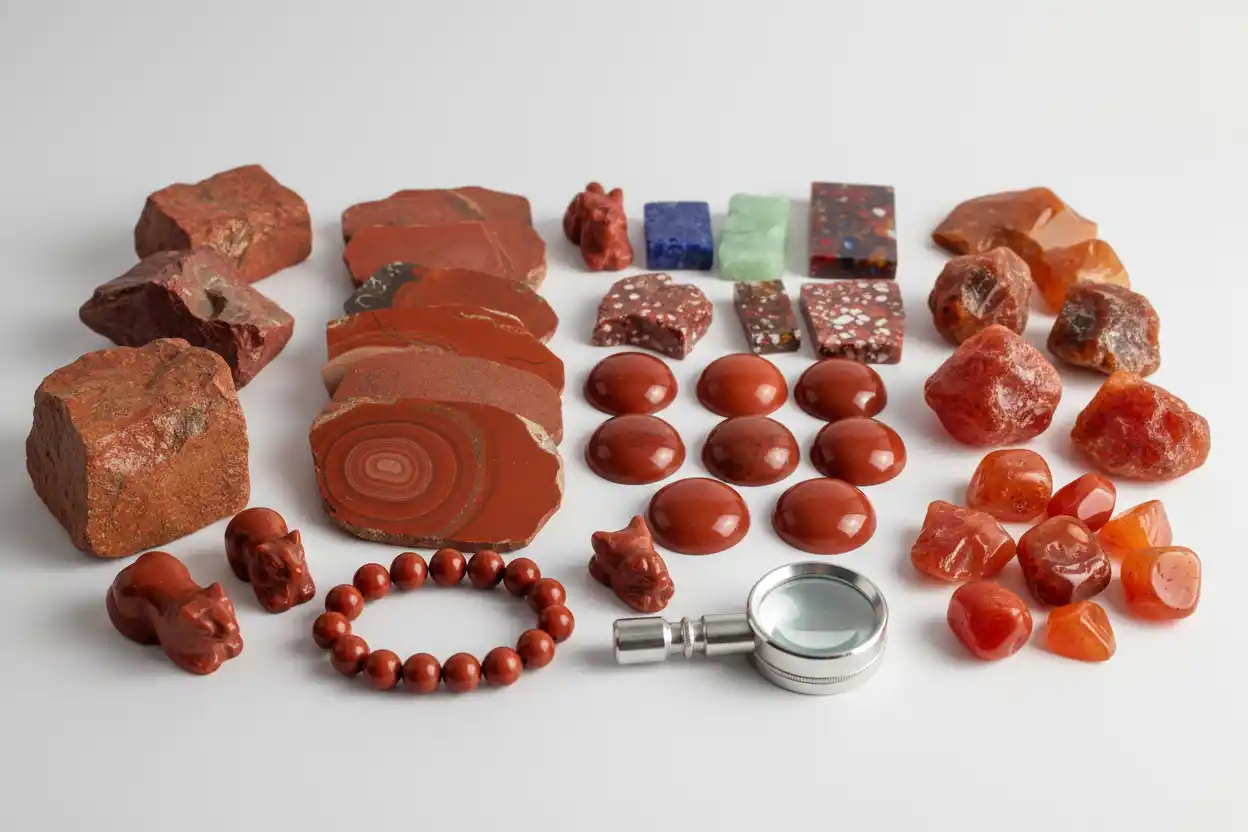
Where to Buy Real Red Jasper and Avoid Dyed Fakes
Real Red Jasper is an opaque red, rust, brick, terracotta, reddish-brown or orange-red silica-rich material traditionally placed within the Jasper and Chalcedony family. Its color commonly relates to finely distributed iron oxides, particularly Hematite, although exact composition and color mechanisms can vary among deposits.
Red Jasper is abundant and generally affordable. Consequently, outright imitation is less profitable than mislabeling, dyeing or applying invented locality names. Pale Jasper, quartzite, Marble, glass, ceramic and resin composites may all be sold as premium Red Jasper.
Some material marketed as Red Jasper is a natural silica-rich rock but does not meet a narrow definition of microcrystalline Chalcedony. Jasper terminology has long been applied broadly to impurity-rich chert, silicified sediment and other polishable opaque rocks.
The Red Jasper meaning and properties guide covers identity and traditional symbolism. This buying guide focuses on color authenticity, treatment, sellers, Carnelian confusion, rock classification and value without duplicating the completed general Jasper buying guide.
What Red Jasper Is
Conventional Jasper is an opaque-to-slightly translucent, impurity-rich form of microcrystalline silica closely related to Chalcedony and chert.
The Jasper meaning and properties guide provides the parent-material context. The types of Jasper guide separates color varieties, patterned materials and source-specific trade rocks.
Red Jasper commonly contains quartz or Chalcedony together with iron-rich material, clay and other mineral impurities.
Fine Hematite particles frequently create red, rust and brown colors. However, a seller should not state that every red grain consists only of Hematite unless testing supports the claim.
The material may form as bedded chert, silicified sediment, veins, nodules, brecciated rock or replacement material.
Red Jasper Is a Commercial Category as Well as a Material
Retailers commonly use the name for several overlapping products:
- Relatively uniform opaque red Jasper
- Red chert
- Banded red-and-brown Jasper
- Brecciated Red Jasper
- Red Jasper with Quartz or Chalcedony veins
- Red Jasper with Hematite-rich layers
- Red-dominant Picture Jasper
- Red-dominant Mookaite or other source-specific material
- Dyed pale silica-rich stone
- Reconstructed Jasper fragments and binder
A responsible listing should identify source-specific material by its more precise name when known.
For example, genuine Mookaite containing large red areas should not be relabeled as rare Red Jasper if its Western Australian identity is established.
Choose the Product Form Before Shopping
| Red Jasper product | Best source | Main buying concern |
|---|---|---|
| Natural rough | Lapidary or geological supplier | Color depth, fractures and rock identity |
| Slab | Specialist lapidary dealer | Dye, pattern continuity, resin and cutting yield |
| Cabochon | Independent cutter | Color, polish, backing and filler |
| Tumbled stone | Reputable crystal retailer | Dyed rock, ceramic and generic red material |
| Bead strand | Established bead supplier | Dye, reconstructed material and drill-hole damage |
| Sphere | Experienced carving retailer | Hidden pale areas, resin and assembly |
| Tower | Stone seller with exact-item video | Carved point, coating and weak reverse color |
| Carving | Skilled lapidary retailer | Composite construction and unstable seams |
| Jewelry | Jeweler with treatment disclosure | Backing, glue and correct material identity |
| Locality specimen | Geological dealer | Provenance and source-specific trade naming |
Red Jasper is usually opaque, so surface, edge and drill-hole photographs are especially important.
Where to Buy Genuine Red Jasper
Specialist lapidary suppliers
A lapidary supplier should show the natural exterior, dry sawn faces and sample polished stones.
Wet or oiled Red Jasper looks deeper and glossier while fine fractures become less visible. Therefore, dry photographs are necessary for an honest assessment.
Ask whether red color continues through the rough. Surface iron staining may cover pale or gray material beneath it.
A reliable supplier should state whether the rock contains soft layers, Quartz veins or open fractures that affect cutting yield.
Gem and mineral shows
Shows allow direct comparison with Carnelian, red Agate, Rhodochrosite, Cinnabar-bearing rock, dyed quartzite, glass and ceramic.
Use a loupe to inspect grain texture, fractures, dye concentrations and surface coatings.
Natural Red Jasper should show a dense geological body rather than one painted red film.
Do not perform scratch or solvent tests on merchandise. Use the seller’s return policy and professional examination instead.
Established online stores
The online gemstone buying guide explains seller identity, payment protection and returns.
Request exact-item photographs under neutral white light. Red is particularly sensitive to saturation and white-balance adjustments.
A brown-red stone can become vivid cherry red after digital editing.
Ask whether the object was photographed wet or oiled and whether the seller adjusted hue, contrast or saturation.
Independent cutters
A cutter who worked from rough may know whether the color, veins and inclusions continued through the slab.
Ask to see the original slab for an expensive cabochon.
Request front, back and girdle photographs. A thin red slice may be attached to a darker or stronger backing.
Geological dealers
A geological dealer can provide context for bedded Jasper, iron formation and source-specific rough.
Ask whether the specimen is conventional Jasper, chert, jasperoid or another silicified rock.
Those distinctions may matter more to collectors than to ordinary jewelry buyers, but they should still be stated accurately.
What Genuine Red Jasper Looks Like
Natural body colors include:
- Brick red
- Rust
- Terracotta
- Reddish brown
- Orange-red
- Burgundy red
- Brown-red
- Muted crimson
- Red with cream, gray or black veins
Perfectly uniform vivid red is less common than mottled or slightly brownish material.
The stone is generally opaque, although thin edges and Chalcedony-rich areas may transmit limited light.
Its rough surface can look dull, earthy or waxy. Polished material develops a smooth vitreous-to-waxy luster.
Natural veins may consist of Quartz, Chalcedony, iron-rich material or contrasting rock components.
Small pits and inclusions can occur. Their presence does not indicate poor authenticity, although excessive cavities reduce lapidary quality.
What Creates the Red Color?
Iron oxides commonly produce Red Jasper’s characteristic appearance.
Hematite can create red, brick and reddish-brown hues. Goethite and related iron hydroxides may contribute yellow, brown and orange areas, while weathering can transform one iron phase into another.
The Hematite meaning and properties guide and Goethite meaning and properties guide provide background on these common coloring minerals.
However, a polished Red Jasper object may contain several iron-rich phases and non-iron impurities.
Color intensity does not reveal the exact Hematite percentage or iron content. Chemical and mineralogical testing is required for precise claims.
Red Jasper Versus Carnelian
Carnelian is orange-to-red Chalcedony that is typically translucent rather than opaque.
Red Jasper has more included material and generally appears opaque and earthier.
The Carnelian versus Red Jasper guide owns the complete comparison.
The completed guide to buying genuine Carnelian covers heat, dye, Agate and glass.
A stone can contain translucent Carnelian zones and opaque Jasper zones. “Jasper-Carnelian” or a descriptive mixed-material listing may be more accurate than forcing it into one category.
Red Jasper Versus Red Agate
Red Agate generally shows visible bands and greater translucency.
Red Jasper is more opaque, and its color can appear as broad solid fields, mottling or veins.
Agate is frequently dyed red, pink or orange. Therefore, bright translucent bands deserve treatment disclosure.
A polished stone containing both banded translucent and opaque areas can legitimately be described as Agate-Jasper.
Red Jasper Versus Bloodstone
Bloodstone is dark green Chalcedony or Jasper marked by red iron-oxide spots.
The completed guide to buying real Bloodstone owns red-spot authenticity, dye and green host identification.
A red-dominant stone with one small green area is not automatically Bloodstone. The traditional identity requires a green host with contrasting red markings.
Red Jasper Versus Brecciated Jasper
Brecciated Jasper contains angular fragments cemented by contrasting silica or mineral material.
Red is one of its most common colors, and white, gray, black or clear veins may cross the fragments.
A naturally brecciated structure should continue through the object. Printed crack patterns or surface-only white lines suggest artificial decoration.
A seller should describe structural fractures honestly because open cracks reduce durability even when the brecciation is natural.
Red Jasper Versus Picture Jasper
Picture Jasper contains scenic bands and markings that resemble landscapes.
The completed guide to buying real Picture Jasper owns printed scenes, cutting composition and locality claims.
Some Picture Jasper is red-dominant. When the scenic pattern drives value, the Picture Jasper name is more informative than generic Red Jasper.
Red Jasper Versus Mookaite
Mookaite commonly combines cream, mustard, red, burgundy, brown, pink and purple.
The completed guide to buying genuine Mookaite owns Western Australian provenance and silicified-radiolarite identity.
A red Mookaite fragment may resemble ordinary Red Jasper, but documented source should remain part of the description.
Red Jasper Versus Noreena Jasper
Noreena Jasper is an Australian trade rock known for angular red, mustard, cream and dark patterns.
Its source identity is more specific than its dominant color.
A generic red-and-yellow stone should not receive the Noreena name without Australian provenance.
Red Jasper Versus Dragon Blood Jasper
Dragon Blood Jasper is a green-and-red trade material whose composition may fall outside strict conventional Jasper.
Its red areas are only one component of the broader pattern.
A red stone lacking the characteristic green matrix should not be sold under the Dragon Blood name.
Red Jasper Versus Rhodochrosite
Rhodochrosite is manganese carbonate and commonly appears pink, rose red or red-and-white banded.
It is softer and has carbonate cleavage, while Red Jasper is silica-rich and more durable.
The next dedicated guide to buying real Rhodochrosite will own banding, treatment and provenance.
Never use acid as a home distinction. It damages Rhodochrosite and may affect mixed or treated material.
Red Jasper Versus Cinnabar-Bearing Rock
Cinnabar is mercury sulfide with intense red color and high density.
Some decorative rocks contain Cinnabar with Quartz or other matrix. Those materials require substantially different safety precautions from ordinary Red Jasper.
A vivid scarlet specimen with unusual weight or a mercury-related locality should receive professional identification.
Red color alone should never justify a Cinnabar claim.
Dyed Red Jasper
Pale Jasper, chert, quartzite and other porous rocks can be dyed red.
Artificial color may concentrate in:
- Open fractures
- Cavities
- Grain boundaries
- Weathered zones
- Drill holes
- Surface pores
A chip may expose a gray, tan or white interior.
However, natural Hematite staining can also follow fractures and bedding. Therefore, several observations are necessary.
Ask for treatment disclosure and inspect different depths rather than relying on one dark crack.
Heated and Color-Enhanced Material
Heating can alter iron-bearing minerals and deepen red or brown coloration in some silica-rich materials.
The resulting stone remains natural rock with treated color.
Because treatment response depends on composition, a seller should not claim that every Red Jasper is heated or that heat can always be detected visually.
Intentional heat treatment should be disclosed when known.
Coatings, Wax and Oil
Oil and wax can deepen red color and conceal fine scratches temporarily.
Clear coatings can improve gloss, while red lacquer can intensify pale material.
Inspect drill holes, high points and chipped edges for a change in luster or color.
A surface coating may peel or wear differently from the stone beneath it.
The gemstone treatments guide explains dye, coating, filling and impregnation.
Resin Filling and Stabilization
Fractured Jasper may be filled or impregnated with polymer.
Clear resin can improve polish and reduce the visibility of cracks. Red or brown filler can conceal missing material.
Under magnification, resin may contain bubbles or show a different reflection.
Limited stabilization can make a fractured stone wearable, but it should not receive an untreated premium.
Reconstructed Red Jasper
Fragments or powder can be mixed with resin and molded into beads, spheres, carvings and cabochons.
The product may contain genuine Red Jasper without being one natural solid stone.
Mold seams, repeated patterns, polymer-rich chips and perfectly uniform color support reconstruction.
A seller should distinguish natural stabilized material from a heavily polymer-bound composite.
Glass and Ceramic Imitations
Opaque red glass can imitate polished Jasper.
Round bubbles, flow lines, mold seams and conchoidal glass chips support manufacture.
Ceramic can reproduce Red Jasper’s earthy color and black or cream veins through glaze or printing.
A chipped ceramic object may reveal a uniformly fired body beneath the decorative surface.
Glass and ceramic can be attractive materials when labeled accurately.
Painted Veins and Artificial Patterns
Manufacturers can paint black, white or cream lines onto plain red stone, resin or ceramic.
Under magnification, paint may bridge scratches, form a raised boundary or stop at the girdle.
Natural veins should enter the rock and change through the front, edge and reverse.
Do not scrape the pattern. Use professional examination and the return policy.
How to Evaluate Rough
Request dry photographs of the natural exterior and several sawn faces.
Color should continue through the material rather than form only an iron-stained crust.
Inspect fractures, cavities and pale internal zones. A large red surface may cover mostly gray or tan rock.
Ask whether test cabochons polished evenly and whether resin was required.
Usable color and structure matter more than weight.
How to Evaluate Slabs
Compare both faces and every edge.
Natural red fields, veins and inclusions should change through the slab’s thickness.
A good slab provides several structurally sound cutting areas.
Inspect for oil, wax, filler and straight glued seams.
Backlighting may reveal translucent Chalcedony zones, but reflected light remains more important for judging ordinary face-up color.
How to Judge Cabochons
A quality cabochon should show attractive red color, a smooth polish and stable edges.
The cutter may use cream Quartz veins or darker iron-rich areas as intentional design features.
Inspect the girdle for open cracks and undercut areas. The back should show color continuity and any backing or filler.
An even dome with deep natural red color is generally more desirable than an oversized stone with weak brown-gray areas.
Buying Beads and Bracelets
Natural strands should show reasonable variation in red shade, veins and inclusions.
Inspect drill holes for dye, resin and radial cracks. The interior color should correspond with the bead’s outer body.
Perfectly identical cherry-red beads with repeated black lines suggest glass, ceramic or reconstructed material.
Ask whether the strand contains only Red Jasper or a mixture of Carnelian, Agate and other red stones.
Buying Spheres, Towers and Carvings
Request a complete rotation. One side may be deep red while the reverse is brown, gray or heavily veined.
A sphere should not contain a straight equatorial seam.
Most towers are carved. Their pointed form did not grow naturally.
Carvings should avoid thin projections across fractures or contrasting soft seams.
Buying Red Jasper Jewelry
Sound silica-rich Red Jasper is generally suitable for pendants, earrings, bracelets and protected rings.
It normally has Mohs hardness around 6.5 to 7 and useful toughness.
The gemstone hardness chart and toughness-versus-hardness guide explain why existing fractures and composite construction still matter.
A bezel protects cabochon edges and can conceal less attractive backs, so request loose-stone photographs before mounting.
Locality and Provenance
Red Jasper occurs worldwide.
Commercial material is associated with India, Brazil, South Africa, Madagascar, Australia, the United States, Russia and many other regions.
Source-specific forms can arise in bedded chert, iron formations, volcanic settings and hydrothermal deposits.
Appearance alone cannot prove a country or mine. Request records when provenance affects price.
The ethical gemstone sourcing guide provides practical questions about mining, cutting labor and traceability.
Price and Value
Ordinary Red Jasper is affordable.
Value increases with:
- Attractive natural red saturation
- Even color or purposeful pattern
- Fine polish
- Large fracture-free dimensions
- Desirable veins or brecciation
- Treatment disclosure
- Cutting quality
- Carving craftsmanship
- Source documentation
- Collector geology
A small deep-red cabochon with an even polish may be more desirable than a large composite carving.
Undefined “AAA” grades add little information. Ask how the seller evaluates color, fractures, treatment and polish.
The gemstone pricing guide explains how workmanship and usable yield influence retail price.
Questions to Ask the Seller
Ask whether the material is conventional Red Jasper, red chert, jasperoid, Carnelian-Jasper or another source-specific rock.
Request the country, deposit and basis for the identification.
Confirm dye, heat, coating, oil, wax, resin, backing, filling and reconstruction.
For rough and slabs, request dry photographs of both faces and edges. For cabochons, request front, back and girdle views.
For beads, ask for drill-hole close-ups. For spheres and carvings, obtain a complete rotation.
Finally, confirm a return policy that permits professional examination.
Professional Identification
Microscopy can reveal microcrystalline texture, dye pathways, coatings, resin and composite boundaries.
Raman spectroscopy and X-ray diffraction can identify Quartz, Chalcedony, Hematite, Goethite and associated crystalline phases.
Petrographic analysis may be necessary when distinguishing conventional Jasper from chert, jasperoid or volcanic rock.
Chemical analysis can identify iron-rich components but generally cannot prove one locality without comparison data.
Several test points may be required because Jasper can be compositionally heterogeneous.
Cleaning and Storage
Clean sound untreated Red Jasper with lukewarm water, mild soap and a soft cloth.
Avoid prolonged soaking when dye, resin, backing or glue is present.
Do not use harsh acids, bleach or abrasive powders.
Ultrasonic cleaning is inappropriate for fractured, filled or assembled stones.
Store polished pieces away from diamonds, sapphires and other harder gemstones.
Frequently Asked Questions
1. Is Red Jasper a type of Quartz?
It is generally an opaque impurity-rich microcrystalline silica material closely related to Chalcedony and chert.
2. What makes Red Jasper red?
Fine iron oxides, commonly including Hematite, usually contribute the red, rust and brown colors.
3. Is every Red Jasper stone pure Chalcedony?
No. Commercial Jasper can include complex silicified rocks, chert and other natural geological materials.
4. Is Red Jasper the same as Carnelian?
No. Carnelian is generally translucent orange-to-red Chalcedony, while Red Jasper is usually opaque and more impurity-rich.
5. Is Red Jasper the same as red Agate?
No. Red Agate commonly displays bands and greater translucency. Some stones contain both Agate and Jasper zones.
6. Can Red Jasper be dyed?
Yes. Dye can enter fractures, pores, grain boundaries and drill holes.
7. Can Red Jasper be heat-treated?
Yes. Heat can deepen or alter iron-related colors in some material.
8. Can Red Jasper contain resin?
Yes. Fractures may be filled, and fragments or powder can be reconstructed with polymer.
9. Is vivid red color proof of treatment?
No. Natural Red Jasper can be strongly colored, although neon or perfectly uniform material deserves scrutiny.
10. Is Red Jasper suitable for daily jewelry?
Most sound natural cabochons are durable enough for regular wear, especially in protective settings.
11. Do ordinary stones need laboratory reports?
Usually not. Testing is more useful for disputed treatment, unusual composition or premium locality claims.
12. What is the biggest warning sign in a listing?
Be cautious when identical cherry-red objects have repeated painted veins and the seller provides no dry edge, reverse or drill-hole photographs.
Buy the Red Silica-Rich Stone Behind the Marketing Name
Red Jasper should have natural color and geological texture that continue beyond one polished face. Its value lies in durable material, strong cutting and transparent treatment disclosure rather than an invented rarity story.
The red crystals guide, red gemstones guide, R crystal directory and R gemstone directory provide wider comparisons. Choose a stone whose color, composition and construction remain credible from every side.
Safety note: Red Jasper and many jasper-like rocks contain crystalline silica. Cutting, drilling, sanding or grinding can generate hazardous respirable silica dust. Never dry-work the material; use professional wet methods, effective local extraction and suitable respiratory and eye protection.