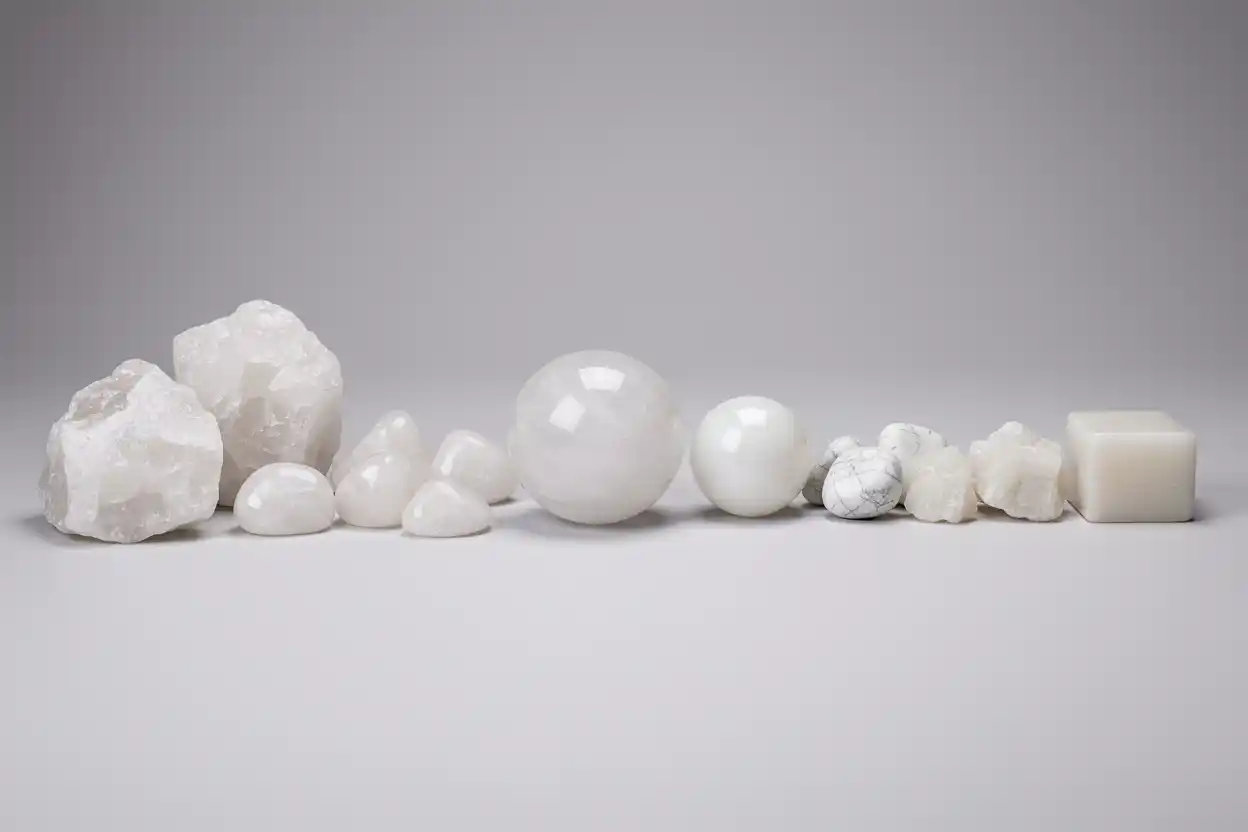
Where to Buy Real Snow Quartz and Avoid White Glass Fakes
Real Snow Quartz is a commercial name for white, cloudy or milky macrocrystalline Quartz. Its appearance ranges from translucent frost-white crystals to nearly opaque massive material resembling packed snow.
The white effect commonly results when numerous microscopic fluid inclusions, tiny mineral particles and microfractures scatter light through the Quartz. Snow Quartz is therefore not white because it contains snow, nor is it a separate mineral species.
Because common Milky Quartz is abundant, outright counterfeiting is less frequent than mislabeling. White Calcite, Howlite, Magnesite, Chalcedony, Opal, Quartzite, glass, ceramic and resin may all be sold as Snow Quartz.
The Snow Quartz meaning and properties guide covers identity and traditional symbolism. This buying guide focuses on seller selection, Milky Quartz terminology, internal cloudiness, lookalikes, treatments and finished-product quality.
Snow Quartz Is Milky Quartz
Snow Quartz and Milky Quartz are generally commercial synonyms.
Both describe macrocrystalline Quartz whose internal light scattering produces a cloudy white appearance.
The Quartz meaning and properties guide explains the parent mineral, while the Clear Quartz meaning guide covers transparent rock crystal.
The types of Clear Quartz guide separates transparent, cloudy and inclusion-bearing material.
A crystal can have a milky base and a clearer termination. Another specimen may remain evenly opaque from base to point. Both can be natural.
A seller should not claim that Snow Quartz has a different chemical formula, hardness or crystal system from Clear Quartz.
What Makes Quartz Look White?
Quartz is silicon dioxide, SiO2.
Pure, defect-free Quartz is colorless. A white or milky appearance develops when internal features scatter visible light.
These can include:
- Microscopic fluid inclusions
- Gas-and-liquid cavities
- Tiny mineral crystals
- Dense microfractures
- Growth irregularities
- Healed fractures
- Closely spaced internal interfaces
The scattering features may be distributed evenly or concentrated in growth zones.
Heating, pressure and geological deformation can change inclusion and fracture patterns, but the precise cause varies among deposits.
The presence of milkiness does not indicate lower authenticity. It simply reduces transparency.
Choose the Product Form Before Shopping
| Snow Quartz product | Best source | Main buying concern |
|---|---|---|
| Natural crystal point | Mineral or Quartz dealer | Natural termination, repairs and coating |
| Cluster | Specialist mineral dealer | Glued crystals and reconstructed matrix |
| Massive rough | Lapidary supplier | Quartzite or white rock substitution |
| Tumbled stone | Reputable crystal retailer | Glass, Howlite, Calcite and ceramic |
| Sphere | Experienced carving retailer | Resin, assembly and internal fractures |
| Tower | Seller with exact-item images | Carved point, coating and repaired tip |
| Cabochon | Independent cutter | Backing, fracture filling and polish |
| Bead strand | Established supplier | White glass, resin and drill-hole damage |
| Carving | Skilled lapidary seller | Composite construction and bruised surfaces |
| Jewelry | Jeweler familiar with Quartz | Backing, glue and exact material identity |
Natural crystal points and carved towers require different descriptions. A Snow Quartz tower can be genuine Quartz while its pointed shape remains entirely lapidary-made.
Where to Buy Genuine Snow Quartz
Quartz and mineral dealers
A specialist dealer should identify whether the piece is a natural crystal, a broken point, a cut base or a completely carved object.
Request photographs of every prism face, the termination and the base.
Natural Quartz crystals commonly show six-sided prism structure and rhombohedral termination faces. Contact areas, healed damage and uneven growth can occur.
Ask whether the piece was acid-cleaned, coated, repaired or mounted on reconstructed matrix.
Lapidary suppliers
For massive Snow Quartz rough, request dry natural surfaces and sawn faces.
Water can make cloudy Quartz look clearer and reduce the visibility of bruising.
Ask whether representative material from the parcel polished without extensive fractures.
Massive white Quartz may occur beside Feldspar or within Quartzite. A seller should state whether the rough is a single Quartz mass or a multi-mineral rock.
Gem and mineral shows
Shows let you compare Snow Quartz with Howlite, Magnesite, White Calcite, Selenite, white Chalcedony and glass.
Use a loupe to inspect crystal structure, internal fractures, bubbles, dye and coatings.
Do not scratch the merchandise. Snow Quartz’s hardness can be confirmed through professional testing without damaging a finished item.
The crystal identification guide provides safer identification principles.
Established online retailers
The online gemstone buying guide explains seller identity, payment protection and returns.
Request exact-item images under front lighting and backlighting. Front lighting shows the white body, while transmitted light reveals translucency and internal structure.
Ask whether photographs were digitally brightened until the Quartz lost its natural gray, cream or translucent variation.
For clusters, request the base and every crystal contact to check for glue.
What Genuine Snow Quartz Looks Like
Snow Quartz may be:
- Bright white
- Frost white
- Milky white
- Gray-white
- Cream-white
- Translucent at the edges
- Cloudy with clearer patches
- Nearly opaque
- White with mineral inclusions
- White with iron staining
Natural points can contain clearer terminations, internal rainbows and veils.
Massive material may show conchoidal fracture or irregular granular breaks. Highly fractured pieces can look especially white because cracks scatter more light.
The surface should have vitreous luster when well polished. Rough faces may appear dull or frosted.
A uniform white body does not prove resin or ceramic, but repeated identical clouds across several objects deserve scrutiny.
Snow Quartz Versus Clear Quartz
Clear Quartz and Snow Quartz share the same basic mineral species and composition.
The difference lies primarily in transparency and inclusion density.
Clear Quartz transmits light with relatively little scattering. Snow Quartz contains enough microscopic inclusions or fractures to appear white and cloudy.
The completed guide to buying real Clear Quartz owns general transparent-Quartz buying concerns.
A single crystal can transition from opaque Snow Quartz at its base to clear rock crystal near its termination.
Snow Quartz Versus White Chalcedony
Chalcedony is microcrystalline Quartz rather than one larger Quartz crystal.
White Chalcedony commonly has a waxier luster and more uniform translucency.
Snow Quartz may show visible macrocrystalline faces, internal veils and clearer growth zones.
In massive polished objects, visual distinction can become difficult. Microscopy and refractive testing may be needed.
Snow Quartz Versus Quartzite
Quartzite is a rock composed mainly of interlocking Quartz grains.
Snow Quartz is usually sold as massive or crystalline Quartz rather than a metamorphic rock.
Quartzite may reveal a sugary or granular texture, especially on a broken surface.
A carving made from natural white Quartzite is not artificial, but it should not be labeled as one Snow Quartz crystal.
Snow Quartz Versus Howlite
Howlite is a white borate mineral commonly marked by gray or black veins.
Snow Quartz usually lacks Howlite’s characteristic webbing and is significantly harder.
The completed guide to buying genuine Howlite covers dyed Turquoise imitations and white-stone identification.
Completely white Howlite can resemble Snow Quartz after polishing, so visual comparison alone may not be sufficient.
Snow Quartz Versus White Calcite
White Calcite is calcium carbonate with Mohs hardness 3, perfect rhombohedral cleavage and strong birefringence.
Snow Quartz has Mohs hardness 7 and lacks easy cleavage.
The completed Calcite buying guide addresses glass, Aragonite and carbonate treatments.
Do not use vinegar or acid for identification. It permanently damages Calcite and can affect a mixed or treated object.
Snow Quartz Versus Selenite
Selenite is crystalline Gypsum with Mohs hardness 2.
Fibrous Satin Spar Gypsum can look snowy white and silky.
The completed guide to buying real Selenite explains the Selenite-versus-Satin-Spar distinction.
Snow Quartz is harder, more resistant to water and lacks the continuous parallel fibers of Satin Spar.
Snow Quartz Versus White Opal
White Opal is hydrated amorphous-to-poorly crystalline silica.
Common white Opal can appear cloudy and waxy without play-of-color.
Snow Quartz is crystalline SiO2, generally harder and more durable.
Refractive-index and spectroscopic testing can separate the materials without scratching them.
Snow Quartz Versus Opalite
Opalite is usually manufactured glass with a milky blue-white appearance and warm orange transmitted color.
Snow Quartz remains white or gray-white under most lighting and shows natural fractures or crystal growth rather than a uniform glass glow.
Round bubbles, mold seams and smooth flow patterns support Opalite glass.
However, Snow Quartz can contain fluid inclusions, so one bubble-like feature is not conclusive.
White Glass Imitations
White or frosted glass can imitate tumbled stones, spheres and towers.
Warning signs include:
- Round bubbles
- Mold seams
- Identical internal swirls
- Conchoidal glass chips
- Repeated factory shapes
- No natural Quartz texture
- An unusually uniform frosted coating
Bubble-free glass exists, so gemological testing may still be necessary for an important item.
The real-versus-fake Clear Quartz guide provides the wider Quartz-versus-glass workflow.
Resin and Ceramic
White resin can be molded into points, beads and carvings.
It may show soft scratches, casting seams, bubbles and a warmer plastic feel.
Ceramic can have a hard white body and factory glaze. A chip may reveal a uniform fired interior.
Mineral powder can be added to resin or ceramic, but the resulting object is not one natural Quartz piece.
The fake-crystal buyer’s guide provides broader manufactured-material checks.
Dyed and Coated Snow Quartz
Snow Quartz is already white, but coatings may make it brighter, pearlier or iridescent.
Titanium or metallic aura coatings create rainbow surfaces. White lacquer can conceal stains and fractures.
Inspect high points, scratches and drill holes for peeling or color differences.
A coated natural Quartz stone remains Quartz, but it should not receive an untreated premium.
The treated Clear Quartz guide owns coating, irradiation, filling and synthetic-Quartz questions.
Fracture Filling and Stabilization
Heavily included Snow Quartz can contain surface-reaching fractures.
Clear resin may reduce their visibility and strengthen a carving or cabochon. White filler can conceal chips or open cavities.
Under magnification, filler may show bubbles, a different luster or concentrations inside cracks.
Limited filling can improve usability but must be disclosed.
The gemstone treatments guide explains filling, impregnation and reconstruction.
Synthetic Snow Quartz
Hydrothermal synthetic Quartz is manufactured commercially, primarily for technological and industrial applications.
Synthetic material can be grown with inclusions or cloudiness, although producing inexpensive Snow Quartz imitations is rarely economically necessary because natural Milky Quartz is abundant.
Nevertheless, large, unusually perfect calibrated objects may contain synthetic Quartz or assembled components.
Microscopy and infrared spectroscopy can assist with natural-versus-synthetic identification.
Glued Crystal Clusters
Separate Quartz points may be attached to a base or arranged into a decorative cluster.
Inspect every crystal contact for glossy adhesive, bubbles and sockets that do not match.
A repaired natural cluster differs from a completely fabricated arrangement, but both require disclosure.
White glue can disappear against Snow Quartz in photographs, making close-up base views important.
How to Evaluate a Natural Crystal
Check the crystal’s six-sided prism and termination geometry.
Determine whether the point is naturally terminated, broken and repolished, or fully carved.
Assess whether milkiness lies inside the crystal rather than in a surface coating.
Inspect the base for glue and the termination for repair.
Natural contact marks and partially healed damage are acceptable when disclosed.
How to Evaluate Rough
Request dry photographs of the exterior and a fresh or sawn surface.
Look for a consistent Quartz texture and determine whether Feldspar or other minerals occupy a large proportion.
Inspect fractures that may divide the block during carving.
Ask whether sample spheres or cabochons have taken a high polish.
Large weight alone offers little value when the interior is intensely fractured or mixed with softer rock.
How to Judge Spheres and Towers
Request a complete rotation.
A natural Snow Quartz sphere should contain internal cloudiness with plausible depth rather than a flat painted-white layer.
A straight equatorial seam suggests assembly.
Most towers are carved. Their point is manufactured even when the Quartz is natural.
Inspect tips and corners for filler, coating and impact bruises.
Buying Beads and Jewelry
Natural bead strands can vary slightly in translucency, cloud density and shade.
Inspect drill holes for resin, glassy cores and radial fractures.
Perfectly identical bright-white beads may be glass, ceramic or reconstructed material.
Quartz has Mohs hardness 7 and no easy cleavage, making sound Snow Quartz suitable for many jewelry forms.
The gemstone hardness chart and gemstone toughness-versus-hardness guide explain why major fractures still affect durability.
Locality and Provenance
Milky Quartz occurs worldwide in veins, pegmatites, hydrothermal deposits and metamorphic environments.
Notable crystal-producing regions include Brazil, Madagascar, India, the United States and the European Alps, among many others.
Arkansas Quartz commonly includes milky crystals and cloudy crystal bases.
A white appearance cannot prove a country. Request original labels when a specific mine or locality carries a premium.
Price and Value
Snow Quartz is abundant and usually affordable.
Value depends on:
- Attractive natural crystal form
- White or softly translucent appearance
- Luster
- Large intact size
- Interesting inclusion patterns
- Minimal distracting damage
- Cutting quality
- Solid construction
- Treatment disclosure
- Locality and provenance
A natural lustrous cluster can be more valuable than a much larger mass-produced tower.
The name Snow Quartz should not create a substantial premium over equivalent Milky Quartz.
The gemstone pricing guide explains how cutting, workmanship and documentation influence price.
Questions to Ask the Seller
Ask whether Snow Quartz is being used as a synonym for natural Milky Quartz.
Request confirmation that the object is macrocrystalline Quartz rather than Calcite, Howlite, glass, ceramic or Quartzite.
Ask whether a point is naturally terminated or carved.
Confirm coating, aura treatment, resin, filling, backing, glue and reconstruction.
For clusters, request every crystal contact. For beads, ask for drill-hole close-ups.
For spheres and towers, obtain a complete rotation.
Finally, confirm a return policy that permits professional testing.
Professional Identification
Refractive index, optic character, specific gravity and microscopy can identify Quartz.
Raman spectroscopy separates it from Calcite, Gypsum, Howlite, glass and many other white materials.
Microscopy can show natural fluid inclusions, fractures, resin, coating and glue.
Infrared spectroscopy can assist with synthetic Quartz and polymer detection.
Confirming Quartz does not establish one locality or prove that every crystal in an assembled cluster is natural.
Cleaning and Storage
Clean sound untreated Snow Quartz with lukewarm water, mild soap and a soft cloth.
Avoid ultrasonic or steam cleaning when the piece is highly fractured, filled, glued or coated.
Do not use abrasive powders, which can dull polished surfaces.
Store natural points so their terminations cannot strike other stones.
Frequently Asked Questions
1. Is Snow Quartz the same as Milky Quartz?
Yes. Snow Quartz is generally a retail synonym for white or cloudy Milky Quartz.
2. Is Snow Quartz a separate mineral species?
No. It is macrocrystalline Quartz with the same SiO2 composition as Clear Quartz.
3. What makes Snow Quartz white?
Microscopic fluid inclusions, tiny particles and microfractures scatter light and create its cloudy appearance.
4. Can Snow Quartz have clear areas?
Yes. One crystal may have a milky base, clearer zones and a transparent termination.
5. Is Snow Quartz the same as White Chalcedony?
No. Snow Quartz is macrocrystalline Quartz, while Chalcedony is microcrystalline.
6. Is Snow Quartz the same as Howlite?
No. Howlite is a softer white borate mineral commonly marked by dark veins.
7. Is Snow Quartz the same as Selenite?
No. Selenite is very soft Gypsum, while Quartz has Mohs hardness 7.
8. Can white glass imitate Snow Quartz?
Yes. Frosted or milky glass can imitate tumbled stones, towers and spheres.
9. Can Snow Quartz be coated?
Yes. White, pearly or metallic aura coatings can alter its surface appearance.
10. Can Snow Quartz contain resin?
Yes. Fractures may be filled, and fragments can be reconstructed with polymer.
11. Is Snow Quartz suitable for everyday jewelry?
Sound Quartz is generally durable, though heavily fractured or filled pieces require more care.
12. What is the biggest warning sign in a listing?
Be cautious when a flawless identical white product is called a rare Quartz variety but the seller provides no crystal structure, edge views or material testing.
Buy Natural Milky Quartz Without Paying for a New Name
Snow Quartz is appealing because internal inclusions transform common Quartz into a soft, frosted material. Its value should come from crystal form, polish and natural cloud structure rather than claims that it is a rare species.
The white crystals guide, white gemstones guide, S crystal directory and S gemstone directory provide wider comparisons. Choose the piece whose white appearance remains recognizably Quartz from every angle.
Safety note: Quartz contains crystalline silica. Cutting, drilling, sanding or grinding can produce hazardous respirable silica dust. Never dry-work Snow Quartz; use professional wet methods, effective local extraction and suitable respiratory and eye protection.