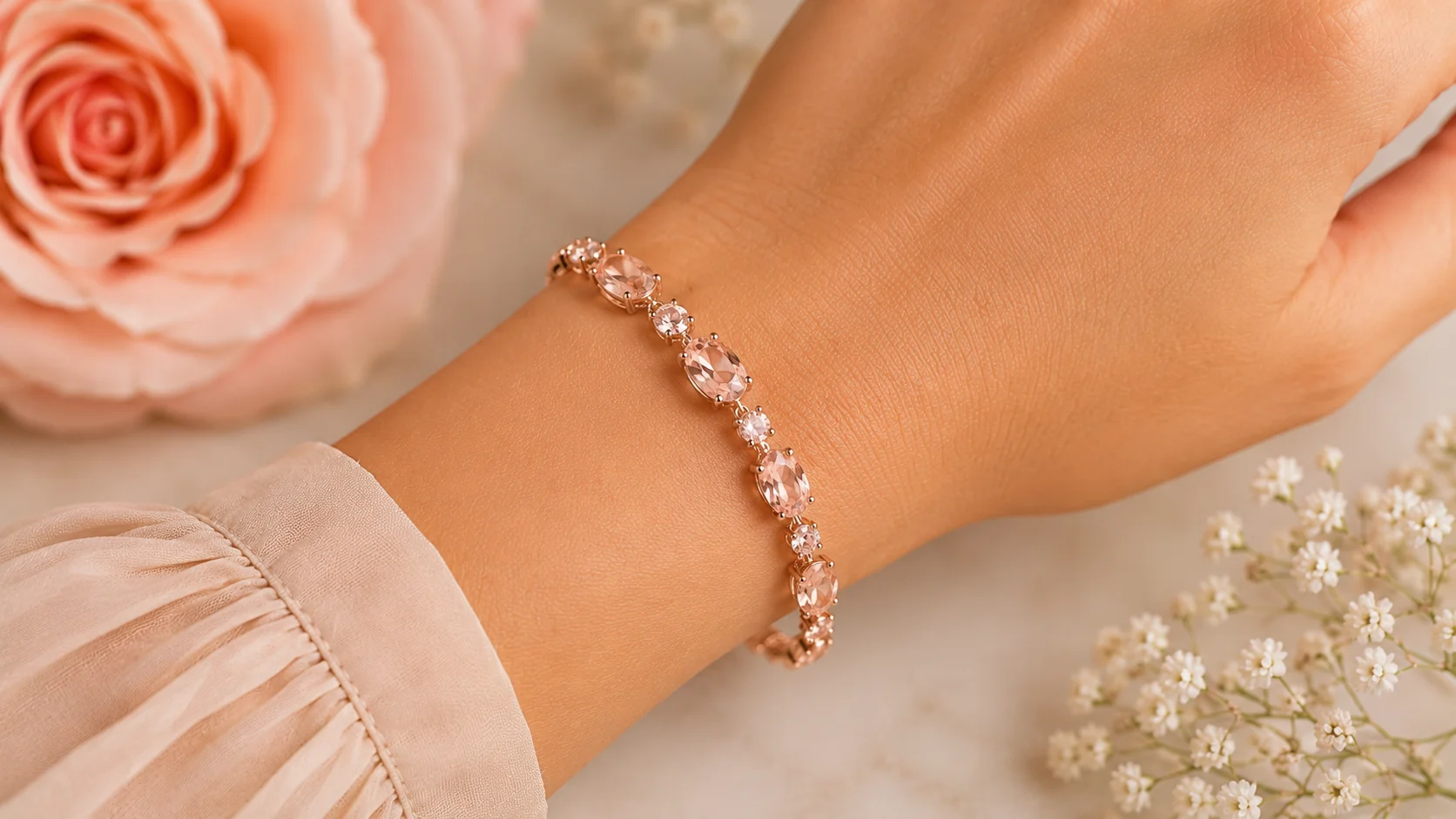
Morganite Bracelets: How to Choose and Wear
Morganite bracelets display the gem’s pale pink, peach and pinkish-purple colors across the wrist. A finely matched line can create a soft continuous glow, while larger station stones reveal the clarity and subtle pleochroism of individual gems.
Morganite is the pink-to-orange-pink variety of beryl, the same mineral family that includes Emerald and Aquamarine. With Mohs hardness of 7.5–8, it offers substantially better scratch resistance than Moonstone, Opal or Rose Quartz.
Bracelet durability still depends heavily on construction. The wrist receives repeated impact, and a line bracelet may contain dozens of links, prongs and joints. A durable gemstone cannot compensate for an undersized clasp, weak shared prongs or a chain too light for the stones.
The broad Morganite gemstone guide owns the mineral’s geology, history and symbolism. This page focuses strictly on bracelet styles, matching, settings, fit, treatment, buying and care.
Morganite Bracelets at a Glance
| Feature | What to evaluate |
|---|---|
| Gem family | Beryl |
| Typical colors | Pale pink, peach, salmon, pinkish purple and orangy pink |
| Main color cause | Manganese |
| Mohs hardness | 7.5–8 |
| Transparency | Usually transparent to translucent |
| Common bracelet forms | Tennis, line, bezel, station, bead, bangle and cuff |
| Main quality factor | Attractive pink color supported by clean cutting |
| Main matching concern | Tone, saturation, cut and visible size |
| Common treatment | Heat treatment to reduce orange or yellow components |
| Main construction concern | Links, prongs, clasp and wrist fit |
| Main cleaning method | Warm water, mild soap and a soft brush |
| Main disclosure issue | Natural or synthetic origin and treatment |
What Is Morganite?
Morganite is pink-to-orange-pink beryl.
Its basic chemical structure is shared with Beryl, Aquamarine and Emerald. Trace manganese produces its pink, peach and salmon colors.
The gem commonly forms in granite pegmatites, where large crystals can develop. Because Morganite rough may be sizable and relatively clean, cutters can fashion substantial stones.
Morganite is sometimes marketed as pink Emerald, but this name is misleading. Emerald is green beryl colored principally by chromium, vanadium or both; Morganite is a separate color variety with different market expectations.
The correct name should remain Morganite.
Why Morganite Works in Bracelets
Morganite’s hardness of 7.5–8 makes it suitable for regular jewelry use.
The Gemstone Hardness Chart places it above Quartz and well above Moonstone, Opal and many ornamental stones.
Nevertheless, it is not as scratch-resistant as Sapphire, Ruby, Moissanite or Diamond. Metal settings and harder neighboring gemstones can abrade it over time.
The Gemstone Toughness vs Hardness guide explains why impact, internal fractures and setting construction matter in addition to hardness.
A well-made Morganite bracelet can be worn frequently, but it should be removed before exercise, cleaning, gardening and mechanical work.
Main Morganite Bracelet Styles
| Bracelet style | Visual character | Main advantage | Main concern |
|---|---|---|---|
| Tennis bracelet | Continuous line of matching pink gems | Formal and highly coordinated | Matching, prongs and clasp |
| Graduated line | Larger stones toward the center | Strong visual focus | Smooth size progression |
| Bezel bracelet | Metal-framed gems | Protection and reduced snagging | More visible metal |
| Station bracelet | Spaced gems on a chain | Lightweight and modern | Flipping stations and chain strength |
| Faceted bead strand | Continuous soft color | Casual and flexible | Drill holes and bead abrasion |
| Bangle | Structured circular design | Easy stacking and clean form | Hinge, clasp and stone height |
| Cuff | Open rigid design | Contemporary statement | Repeated bending |
| Charm bracelet | Individual Morganite accents | Personalization | Charm collision |
| Mixed-beryl bracelet | Morganite with Aquamarine or Emerald | Family-based color contrast | Matching and durability differences |
| Mixed-gem bracelet | Morganite with Diamond, Sapphire or Pearl | Expanded visual palette | Direct contact with harder stones |
Morganite Tennis Bracelets
A Morganite tennis bracelet uses an articulated line of similarly sized faceted stones.
Each link should bend independently. A stiff section can cause the bracelet to twist, sit unevenly or transfer force into neighboring settings.
Round and oval Morganites are common because they can be matched efficiently. Cushions and emerald cuts create a more distinctive line but require closer control of proportions.
The stones should remain face-up through ordinary movement. Settings that roll beneath the wrist expose pavilion edges and reduce visual consistency.
A box clasp with one or two safety catches is appropriate for valuable bracelets. The links beside the clasp need particular strength because they receive repeated stress.
Graduated Morganite Bracelets
Graduated designs increase the stone size toward the center.
The progression should be smooth. Abrupt changes in dimensions can make the bracelet look assembled from unrelated parcels.
Larger Morganites often show stronger color because light travels through more material. A well-designed bracelet may therefore use slightly paler small side stones without appearing mismatched.
The central stones also add weight. The bracelet should remain balanced so the largest gems stay near the top of the wrist rather than pulling the line sideways.
Bezel-Set Morganite Bracelets
A bezel surrounds each stone with metal.
This construction protects the girdle, reduces snagging and creates a smooth surface suitable for frequent wear.
Morganite’s brilliance remains visible through the face, although the metal covers a small portion of the edge.
The bezels should remain even in height and thickness. One deep or crooked setting can interrupt the complete line.
The reverse should provide enough access for cleaning. Closed cups trap skin oil and soap beneath the gems, making pale Morganite appear dull.
Station Bracelets
A station bracelet spaces individual Morganites along a chain.
The design requires less total stone weight than a tennis bracelet and can create a lighter everyday appearance.
Two-point connections help each station remain face-up. A one-point connection permits more movement but may cause the stone to turn backward.
The chain must be proportionate to the gem weight. Fine chains can stretch or break even though Morganite itself remains intact.
Adjustable sliders are convenient, but the mechanism should hold securely rather than lengthen gradually during wear.
Morganite Bead Bracelets
Morganite can be fashioned into round, oval, faceted or irregular beads.
Transparent faceted beads produce flashes of light, while translucent beads emphasize continuous peach or pink color.
Drill holes should be smooth and free from radiating fractures. Chips at the opening can damage cord or elastic.
Knots between valuable beads reduce direct contact and limit loss if the strand breaks.
Stretch bracelets are convenient but require periodic restringing. Roll the bracelet over the hand rather than pulling it outward excessively.
A bead strand may contain lower-clarity material than a fine faceted line bracelet, but attractive color and polish can still create a successful design.
Morganite Bangles and Cuffs
Bangles may hold one central Morganite, several stations or a complete line across the upper surface.
A hinged bangle should open through its mechanical joint rather than flex through the stone-set section.
Cuffs are designed with an opening, but they should not be bent repeatedly to adjust the fit. Repeated flexing weakens metal and can disturb bezels or prongs.
A large center stone should sit low enough to avoid frequent impact.
The inside surface should remain smooth and free from protruding pavilion tips.
Choosing Morganite Color
Color is Morganite’s most important visual quality factor.
The gem ranges from pale pink and peach to salmon, purplish pink and stronger magenta-pink. Much commercial material is light in tone.
A large stone may show more color than a small one cut from comparable rough. Consequently, bracelet accents can look paler than center stones even when they are well matched.
The most valued colors generally show a clear attractive pink rather than an overly brown, gray or weakly tinted appearance.
The Pink Gemstones guide places Morganite beside Pink Sapphire, Spinel, Tourmaline, Kunzite and other pink materials.
Color should be viewed under neutral light and against the wearer’s skin rather than only beneath warm jewelry-store lamps.
Peach, Salmon and Pink Morganite
Untreated Morganite commonly contains an orange component, producing peach or salmon color.
Heat treatment can reduce yellow or orange tones and leave a pinker appearance.
Peach material is not automatically inferior. Some buyers prefer its warmth, especially in yellow or rose gold.
A bracelet should use a consistent color direction. Mixing cool purplish-pink stones with strongly orange-peach gems can look accidental unless the design uses a deliberate gradient.
Marketing terms such as blush, champagne pink and rose peach are not standardized gemological grades.
Pleochroism and Cutting Orientation
Morganite is pleochroic, meaning it can display different color strength or hue when viewed along different directions.
The cutter must orient the rough to retain the most attractive face-up color.
Poor orientation can leave a stone nearly colorless from above while stronger pink remains visible from the side.
In a bracelet, differently oriented stones may alternate between pink and pale as the wrist moves. A refined line should maintain reasonably consistent face-up color.
The effect is more noticeable in larger stones than in tiny accents.
Clarity
Morganite often occurs in relatively clean crystals.
Fine faceted material is generally expected to appear eye-clean, although needles, tubes, crystals, liquid inclusions and fractures may occur.
One visibly included stone can interrupt a tennis bracelet, particularly when every neighboring gem is transparent.
A small internal inclusion away from the girdle may have little practical effect. A surface-reaching fracture near a prong or drill hole creates a more serious durability concern.
Morganite can accumulate oil beneath the stone, producing apparent cloudiness that disappears after cleaning.
Cut Quality
Round brilliants provide strong brightness and are easier to match.
Ovals, cushions, pears and emerald cuts create different visual rhythms across the bracelet. Fancy shapes require consistency in length-to-width ratio and outline.
A broad window through the center reduces color and brilliance. Excessive depth hides weight without improving face-up size.
Morganite’s pale tone makes good cutting especially important. A weakly colored stone cannot afford major light leakage.
The Morganite Buying Guide owns full loose-stone evaluation.
Heat Treatment
Morganite is commonly heated to improve pink color.
The process reduces yellow or orange components and is generally considered stable.
Heat-treated Morganite remains natural beryl, but known enhancement should be disclosed. Treatment may be difficult to detect conclusively through routine gemological testing.
The dedicated How to Spot Treated or Synthetic Morganite owns the treatment boundary.
Heating does not transform Rose Quartz, glass or another gem into Morganite. Material identity and color treatment are separate questions.
Synthetic Morganite and Imitations
Laboratory-grown pink beryl can exist, although it is less prominent in ordinary jewelry than some other synthetic gems.
Glass, Cubic Zirconia, Pink Sapphire, Spinel, Kunzite and other stones may be sold incorrectly or confused with Morganite.
The Real vs Fake Morganite guide owns the complete authentication workflow.
The direct Morganite vs Rose Quartz comparison separates transparent beryl from commonly translucent-to-opaque Quartz.
Kunzite vs Morganite addresses another frequent pink-gem confusion. Kunzite has strong cleavage and light-sensitivity concerns that differ from Morganite.
Matching Stones
A multi-stone bracelet should be compared for hue, tone, saturation, transparency, cut, dimensions and brilliance.
Exact matching is more difficult in larger stones because slight differences become easier to see.
The stones do not need identical inclusions, but one gray, orange or visibly windowed gem can interrupt the line.
Ask for continuous video showing the complete bracelet. Separate optimized photographs cannot demonstrate how the stones interact under one light source.
A graduated design can tolerate controlled color differences when the progression supports the change in size.
Bracelet Fit
A Morganite bracelet should move comfortably without rotating excessively or striking desks repeatedly.
Measure the wrist with a flexible tape and compare it with the stated wearable circumference.
Large stones and deep settings occupy space inside the bracelet, so laid-flat length may exaggerate the effective fit.
A loose tennis bracelet can roll under the wrist and place the clasp against hard surfaces. A tight bracelet stresses links and pinches skin.
The ideal allowance depends on bracelet width, stone size and wearer preference.
Clasps and Safety Features
A valuable line bracelet should have a secure clasp.
Box clasps create a clean appearance and can include one or two safety latches. The tongue should engage positively without excessive force.
Lobster clasps work well for station and chain bracelets. Spring-ring clasps are more appropriate for lightweight designs.
Inspect jump rings and links beside the clasp. These components receive repeated movement and often fail before the center settings.
A safety chain can reduce loss risk but should remain short enough not to catch on objects.
Metal Choices
Rose gold is strongly associated with Morganite because it complements peach and pink tones.
Yellow gold emphasizes warmth, while white gold and platinum create greater contrast and may make a pale stone appear cooler.
The best metal is not determined by color alone. Alloy strength, total weight, link construction and skin compatibility matter.
The Best Gemstones and Metals for Sensitive Skin guide explains nickel, solder, plating and alloy concerns.
White gold may require periodic rhodium replating. Sterling silver offers a lower-cost option but tarnishes and may be less suitable for very valuable stone lines.
Morganite With Other Gemstones
Morganite can be paired with Diamond, Sapphire, Aquamarine, Emerald, Pearl or other gems.
A mixed-beryl bracelet may combine pink Morganite and blue Aquamarine, linking two varieties of the same mineral family.
Harder Diamond or Sapphire accents must not rub directly against Morganite. Metal should separate the stones.
Pearl introduces a much softer organic gem and imposes stricter cleaning limits.
A mixed bracelet should follow the care requirements of its most delicate component.
Price and Value
The Morganite Price Guide owns current material valuation.
Bracelet price depends on color, clarity, cut, matching, total stone dimensions, treatment, metal weight, clasp quality and setting labor.
A long tennis bracelet requires many matched stones and can cost more than a larger solitaire pendant with similar total gem weight.
Large size alone does not guarantee strong value because pale Morganite crystals can occur in substantial dimensions.
A bracelet should not be marketed as an investment with guaranteed appreciation.
Buying Online
Follow How to Buy Gemstones Online Without Getting Scammed.
Request a continuous video of the exact bracelet under neutral light and against skin.
The listing should provide wearable length, stone count, millimeter dimensions, total weight, metal alloy, clasp type, treatment disclosure and return terms.
For an expensive line, ask whether matched replacement stones are available. A standard round is easier to replace than a proprietary cushion or unusual peach tone.
A laboratory report may be useful for a significant center or disputed natural identity. The Gemstone Certification guide explains report limitations.
Wearing and Stacking
Morganite bracelets can coordinate with Morganite Earrings, a Morganite Necklace or Morganite Rings through color and metal rather than exact stone matching.
A Morganite Engagement Ring may guide the preferred cut or alloy for a bridal set.
When stacking, avoid continuous contact with rough metal, Diamond girdles or Sapphire settings.
A smooth gold bangle can provide separation between a Morganite line and harder jewelry.
Remove the bracelet before exercise, cleaning, swimming and mechanical work.
The Crystal Bracelets guide covers general bracelet formats and symbolism without replacing Morganite-specific construction guidance.
Cleaning and Maintenance
Follow How to Clean Morganite Jewelry Safely.
Use lukewarm water, mild dish soap and a soft brush. Clean beneath the stones, where oil reduces Morganite’s pale brilliance.
Avoid sudden heat and do not expose the gem casually to a jeweler’s torch during repair.
Ultrasonic and steam cleaning may be suitable for some sound untreated stones, but they should be avoided when fractures, filler, coatings or delicate mixed gems are present. Gentle hand cleaning is the safest routine option.
Dry the bracelet thoroughly around links and clasps.
Have frequently worn line bracelets inspected periodically. A loose stone, catching prong, stiff link or changing clasp requires repair before continued wear.
Frequently Asked Questions
1. Is Morganite durable enough for bracelets?
Yes. Its hardness of 7.5–8 makes it suitable for regular jewelry, although settings and links still require protection from impact.
2. What is the best Morganite bracelet style?
A well-constructed tennis bracelet provides classic continuous color, while bezel and station styles offer smoother everyday alternatives.
3. Is rose gold always best for Morganite?
No. Rose gold complements peach tones, but yellow gold, white gold and platinum can also create attractive combinations.
4. Is Morganite naturally pink?
Yes. Manganese produces its pink-to-orange-pink color, although heat treatment commonly modifies the hue.
5. Is most Morganite heat-treated?
Heat treatment is common and often used to reduce orange or yellow components and create a pinker appearance.
6. Is Morganite the same as pink Emerald?
No. Pink Emerald is a misleading marketing term. Morganite and Emerald are separate color varieties of beryl.
7. Does Morganite scratch easily?
It resists ordinary scratches reasonably well but can still be scratched by Sapphire, Diamond and other harder materials.
8. Why are small Morganites often very pale?
Morganite commonly has light tone, and larger stones show more color because light travels through more material.
9. Can Morganite bracelets contain synthetic stones?
Yes. Laboratory-grown pink beryl and other pink imitations can occur, so material identity should be disclosed.
10. How should a Morganite tennis bracelet fit?
It should move comfortably without rotating excessively or pressing continuously against the wrist.
11. Can Morganite be cleaned ultrasonically?
Some sound stones may tolerate it, but gentle hand cleaning is safer when fractures, treatments or mixed gems are present.
12. When should a Morganite bracelet be inspected?
Inspect it whenever a prong catches, a link stiffens, a stone moves or the clasp begins closing differently.
Morganite bracelets are defined by consistency more than by one exceptional stone. The color must continue across the wrist, cuts must return light at similar strength and every link must move without sacrificing security. When matching and construction receive equal attention, the bracelet preserves Morganite’s delicate appearance without being delicately built.