Where to Buy Real Peach Moonstone and Avoid Glass Fakes
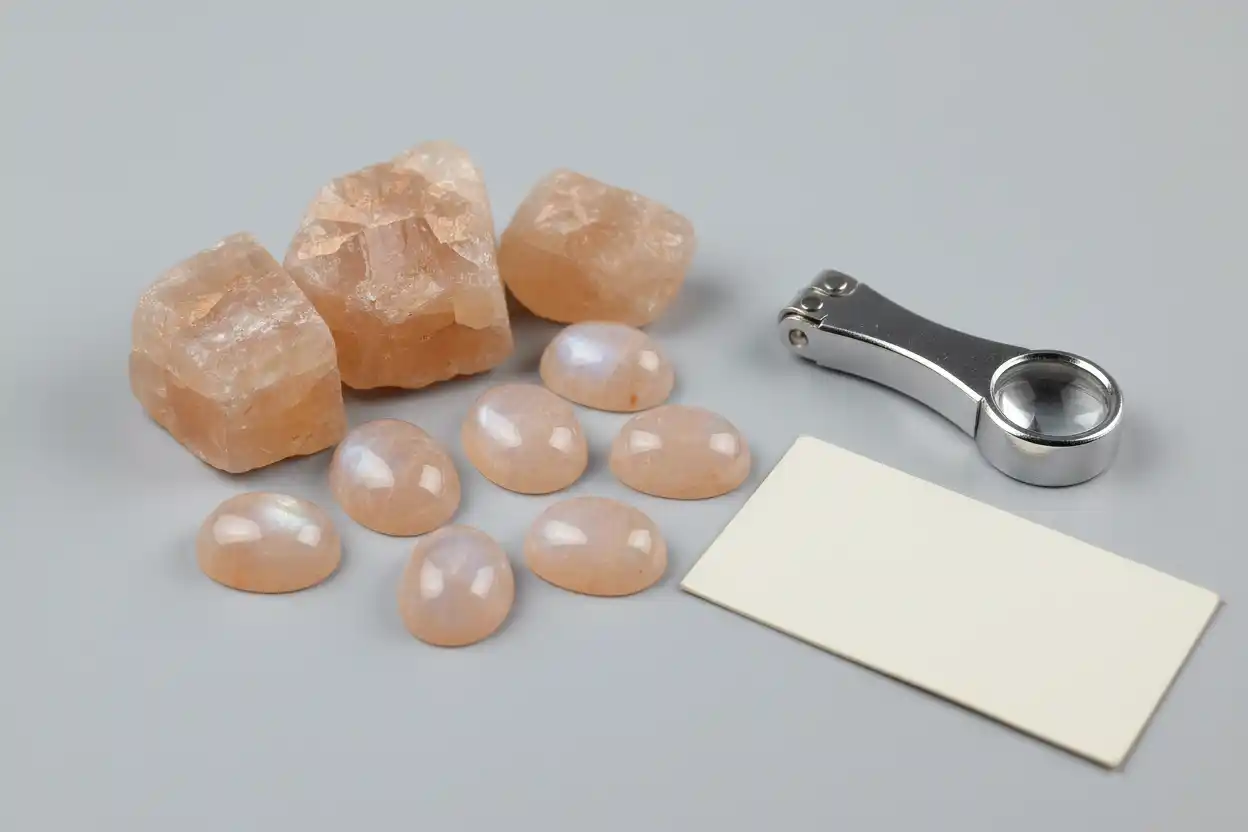
Real Peach Moonstone is a warm peach, apricot, beige-pink, salmon or light orange-brown feldspar that displays a floating white, silver or occasionally bluish sheen known as adularescence.
The body color alone does not make a stone Moonstone. A genuine piece should also have feldspar structure and an optical effect consistent with intergrown feldspar layers.
Peach-colored glass, Orange Calcite, Peach Aventurine, Sunstone, resin, dyed feldspar and low-grade material coated to improve sheen may all enter the market under Moonstone-related names.
The Peach Moonstone meaning and properties guide covers identity and traditional symbolism. This buying guide focuses on adularescence, sellers, treatment, lookalikes, cutting quality, durability and value.
Peach Moonstone Belongs to the Feldspar Family
Moonstone is an intergrowth of feldspar phases that produces adularescence when light scatters through thin internal layers.
The Moonstone meaning and properties guide explains the broader gemstone. The types of Moonstone guide separates peach, white, gray, green, black and rainbow-market material.
The feldspar family guide provides wider mineral context without replacing Moonstone-specific optical identification.
Peach Moonstone is a body-color variety rather than a separate mineral species. Its peach, tan or orange-pink color may relate to iron-bearing components or other features within the feldspar.
The exact color mechanism can vary, so a seller should not promise one universal trace-element explanation without evidence.
Adularescence Is the Essential Optical Feature
Adularescence appears as a soft light that seems to float beneath the surface and move as the stone or light source changes position.
In Peach Moonstone, the sheen is often white, cream or silvery. Blue sheen can occur but is less typical than in prized colorless Moonstone.
The effect should have depth. It should not sit like glitter, metallic paint or a flat surface reflection.
Good cutting centers the sheen across the cabochon’s top. Poor orientation may confine it to one edge or make it visible only from a narrow angle.
A stone can be genuine feldspar but have weak adularescence. In that case, it should not receive a high Moonstone-quality premium.
Choose the Product Form Before Shopping
| Peach Moonstone product | Best source | Main buying concern |
|---|---|---|
| Natural rough | Feldspar or lapidary supplier | Sheen orientation, cleavage and treatment |
| Slab | Lapidary dealer | Adularescent yield, fractures and backing |
| Cabochon | Specialist gem dealer | Centered sheen, body color and structural condition |
| Faceted stone | Collector-gem dealer | Weak adularescence, chips and material identity |
| Tumbled stone | Reputable crystal retailer | Peach Aventurine, Calcite, glass and resin |
| Bead strand | Established bead supplier | Coating, filler, mixed feldspar and drill-hole cracking |
| Sphere | Experienced carving retailer | Weak reverse sheen, resin and glass |
| Tower or carving | Stone seller with exact-item video | Carved point, coating and poor optical orientation |
| Ring stone | Jeweler familiar with Moonstone | Cleavage, setting pressure and treatment |
| Pendant or earrings | Independent jeweler | Centered sheen, glue and backing |
A cabochon should be evaluated for optical performance. Rough and slabs require evidence that correctly oriented cuts can produce that performance.
Where to Buy Genuine Peach Moonstone
Specialist feldspar and Moonstone dealers
A specialist seller should distinguish Peach Moonstone from Sunstone, Labradorite and other feldspars.
Listings should show the stone in movement under one neutral light rather than only in diffuse studio lighting.
Ask whether the material is orthoclase Moonstone, another alkali feldspar product or a trade-labeled feldspar that has not been analyzed.
Request disclosure of fracture filling, coating, backing, dye and oil.
Lapidary suppliers
Moonstone rough can look unimpressive until cut in the correct orientation.
Request polished windows or sample cabochons from the same parcel. They demonstrate the sheen’s direction and quality.
Ask for dry photographs. Oil and water can reduce the visibility of scratches and fractures.
Examine the rough’s thickness because cleavage and inclusions can reduce usable yield.
Gem and mineral shows
Shows allow you to compare Peach Moonstone with Peach Aventurine, Sunstone, Rainbow Moonstone, glass and Orange Calcite.
Rotate the stone beneath one stationary white light. Adularescence should glide beneath the surface rather than sparkle from fixed particles.
Use a loupe to inspect cleavage, coatings, resin and stress cracks.
Do not scratch the item. Feldspar hardness and cleavage make destructive tests inappropriate.
Established online sellers
The online gemstone buying guide explains seller verification and return protection.
Request a continuous video showing the entire stone. The seller should not move several lights independently because that can exaggerate weak sheen.
Ask whether the pictured stone is the exact item that will ship.
Peach color is highly sensitive to white balance. Request images in daylight-equivalent and ordinary indoor light.
Independent jewelers
A jeweler should understand Moonstone’s cleavage and avoid excessive setting pressure.
Ask to see the loose stone before mounting. A reflective backing can brighten weak adularescence, while colored adhesive can deepen the body color.
Request written disclosure of treatment and whether the stone is solid or assembled.
What Genuine Peach Moonstone Looks Like
The body color may be:
- Pale cream-peach
- Apricot
- Beige-pink
- Salmon
- Pale orange
- Rosy tan
- Brownish peach
Transparency ranges from nearly transparent to translucent and cloudy.
The adularescence commonly appears white or silver, although blue, cream or warm light may occur.
Natural inclusions can include fine fractures, mineral grains, cloudy zones and stress features sometimes called centipede inclusions.
Color and transparency can vary through one cabochon. A faint pale band or cloud does not automatically indicate treatment.
A perfectly uniform peach body with mechanically identical sheen across many stones deserves closer inspection.
Peach Moonstone Versus White Moonstone
White Moonstone has a white, colorless or gray-white body and commonly displays white, silver or blue adularescence.
Peach Moonstone has warmer body color, though pale pieces can overlap.
The difference is primarily color rather than a separate mineral structure.
Colorless material with vivid blue sheen often commands a higher conventional Moonstone premium, but an attractive peach stone can still have excellent cutting and adularescence.
Peach Moonstone Versus Black Moonstone
Black Moonstone has a gray, charcoal, brown-black or nearly black body with silver, white, peach or blue sheen.
Some dark brown Peach Moonstone may enter the Black Moonstone market and vice versa.
The completed guide to buying genuine Black Moonstone owns dark-body feldspar, coating and variety-specific mislabeling.
The seller should show the body color under neutral light rather than choosing a premium name based on one photograph.
Peach Moonstone Versus Rainbow Moonstone
Rainbow Moonstone is commonly a trade name for transparent to translucent white Labradorite displaying blue or multicolored labradorescence.
It is not generally the same feldspar material as traditional orthoclase Moonstone.
The future guide to buying real Rainbow Moonstone will own Labradorite identity, rainbow flash and treatment.
Peach Moonstone normally has a warm body and softer white or silver adularescence.
Peach Moonstone Versus Sunstone
Sunstone displays aventurescence from reflective inclusions, often appearing as coppery, red, gold or silver sparkle.
Moonstone displays a billowy floating sheen rather than fixed glitter.
The Sunstone buying guide explains aventurescence and copper-bearing material.
Some feldspar pieces display both adularescence and aventurescence. Sellers should describe both effects rather than selecting whichever name carries the highest price.
Peach Moonstone Versus Peach Aventurine
Peach Aventurine is a quartz-rich material containing reflective mineral inclusions.
It commonly shows numerous small sparkles throughout its body. Peach Moonstone instead shows one broader floating light effect.
Aventurine is also usually more granular and lacks Moonstone’s feldspar cleavage.
The completed general Aventurine buying guide provides family-wide quartz and glass checks.
Peach Moonstone Versus Orange Calcite
Orange Calcite is a soft calcium-carbonate mineral.
Calcite can be peach, orange or salmon-colored, but it does not display true adularescence. Flat cleavage reflections may imitate a pale sheen in photographs.
The completed guide to buying Orange Calcite owns carbonate treatment and care.
Calcite has Mohs hardness 3 and extreme birefringence, while Moonstone has different optical properties and greater hardness.
Peach Moonstone Versus Opal
Opal may appear peach, pink or orange and can show internal color effects.
Moonstone’s adularescence is a soft moving sheen, whereas precious Opal displays play-of-color through spectral flashes.
The Moonstone-versus-Opal guide owns the detailed comparison.
Common Opal without play-of-color can still resemble cloudy Peach Moonstone, making gemological testing useful.
Peach Moonstone Versus Glass
Glass can be manufactured with floating white layers, swirls, foil or reflective films.
Round bubbles, flow lines, mold seams and repeated optical patterns support glass.
A flat reflective layer at one depth can mimic Moonstone in a static image. Natural adularescence usually appears softer and relates continuously to the internal feldspar structure.
The real-versus-fake Moonstone guide provides the complete diagnostic workflow.
Coatings and Surface Films
A transparent or pearly coating can create a Moonstone-like sheen on feldspar, glass or resin.
Inspect the girdle, back and worn edges for peeling, scratches or a change in reflection.
A coating may produce color that follows the surface rather than floating beneath it.
Clear coatings can also conceal abrasion without creating the main optical effect.
Fracture Filling
Moonstone can contain cleavage cracks and stress fractures.
Clear resin or oil may reduce their visibility and improve transparency. GIA laboratories have documented filled Moonstone beads.
Filler may show bubbles, a flash effect within fractures or differing infrared behavior.
The gemstone treatments guide explains fracture filling and impregnation.
Dyed Feldspar
Pale or porous feldspar can be dyed peach, pink or orange, especially when fractures reach the surface.
Artificial color may concentrate along cleavage, grain boundaries and drill holes.
Natural Peach Moonstone can also show uneven iron-related color. Therefore, color distribution must be interpreted with microscopy and treatment history.
Resin and Composite Products
Resin can be molded with pearly pigment to imitate Peach Moonstone.
Casting seams, soft scratches, bubbles and identical floating bands across several pieces support polymer manufacture.
Thin feldspar slices can also be backed or assembled over reflective material.
A doublet can be attractive when disclosed, but it should not be sold as one solid natural Moonstone.
How to Evaluate Rough
Ask for polished test windows under one directional white light.
Determine how broad the adularescent area is and whether it can be centered in a cabochon.
Inspect cleavage planes and internal fractures. Large rough may contain little usable material if cracks cross the optical layers.
Ask whether the material has been oiled, filled or resin-stabilized.
How to Judge Cabochons
The strongest cabochon should display centered sheen across much of the dome.
A high dome can improve the optical effect, but excessive thickness may darken the peach body or add unnecessary weight.
The sheen should remain visible through a useful range of viewing angles.
Inspect the girdle and back for cracks, filler, backing and glue.
A beautiful but deeply fractured stone should cost less than a structurally sound cabochon with similar optical quality.
Buying Faceted Peach Moonstone
Faceting often weakens adularescence because the phenomenon is best displayed by a smooth cabochon surface.
A faceted stone may emphasize transparency, body color and brilliance instead.
Ask whether the gem shows recognizable Moonstone sheen face-up. Otherwise, the purchase may belong more naturally in the collector-feldspar market.
Inspect facet junctions and girdle edges for abrasion and cleavage chips.
Buying Beads
Natural strands should show variation in body color, clarity and adularescence.
Inspect drill holes for radial cracks, dye and filler. Drilling across cleavage can weaken a bead substantially.
Perfectly identical peach beads with one fixed white stripe may indicate coated glass or resin.
Ask whether every bead is Moonstone or whether the strand includes Sunstone, Labradorite or ordinary feldspar.
Buying Rings and Other Jewelry
Moonstone has Mohs hardness around 6 to 6.5 but has cleavage and relatively poor toughness.
The gemstone hardness chart, gemstone cleavage guide and toughness-versus-hardness guide explain why these properties must be evaluated separately.
Pendants, earrings and brooches are safer than exposed rings.
A low bezel or protective halo reduces edge impact. Avoid tension settings and excessive pressure.
The Moonstone ring guide provides form-specific buying considerations.
Locality and Provenance
Moonstone is associated with Sri Lanka, India, Myanmar, Tanzania, Madagascar and other feldspar-producing regions.
Peach material is commonly marketed from India and Madagascar, although country claims should not be inferred from color alone.
A locality premium requires supplier records or a credible dealer chain.
The ethical gemstone sourcing guide provides practical questions about mining, cutting labor and traceability.
Price and Value
Peach Moonstone is generally less expensive than top transparent colorless Moonstone with vivid blue sheen, but fine examples can command meaningful prices.
Important value factors include:
- Attractive natural peach body color
- Strong adularescence
- Centered sheen
- Wide viewing range
- Translucency
- Minimal distracting inclusions
- Structural condition
- Cutting quality
- Treatment disclosure
- Size
- Provenance
The Moonstone price guide provides broader market context.
Avoid arbitrary “AAA” grades unless the seller defines body color, sheen, clarity, orientation and treatment.
Questions to Ask the Seller
Ask whether the stone is traditional Moonstone feldspar, Rainbow Moonstone Labradorite or another feldspar product.
Request a continuous video under one stationary white light.
Confirm whether the sheen is natural and whether coating, backing, dye, oil, resin or fracture filling is present.
Ask for front, back, edge and drill-hole views as appropriate.
Request the country of origin and the basis for that claim.
Finally, obtain a return policy that permits independent gemological inspection.
Professional Identification
Refractive index, specific gravity, optic character and microscopy can separate Moonstone from glass, Calcite, quartz and many other lookalikes.
Microscopy may reveal feldspar inclusions, stress cracks, filler, coatings and assembly seams.
Raman spectroscopy and related testing can identify feldspar phases, while infrared spectroscopy may detect resin.
Confirming feldspar does not automatically prove natural peach color or untreated construction.
Cleaning and Storage
The completed Moonstone jewelry cleaning guide provides detailed care.
Use lukewarm water, mild soap and a soft cloth. Avoid steam and ultrasonic cleaners.
Do not soak filled, backed, glued or heavily fractured stones.
The completed Moonstone cleansing and charging guide offers non-destructive options for traditional practices.
Store Moonstone separately from harder gems and remove rings before household or manual work.
Frequently Asked Questions
1. Is Peach Moonstone a real Moonstone variety?
Yes. It is a warm peach-to-orange-pink body-color variety within the Moonstone market.
2. What creates Moonstone’s glow?
Light scatters through microscopic intergrown feldspar layers, producing adularescence.
3. What color should the sheen be?
Peach Moonstone commonly shows white or silver sheen. Blue or cream adularescence can also occur.
4. Is Peach Moonstone the same as Sunstone?
No. Sunstone displays sparkle or aventurescence, while Moonstone shows a broader floating sheen.
5. Is Peach Moonstone the same as Rainbow Moonstone?
No. Rainbow Moonstone is usually transparent white Labradorite with blue or multicolored labradorescence.
6. Can Orange Calcite look like Peach Moonstone?
Yes. Orange Calcite can have similar body color, but it lacks true feldspar adularescence and is much softer.
7. Can Peach Moonstone be dyed?
Yes. Pale feldspar can be dyed, particularly along fractures and drill holes.
8. Can Moonstone contain resin?
Yes. Fractures can be filled, and thin stones can be backed or assembled.
9. Does a white surface reflection prove adularescence?
No. Glass, coating and polished surfaces can create ordinary reflections. True adularescence appears to float beneath the surface.
10. Is Peach Moonstone suitable for daily rings?
It is vulnerable to scratches, cleavage and impact. A protective occasional-wear setting is more realistic than an exposed daily ring.
11. Do ordinary cabochons need laboratory reports?
Usually not. Testing is more useful for expensive stones, disputed treatment or uncertain feldspar identity.
12. What is the biggest warning sign in a listing?
Be cautious when every stone displays the same perfectly fixed white stripe and identical peach color but the seller provides no moving-light video or treatment statement.
Buy the Floating Sheen, Not Only the Peach Color
Peach body color can occur in several minerals and manufactured materials. Genuine Peach Moonstone should combine that warmth with recognizable feldspar adularescence and realistic cleavage.
The P crystal directory, P gemstone directory, pink gemstones guide and visual gemstone guide provide wider comparisons. Choose the stone whose sheen remains natural-looking as it moves beneath one light.
Safety note: Moonstone can split along cleavage after impact or excessive setting pressure. Avoid steam and ultrasonic cleaning. Cutting and drilling feldspar should use wet methods, effective dust extraction and suitable eye and respiratory protection.