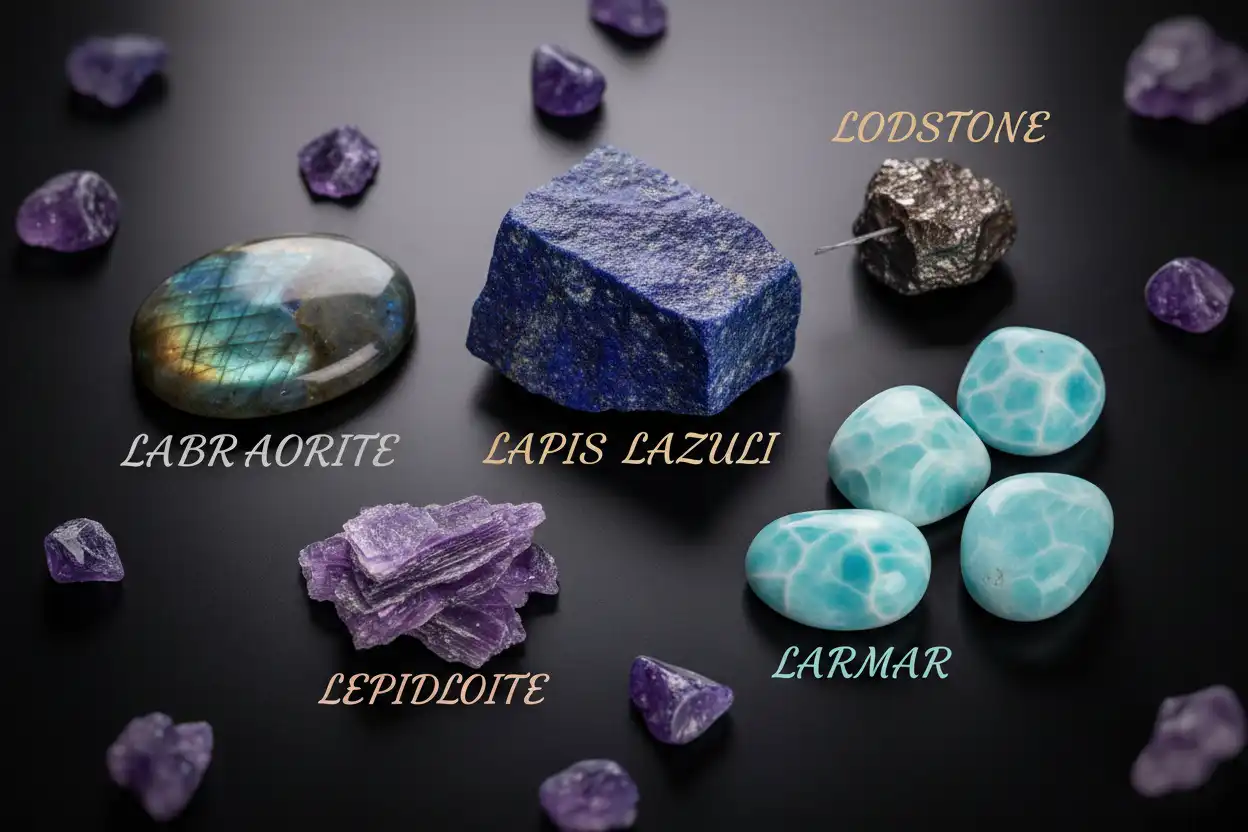
Crystals That Start With L: Names and Meanings
Crystals and gem materials that start with L include lab diamond, lab emerald, lab ruby, lab sapphire, labradorite, lapis lazuli, larimar, larvikite, lava stone, lazulite, lemon quartz, Lemurian quartz, lepidolite, Libyan desert glass, limonite, lithium quartz, lizardite, lodestone and London blue topaz.
This group includes natural minerals, rocks, volcanic materials, impact glass and laboratory-created gemstones.
Their symbolic meanings are interpretive traditions, not scientifically established health effects.
Continue from Crystals That Start With K.
L Crystals at a Glance
| Crystal or material | Typical appearance | Common symbolic meaning |
|---|---|---|
| Lab Diamond | Colorless or colored crystalline carbon | Commitment and clarity |
| Lab Emerald | Transparent green synthetic beryl | Renewal and wisdom |
| Lab Ruby | Red laboratory-grown corundum | Courage and vitality |
| Lab Sapphire | Blue or other-colored synthetic corundum | Discipline and loyalty |
| Labradorite | Gray feldspar with blue, green or gold flashes | Transformation and intuition |
| Lapis Lazuli | Deep blue rock with white calcite or gold pyrite | Wisdom and truthful expression |
| Larimar | Pale blue and white pectolite | Calm and communication |
| Larvikite | Dark rock with blue-silver feldspar flashes | Grounding and self-awareness |
| Lava Stone | Porous black or brown volcanic rock | Strength and renewal |
| Lazulite | Blue to blue-green phosphate mineral | Focus and clear thinking |
| Lemon Quartz | Pale yellow to greenish-yellow quartz | Optimism and concentration |
| Lemurian Quartz | Clear quartz with horizontal surface striations | Reflection and personal growth |
| Lepidolite | Pink, lilac or purple mica | Calm and transition |
| Libyan Desert Glass | Pale yellow natural glass | Resilience and transformation |
| Limonite | Yellow-brown to dark brown iron-rich material | Persistence and stability |
| Lithium Quartz | Quartz with pink, purple or gray inclusions | Emotional balance |
| Lizardite | Green or yellow-green serpentine mineral | Adaptability and renewal |
| Lodestone | Naturally magnetic magnetite | Direction and attraction |
| London Blue Topaz | Deep blue treated topaz | Communication and confidence |
Lab Diamond
A lab-grown diamond has the same fundamental crystal structure and chemical composition as a natural diamond but is created in a controlled manufacturing environment.
Lab diamonds may be:
- Colorless.
- Yellow.
- Pink.
- Blue.
- Brown.
- Other treated or growth-related colors.
They are traditionally associated with:
- Commitment.
- Clarity.
- Strength.
- Endurance.
- Modern innovation.
Laboratory origin does not mean a diamond is an imitation. Moissanite and cubic zirconia are different materials.
Compare optical performance, cost and composition in Lab Diamond vs. Moissanite.
Lab Emerald
Lab emerald is laboratory-grown green beryl produced to imitate the composition and appearance of natural emerald.
Its color may range from:
- Light green.
- Bluish green.
- Medium green.
- Deep saturated green.
Lab emerald is traditionally associated with:
- Renewal.
- Wisdom.
- Loyalty.
- Emotional growth.
- Thoughtful relationships.
Growth features can help gemologists separate laboratory-created emerald from natural material.
Both may contain fractures or inclusions, so safe cleaning depends on the individual stone and setting.
Lab Ruby
Lab ruby is laboratory-grown red corundum.
Its red color is primarily associated with chromium, as it is in natural ruby.
It is linked symbolically with:
- Courage.
- Vitality.
- Passion.
- Confidence.
- Determination.
Lab ruby may be produced by several methods, each leaving characteristic growth patterns or inclusions.
It should be described accurately as laboratory-grown rather than mined.
Lab Sapphire
Lab sapphire is laboratory-grown corundum produced in blue and many other colors.
Available colors include:
- Blue.
- Pink.
- Yellow.
- Green.
- Purple.
- White.
- Color-changing varieties.
Its traditional associations include:
- Discipline.
- Loyalty.
- Clear judgment.
- Responsibility.
- Long-term commitment.
The lab sapphire color guide explains the symbolism commonly assigned to different shades.
The broader lab-grown vs. natural gemstones guide covers origin, disclosure and buying considerations for manufactured gems.
Labradorite
Labradorite is a feldspar known for labradorescence—flashes of blue, green, gold, orange or violet that appear as the stone moves.
Its base color is commonly:
- Gray.
- Dark gray.
- Greenish gray.
- Brownish gray.
- Nearly black.
Labradorite is traditionally associated with:
- Transformation.
- Intuition.
- Adaptability.
- Recognizing hidden strengths.
- Navigating change.
Labradorescence results from light interacting with fine internal layers in the feldspar.
Its appearance can overlap with moonstone. Compare their optical effects in Labradorite vs. Moonstone.
Lapis Lazuli
Lapis lazuli is a blue rock composed of several minerals rather than one mineral species.
It may contain:
- Blue sulfur-bearing minerals.
- White calcite.
- Metallic pyrite.
- Other minor minerals.
Modern mineral references use “lapis lazuli” primarily for the decorative rock, not one single blue mineral.
Its traditional meanings include:
- Wisdom.
- Truthful expression.
- Confidence.
- Self-awareness.
- Intellectual curiosity.
Lapis may be dyed, stabilized or imitated. The guide to real vs. fake lapis lazuli explains common warning signs.
Larimar
Larimar is the blue variety of pectolite most closely associated with the Dominican Republic.
Its colors may include:
- Pale sky blue.
- Turquoise blue.
- Blue-green.
- White cloud-like patterns.
- Greenish areas.
Larimar is traditionally associated with:
- Calm.
- Communication.
- Emotional balance.
- Adaptability.
- Connection with the sea.
It can resemble turquoise, dyed howlite and other blue materials. Compare them in Larimar vs. Turquoise.
Protect larimar from prolonged strong light, heat, acids and hard impacts.
Larvikite
Larvikite is a coarse-grained igneous rock known for blue, silver or steel-colored flashes from feldspar.
It is not one mineral species. It is a rock composed of feldspar and darker minerals, and it has sometimes been marketed as black moonstone or blue pearl granite.
Mineral references classify larvikite as a rock type rather than a standalone mineral.
Its symbolism includes:
- Grounding.
- Self-awareness.
- Practical judgment.
- Emotional stability.
- Recognizing hidden complexity.
Polished larvikite is used in beads, cabochons, tiles and architectural stone.
Lava Stone
Lava stone is a general commercial name for porous volcanic rock, commonly basaltic in composition.
It is usually:
- Black.
- Dark gray.
- Brown.
- Highly porous.
- Lightweight compared with many dense stones.
Its traditional meanings include:
- Strength.
- Renewal.
- Grounding.
- Resilience.
- Beginning again after change.
Lava beads may absorb perfume or essential oils, but skin sensitivity and jewelry components should be considered before applying liquids.
Lazulite
Lazulite is a blue to blue-green phosphate mineral.
It may form:
- Prismatic crystals.
- Grainy masses.
- Crystals in quartz.
- Deep blue collector specimens.
Its traditional symbolism includes:
- Focus.
- Clear thinking.
- Study.
- Mental organization.
- Independent judgment.
Lazulite has a Mohs hardness around 5½ to 6 and is brittle.
It should not be confused with lazurite, the historically named blue component associated with lapis lazuli.
Lemon Quartz
Lemon quartz is pale yellow to greenish-yellow quartz.
Some material is naturally colored, while other stones are produced or enhanced through heat and irradiation treatments.
Its symbolic associations include:
- Optimism.
- Concentration.
- Confidence.
- Clear goals.
- Productive thinking.
Lemon quartz may resemble citrine or yellow topaz, but the exact color and treatment history can differ.
Its physical properties come from the wider quartz family.
Lemurian Quartz
Lemurian quartz is a trade name for quartz crystals with prominent horizontal striations or ladder-like markings on one or more faces.
It is traditionally associated with:
- Reflection.
- Personal development.
- Memory.
- Meditation.
- Recognizing recurring patterns.
The markings are natural growth features, although not every striated quartz crystal is sold under this name.
When buying, inspect the term’s use, crystal condition and seller disclosure. The guide to buying real Lemurian quartz provides additional checks.
Lepidolite
Lepidolite is a lithium-bearing mica commonly found in:
- Lilac.
- Pink.
- Purple.
- Gray.
- Silvery-white.
It may occur as flaky masses, layered crystals or inclusions within quartz and pegmatite.
Its traditional meanings include:
- Calm.
- Transition.
- Emotional balance.
- Accepting change.
- Reducing mental clutter.
Lepidolite is soft and splits easily along its mica layers.
Learn how its sheet-like structure relates to other minerals in the mica guide.
Libyan Desert Glass
Libyan desert glass is a natural silica-rich glass found in the desert region near the border of Libya and Egypt.
It is usually:
- Pale yellow.
- Golden yellow.
- Greenish yellow.
- Transparent to translucent.
- Pitted or wind-worn.
Its exact formation has been linked to an extremely high-temperature event, such as a meteorite impact or atmospheric explosion.
Its traditional symbolism includes:
- Resilience.
- Transformation.
- Confidence.
- Survival through change.
- Personal independence.
It is natural glass rather than a mineral crystal.
Limonite
Limonite is a general term for mixtures of hydrated iron oxide minerals rather than one precisely defined mineral species.
It commonly appears:
- Yellow-brown.
- Rusty orange.
- Dark brown.
- Blackish brown.
- Earthy or botryoidal.
Its symbolic meanings include:
- Persistence.
- Stability.
- Practical effort.
- Endurance.
- Working with available resources.
Limonite may stain hands, fabric or nearby specimens with yellow-brown residue.
Lithium Quartz
Lithium quartz is a commercial name for quartz containing pink, lilac, gray or purple mineral inclusions associated with lithium-bearing minerals.
Its traditional associations include:
- Emotional balance.
- Calm reflection.
- Adaptability.
- Self-compassion.
- Releasing accumulated tension.
Appearance alone cannot confirm lithium content. Seller descriptions should not be treated as laboratory analysis.
The guide to buying real lithium quartz explains how to assess claims and treatments.
Lizardite
Lizardite is a member of the serpentine mineral group.
It may appear:
- Pale green.
- Yellow-green.
- Olive green.
- White.
- Brownish green.
Its traditional meanings include:
- Adaptability.
- Renewal.
- Patience.
- Emotional flexibility.
- Connection with nature.
Lizardite can occur as soft, massive material and may resemble jade or other green stones.
Avoid creating dust from unidentified serpentine-group specimens.
Lodestone
Lodestone is naturally magnetized magnetite.
It can attract iron and may align with Earth’s magnetic field when allowed to move freely.
Its traditional symbolism includes:
- Direction.
- Attraction.
- Focus.
- Commitment.
- Recognizing what draws attention.
Lodestone is usually black or dark gray with a metallic to dull surface.
Keep it away from magnetic cards, sensitive electronics and items that may be affected by magnets.
London Blue Topaz
London blue topaz is a deep grayish-blue or inky-blue form of treated topaz.
The color is generally produced through irradiation followed by heat treatment.
Its traditional meanings include:
- Communication.
- Confidence.
- Clear thinking.
- Emotional restraint.
- Responsible decision-making.
The underlying mineral is topaz, which is hard but has perfect cleavage.
Treatment disclosure and safe handling are covered in How to Spot Treated Topaz.
Which L Materials Are Natural?
Natural materials include:
- Labradorite.
- Lapis lazuli.
- Larimar.
- Larvikite.
- Lava stone.
- Lazulite.
- Lepidolite.
- Libyan desert glass.
- Limonite.
- Lizardite.
- Lodestone.
Lab diamond, lab emerald, lab ruby and lab sapphire are manufactured crystals with compositions designed to match their natural counterparts.
London blue topaz is natural topaz whose blue color is generally created through treatment.
Which L Materials Are Suitable for Jewelry?
Common jewelry choices include:
- Lab-grown gems.
- Labradorite.
- Lapis lazuli.
- Larimar.
- Lemon quartz.
- Lepidolite in protected designs.
- Libyan desert glass.
- London blue topaz.
Lapis lazuli, larimar and lepidolite are softer than diamond, sapphire and topaz.
Lava stone and larvikite are often used for beads, pendants and casual jewelry.
Explore their cutting, wearability and value in Gemstones That Start With L.
Care Notes for L Materials
The L group contains several different material classes:
- Clean lab-grown gems according to their species and treatments, not merely their laboratory origin.
- Keep labradorite away from hard impacts that can damage feldspar cleavage.
- Avoid acids, prolonged soaking and aggressive compounds on lapis lazuli.
- Protect larimar from heat and strong sunlight.
- Check lava beads for absorbed oils or fragrances before wearing them against sensitive skin.
- Keep soft lepidolite away from water and abrasion.
- Avoid striking or overheating natural desert glass.
- Store lodestone away from magnetically sensitive objects.
- Confirm the treatment history of London blue topaz before professional cleaning.
Frequently Asked Questions
What is the most popular crystal that starts with L?
Labradorite, lapis lazuli, larimar and lepidolite are among the most familiar natural materials.
Which blue crystals start with L?
Lapis lazuli, larimar, lazulite, London blue topaz and some lab-grown gems are notable examples.
Is lapis lazuli one mineral?
No. Lapis lazuli is a rock composed of several minerals.
Is larvikite the same as labradorite?
No. Larvikite is a rock containing feldspar, while labradorite is a feldspar mineral variety.
Is lab diamond fake?
No. A lab diamond is manufactured rather than mined, but it is crystalline carbon and is different from diamond simulants.
Is Libyan desert glass a crystal?
It is natural glass rather than a mineral crystal.
Is lodestone naturally magnetic?
Yes. Lodestone is naturally magnetized magnetite.
Is London blue topaz natural?
The topaz is natural, but the deep blue color is normally produced through treatment.
Continue Exploring Crystals
Continue alphabetically with Crystals That Start With M, or return to the Crystals 101 collection for directories and beginner guidance.