Gemstones That Start With R: A–Z Guide
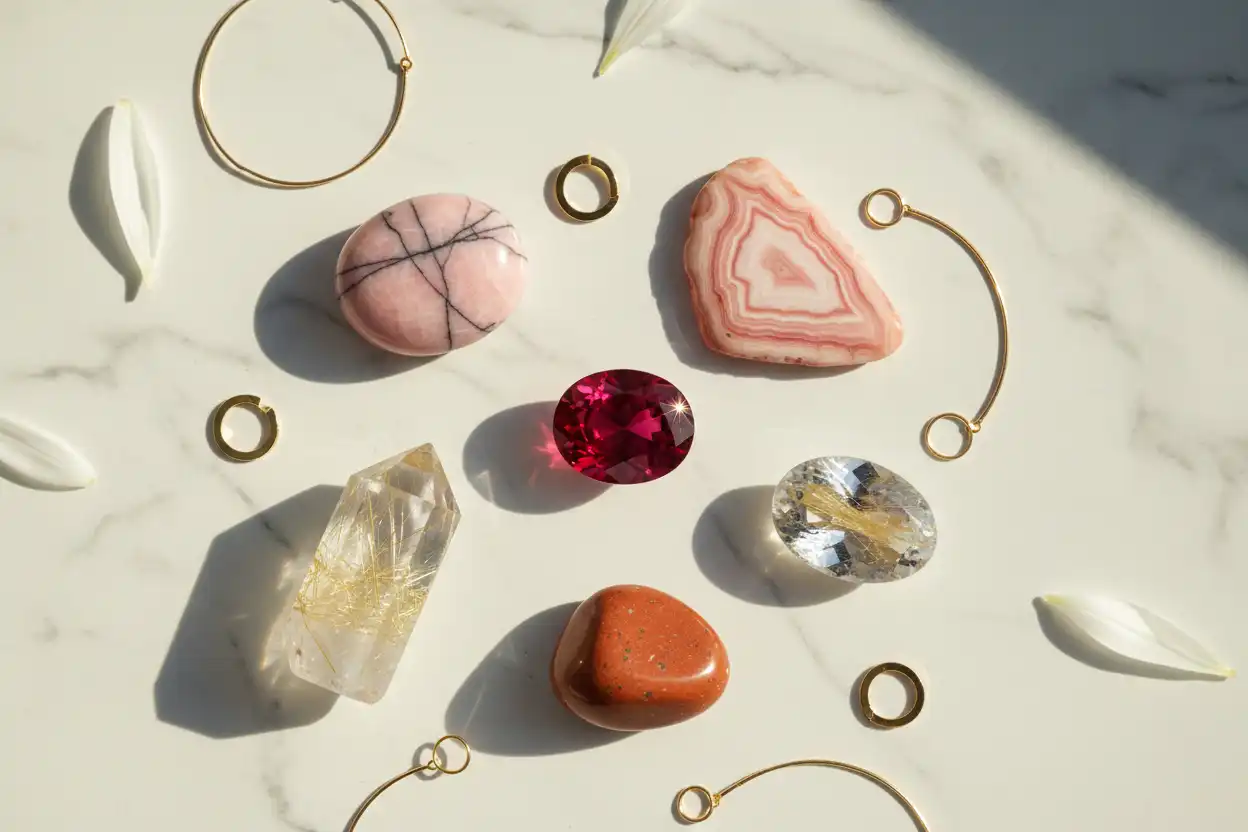
Gemstones and gem materials that start with R include rainbow fluorite, rainbow moonstone, rainbow obsidian, realgar, red aventurine, red beryl, red calcite, red jasper, red tiger’s eye, rhodochrosite, rhodolite garnet, rhodonite, rhyolite, rosasite, rose quartz, rubellite, ruby, ruby in fuchsite, ruby in zoisite, rutilated quartz and rutile.
The R directory includes major fine-jewelry gems, ornamental quartz, patterned rocks, volcanic glass, delicate carbonates and hazardous collector minerals.
Traditional meanings are symbolic associations rather than scientifically proven medical effects.
Continue from Gemstones That Start With Q. For a broader specimen-focused overview, explore Crystals That Start With R.
R Gemstones at a Glance
| Gemstone or material | Typical appearance | Material type | Common use |
|---|---|---|---|
| Rainbow Fluorite | Purple, green, blue and clear bands | Fluorite variety | Collector gems and protected pendants |
| Rainbow Moonstone | White feldspar with blue or multicolored flash | Labradorite trade variety | Cabochons and jewelry |
| Rainbow Obsidian | Black glass with colored sheen | Volcanic glass | Cabochons and carvings |
| Realgar | Orange-red to scarlet crystals | Arsenic sulfide mineral | Protected collector specimens |
| Red Aventurine | Red-orange quartz with subtle sparkle | Quartz-rich material | Beads and cabochons |
| Red Beryl | Vivid red to pinkish red | Beryl gemstone | Rare faceted jewelry |
| Red Calcite | Brick-red, orange-red or pink-red | Calcite variety | Carvings and protected pendants |
| Red Jasper | Opaque red to brownish red | Silica-rich material | Rings, beads and carvings |
| Red Tiger’s Eye | Red-brown chatoyant quartz | Treated or natural tiger’s eye | Cabochons and beads |
| Rhodochrosite | Pink, red or white-banded | Manganese carbonate | Cabochons and collector jewelry |
| Rhodolite Garnet | Raspberry, pink-red or purple-red | Garnet variety | Faceted fine jewelry |
| Rhodonite | Pink with black or brown veining | Manganese silicate | Cabochons and carvings |
| Rhyolite | Green, brown, red or patterned | Volcanic rock | Beads and cabochons |
| Rosasite | Blue-green or turquoise coatings | Copper-zinc carbonate | Collector specimens |
| Rose Quartz | Pale pink to rose | Quartz variety | Beads, carvings and cabochons |
| Rubellite | Vivid pink-red to deep red | Tourmaline variety | Fine jewelry |
| Ruby | Red corundum | Corundum gemstone | Everyday fine jewelry |
| Ruby in Fuchsite | Red ruby in green reflective mica | Multi-mineral material | Cabochons and carvings |
| Ruby in Zoisite | Red ruby in green and black rock | Multi-mineral material | Cabochons and decorative jewelry |
| Rutilated Quartz | Quartz containing metallic-looking needles | Included quartz | Rings, pendants and cabochons |
| Rutile | Golden, red-brown or black crystals | Titanium dioxide mineral | Collector gems and inclusions |
Rainbow Fluorite
Rainbow fluorite contains bands or zones of purple, green, blue, yellow and colorless fluorite.
It is traditionally associated with:
- Organization.
- Learning.
- Mental focus.
- Perspective.
- Reducing distraction.
The colors may form as straight bands, irregular zones or geometric layers within cubic crystals.
Fluorite has a Mohs hardness of 4 and perfect cleavage. It is better suited to pendants, earrings and collector stones than exposed everyday rings.
Prolonged strong sunlight may weaken or fade the color of some specimens.
Rainbow Moonstone
Rainbow moonstone is a trade name commonly used for white or transparent labradorite with blue or multicolored flashes.
Its optical colors may include:
- Blue.
- Green.
- Yellow.
- Orange.
- Violet.
- Several colors in one stone.
It is traditionally associated with intuition, emotional awareness and new beginnings.
Rainbow moonstone is commonly cut as a cabochon to emphasize the moving flash. Internal fractures and feldspar cleavage make protective settings important.
High-quality stones should show a bright, mobile flash rather than a flat surface coating.
Rainbow Obsidian
Rainbow obsidian is black volcanic glass that reveals bands of green, purple, blue, gold or red under directional light.
The effect comes from microscopic structures created as the volcanic glass cooled.
Rainbow obsidian is traditionally associated with:
- Self-awareness.
- Protection.
- Emotional reflection.
- Recognizing hidden patterns.
- Moving beyond appearances.
It is commonly used in cabochons, beads, spheres and carvings.
Obsidian can chip into extremely sharp edges, so exposed corners and thin jewelry sections require protection.
Realgar
Realgar is an arsenic sulfide mineral known for vivid orange-red to scarlet crystals.
It is traditionally associated with caution, transformation and recognizing consequences.
Realgar is unsuitable for jewelry because it is:
- Toxic.
- Soft.
- Light-sensitive.
- Vulnerable to alteration.
- Dangerous when dust is produced.
Store it in a sealed, labeled specimen container away from light, food, children and pets.
Never grind, heat, lick, soak or use realgar in water preparations. Broader handling guidance appears in the toxic crystals safety list.
Red Aventurine
Red aventurine is a quartz-rich material colored by iron-bearing inclusions such as hematite or goethite.
Its shades may include:
- Rust red.
- Orange-red.
- Copper brown.
- Brick red.
- Red with subtle sparkle.
It is traditionally associated with motivation, confidence and completing delayed work.
Red aventurine is commonly used for beads, cabochons and carvings. Solid material generally offers good durability, although fractures and softer inclusions should be checked.
Dyed quartzite, glass and reconstructed products may be sold under the same name.
Red Beryl
Red beryl is a rare red to pinkish-red variety of beryl.
Its color is associated primarily with manganese, and gem-quality crystals are usually small and included.
Red beryl is traditionally linked with:
- Courage.
- Individuality.
- Persistence.
- Confidence.
- Recognizing personal value.
Transparent faceted stones are highly collectible. Independent laboratory identification is important because red beryl can be confused with ruby, spinel, tourmaline and synthetic material.
Its hardness supports jewelry use, but inclusions and fractures require careful setting.
Red Calcite
Red calcite ranges from muted pink-red and brick red to orange-red and brownish-red.
It is traditionally associated with energy, direct communication and emotional honesty.
Red calcite is commonly fashioned into:
- Carvings.
- Beads.
- Cabochons.
- Decorative objects.
- Protected pendants.
Calcite is soft and reacts with acids. It should not be cleaned with vinegar, citrus juice, abrasive compounds or ultrasonic equipment.
Rings and bracelets are poor choices because ordinary contact can scratch or chip the material.
Red Jasper
Red jasper is an opaque silica-rich material colored mainly by iron oxides.
Its shades include:
- Warm red.
- Rust.
- Brick red.
- Brownish red.
- Red with cream or dark markings.
Red jasper is traditionally associated with stability, endurance and practical strength.
Its durability makes it suitable for rings, signet stones, beads, cabochons and carvings.
Natural material often shows uneven color, veins or mineral spots. Extremely bright and uniform pieces may have been dyed.
Red Tiger’s Eye
Red tiger’s eye is a chatoyant quartz material with red-brown, mahogany or copper-colored bands.
Some natural material is reddish, but much commercial red tiger’s eye is produced by heating golden-brown tiger’s eye.
It is traditionally associated with:
- Determination.
- Focus.
- Controlled action.
- Motivation.
- Practical confidence.
The moving band of light is created by aligned fibrous structures within the stone.
It is commonly cut into beads, cabochons, rings and pendants. Heat treatment should be disclosed when known.
Rhodochrosite
Rhodochrosite is a manganese carbonate mineral found in pink, red, peach and white-banded forms.
It is traditionally associated with compassion, self-worth and emotional honesty.
Transparent crystals may be faceted, while banded material is commonly used for:
- Cabochons.
- Beads.
- Carvings.
- Collector slices.
- Pendants.
Rhodochrosite is soft and acid-sensitive. Steam, ultrasonic cleaning, vinegar and strong household products should be avoided.
Its differences from similarly colored rhodonite are explained in Rhodochrosite vs. Rhodonite.
Rhodolite Garnet
Rhodolite is a pink-red, raspberry or purplish-red garnet variety commonly composed of pyrope and almandine components.
It is traditionally associated with:
- Commitment.
- Confidence.
- Affection.
- Motivation.
- Emotional maturity.
Rhodolite’s good hardness and lack of prominent cleavage make it suitable for rings, earrings, bracelets and pendants.
Color, clarity, cut and size influence the figures discussed in the rhodolite garnet price guide.
Well-cut stones should appear lively rather than overly dark.
Rhodonite
Rhodonite is a manganese silicate mineral commonly found as pink material with black or brown manganese-oxide veining.
It is traditionally associated with forgiveness, emotional balance and constructive conflict resolution.
Rhodonite is commonly used for:
- Cabochons.
- Beads.
- Carvings.
- Decorative boxes.
- Pendants.
Fine transparent crystals are rare. Most jewelry uses opaque massive material.
Open fractures and veining can create weak areas, so rings should use protective settings.
Rhyolite
Rhyolite is a silica-rich volcanic rock that may contain visible quartz and feldspar crystals within a fine-grained matrix.
Its colors and patterns include:
- Green.
- Brown.
- Cream.
- Red.
- Gray.
- Orbicular or flow-like markings.
Rhyolite is traditionally associated with adaptability, creativity and learning from varied experiences.
It is commonly cut into beads, cabochons and decorative carvings.
Because it is a multi-mineral rock, hardness and porosity may differ across one piece.
Rosasite
Rosasite is a hydrated copper-zinc carbonate hydroxide mineral found in blue-green, turquoise or green coatings.
It may occur as:
- Botryoidal surfaces.
- Fibrous coatings.
- Crystals on matrix.
- Mixtures with other copper minerals.
Rosasite is traditionally associated with communication, renewal and gradual confidence.
It is generally too soft and fragile for ordinary jewelry. Collector specimens should be protected from acids, soaking and abrasion.
Because it contains copper, it should not be placed in drinking water or ground into powder.
Rose Quartz
Rose quartz is a pale pink to rose-colored variety of quartz.
It usually occurs as massive translucent material rather than sharply formed transparent crystals.
Rose quartz is traditionally associated with affection, compassion and self-respect.
It is widely used for:
- Beads.
- Cabochons.
- Carvings.
- Pendants.
- Decorative spheres.
Quartz-level hardness makes it practical for many jewelry styles, although strongly fractured pieces can still chip.
Natural color is often softly uneven rather than intensely saturated.
Rubellite
Rubellite is the trade name used for vivid pink-red to deep red tourmaline.
It may appear:
- Raspberry red.
- Purplish red.
- Hot pink-red.
- Deep ruby-like red.
- Color-zoned.
Rubellite is traditionally associated with passion, emotional openness and confident expression.
High-quality stones retain attractive red color under different lighting conditions.
Rubellite is suitable for fine jewelry, but heavily included stones should be protected from sharp impacts and sudden heat.
Explore its place among green, blue, pink and multicolored varieties in Types of Tourmaline.
Ruby
Ruby is the red variety of corundum.
Its color ranges from pinkish red and vivid red to purplish or brownish red.
Ruby is traditionally associated with:
- Courage.
- Vitality.
- Commitment.
- Leadership.
- Determination.
Its hardness makes it one of the strongest colored gemstones for everyday rings.
Natural rubies commonly contain inclusions, and treatments may include heat, fracture filling or diffusion. Significant purchases should include treatment disclosure and independent documentation.
The guide to types of ruby covers major colors, origins and commercial varieties.
Ruby in Fuchsite
Ruby in fuchsite combines red corundum crystals with green chromium-bearing mica.
Some pieces also show pale blue reaction rims around the ruby.
It is traditionally associated with balance, resilience and combining strength with flexibility.
Ruby and fuchsite have dramatically different hardness levels. Aggressive polishing can wear away the mica while leaving ruby crystals raised above the surface.
The material is best suited to pendants, carvings and protected cabochons rather than everyday rings.
Ruby in Zoisite
Ruby in zoisite combines red ruby, green zoisite and commonly black hornblende.
It is also sold as anyolite.
Traditional symbolism includes growth, purposeful action and turning potential into progress.
The contrasting minerals create distinctive red, green and black patterns used in:
- Cabochons.
- Beads.
- Carvings.
- Pendants.
- Decorative objects.
Different components polish and wear unevenly. Avoid harsh mechanical cleaning and inspect the material for fractures before setting.
Rutilated Quartz
Rutilated quartz contains needle-like rutile inclusions within clear, smoky or milky quartz.
The needles may appear:
- Golden.
- Copper-red.
- Brown.
- Silver-gray.
- Nearly black.
Rutilated quartz is traditionally associated with focus, momentum and clear direction.
It is commonly faceted or cut as cabochons to highlight the inclusion pattern.
Internal fractures are common and may reach the surface. Jewelry settings should protect vulnerable edges and exposed rutile needles.
Rutile
Rutile is a titanium dioxide mineral occurring in red-brown, golden, black and metallic-looking crystals.
It is widely recognized as an inclusion in quartz, sapphire and other gemstones.
Rutile is traditionally associated with determination, direction and recognizing connections.
Transparent or attractive individual crystals may be collected, while fine needles contribute optical effects such as:
- Asterism.
- Chatoyancy.
- Golden inclusion patterns.
- Silky reflections.
Rutile crystals can be brittle, particularly when thin or arranged in delicate sprays.
Which R Gemstones Are Best for Jewelry?
Strong choices include:
- Ruby.
- Rhodolite garnet.
- Rubellite.
- Red beryl.
- Red jasper.
- Rose quartz.
- Red aventurine.
- Rutilated quartz.
Good choices for protected or occasional wear include:
- Rainbow moonstone.
- Rainbow obsidian.
- Rhodonite.
- Rhodochrosite.
- Red tiger’s eye.
Rainbow fluorite, red calcite and rosasite require substantially more protection. Realgar is unsuitable for jewelry.
Buying and Identification Notes
Pay attention to:
- Dyed red aventurine or jasper.
- Heat-treated red tiger’s eye.
- Synthetic or misidentified red beryl.
- Filled or treated ruby.
- Glass sold as rainbow obsidian.
- Commercial rainbow moonstone that is actually labradorite.
- Composite ruby-in-matrix products.
- Quartz with artificial metallic inclusions.
- Soft carbonates represented as durable ring stones.
Ruby, garnet and spinel are frequently confused. Ruby vs. Garnet vs. Spinel explains their primary identification differences.
Care Guide for R Gemstones
- Keep realgar sealed and protected from light.
- Avoid acids on red calcite, rhodochrosite and rosasite.
- Protect fluorite and moonstone from cleavage-related impacts.
- Keep obsidian edges smooth and protected.
- Clean ruby according to its treatment status.
- Store soft carbonates separately from quartz, garnet and corundum.
- Avoid sudden heat on included rubellite and rutilated quartz.
- Treat ruby-in-matrix stones according to their softest component.
- Inspect patterned rocks for open fractures before soaking.
Frequently Asked Questions
What is the most valuable gemstone that starts with R?
Fine ruby can reach exceptionally high values. Rare red beryl and premium rubellite can also be expensive.
Which red gemstones start with R?
Ruby, rubellite, red beryl, red jasper, red aventurine, red calcite and rhodolite garnet are notable examples.
Is rainbow moonstone a real moonstone?
The commercial name usually refers to white or transparent labradorite with blue or multicolored flash.
Is red tiger’s eye treated?
Much commercial red tiger’s eye is heat-treated, although naturally reddish material also exists.
Is realgar safe to wear?
No. Its arsenic content, softness and light sensitivity make it unsuitable for jewelry.
Is rhodochrosite the same as rhodonite?
No. Rhodochrosite is a manganese carbonate, while rhodonite is a manganese silicate.
Is ruby in fuchsite durable?
The ruby is hard, but the fuchsite matrix is very soft. The combined material requires gentle care.
Is rutilated quartz natural?
Natural rutilated quartz exists, but manufactured glass and artificially included materials may imitate it.
Continue the Gemstone Alphabet
Continue with Gemstones That Start With S, or browse all alphabetical directories through the Crystals 101 collection.