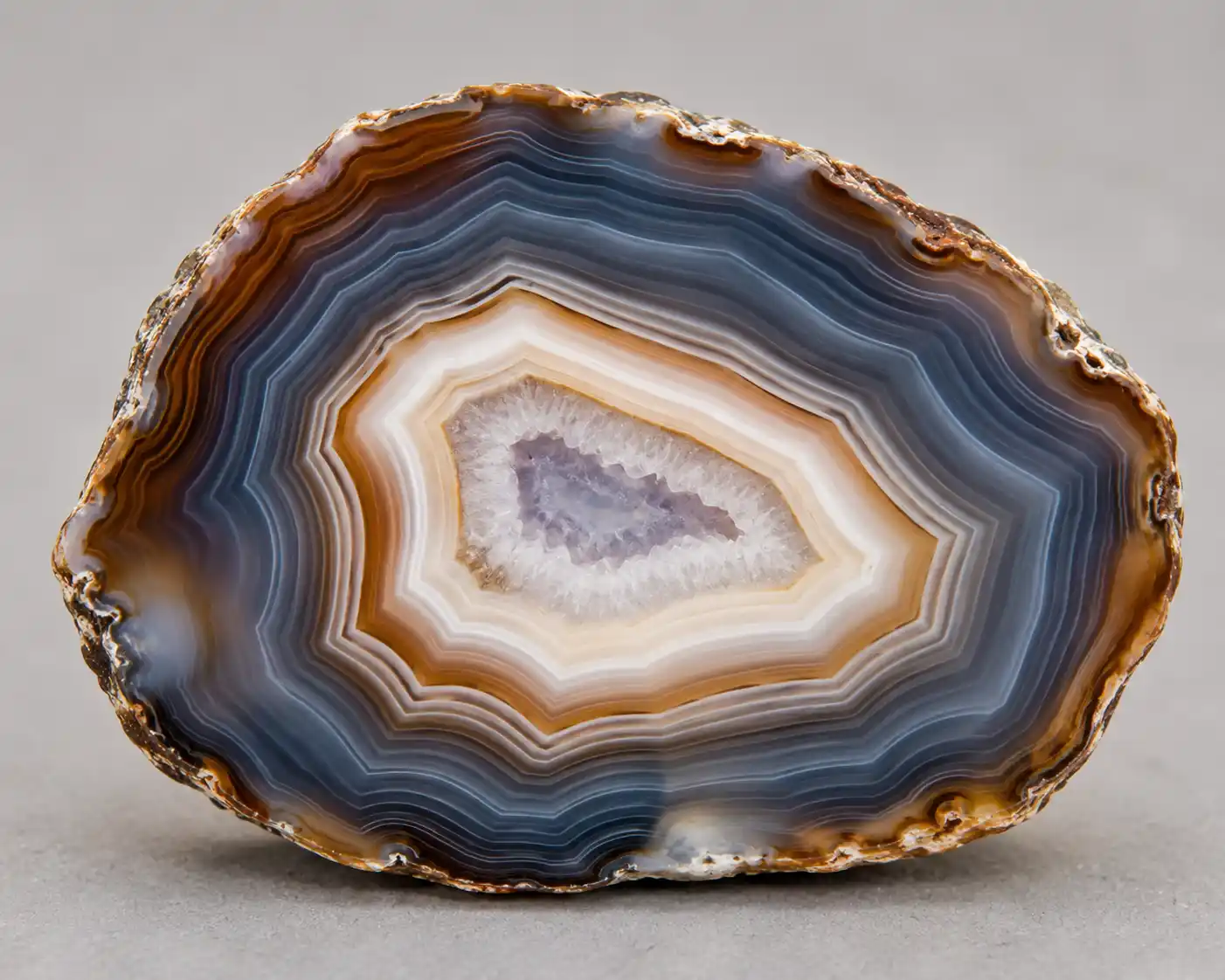
Agate Meaning: Formation, Banding and Recorded Lore
Agate is a patterned form of chalcedony recognized primarily by bands, layers or repeating zones of fine-grained silica. Although it is commonly called a gemstone or crystal, agate is not an independent mineral species and is not normally a single crystal. It consists mainly of microscopic quartz intergrown with moganite, another form of silica, while small amounts of iron oxides, manganese compounds, clay minerals and other inclusions can influence its color and pattern.
Agate meaning usually refers to symbolic ideas such as balance, stability, protection and gradual personal development. These associations developed through cultural use, visual interpretation and modern crystal traditions; they are not physical effects produced by silica. The stone’s measurable identity comes from its composition, fibrous microstructure, banding, hardness, optical properties and geological formation.
Agate identity record
| Property | Agate |
|---|---|
| Material classification | Banded variety of chalcedony |
| Principal composition | Silicon dioxide, SiO₂ |
| Main silica phases | Microscopic quartz with varying amounts of moganite |
| Structural character | Dense aggregate of intergrown silica crystallites |
| Typical appearance | Concentric, parallel, angular, wavy or irregular bands |
| Common colors | White, gray, brown, red, orange, yellow and muted combinations |
| Transparency | Translucent to opaque |
| Surface luster | Waxy when unpolished; vitreous after polishing |
| Mohs hardness | Approximately 6.5–7 |
| Cleavage | None |
| Fracture | Conchoidal to uneven |
| Specific gravity | Commonly around 2.60–2.64 |
| Refractive index | Commonly around 1.53–1.54 |
| Common cuts | Cabochons, beads, tablets, slices, cameos and carvings |
| Major identification concern | Dyeing, misleading variety names and imitation materials |
Agate’s absence of cleavage and tightly intergrown microstructure generally give it useful toughness. However, an agate nodule may contain open cavities, quartz-lined centers, healed cracks, porous zones or weak boundaries between its silica layers and attached host rock. A polished cabochon can therefore be durable while a thin slice from the same nodule remains vulnerable to impact.
The difference between scratch resistance and break resistance matters when assessing any ornamental stone. The gemstone hardness chart places agate within the quartz range, while the explanation of gemstone toughness versus hardness shows why hardness alone cannot predict how a carved edge, drilled bead or thin slab will survive use.
What makes a stone agate?
In strict mineralogical usage, recognizable banding is central to the agate name. The bands consist of finely intergrown silica whose crystallite size, orientation, porosity, inclusions and proportions of quartz and moganite vary across the specimen. Even colorless agate can show light and dark bands because different layers transmit and scatter light differently.
Not every patterned chalcedony has sharp concentric rings. Bands can be parallel, angular, scalloped, fortified, wavy, horizontal or interrupted by channels and crystal-lined cavities. Some layers adhere closely to the original cavity wall, while others form across the lower part of the cavity. Cutting direction determines which part of this structure becomes visible, so two slices from one nodule may display surprisingly different patterns.
The broader types of agate reference separates structural varieties, locality names and commercial labels. That distinction is useful because the gem trade often applies “agate” to attractive chalcedony that has inclusions or a distinctive surface form but little obvious banding.
Agate is chalcedony, but not all chalcedony is agate
Chalcedony is the broader material category. Agate belongs within it because agate consists primarily of fibrous, microcrystalline silica. Carnelian, chrysoprase, ordinary chalcedony and many kinds of jasper are also connected with cryptocrystalline silica, yet they are named according to color, opacity, inclusions or texture rather than agate-style banding.
The boundaries are not always clean. A single specimen can move from translucent banded agate into opaque jasper-like material or contain a central cavity lined with visibly crystalline quartz. Trade names often describe the most attractive feature rather than every mineralogical component. A careful description can therefore read “banded chalcedony with a quartz-lined cavity” instead of forcing the entire object into one simplified label.
How agate forms
Many agates develop inside cavities in volcanic rock. Gas bubbles, fractures and other openings remain after the host rock solidifies, creating spaces into which silica-bearing fluids can move. Silica is transported from surrounding altered rock or introduced by later fluids, then precipitates along the cavity walls as fibrous chalcedony, moganite-bearing silica, macrocrystalline quartz or other silica phases.
Agate formation is more complicated than the familiar image of separate liquid layers being poured into a hollow rock. Scientific examinations indicate that banding can reflect changes in crystallite size, porosity, silica phase, fiber orientation, trace impurities and growth conditions. Fluid movement, host-rock alteration and self-organizing crystallization processes may all contribute. No single mechanism explains every volcanic, sedimentary and hydrothermal agate.
Agate can also form in sedimentary environments, mineral veins and cavities created by dissolution or replacement. Consequently, a rounded nodule does not automatically prove volcanic origin, and a flat banded seam is not necessarily artificial. The surrounding host rock, mineral associations and field context provide better geological evidence than shape alone.
What creates agate banding?
Agate bands are structural records rather than calendar marks. One band does not represent a fixed period of growth, and counting layers cannot establish the age of a specimen. Adjacent bands may differ because their microscopic silica fibers grew with different orientations, because their pores contain different materials or because the relative amounts of quartz and moganite changed.
Some bands form parallel to the walls of a cavity and preserve its original contours. Others create sharp, angular fortification patterns that point inward. Horizontal or gravity-influenced bands can cross the lower part of a nodule, while narrow channels may preserve pathways through which fluids entered the developing structure.
The finest bands can be too narrow to resolve without magnification. A high-resolution photograph taken perpendicular to a polished surface can reveal whether the pattern continues naturally through the stone, stops at a fracture or becomes obscured by dye. Transmitted light is useful for thin pieces because differences in translucency may reveal bands that appear nearly uniform under reflected light.
Why agate has so many colors
Pure silica is colorless, so agate’s natural colors generally come from microscopic inclusions, structural differences and mineral pigments. Iron oxides and hydroxides are especially important in red, orange, yellow and brown material, while manganese compounds can create darker zones or branching inclusions. White and gray bands may result from differences in porosity, crystallite size and light scattering rather than strong pigmentation.
The separate agate color meaning page examines natural color, introduced color and modern color symbolism. This parent reference does not assign a fixed effect to every hue because color interpretations vary between cultures and individual practices.
Agate’s microscopic porosity also allows coloring agents to enter receptive layers. Strong pink, electric blue, vivid purple, bright green and uniformly dark commercial material may be dyed, although appearance alone cannot confirm every enhancement. Treated agate requires examination of color concentrations, fractures, drill holes, band boundaries and treatment disclosure.
A practical agate-name audit
Commercial terminology mixes mineralogical names, locality labels, pattern descriptions and marketing terms. The following distinctions help prevent one attractive feature from becoming an unsupported identity claim.
| Name | What the name usually describes | Naming caution |
|---|---|---|
| Ordinary agate | Banded chalcedony | Visible banding should support the name |
| Onyx | Parallel-banded chalcedony in strict usage | “Onyx” is also used commercially for banded calcite |
| Sardonyx | Reddish-brown and pale parallel-banded chalcedony | Dyeing may strengthen contrast |
| Moss agate | Chalcedony with moss-like mineral inclusions | It may have little or no true agate banding |
| Dendritic agate | Chalcedony with branching mineral inclusions | Dendrites are not fossilized plants |
| Tree agate | Pale chalcedony with green branching inclusions | The name describes appearance, not plant material |
| Flower agate | Plume-bearing chalcedony with blossom-like patterns | “Flowers” are mineral structures, not fossils |
| Grape agate | Botryoidal chalcedony with rounded clusters | The commercial name can apply without banding |
| Fire agate | Iridescent, commonly botryoidal chalcedony | Its identity is often marketed through the optical effect |
| Iris agate | Thin agate that displays transmitted-light iridescence | The effect depends on fine periodic structure and cutting |
| Blue lace agate | Pale blue chalcedony with delicate lace-like bands | Very intense blue warrants treatment disclosure |
| Botswana agate | Fine-banded material associated with Botswana | Pattern alone does not verify locality |
| Crazy lace agate | Intricately curved and looping banded chalcedony | The name is descriptive rather than a mineral species |
| White agate | Predominantly white or pale banded chalcedony | Some commercial material is bleached or dyed |
The table separates strict identity from useful trade language without declaring every commercial name invalid. A seller can accurately use a trade name when the material, appearance and treatment are properly described. The problem begins when a descriptive label is presented as a separate mineral species or as proof of locality.
Named agates and their defining evidence
Blue lace agate is recognized for pale blue and white lace-like banding. Botswana agate commonly displays fine parallel or curving bands in muted gray, brown, pink and white, although a locality claim should still be supported rather than inferred solely from pattern.
Crazy lace agate has complex loops, eyes and irregular banding, while white agate is defined more broadly by its pale appearance. Each name emphasizes a different visual or geographic feature, which is why they should not be treated as interchangeable color varieties.
Moss agate, dendritic agate and tree agate receive their names from branching or vegetation-like inclusions. These patterns are mineral deposits, not preserved moss, trees or flowers. Likewise, the plume structures in flower agate are geological features that merely resemble blossoms.
The rounded surfaces sold as grape agate are botryoidal chalcedony. The term refers to clustered, grape-like form rather than biological grapes, and many examples do not display the banding expected in strict agate terminology.
Fire agate displays iridescent colors associated with very fine internal layers, including iron-bearing material. Iris agate produces a different phenomenon when a thin, suitably banded slice diffracts transmitted light. One effect is not a brighter version of the other.
Agate, onyx and sardonyx
Traditional onyx is chalcedony with relatively straight, parallel bands. Onyx can be confused by commercial usage because “onyx marble,” “Mexican onyx” and similarly named decorative stones may be banded calcite or aragonite rather than silica. These carbonate materials are softer and react differently to acids.
Sardonyx combines contrasting pale and reddish-brown chalcedony bands. The layered structure has long made it suitable for cameos, seals and engraved objects because a cutter can expose different colors at different depths.
A label stating only “onyx” is therefore incomplete when identity affects care or value. A seller should clarify whether the object is quartz-based chalcedony, a carbonate decorative stone or another material using the onyx name commercially.
How to identify agate without damaging it
Begin with pattern, translucency and texture. Natural agate commonly shows bands that curve with the original cavity, change thickness and continue into the stone rather than sitting only on the surface. Rough edges may have a waxy appearance, while polished surfaces develop a brighter luster. Fine banding may become clearer under transmitted light or magnification.
A refractive-index spot reading near 1.54 and specific gravity near 2.6 are consistent with chalcedony. These measurements are more useful than color because genuine agate occurs in many colors and dyed agate remains real chalcedony beneath its treatment. The broader crystal identification process explains how several independent observations build a stronger conclusion.
Do not use scratch, flame, acid or impact tests on a finished piece. A scratch test can permanently mark softer imitations or damage a polish without proving that the remaining possibilities are agate. A hot needle can release fumes from plastic or resin and is inappropriate for jewelry. Laboratory spectroscopy, microscopy and chemical analysis are better options when identity materially affects a purchase.
The real versus fake agate reference covers glass, plastic, resin, reconstructed material and misleading photographs in greater detail. A natural-looking pattern is useful evidence, but no single band, bubble or surface mark should be treated as conclusive.
A photograph checklist for agate specimens
A useful agate record begins with an unedited photograph under neutral illumination. Include the entire polished face, the unpolished exterior, the edge between them and any remaining host rock. Add a scale and photograph the specimen both dry and under ordinary transmitted light when it is thin enough. Do not use wetting, saturation filters or backlighting without disclosing them because each can make color and transparency appear stronger.
Record whether bands continue across the specimen, terminate against a cavity or become displaced by fractures. Photograph concentrations of color near cracks, drill holes and outer surfaces. If the object is a pair of bookmatched slices, keep the two halves together because their mirrored pattern can document that they came from one nodule.
Preserve the original seller label even when its terminology seems questionable. Record locality as “reported” unless evidence supports it independently. Weight, dimensions, treatment disclosure, purchase record and previous ownership create a far more useful provenance file than a rewritten label claiming certainty.
Historical uses and recorded lore
Agate has been carved into beads, seals, signet stones, vessels, handles, inlays, cameos and small decorative objects across many cultures. Its fine texture accepts detailed polish and engraving, while contrasting layers allow a carver to build pale and dark areas into the same design. These material qualities explain much of agate’s lasting importance in lapidary work.
The traditional name is associated with the ancient Achates River in Sicily, although historical naming and modern variety terminology should not be treated as perfectly continuous. Different societies encountered different colors, sources and carved forms, so there was never one universal ancient agate meaning.
Historic writings and later folklore assigned agate protective, medicinal and weather-related powers. Such records tell us what people believed; they do not establish that the stone performed those functions. Historical documentation and scientific validation answer different questions.
Agate meaning and symbolism
Common symbolic themes attached to agate include steadiness, protection, balance, patience and resilience. The layered structure makes gradual development an understandable metaphor: the visible pattern was built through changing geological conditions, so a person may use it as a reminder that complex results can develop through repeated smaller processes.
The symbolism changes with culture, color and individual practice. Modern crystal traditions often connect blue material with communication, brown agate with grounding and pale agate with clarity. Those interpretations belong on the separate color page because they are not diagnostic properties of agate itself.
Claims described as agate healing properties should also remain distinct from mineral facts. Agate has not been scientifically demonstrated to treat anxiety, digestive disorders, inflammation, infection, hormonal conditions or other illnesses. Using a stone during reflection or meditation is a personal practice, not medical treatment.
A grounded symbolic use might connect an agate object with a specific behavior: reviewing evidence before a decision, pausing before responding or breaking a large task into manageable steps. Any benefit comes from the chosen practice and the meaning assigned to the object, not a medically active force emitted by silica.
Agate in jewelry and carving
Agate’s fine grain, lack of cleavage, useful hardness and ability to accept a smooth polish make it suitable for beads, cabochons, pendants, earrings, rings, boxes, handles and ornamental carving. Its bands can become part of the design rather than merely decorating the surface. The gemstones selected for carving resource compares agate with other materials used for relief work and small sculpture.
Cabochons should be checked for undercutting, open cavities, poorly finished edges and fractures near drilled holes. A thin bezel can protect an edge, while beads need smooth drill openings that will not abrade stringing material. Thin agate slices should be supported carefully because a broad slab can break under leverage despite the toughness of its microcrystalline structure.
Cleaning and storage
Untreated agate can generally be cleaned with lukewarm water, mild soap and a soft brush or cloth. Rinse briefly and dry the piece thoroughly, paying attention to drilled openings and metal settings. Avoid abrupt temperature changes and hard impacts.
Ultrasonic and steam cleaning are unnecessary, particularly when treatment, filling, glue or structural weakness is unknown. Dye can behave differently from natural mineral color, while composite objects may contain adhesives or backing materials that do not tolerate heat or prolonged soaking. If the piece has intense commercial coloring, follow the most conservative care method.
Store agate away from diamonds, sapphires, topaz and other harder gems that can scratch its polish. Individual pouches or divided compartments also prevent agate pieces from striking one another. The safe crystal storage guide covers separation by hardness, fragile edges, sunlight and humidity.
Water does not normally dissolve agate during ordinary cleaning, but water safety depends on treatments, attached matrix, metal settings and adhesives rather than the silica alone. The guide to crystals in water should not be interpreted as permission to prepare gemstone drinking water. Decorative stones can carry residues, coatings or contamination that are not visible.
Safe cutting and ownership
Finished agate jewelry and polished specimens can be handled normally. The significant material hazard appears during cutting, grinding and dry polishing because these processes can release respirable crystalline silica dust. Lapidary work requires wet cutting, suitable local extraction, controlled cleanup and appropriate respiratory protection.
Do not dry-sweep or blow grinding dust into the air. A hobby workspace should be separated from living areas, and children or pets should not be present during cutting. Finished pieces should be washed after lapidary work to remove polishing compound and dust.
Agate should not be ground into powders, ingested or used to make elixirs. Symbolic use does not require consuming the material or placing it in drinking water.
What influences agate quality?
Agate quality depends on pattern rather than one universal color grade. Collectors may value crisp bands, complete fortification structures, distinctive eyes, unusual channels, strong natural contrast, rare optical effects or a documented locality. Lapidary quality also depends on cutting orientation, symmetry, polish, usable thickness and the absence of distracting fractures.
Natural color and disclosed treatment should be evaluated separately from visual appeal. Dyed agate can be attractive and suitable for decorative use, but it should not be priced or represented as rare naturally colored material. Buyers seeking reliable descriptions can use the agate purchasing checklist to evaluate photographs, seller claims, return terms and provenance.
Frequently asked questions
Is agate a mineral?
Agate is not an independent mineral species. It is a banded variety of chalcedony composed mainly of microscopic quartz with varying amounts of moganite and other inclusions.
What is the defining feature of agate?
Visible or microscopic banding is the principal defining feature. The bands may be concentric, parallel, angular, wavy or irregular.
Is agate a type of quartz?
Yes. Agate belongs to the cryptocrystalline quartz family through chalcedony, although its microstructure is more complex than a single macroscopic quartz crystal.
How hard is agate?
Agate has a Mohs hardness of approximately 6.5–7. It resists many ordinary scratches but can still be scratched by harder gemstones.
Does agate have cleavage?
Agate has no cleavage. It generally breaks with a conchoidal or uneven fracture, although existing cracks, cavities and thin sections can weaken an object.
Are bright agate colors natural?
Some strong colors occur naturally, especially iron-related reds, oranges and browns. Electric blue, vivid pink, intense purple, bright green and uniformly dark material commonly warrant investigation for dye.
Is moss agate a true agate?
Moss agate is an established trade and gem name for inclusion-bearing chalcedony, but many examples lack the banding required by a strict agate definition.
Is grape agate genuine agate?
Grape agate is usually botryoidal chalcedony. The material can be genuine chalcedony even when it lacks obvious agate banding, making “grape agate” primarily a commercial name.
Is agate safe for rings?
Agate is suitable for many rings because it has useful hardness, good toughness and no cleavage. Protective settings remain helpful for thin cabochons, pointed cuts and stones with fractures.
What does agate symbolize?
Agate commonly symbolizes balance, patience, protection, stability and gradual development. These are cultural and personal interpretations rather than scientifically measurable properties.
Does agate have healing powers?
Agate has no scientifically established ability to treat physical or psychological conditions. It may be used as a symbolic object during reflection without replacing appropriate healthcare.
How should agate be cleaned?
Use lukewarm water, mild soap and a soft cloth or brush. Avoid harsh chemicals, abrupt heat and aggressive cleaning when dye, filling, glue or another treatment may be present.