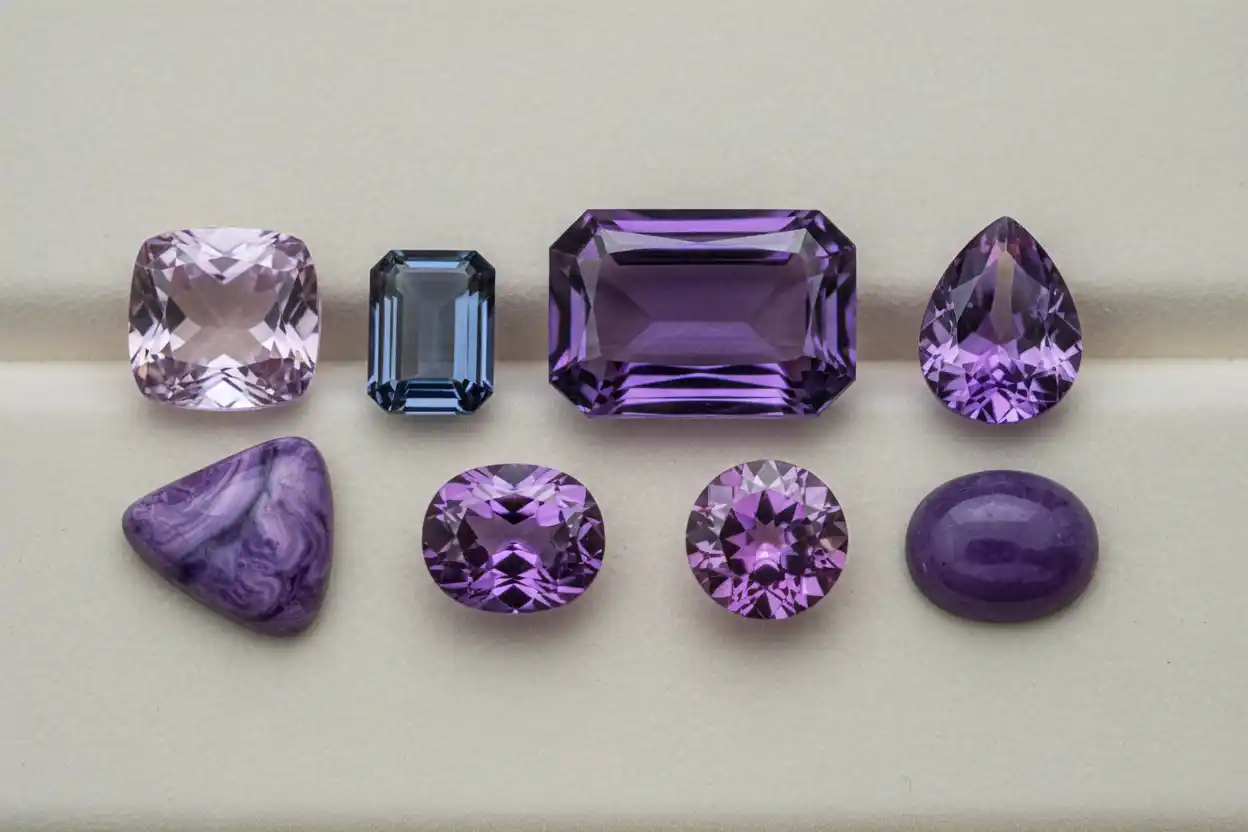
Purple Gemstones: Complete List, Meanings and Jewelry Uses
Purple gemstones include durable transparent corundum, accessible quartz, directionally colored cordierite, soft cubic fluorite and opaque ornamental minerals with swirling violet patterns. They may be faceted for fine jewelry, polished as cabochons, drilled as beads or preserved as mineral specimens.
The name “purple gemstone” describes color, not mineral identity or quality. A violet sapphire, purple fluorite and charoite have different compositions, structures, treatments and durability. Their market values and appropriate uses should never be inferred from color alone.
This guide owns the gemological list, jewelry uses, durability and treatment overview. The purple crystals guide retains meditation and belief-based practices, while purple engagement-ring gemstones owns the daily-ring decision.
Purple Gemstones at a Glance
| Purple gemstone | Material identity | Approximate Mohs hardness | Typical form | Best use |
|---|---|---|---|---|
| Purple diamond | Diamond | 10 | Transparent faceted gem | Fine daily jewelry |
| Purple sapphire | Corundum | 9 | Transparent faceted gem | Daily rings and fine jewelry |
| Purple spinel | Spinel | 8 | Transparent faceted gem | Rings, earrings and pendants |
| Amethyst | Quartz | 7 | Crystals and faceted stones | Broad jewelry and decorative use |
| Ametrine | Bicolor quartz | 7 | Purple-yellow faceted gem | Pendants, rings and collector cuts |
| Iolite | Cordierite | 7–7.5 | Transparent pleochroic gem | Earrings, pendants and protected rings |
| Purple garnet | Garnet group | About 7–7.5 | Transparent faceted gem | Rings and colored-stone jewelry |
| Tanzanite | Blue-violet zoisite | 6–7 | Transparent faceted gem | Protected jewelry |
| Kunzite | Spodumene | 6.5–7 | Transparent pink-violet gem | Pendants and occasional jewelry |
| Purple zircon | Zircon | About 6–7.5 | Brilliant faceted gem | Earrings and careful-wear rings |
| Purple scapolite | Scapolite group | About 5.5–6 | Transparent faceted gem | Pendants and occasional jewelry |
| Purple taaffeite | Taaffeite group | About 8–8.5 | Rare transparent gem | Collector and fine jewelry |
| Purple fluorite | Calcium fluoride | 4 | Crystals, carvings and faceted gems | Specimens and protected pendants |
| Charoite | Complex silicate mineral | Variable ornamental durability | Opaque fibrous material | Cabochons and carvings |
| Sugilite | Complex silicate mineral | About 5.5–6.5 | Opaque violet material | Cabochons and beads |
| Lepidolite | Lithium-rich mica | About 2.5–4 | Platy aggregates | Specimens and protected carvings |
| Purpurite | Manganese phosphate | About 4–4.5 | Matte massive material | Mineral specimens |
| Grape agate | Botryoidal chalcedony | About 6.5–7 | Rounded aggregates | Specimens and pendants |
| Hackmanite | Sodalite-group mineral | About 5.5–6 | Photochromic rough and cabochons | Specimens and careful-wear jewelry |
For a wider classification framework, see types of gemstones.
Purple Diamond
Purple is among the rarest natural diamond colors. Stones may show gray, pink, brown or red modifiers, and strongly saturated examples can command exceptional prices.
Diamond offers Mohs 10 hardness, although it is not immune to chipping. Pointed corners and thin girdles still require protection.
Color origin is critical. Purple diamonds may be natural-color, treated or laboratory-grown. Advanced testing is often necessary because visual appearance cannot establish the category.
A natural-color claim should be supported by a recognized laboratory report.
Purple Sapphire
Sapphire is corundum in colors other than red. Purple sapphire may appear lavender, violet, plum, reddish purple or blue-purple.
Its hardness and toughness make it one of the strongest purple jewelry stones. It works in rings, bracelets, earrings and pendants with fewer restrictions than amethyst, tanzanite or fluorite.
Color may result from combinations involving chromium, iron, titanium and other defects within the crystal. Some stones shift between violet, blue and reddish purple under different lighting.
Heating is common, while diffusion, filling and laboratory growth also occur. Purple sapphire should be evaluated through exact disclosure rather than an unexplained retail grade.
Purple Spinel
Spinel occurs in lilac, violet, gray-purple, grape, plum and reddish-purple shades.
It is singly refractive and can show crisp brilliance. Mohs 8 hardness and generally good durability make it suitable for frequently worn jewelry.
Synthetic spinel has been produced for a long time and can imitate sapphire, amethyst and other colored gems. A rare-color or high-value stone benefits from independent identification.
Purple spinel is often less familiar than sapphire, which can create attractive buying opportunities, although fine specific shades may be difficult to source.
Amethyst
Amethyst is purple quartz and the most widely available natural purple gem.
Its color ranges from pale lilac to deep purple with red or blue modifiers. Zoning may occur as bands, angular sections or uneven patches.
The types of amethyst guide explains chevron, banded, locality-associated and color varieties.
Most amethyst is not treated routinely, but heating can convert suitable material to citrine-like, green or colorless appearances. Synthetic amethyst and fracture-filled material also occur, as discussed in treated and synthetic amethyst.
Amethyst suits most jewelry but may require repolishing after years of daily ring wear.
Ametrine
Ametrine displays purple amethyst and yellow citrine zones within the same quartz crystal.
Cutters orient the color boundary through the face or use fantasy cuts to divide, blend or repeat the two colors.
A sharp division can be attractive, but an overly dark purple section and weak yellow section may feel unbalanced. The proportions should be judged face-up rather than by rough weight.
Ametrine shares quartz durability and care. High heat and prolonged intense light remain unnecessary.
Iolite
Iolite is gem-quality cordierite. Its strongest feature is pleochroism: different crystal directions can appear violet-blue, blue, gray or nearly colorless.
Cutting orientation determines whether the finished stone appears richly violet or washed out.
Iolite ranks around 7–7.5 but has perfect cleavage. It works best in earrings, pendants and protected rings.
Because its color can resemble tanzanite or sapphire, professional optical testing may be required for an unknown stone.
Tanzanite
Tanzanite is the blue-violet to violet-blue variety of zoisite associated with a restricted Tanzanian source.
Pleochroism creates blue, violet and other directional colors. Heating is widely used to develop or stabilize the familiar market appearance.
Tanzanite is less durable than sapphire or spinel. Cleavage and a hardness of approximately 6–7 make protective settings important.
It is most successful in pendants, earrings and carefully worn rings. Saturation often becomes stronger in larger stones.
Kunzite
Kunzite is pink-to-violet spodumene. It may appear lilac, violetish pink or pale purple depending on orientation and lighting.
Large, clean stones are available, but cleavage creates a substantial risk during cutting, setting and wear.
Kunzite may also fade after prolonged intense light exposure. This makes it a poor candidate for permanent sunny-window display or an uninterrupted daily ring.
Pendants and evening jewelry allow its delicate color to be appreciated with less physical risk.
Purple Garnet
Purple garnet is a color category rather than one universally defined variety. Stones may involve pyrope, almandine, spessartine or mixed compositions.
Colors range from raspberry-purple to grape, plum and reddish violet. Some material changes appearance between daylight and incandescent light.
Garnet generally lacks cleavage and works well in jewelry. However, darkness can reduce face-up brilliance, especially in deeply cut stones.
A rare trade or locality name should be supported by laboratory evidence when it materially affects value.
Purple Zircon
Zircon is a natural mineral and should not be confused with cubic zirconia.
Purple zircon may appear violet, plum, pink-purple or reddish purple. Its high refractive index and dispersion create bright flashes.
The gemstone can be brittle, and facet edges may abrade with repeated wear. Earrings and pendants are safer than exposed rings.
Heating can affect zircon color, so treatment disclosure matters.
Purple Scapolite
Scapolite can occur in lavender, violet, pink-purple and grayish-purple shades.
Transparent material is relatively uncommon and may display attractive brilliance or chatoyancy in included stones.
Scapolite has moderate hardness and cleavage. It is better suited to pendants, earrings and occasional rings than to harsh daily wear.
Its limited consumer familiarity makes reliable seller knowledge particularly important.
Purple Taaffeite
Taaffeite is a rare gem that can occur in mauve, violet, pink-purple and gray-purple shades.
Its rarity, small production and similarity to spinel historically made identification difficult. Laboratory testing is essential for any stone sold under the name.
Fine taaffeite can be hard enough for jewelry, but scarcity, inclusions and replacement difficulty make it primarily a collector gem.
A report should identify the species rather than relying on a seller’s visual claim.
Purple Fluorite
Purple fluorite can form vivid cubes, octahedra and color-zoned crystals. Transparent material is sometimes faceted, while banded or massive pieces become carvings and cabochons.
Its hardness of 4 and perfect cleavage make it unsuitable for hard daily wear. Even careful rings can scratch and split.
The guide to buying real purple fluorite covers color enhancement, imitations and specimen considerations.
Fluorite is best appreciated as a mineral specimen, protected pendant or collector’s faceted stone.
Charoite
Charoite is recognized by swirling lilac, violet, black and white fibrous patterns.
It is an ornamental material rather than a transparent faceting gem. Cabochons, beads and carvings display its internal movement most effectively.
Charoite’s geological association with the Murun massif is important. Generic dyed purple stone should not inherit the name.
A strong polish and well-composed pattern matter more than perfect uniformity.
Sugilite
Sugilite ranges from pale lavender to vivid violet, magenta and nearly black purple.
Most jewelry material is opaque and cut into cabochons, beads or inlay. Strong saturated color and relatively clean texture can add value.
Dyed stone, reconstructed products and imitations occur. Accurate identity matters because the trade name commands a premium.
Sugilite is less scratch-resistant than sapphire, spinel or quartz and should be stored separately.
Lepidolite
Lepidolite is a lithium-bearing mica whose lilac or pink-purple flakes may form books, plates, masses and pegmatite aggregates.
Its softness and sheet-like cleavage make it unsuitable for exposed fine jewelry.
Polished slabs and carvings can be attractive, but rough storage may cause flaking and surface damage.
Lepidolite should not be marketed as a source of medically active lithium through skin contact.
Purpurite
Purpurite is a manganese phosphate mineral with violet, reddish-purple or deep purple surfaces.
It commonly occurs as massive material with a matte or earthy luster. Polishing may reduce the surface character that attracts collectors.
Its softness and brittleness favor display rather than jewelry.
The appearance can overlap with dyed or coated materials, so strong color alone is not proof of identity.
Grape Agate
Grape agate consists of rounded purple botryoidal aggregates commonly associated with chalcedony.
The trade name refers to appearance, not conventional banded agate.
Specimens may show lavender, purple, green or gray spheres on matrix. Well-separated rounded forms and good condition influence desirability.
The aggregates can chip when dropped, even though chalcedony itself has respectable hardness.
Hackmanite
Hackmanite is a sodalite-group material known in some examples for reversible photochromism.
A pale stone may deepen to purple after ultraviolet exposure and gradually return toward its earlier color.
The strength and speed of this behavior vary. It should not be assumed in every hackmanite specimen.
Faceted material exists, but specimens and cabochons are more common.
Purple Gemstone Treatments
Purple sapphire may be heated, diffused or laboratory-grown. Amethyst may be synthetic or altered by heating. Tanzanite is commonly heated. Kunzite may be irradiated and heated. Zircon colors may also result from treatment.
The gemstone treatments guide explains why heating, diffusion, irradiation, filling and coating should not be treated as interchangeable.
Treatment can be stable and accepted, but the buyer needs accurate disclosure. A treated natural gem is not the same as a laboratory-grown gem, and neither is the same as an imitation.
Choosing Purple Gemstones for Jewelry
For daily rings, purple sapphire, spinel and diamond lead the group. Amethyst can work with maintenance, while iolite and tanzanite require protection.
Kunzite, fluorite, scapolite and zircon are safer in earrings or pendants. Charoite, sugilite and grape agate suit cabochons and beads. Lepidolite and purpurite are primarily specimen materials.
Use the gemstone hardness chart as one part of the decision rather than a complete ranking.
Setting construction, cleavage, inclusions and the wearer’s routine remain essential.
Identifying and Buying a Purple Gemstone
Color alone cannot separate amethyst, sapphire, spinel, iolite, glass and synthetic materials.
A gemologist may use refractive index, birefringence, pleochroism, specific gravity, magnification, spectroscopy and advanced testing.
The gemstone certification guide explains when laboratory documentation is proportionate to value.
Remote buyers should follow how to buy gemstones online and request exact-stone videos, dimensions, treatment disclosure and a meaningful return period.
Purple Gemstone Meanings
Purple gemstones commonly symbolize reflection, dignity, creativity, intuition and spiritual inquiry.
Individual materials add more specific themes. Amethyst represents restraint, spinel renewal, iolite perspective, tanzanite transition and charoite adaptation.
These associations arise from cultural history and contemporary belief. They are not measurable effects produced by color saturation, rarity or price.
Frequently Asked Questions
1. What is the most valuable purple gemstone?
Fine natural purple diamond can be exceptionally valuable. Rare sapphire, spinel, taaffeite and unusual garnet can also command high prices.
2. What is the most durable purple gemstone?
Purple diamond is the hardest. Purple sapphire provides one of the strongest practical combinations of hardness and toughness for colored jewelry.
3. What is the most affordable purple gemstone?
Amethyst is usually the most accessible natural transparent purple gem and is available in large sizes.
4. Which purple gemstone is best for a daily ring?
Purple sapphire and spinel are the leading colored-stone choices. Diamond is also highly durable when natural or laboratory origin is disclosed.
5. Is tanzanite purple or blue?
Tanzanite can appear blue-violet, violet-blue or predominantly violet because of pleochroism and cutting orientation.
6. Is purple fluorite suitable for jewelry?
It works in protected pendants and collector pieces, but its softness and perfect cleavage make it poor for daily rings.
7. Is charoite a gemstone?
Yes, in the broad ornamental-gem sense. It is commonly polished into cabochons, beads and carvings rather than faceted as a transparent gem.
8. Is sugilite the same as charoite?
No. They are separate minerals with different structures, textures and geological occurrences.
9. Can purple sapphire be synthetic?
Yes. Laboratory-grown purple sapphire exists, and natural sapphire may also be heated or diffusion-treated.
10. Why does iolite show several colors?
Iolite is strongly pleochroic, so different crystal directions transmit violet-blue, blue, gray or nearly colorless appearances.
11. Which purple gemstones can fade?
Kunzite is especially relevant, while some amethyst and treated materials may also change after prolonged intense light or heat.
12. Can color alone identify a purple gemstone?
No. Many natural, synthetic, treated and imitation materials overlap in purple appearance and require optical or laboratory testing.
Purple gemstones cover almost the full range of gem use: sapphire and spinel can survive daily rings, amethyst supplies accessible faceted color, tanzanite and iolite reward careful cutting, and charoite or sugilite turn mineral texture into ornamental design. The best choice begins with exact identity and intended wear, then moves to shade, symbolism and price.
Purple gemstone meanings and healing associations are cultural, historical or contemporary spiritual interpretations. Gemstones do not diagnose, prevent or cure medical or mental-health conditions.