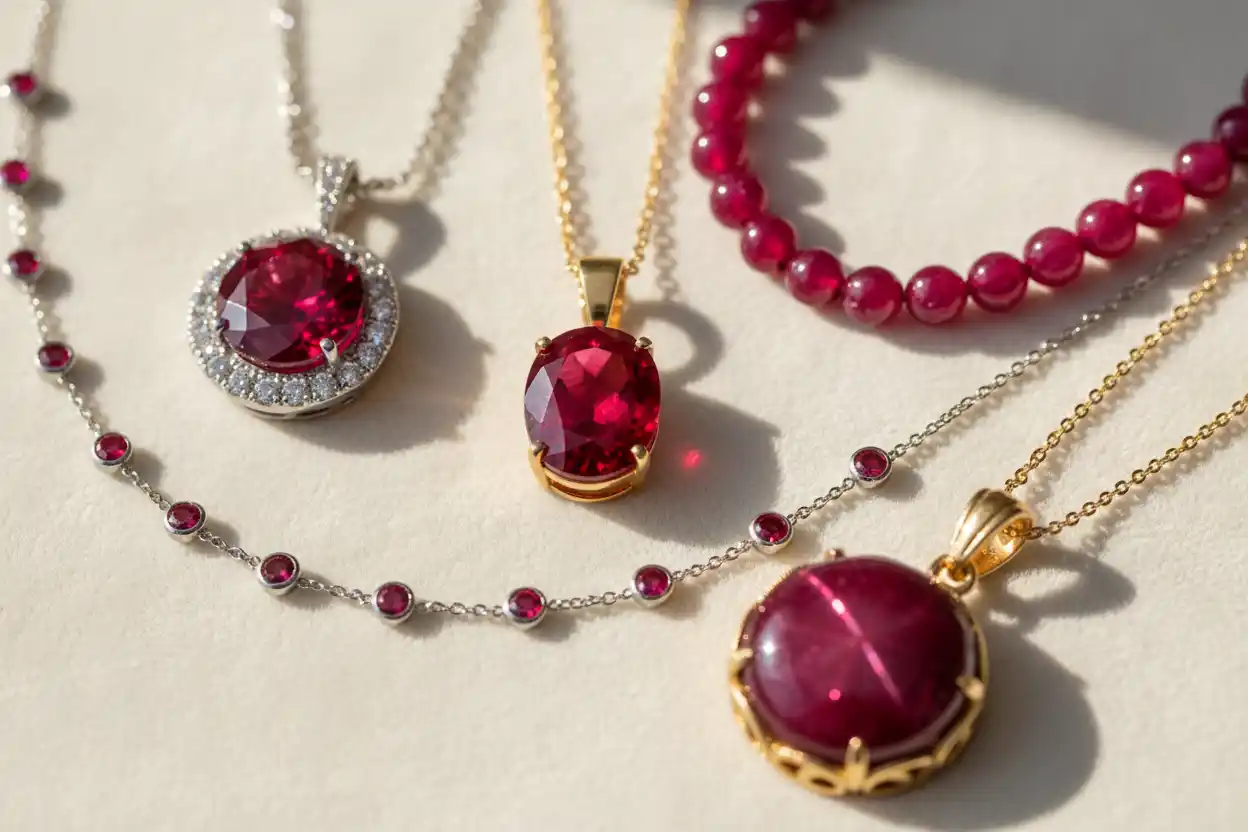
Ruby Necklaces and Pendants: Styles, Quality and Buying Guide
Ruby necklaces range from understated solitaire pendants to graduated strands containing hundreds of red stones. The gemstone’s hardness and strong color make it suitable for regular neckwear, while the relatively protected position allows larger, more included or optically unusual rubies to be used safely.
A necklace must still be evaluated as a complete object. The ruby may be durable, but a weak chain, undersized bail, open jump ring or extensively glass-filled stone can limit long-term wear.
Color and treatment are especially important. A vivid small ruby can remain clearly visible at the neckline, while a larger dark stone may appear nearly black once enclosed by metal. Laboratory-grown ruby, heated natural ruby, opaque corundum beads and ruby–glass composites also occupy very different value categories.
For ruby’s mineral identity and symbolism, see Ruby: Meaning, Properties & Symbolism. Belief-based use appears in Ruby Healing Properties, while loose-stone evaluation remains in the Ruby Buying Guide.
Ruby Necklaces at a Glance
| Necklace style | Appearance | Best use | Main concern |
|---|---|---|---|
| Solitaire pendant | One principal ruby | Everyday, birthstone and milestone jewelry | Bail security and pendant balance |
| Bezel pendant | Smooth metal-framed ruby | Frequent wear and low snagging | Deep metal can darken the stone |
| Halo pendant | Ruby surrounded by bright accents | Formal and romantic styling | Small settings and residue buildup |
| Three-stone pendant | Ruby with two companions | Anniversary and symbolic gifts | Stone spacing and balance |
| Star ruby pendant | Domed cabochon with asterism | Collector and distinctive jewelry | Star centering and treatment |
| Cluster pendant | Group of smaller rubies | Strong color at moderate cost | Shared prongs and cleaning |
| Station necklace | Rubies spaced along a chain | Lightweight layering | Flipping and fine-chain strain |
| Graduated necklace | Stones increase toward the center | Formal and traditional jewelry | Matching many rubies |
| Ruby bead strand | Continuous opaque or translucent red | Casual, cultural and statement styling | Drill holes, cord and material identity |
| Choker | Close-fitting ruby line | Formal and contemporary appearance | Exact internal length |
| Lariat | Adjustable open necklace | Modern styling and movement | Sliding components and end weight |
| Ruby-and-diamond necklace | Strong red-white contrast | Fine jewelry and celebrations | Hardness interaction and complex settings |
Why Ruby Works Well in Necklaces
Ruby ranks 9 on the Mohs scale and has no perfect cleavage.
It resists ordinary scratching and is less likely to split structurally than topaz, tanzanite or moonstone.
The neck is a relatively safe position. Pendants and strands encounter fewer direct impacts than rings and bracelets.
Movement improves red-light return. A pendant that shifts against clothing can show brighter flashes than the same stone in a static display.
Ruby also has strong bodycolor. Small stones can remain visible in station chains and pendants where pale gemstones might disappear.
The durability distinction is explained further in the gemstone-hardness chart and gemstone toughness-versus-hardness guide.
Solitaire Ruby Pendants
A solitaire places one ruby at the center.
Rounds, ovals and cushions are the most common shapes. Pears create a natural downward line, while hearts add overt romantic symbolism.
The stone should hang with its table facing outward.
A pendant that tilts forward may have an imbalanced basket, an incorrectly placed bail or too much metal behind the pavilion.
Open-backed settings generally preserve brightness and allow inspection.
The bail should be proportionate to the ruby and strong enough to carry the complete pendant without bending.
A fine solitaire can be worn daily when the stone is sound and the chain is appropriate.
Bezel-Set Ruby Pendants
A bezel surrounds the ruby’s girdle with metal.
It provides strong edge protection, reduces snagging and creates a smooth profile.
A full bezel can deepen the appearance of a dark ruby. Select a medium or vivid stone with sufficient brightness before enclosing it.
An open back helps light enter and allows cleaning.
A partial bezel exposes more of the stone while protecting selected sides.
The rim should be smooth, even and fully in contact with the ruby. Gaps can allow movement and trap residue.
Prong-Set Pendants
Prongs admit more side light.
Four prongs create an open design, while six add redundancy around larger rounds and ovals.
Pear, marquise and heart points require V-prongs or protective end bezels.
The prongs should hold the girdle securely without covering too much red surface.
Inspect the pendant from the side. The ruby should sit level and should not move when the jewelry is handled gently.
Sharp or raised prongs can catch clothing and should be repaired.
Halo Ruby Pendants
A halo surrounds ruby with diamonds, white sapphires, lab-grown diamonds or other accents.
The border increases apparent size and strengthens color contrast.
A vivid medium-sized ruby can look more prominent in a halo than a larger dark solitaire.
The center should not sit so high that it becomes vulnerable to impact.
Shared accent prongs require regular inspection.
Open galleries provide cleaning access, particularly because skin oils and cosmetics collect beneath compact designs.
Diamond accents should be separated from the ruby’s exposed girdle so the harder material does not rub against it.
Three-Stone Ruby Pendants
A three-stone pendant may symbolize past, present and future or another personal sequence.
The center ruby can be paired with diamonds, white sapphires or smaller rubies.
Graduated proportions usually create the strongest visual balance.
The stones should not touch directly. Metal separators or individual baskets reduce abrasion.
When all three stones are rubies, matching hue and treatment status matters.
A pendant containing one unheated natural stone and two filled rubies should not be represented as a uniform set without disclosure.
Star Ruby Pendants
Star ruby is cut as a cabochon to show asterism.
A pendant is an excellent format because it protects the domed surface better than a ring.
The star should move across the stone beneath a focused light.
Color, star centering, ray completeness, transparency and treatment all affect quality.
Synthetic star ruby and glass-filled natural star ruby occur.
A bezel or substantial prongs protect the perimeter without obstructing the dome.
The pendant should hang upright so the star remains oriented attractively.
Ruby Cluster Pendants
Clusters arrange several small rubies in floral, geometric or abstract designs.
They create broad red coverage without requiring one large transparent stone.
Each ruby should contribute to a consistent visual field.
A deliberate gradient can use darker stones at the center and lighter stones around the edge, but random mismatching looks poorly sorted.
Shared prongs reduce visible metal but create connected risk.
Clusters should have open backs or accessible galleries because residue accumulates between the stones.
Ruby Station Necklaces
Station necklaces place individual rubies at intervals along a chain.
Bezel-set stations are smooth, practical and less likely to snag.
Prong-set stations admit more light but require precise alignment.
Each station should connect symmetrically so the ruby faces forward rather than flipping continually.
Spacing controls the visual effect. Wide intervals create a minimal line, while close spacing produces stronger red presence.
A very fine chain may distort under several large stones. Chain gauge should match the total ruby and setting weight.
Graduated Ruby Necklaces
A graduated necklace uses smaller stones near the clasp and larger stones toward the center.
Matching is demanding because color, cut, transparency and treatment must transition smoothly.
Large natural rubies become expensive quickly, so many graduated necklaces use opaque beads, laboratory-grown stones, composites or numerous small heated rubies.
The listing should identify which category is present.
The necklace should drape without stiff segments.
A substantial center section needs a clasp and stringing system designed for its weight.
Ruby Bead Necklaces
Ruby bead strands range from opaque commercial corundum to transparent faceted material.
Affordable strands commonly contain included, translucent or opaque stones. Some are ruby-bearing rock rather than pure red corundum.
Inspect drill holes for chips, white stress areas, filler and pale interiors.
Knots between beads reduce direct contact and limit loss if the cord breaks.
Transparent fine-quality ruby beads are rare and valuable. Strongly colored inexpensive transparent beads may be laboratory-grown, glass-filled or imitations.
The material should be identified clearly rather than described only as genuine red gemstone.
Ruby in Matrix Necklaces
Ruby can occur in fuchsite, zoisite, marble and other host materials.
Ruby in fuchsite combines very hard ruby with soft green mica. A necklace must be cared for according to the softer matrix.
Ruby in zoisite contains green zoisite and commonly black amphibole around red corundum.
These materials are popular in cabochons and beads but should not be priced as though the entire object consists of transparent gem-quality ruby.
Matrix patterns can be attractive and geologically informative when disclosed accurately.
Natural Ruby Necklaces
Natural ruby carries geological rarity.
A fine transparent natural pendant may justify an independent laboratory report.
Natural bead strands can contain wide variation in color, inclusions and mineral matrix.
Heat treatment is common and generally accepted when disclosed.
A necklace marketed as natural should not conceal laboratory-grown replacement stones, glass-filled composites or red simulants.
The real-versus-fake ruby guide explains material identification.
Lab Ruby Necklaces
Laboratory-grown ruby is manufactured corundum.
It offers ruby hardness, vivid color and easier matching at a lower price.
A lab ruby solitaire can be a practical choice for frequent wear.
Large matched station and graduated necklaces become more accessible because manufacturing can produce consistent material.
Origin must remain explicit.
The Lab Ruby Meaning, Lab Ruby Buying Guide and Lab Ruby Price Guide explain the category without confusing it with natural geological rarity.
Heat-Treated Ruby
Conventional heat can improve color and clarity.
A heated ruby remains natural corundum.
Heat treatment is common enough that an untreated claim should receive laboratory support when it affects price.
A well-cut heated ruby can be an excellent necklace stone.
Care is normally similar to untreated ruby when the stone is structurally sound and has not undergone extensive filling.
The invoice and report should state treatment accurately.
Glass-Filled Ruby Necklaces
Heavily fractured ruby can be filled with glass to improve transparency.
The material may look attractive and affordable, but it requires much more cautious care.
Acids, heat and repair work can damage the filler.
Warm soapy water may also be inappropriate when filling is extensive or the jewelry contains additional sensitive components.
Filled stones should not be represented simply as untreated or conventionally heated ruby.
The detailed boundaries appear in How to Spot Treated or Synthetic Ruby and Gemstone Treatments Explained.
Choosing Ruby Color
Look for red that remains visible in ordinary light.
Fine material commonly shows vivid red to slightly purplish red.
Very dark stones may appear almost black against skin or clothing.
Pinkish-red rubies create a lighter appearance and can suit delicate pendants.
Orangish or brownish modifiers may work well in yellow gold but usually command less than vivid pure-red material.
For a multi-stone necklace, color consistency matters more than one ideal hue.
The types-of-ruby guide explains the full color and variety range.
Clarity and Transparency
Ruby commonly contains inclusions.
A pendant can tolerate visible inclusions better than a ring because it receives less impact.
However, large surface-reaching fractures near prongs or drill holes create weakness.
Transparency affects brilliance. Opaque ruby depends on bodycolor and polish, while transparent ruby returns internal light.
A completely clean ruby can be natural or laboratory-grown.
An included stone can still be synthetic, filled or composite.
Clarity must be interpreted with treatment and structure rather than used as a simple authenticity test.
Cut Quality
Good cutting allows ruby to return red light.
Deep stones can appear dark, while shallow stones may show windows.
Rounds, ovals and cushions work well in pendants.
Pears create an elegant drop but need point protection.
Cabochons suit star ruby, opaque material and heavily included stones.
A pendant setting can conceal an overly deep pavilion, so review measurements and side photographs rather than judging only the front.
Carat Weight and Visible Size
Carat measures weight.
Ruby is dense, so it may look smaller than a quartz, beryl or diamond of equal weight.
Millimeter dimensions are more useful for judging how large a pendant will appear.
The Carat vs Millimeter Size Chart explains density differences.
A halo or broad bezel can increase visual presence without requiring a much larger center.
For a bead strand, total carat weight may sound impressive but reveals little about color, treatment or necklace length.
Chain Lengths
| Approximate length | Typical position |
|---|---|
| 14–16 inches | Choker or high at the neck |
| 17–18 inches | Collarbone level |
| 20 inches | Below the collarbone |
| 22–24 inches | Upper chest |
| 28–36 inches | Long pendant or layering length |
Body proportions and neckline change the actual position.
A ruby pendant should sit clearly above or below a clothing edge.
Long chains allow more movement and increase the chance of striking a desk or countertop.
Adjustable chains provide flexibility but require a secure slider or extension.
Choosing a Chain
Small pendants work with cable, box and fine wheat chains.
Heavier rubies need greater chain width and stronger links.
Box and wheat chains provide good structural substance.
Snake chains create a smooth line but can kink if bent sharply.
The chain must pass freely through the bail.
For removable pendants, the bail also needs to pass over the clasp.
Inspect soldered rings near the clasp and pendant. Open jump rings are common points of failure.
Bail Design
The bail supports the complete pendant.
A fixed bail keeps the ruby oriented.
A hinged bail provides movement and can help the pendant lie flat.
Hidden bails create a clean appearance but may fit only narrow chains.
Decorative bails can contain diamonds or small rubies, adding more settings that require inspection.
The bail should not rub directly against an exposed ruby edge.
Its thickness should match the pendant’s weight rather than serving only a decorative purpose.
Choosing the Metal
Yellow gold emphasizes warmth and traditional richness.
Rose gold complements pinkish and purplish-red ruby.
White gold and platinum create strong contrast with vivid red.
Sterling silver offers an accessible option for opaque beads and cabochons but is softer and may tarnish.
Ask for metal fineness, alloy and plating details.
Some white-gold alloys contain nickel.
The chain and pendant do not need to use identical metals, but their colors and strengths should be compatible.
Ruby-and-Diamond Necklaces
Diamond accents create the classic red-white combination.
A halo, station chain or graduated necklace may use both materials.
Diamond is harder than ruby. Metal should separate exposed girdles so movement does not produce abrasion.
Numerous diamond settings increase maintenance needs.
Lab-grown diamonds can provide the same basic hardness and brilliance with a different origin and price structure.
The necklace should disclose both ruby and diamond origins rather than applying one generic natural label to the entire piece.
Styling Ruby Necklaces
A small solitaire works with open collars, V-necks and everyday clothing.
A vivid station necklace adds red without the formality of a large pendant.
Graduated and ruby-and-diamond designs suit formal wear and simple solid fabrics.
Dark ruby can disappear against black or burgundy clothing. White, cream, gray and cool blue backgrounds create stronger contrast.
Yellow gold and ruby pair naturally with warm neutrals, while platinum provides a sharper contemporary effect.
The necklace can be coordinated with a ruby bracelet or ruby earrings by repeating the metal rather than matching every stone exactly.
Layering Ruby Necklaces
Use clearly separated chain lengths.
A short ruby pendant can sit above a plain gold chain or a longer diamond station necklace.
Prevent pendants from striking one another.
Diamond components can scratch ruby, while ruby can scratch softer pearls, opals and tourmalines.
Fine chains with similar link sizes tangle easily.
A connector or necklace separator may improve layering, but it must support the combined weight.
Birthstone and Anniversary Use
Ruby is July’s birthstone.
The July Birthstone Jewelry guide compares gift formats, while the main July Birthstone page covers history.
Ruby also appears in traditional anniversary lists, particularly for major milestones.
The complete framework appears in Anniversary Gemstones by Year.
A ruby pendant can mark a birth, wedding, promotion or personal achievement without requiring a ring size.
Symbolism remains personal and does not guarantee relationship outcomes.
Buying a Ruby Necklace
First confirm whether the listing includes the chain.
Ask whether the ruby is natural, laboratory-grown, heated, diffusion-treated, glass-filled, composite or simulated.
Request exact dimensions, total gemstone weight, chain length, metal fineness, clasp type and treatment disclosure.
Inspect photographs of the front, side and back.
A significant natural ruby may justify independent testing. The gemstone-certification guide explains report options, and How to Read a Gem Lab Report helps interpret treatment and origin wording.
Use the Ruby Price Guide for value factors.
For remote purchases, follow How to Buy Gemstones Online and retain enough time for inspection.
Daily Wear
Ruby necklaces are suitable for regular wear when construction and treatment are appropriate.
Apply perfume, lotion and sunscreen before putting the necklace on.
Remove it before exercise, swimming, bathing and household cleaning.
Long pendants should be secured when leaning over hard surfaces.
Inspect the clasp, bail and connecting rings regularly.
A pendant that tilts differently, clicks in its setting or catches clothing needs professional attention.
Cleaning and Storage
Sound untreated and conventionally heated ruby can usually be cleaned with warm water, mild soap and a soft brush.
Glass-filled, dyed or uncertain ruby requires gentler treatment.
Use How to Clean Ruby Jewelry Safely for detailed instructions.
Store the necklace flat or hanging individually.
Fasten the clasp before storage.
Keep ruby away from diamonds and from softer stones it can scratch.
Do not place heavy jewelry over a fine chain or star-ruby cabochon.
Frequently Asked Questions
1. Is ruby suitable for a necklace?
Yes. Ruby’s hardness and the protected position of neckwear make it excellent for pendants, stations, strands and formal necklaces.
2. Which ruby pendant setting is most durable?
A low full or partial bezel provides strong girdle protection and reduced snagging.
3. Are ruby bead necklaces made from fine transparent ruby?
Most affordable strands use opaque or translucent commercial corundum. Transparent fine ruby beads are much rarer.
4. Is heated ruby suitable for a necklace?
Yes. Conventional heat treatment is generally stable and compatible with ordinary jewelry wear when disclosed.
5. Are glass-filled ruby necklaces durable?
They require much greater care because filler can be damaged by chemicals, heat and repair.
6. Is lab ruby suitable for necklaces?
Yes. Lab ruby is durable corundum and can provide vivid matched stones at a lower price.
7. What color should a good ruby pendant show?
Look for visible red under ordinary light, preferably vivid red to slightly purplish red without excessive darkness.
8. Does carat weight show how large a ruby pendant looks?
Not reliably. Millimeter dimensions and setting design provide a clearer indication of face-up size.
9. What chain length works best for a ruby pendant?
Around 18 inches suits many collarbone-level designs, but body proportions, pendant size and neckline determine the best fit.
10. Does a natural ruby necklace need a laboratory report?
A report is advisable when natural origin, treatment, geographic origin or substantial value depends on the claim.
11. Can ruby necklaces be cleaned ultrasonically?
Sound untreated or heated ruby may be suitable, but filled, fractured or uncertain stones should not receive ultrasonic cleaning.
12. What does a ruby necklace symbolize?
Ruby necklaces traditionally represent vitality, courage, devotion, passion and July birthstone identity.
A ruby necklace succeeds when the gem, setting and chain are evaluated together. Strong red color may create the visual focus, but treatment disclosure, bail strength, chain proportion, clasp security and cleaning access determine whether the jewelry remains practical over time.
Ruby is indexed in Crystals That Start With R and Gemstones That Start With R.