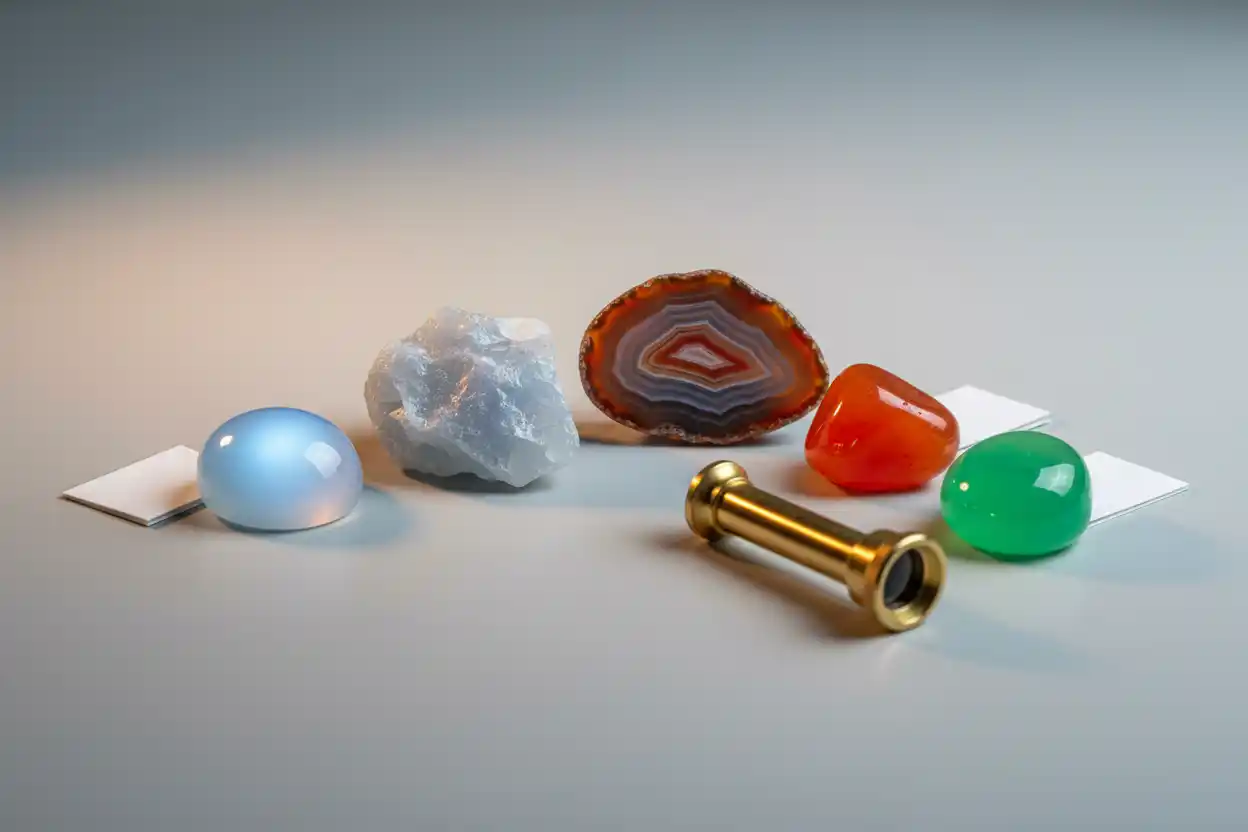
Where to Buy Real Chalcedony and Avoid Dyed or Glass Fakes
Buying chalcedony becomes complicated because the name can refer to both a specific-looking gemstone and a broad family of microcrystalline silica materials. Some sellers use “chalcedony” mainly for translucent white, gray, lavender or blue stones. Others apply the term broadly to agate, carnelian, chrysoprase, bloodstone, onyx and several jasper-like materials.
Neither approach is necessarily deceptive, but the listing should make the intended variety clear. A buyer choosing pale blue chalcedony needs different treatment information from someone buying a banded agate slab, a carnelian seal or an opaque jasper carving.
The chalcedony meaning and properties guide explains the material’s identity and traditional symbolism. This guide focuses on where to shop, how sellers use the name, which treatments and imitations occur, and how to evaluate rough, cabochons, beads, carvings and jewelry without duplicating the dedicated variety pages.
Understand What Chalcedony Is
Chalcedony is a microcrystalline to cryptocrystalline silica material composed primarily of extremely fine quartz, commonly with intergrown moganite. Its crystals are too small to distinguish with ordinary unaided viewing, which gives polished chalcedony its smooth, compact appearance.
Unlike a transparent rock-crystal point, chalcedony typically forms crusts, nodules, cavity fillings, veins, botryoidal surfaces and massive aggregates. It can be translucent, opaque or occasionally nearly transparent in thin areas.
The broad chalcedony family contains materials differentiated by color, pattern, inclusions or traditional trade usage. The types of chalcedony guide provides the full taxonomy, while the chalcedony color guide keeps color symbolism separate from treatment and buying questions.
Quartz-rich chalcedony generally has Mohs hardness around 6.5 to 7. Its fine-grained structure can provide good toughness, making sound material suitable for cabochons, carvings, beads, seals and many jewelry applications. However, cavities, fractures, dye, filler and thin edges can still reduce durability.
Decide Which Chalcedony Market You Are Entering
A listing for “real chalcedony” is not specific enough by itself. Before comparing prices, determine which form and variety you actually want.
| Product type | Best buying source | Main issue to investigate |
|---|---|---|
| Natural nodules and rough | Mineral dealer or lapidary supplier | Interior quality, fractures, dye and misleading wet photographs |
| Slabs | Lapidary supplier | Pattern depth, color penetration, resin and cutting yield |
| Uniform translucent cabochons | Colored-stone dealer or independent cutter | Natural color, backing, filling and polish |
| Agate cabochons or slices | Agate specialist or lapidary | Dye, band enhancement, assembly and locality claims |
| Carnelian or sard | Chalcedony dealer or experienced lapidary | Heat, dye, glass and historical naming |
| Chrysoprase | Colored-stone dealer | Nickel-related natural color, dye, serpentine and treatment |
| Bloodstone | Lapidary or gemstone dealer | Painted spots, dyed jasper and Heliotrope naming |
| Bead strands | Established bead supplier | Mixed varieties, dye, resin and drill-hole damage |
| Carvings | Skilled stone seller | Epoxy filling, coating and composite construction |
| Fine jewelry | Jeweler with treatment disclosure | Backing, glue, metal quality and exact variety identity |
| Antique seals or cameos | Specialist antique-gem dealer | Restoration, recutting, provenance and legal ownership |
The variety name affects value. Fine natural-color chrysoprase or gem silica should not be compared directly with ordinary dyed agate, even though all may fall within the broad chalcedony market.
Where to Buy Genuine Chalcedony
Specialist lapidary suppliers
Lapidary suppliers are often the best source for rough, slabs and preforms. Experienced sellers understand how an outer rind can differ from the interior and whether fractures will reduce cutting yield.
Ask for dry photographs of every visible face. Water and oil can deepen color, conceal scratches and make a porous surface look more translucent. A wet photograph can be helpful when paired with a matching dry view, but it should not be the only image.
For slabs, request images of both faces and the edges. These views show whether color and pattern continue through the material or remain concentrated near one surface.
Colored-stone dealers
A specialist gemstone dealer is appropriate for calibrated cabochons, matched pairs and finer translucent material. The listing should identify the variety, dimensions, weight, transparency, treatment and geographic origin when known.
“Natural chalcedony” does not answer whether the color was dyed or whether cavities were filled. Ask separate questions about origin and treatment.
For higher-value material, such as fine chrysoprase or gem silica, an independent laboratory report may be worthwhile. Ordinary pale chalcedony cabochons generally do not require one when the seller provides clear disclosure and a reliable return policy.
Gem and mineral shows
Shows let you compare many chalcedony varieties under the same lighting. Place pale or translucent material over white paper, then rotate it beneath a focused lamp.
Use a 10× loupe to inspect fractures, drill holes, band boundaries, filled cavities and surface coatings. Color that gathers in cracks or around holes can suggest dye, although sophisticated treatments may remain difficult to confirm visually.
Do not scratch a polished stone or apply chemicals. The crystal identification guide explains why several nondestructive observations provide more useful evidence than one damaging test.
Established online stores
An online seller should show the exact cabochon, carving or collectible specimen whenever pattern and color materially affect the purchase. Batch photography may be acceptable for inexpensive tumbles, but the listing should describe the variation buyers can expect.
The online gemstone buying guide explains how to evaluate seller identity, protected payment options and return terms.
For translucent stones, request images against both white and neutral gray backgrounds. Strong backlighting can make a pale stone appear far more saturated than it will look in jewelry.
Independent cutters and jewelry makers
A lapidary who bought the rough and cut the stone can often explain its construction more accurately than a reseller. Ask whether resin, dye, backing or coating was used during preparation.
For custom jewelry, request photographs of the loose stone before it enters a closed-back setting. Once mounted, foil, colored metal, resin or a dark backing may be difficult to detect.
Strict Chalcedony Versus the Broad Chalcedony Family
In stricter retail usage, “chalcedony” often means relatively uniform, translucent material in white, gray, lavender or blue. Agate is distinguished by banding, while jasper is usually opaque and more rock-like.
In broader mineral and gem usage, carnelian, chrysoprase, bloodstone, agate, onyx and jasper may all be discussed as chalcedony or closely related microcrystalline quartz materials.
A seller should not use the broad definition selectively to disguise uncertainty. For example, a product listed as “natural blue chalcedony” should not arrive as visibly banded dyed agate merely because agate belongs to the chalcedony family.
The quartz family guide places chalcedony within the wider silica group without replacing this commercial naming discussion.
Blue Chalcedony
Blue chalcedony generally has a soft blue, gray-blue or lavender-blue body with diffused translucency. Natural material can range from very pale to stronger color, although intensely uniform blue deserves treatment questions.
The completed guide to buying genuine blue chalcedony owns blue-specific dye, glass, epoxy and color-origin checks.
Do not assume that every blue chalcedony is gem silica. Gem silica is a more specific blue-to-bluish-green chalcedony associated with finely distributed copper-bearing material.
Gem Silica and Chrysocolla Chalcedony
Gem silica can display vivid blue or bluish-green color and attractive translucency. It is often called chrysocolla chalcedony because its color relates to finely dispersed chrysocolla or related copper-bearing material within chalcedony.
The chrysocolla guide covers the associated copper mineral. The next dedicated guide to buying real chrysocolla will address soft chrysocolla, stabilized material and mixed copper minerals separately.
Fine gem silica can command a substantial premium over ordinary blue chalcedony. That premium makes dyed chalcedony, colored glass and polymer-rich composites realistic imitation concerns.
A seller should provide stronger treatment evidence when a saturated blue-green cabochon is priced as high-quality gem silica.
Agate
Agate is chalcedony distinguished by banding, layering or related internal structures. It occurs in a vast range of natural colors and patterns, but it is also one of the most commonly dyed gem materials.
The real-versus-fake agate guide owns the detailed distinction among natural agate, manufactured substitutes and misleading listings. The treated-agate guide covers dye, heat, bleaching and enhancement.
When buying a general chalcedony parcel, ask whether banded pieces are natural-color agate or treated products. A seller should not use “chalcedony” to avoid disclosing agate dye.
Carnelian and Sard
Carnelian is orange to reddish-brown chalcedony whose color commonly relates to iron. Heating has a long history of improving or deepening its color.
The completed guide to buying real carnelian covers heat treatment, dye, red jasper and glass in detail.
Sard is a traditional name for darker brownish-red chalcedony. The boundary between sard and carnelian is gradual, so a seller should not represent sard as a separate rare mineral species.
Chrysoprase
Chrysoprase is a green chalcedony variety whose natural color is associated with nickel-bearing components.
Its color can overlap with dyed chalcedony, serpentine, jade substitutes and several green glasses. Fine translucent material deserves careful treatment disclosure.
The next dedicated guide to buying real chrysoprase will own green-color quality, locality and imitation checks rather than allowing this parent page to duplicate them.
Bloodstone
Bloodstone is traditionally a dark green chalcedony or jasper-like material with red iron-oxide markings. Heliotrope is an alternate name, not a separate premium stone.
The completed guide to buying genuine bloodstone covers painted red spots, dyed green stone, dragon blood jasper and historical seal purchases.
Within a mixed chalcedony parcel, bloodstone should show integrated red markings rather than surface paint.
Onyx, Sardonyx and Jasper
Onyx is traditionally a banded chalcedony with relatively straight, parallel layers. Much commercial black onyx is dyed chalcedony, which is acceptable when disclosed.
Jasper is generally opaque and can contain more mineral impurities or rock-like texture than translucent chalcedony. Retail boundaries between jasper and chalcedony are not always rigid.
A seller should identify the stone by its actual appearance and treatment rather than combining multiple names—such as “onyx jasper chalcedony”—without explanation.
What Genuine Chalcedony Looks Like
Uniform chalcedony usually has a waxy to vitreous luster and a compact, fine-grained appearance. It may be milky, softly clouded or translucent along thin edges.
Natural material can contain dendrites, color zones, botryoidal surfaces, cavities, fine bands and mineral inclusions. Those features should continue beneath the polished surface.
A perfectly smooth body is possible, so natural irregularity is not required. Conversely, bubbles, mold seams and a repeated manufactured pattern suggest glass or resin.
Chalcedony normally lacks the large visible crystals of coarse-grained quartzite. If individual sparkling grains dominate the stone, the material may be quartzite or another silica-rich rock rather than compact chalcedony.
Common Treatments
Dye
Chalcedony’s microscopic structure and variable porosity make it suitable for commercial dyeing. Blue, green, red, orange, purple, pink and black treatments all occur.
Color often concentrates in fractures, porous bands, pits and drill holes. However, well-executed dye may penetrate deeply and require professional analysis.
Heat
Heat may change iron-related colors in carnelian and some agates. It can also be part of multi-step commercial color processes.
Heated material remains natural stone, but the seller should disclose treatment when it is known.
Bleaching
Bleaching can lighten dark organic or iron-related color before another treatment. It may be followed by dyeing.
Wax and oil
Surface treatments can improve luster and deepen color temporarily. Their stability depends on exposure to heat, chemicals and repeated cleaning.
Epoxy and resin filling
Fractures and cavities may be filled to strengthen carvings or improve polish. Clear bubbles, different surface luster and ultraviolet response can sometimes reveal resin.
Polymer impregnation
Porous or fractured material can be impregnated throughout with polymer. When polymer occupies substantial volume, a laboratory may describe the object as impregnated or composite rather than merely filled.
Backing and assembly
Thin translucent stones may be mounted over colored, reflective or dark material. Doublets and backed cabochons should be described clearly because the face-up color may change after removal from the setting.
The gemstone treatments guide explains how these treatments affect disclosure, durability and value.
Common Imitations and Misrepresentation
Colored glass
Glass can imitate translucent chalcedony and banded agate. Round bubbles, flow lines, mold seams and an unusually uniform glassy body may provide clues.
Some glass contains no obvious bubbles, so professional testing may still be necessary.
Resin
Resin can be colored, molded or mixed with stone powder. It may show casting seams, bubbles, soft scratches and repeated patterns.
Reconstituted material
Ground chalcedony or agate fragments can be combined with polymer. The product contains natural silica but is not one solid natural stone.
Dyed quartzite
Quartzite may accept dye and retain a convincing stone texture. Visible interlocking grains distinguish it from finer chalcedony, although polished pieces can remain confusing.
Other natural stones
Calcite, serpentine, jade substitutes, opal, common quartz and silica-rich rocks may be mislabeled according to color. Natural origin alone does not make the name correct.
How to Evaluate Rough and Nodules
Ask for a sawn face whenever possible. The rind of a chalcedony nodule may reveal little about the interior, while one small exposed window can overrepresent the quality of the whole piece.
Compare the sawn face, natural exterior and edges. Color or pattern that appears only near the surface may not provide good cutting yield.
Check for fractures and cavities. Chalcedony is tough, but a nodule can contain open seams that divide its best areas.
For banded material, evaluate how the pattern curves through the nodule. A large piece with one narrow patterned zone may produce fewer desirable cabochons than a smaller densely banded nodule.
How to Evaluate Slabs
Inspect both faces and all exposed edges. Bands, color and inclusions should continue through the stone in a geologically plausible way.
Backlighting reveals translucent zones, hidden cracks and areas where filler may have entered. Nevertheless, judge the slab under normal reflected light as well because extreme backlighting exaggerates color.
Ask about resin stabilization before purchasing. A stabilized slab can cut successfully, but it should not be priced as equivalent untreated rough.
How to Judge Cabochons
A good cabochon has an even dome, clean outline, stable girdle and polish appropriate to the material.
The cutter should position the most attractive color or pattern face-up. Thin blue chalcedony may look washed out, while an overly thick stone may become gray or opaque.
Inspect the back for dye concentration, resin, backing and open fractures. In translucent stones, a backing can change color dramatically.
If a cabochon contains a cavity, determine whether it is open, naturally druzy, filled with resin or concealed beneath coating.
Buying Beads
Natural beads should show plausible variation. Uniform size and good matching add value, but identical color, translucency and internal patterns can indicate heavy treatment or manufacture.
Drill holes deserve close inspection. Dye commonly accumulates there, while chips and radial fractures can weaken the bead.
Ask whether a strand contains one chalcedony variety or several materials selected for color. Mixed strands should not be presented as one uniform gemstone.
Buying Carvings
Chalcedony’s toughness makes it a traditional carving and engraving material. Even so, large carvings can contain natural cavities, hidden filler and repaired breaks.
Inspect the underside and deep recesses. These areas can reveal unpolished resin, dye residues and assembled sections.
A thick glossy coating may conceal a mediocre polish. Ask whether the surface is bare stone, waxed, lacquered or resin-coated.
Buying Chalcedony Jewelry
Sound chalcedony works in rings, pendants, earrings, bracelets and brooches. A protective bezel reduces edge exposure, particularly for thin cabochons.
The gemstone hardness chart places chalcedony near the quartz range. The gemstone toughness-versus-hardness guide explains why fractures, drilled holes and thin edges still matter.
For closed-back jewelry, request pre-setting images when the stone carries a meaningful natural-color premium. Ask whether glue, foil or colored backing is present.
Price and Value
Chalcedony prices vary substantially because the market includes inexpensive dyed beads, fine natural-color cabochons, rare locality specimens, gem silica, antique carvings and designer jewelry.
Important value factors include:
- Natural versus treated color
- Variety and market demand
- Translucency
- Color evenness or pattern quality
- Usable size
- Structural condition
- Cut and polish
- Filling or impregnation
- Locality and provenance
- Carving or engraving skill
- Matching quality in sets
Weight alone is a poor guide. A large pale carving can be less valuable than a small fine natural-color chrysoprase or gem-silica cabochon.
The gemstone pricing guide explains how rarity, cutting yield, treatment evidence and workmanship interact.
Questions to Ask the Seller
Ask which chalcedony variety the seller believes the product to be. Determine whether the name is based on laboratory testing, mine provenance, supplier labeling or visual appearance.
Request separate statements about natural origin and treatment. Confirm dye, heat, bleaching, wax, oil, resin, impregnation, backing, coating and assembly.
For rough, ask for dry sawn-face photographs. For cabochons, request front, back and edge views. For beads, request drill-hole close-ups.
When locality affects price, ask for invoices, labels or collection history. Finally, obtain a return policy that permits normal visual and gemological inspection.
Professional Identification
A gemologist can use refractive index, specific gravity, microscopy, Raman spectroscopy and infrared spectroscopy to confirm chalcedony and investigate treatment.
Microscopy may reveal dye concentrations, glass bubbles, resin-filled cavities and composite boundaries. Raman spectroscopy can confirm quartz and identify some included minerals.
Infrared analysis can assist in detecting polymers. Chemical or spectroscopic analysis may also help separate natural-color copper- or nickel-bearing chalcedony from dyed material.
Geographic origin is often harder to prove than mineral identity. A generic laboratory report may confirm chalcedony without confirming the seller’s exact mine claim.
Responsible Buying and Long-Term Care
Chalcedony occurs widely, but premium locality claims and antique objects still require responsible provenance. The ethical gemstone sourcing guide provides practical questions about mining, cutting labor and supply-chain transparency.
Sound untreated chalcedony can generally be cleaned with lukewarm water, mild soap and a soft cloth. However, dyed, filled, coated, backed or glued products may require gentler care.
Avoid strong heat, harsh chemicals and prolonged soaking when treatment is uncertain. Store polished pieces away from diamonds, sapphires and other harder gems that can scratch them.
The C crystal directory, C gemstone directory and visual gemstone guide provide broader context for comparing chalcedony varieties and lookalikes.
Frequently Asked Questions
1. Is chalcedony a single gemstone or a family?
Both usages occur. Strict retail usage often reserves chalcedony for relatively uniform translucent material, while broader usage includes agate, carnelian, chrysoprase, bloodstone and related microcrystalline quartz varieties.
2. Is all agate chalcedony?
Agate is a banded or structurally patterned chalcedony variety. However, not all chalcedony is agate because many chalcedonies lack visible banding.
3. Is jasper the same as chalcedony?
Jasper is generally opaque microcrystalline silica with more impurities or rock-like texture. It is closely related to chalcedony, and boundaries can overlap in commercial usage.
4. Is natural chalcedony commonly dyed?
Yes. Dyeing is widespread, particularly in agate, beads and brightly colored decorative objects.
5. How can I recognize dyed chalcedony?
Look for concentrated color in fractures, porous bands, pits and drill holes. Sophisticated dye may still require professional testing.
6. Can chalcedony contain resin?
Yes. Cavities and fractures can be filled, while porous or unstable material may be polymer-impregnated.
7. Is chalcedony the same as quartz?
Chalcedony consists mainly of microscopic quartz with associated moganite. It belongs to the quartz family but differs in texture from large single quartz crystals.
8. Is glass chalcedony?
No. Glass is amorphous manufactured or natural material, while chalcedony has a microcrystalline silica structure.
9. Is chalcedony suitable for everyday rings?
Sound untreated chalcedony is generally suitable for many ring designs. Thin edges, open fractures, filler and high settings require additional care.
10. Do all chalcedony purchases need laboratory certificates?
No. Reports are most useful for expensive natural-color stones, gem-silica claims, major treatments, antiques or disputed identification.
11. Can a natural stone still be misleadingly sold as chalcedony?
Yes. Quartzite, calcite, serpentine, glassy rocks and other natural materials can be given an incorrect chalcedony label.
12. What is the biggest warning sign in a chalcedony listing?
Be cautious when a seller uses only the word “natural” but will not name the variety, discuss color treatment, show the back or provide a return policy.
Buy the Correct Variety, Not the Broadest Name
Chalcedony is too diverse for one appearance checklist. A pale blue cabochon, a banded agate slab, a carnelian bead and a chrysoprase ring belong to different quality and treatment markets even though they share a silica-rich family connection.
Choose a seller who can narrow the material to its correct variety, explain every enhancement and show the complete object. Accurate naming is the first evidence that the seller understands what they are offering.
Safety note: Chalcedony contains crystalline silica. Intact polished stones are appropriate for normal handling, but cutting, drilling, sanding or grinding can create hazardous respirable silica dust. Do not dry-work chalcedony; lapidary processing requires wet methods, local extraction and suitable respiratory and eye protection.