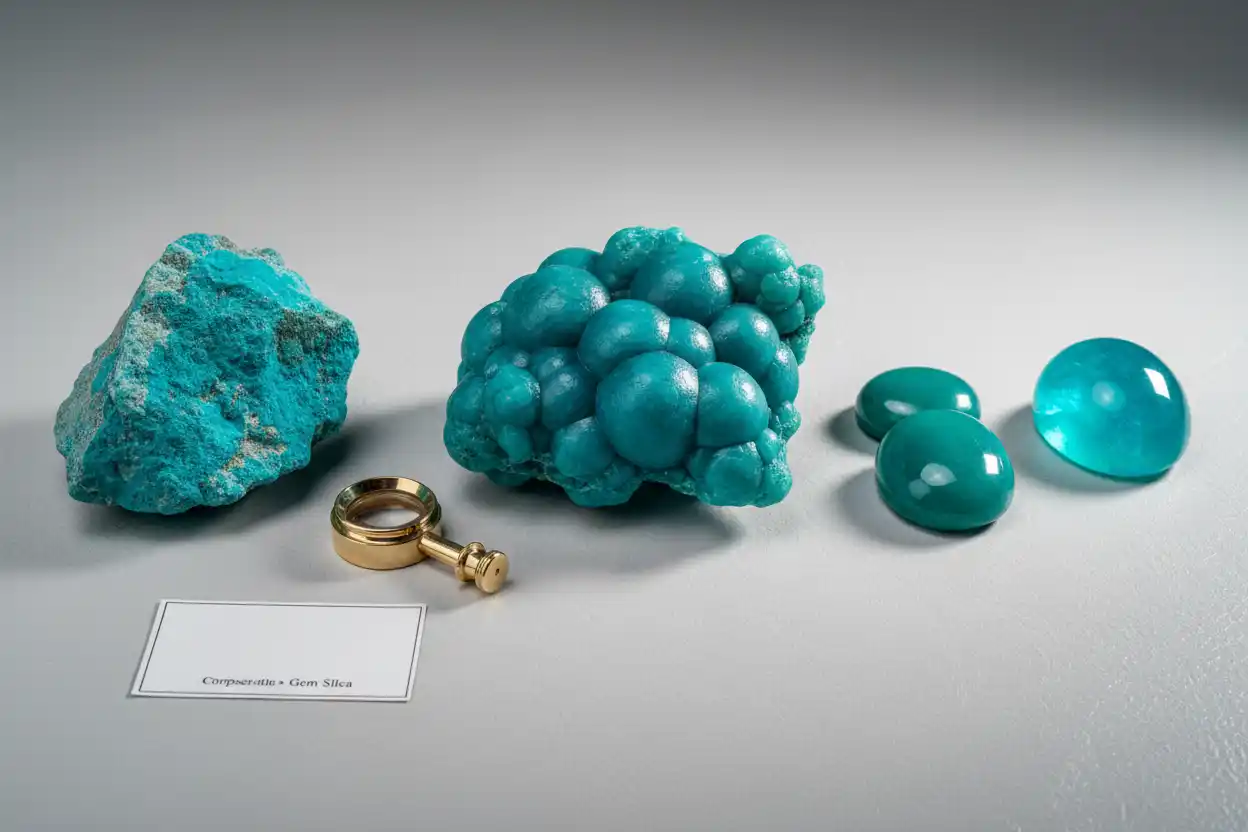
Where to Buy Real Chrysocolla and Avoid Dyed or Stabilized Fakes
Buying real chrysocolla requires more than finding a blue-green stone. The retail name can describe soft natural chrysocolla, chrysocolla mixed with quartz or chalcedony, copper-mineral matrix, stabilized lapidary material, gem silica, dyed stone, resin composites and reconstructed decorative objects.
Those products are not interchangeable. Relatively pure chrysocolla is soft and brittle, while chrysocolla enclosed within quartz or chalcedony can be durable enough for polished jewelry. A seller who describes every bright blue-green cabochon as untreated solid chrysocolla may therefore be overlooking the material’s actual structure.
The chrysocolla meaning and properties guide covers the mineral’s identity and traditional symbolism. This guide focuses on seller selection, construction, treatment, associated minerals, imitation risks and choosing a product appropriate for collecting, cutting, display or jewelry.
First Determine Which Chrysocolla Product You Are Buying
Chrysocolla is a hydrated copper-bearing silicate mineral with variable composition. Natural material commonly occurs in the oxidized portions of copper deposits, where it may form crusts, rounded masses, botryoidal surfaces, vein fillings and fine-grained aggregates.
Pure or nearly pure chrysocolla commonly has Mohs hardness around 2 to 4. That softness makes it unsuitable for most exposed jewelry unless another mineral supports it.
However, many polished products contain chrysocolla within harder quartz or chalcedony. Their durability can approach that of the silica host rather than the soft blue-green mineral alone.
| Retail description | What the seller should mean |
|---|---|
| Natural chrysocolla specimen | Chrysocolla preserved in its original mineral or matrix form |
| Chrysocolla rough | Natural cutting material that may contain quartz, chalcedony, malachite, host rock or other minerals |
| Chrysocolla in quartz | Blue-green chrysocolla enclosed within or mixed with crystalline or massive quartz |
| Chrysocolla chalcedony | Chalcedony containing finely distributed chrysocolla |
| Gem silica | Fine translucent chrysocolla-bearing chalcedony with strong blue-to-green color |
| Stabilized chrysocolla | Natural material strengthened with polymer or resin |
| Chrysocolla composite | Natural fragments or powder held together by significant binder |
| Chrysocolla matrix | A multi-mineral rock containing visible chrysocolla |
Ask the seller to move beyond the general name and describe which of these constructions applies.
Where to Buy Genuine Chrysocolla
Specialist mineral dealers
Mineral dealers are usually the strongest source for natural crusts, botryoidal specimens, stalactitic forms and documented copper-mine material.
A good listing identifies the blue-green mineral, associated species, locality, dimensions, weight and condition. It should also state whether matrix was repaired or stabilized.
Request photographs of the front, back, sides and base. One attractive blue display face can conceal a plain host rock, glued fragment or unstable underside.
The seller should distinguish a visual field identification from laboratory-confirmed mineralogy. Copper deposits frequently contain several blue and green minerals in the same small area.
Lapidary suppliers
Lapidary suppliers are the best source for rough, slabs, preforms and stabilized cutting material. Experienced sellers understand that much chrysocolla requires support from quartz, chalcedony or resin before it can take a lasting polish.
Ask whether the rough was photographed dry, wet or oiled. Water can deepen blue-green color and temporarily hide scratches, porous zones and weak surfaces.
A competent supplier should explain whether the material cuts as soft chrysocolla, hard chrysocolla-in-quartz or a mixed copper-mineral rock. Sample cabochons from the same parcel provide useful evidence.
Gem and mineral shows
Shows let you compare specimens, stabilized cabochons, gem silica and other blue-green copper minerals in person.
Use a loupe to inspect fractures, color boundaries, resin, matrix contacts and drill holes. Do not scratch the material. A scratch test can permanently damage soft chrysocolla and may test quartz, resin or another associated mineral instead.
The crystal identification guide explains why habit, luster, associations and measured properties should be evaluated together.
Established online gemstone stores
Online sellers should show the exact cabochon, carving or collector specimen. Pattern, matrix and treatment vary too widely for one stock photograph to represent every piece.
The online gemstone buying guide covers seller identity, protected payment methods and return terms.
For chrysocolla, request dry photographs under neutral lighting and a video that tilts the piece slowly. Strong digital saturation can make muted green material look electric blue.
Independent cutters and jewelry makers
A lapidary who cut the stone may know whether it was stabilized, backed or mixed with quartz. Ask for photographs of the rough or slab before cutting when purchasing a premium custom piece.
For closed-back jewelry, request an image of the loose stone. A dark backing or colored adhesive can change the face-up appearance significantly.
What Natural Chrysocolla Looks Like
Natural chrysocolla can be blue, blue-green, turquoise-green, green, brownish or nearly black when mixed with impurities. It is commonly translucent at thin edges but opaque in thicker masses.
Luster varies from vitreous or waxy to dull and earthy. Dense polished material can develop a strong gloss, while porous or chalky chrysocolla may remain matte unless stabilized.
Botryoidal surfaces resemble clusters of rounded bubbles. Crusts may cover fractures or host rock, and veins can follow irregular openings within a copper deposit.
Natural color often changes across the specimen. Pale turquoise areas may merge into green malachite, dark matrix, colorless quartz or brown iron oxides.
A uniform bright blue surface is not automatically fake, but it needs supporting structural evidence. Painted rock and resin can produce an equally uniform appearance.
Chrysocolla Versus Gem Silica
The gem silica guide owns the identity of chrysocolla-bearing chalcedony. Gem silica is not simply an unusually hard piece of pure chrysocolla.
Fine gem silica consists mainly of chalcedony or related silica material colored by finely dispersed chrysocolla. It can show vivid blue or bluish-green color, useful translucency and enough durability for fine cabochons.
Because gem silica can command a substantial premium, buyers should request laboratory evidence for expensive examples. Dyed chalcedony and greenish-blue glass can imitate its color.
A seller should not call every opaque chrysocolla-in-quartz cabochon gem silica. The premium name generally implies strong silica content, attractive translucency and fine lapidary quality.
The chalcedony guide provides the parent-material context.
Chrysocolla Versus Turquoise
Turquoise is a different copper-aluminum phosphate mineral. It often has a more uniform waxy body and can show brown or black matrix.
Chrysocolla commonly displays more varied blue-green zones and occurs with several other copper minerals. However, polished opaque cabochons can resemble one another.
The completed turquoise buying guide covers porosity, stabilization, dye and value. The real-versus-fake turquoise guide explains common turquoise imitations, while the treated-turquoise guide owns treatment-specific identification.
A listing that combines the names “chrysocolla turquoise” should explain whether the material is a natural mixed rock, an informal color comparison or an uncertain identification.
Chrysocolla Versus Malachite and Azurite
Malachite is green copper carbonate, while azurite is blue copper carbonate. All three minerals can occur together in oxidized copper deposits.
A chrysocolla specimen may therefore contain blue, green and dark zones without being dyed. Natural transitions can be irregular, vein-like, botryoidal or brecciated.
The malachite buying guide explains band quality and polished products. The real-versus-fake malachite guide covers resin, reconstructed powder and painted banding.
The completed guide to buying genuine azurite covers crystal repairs, malachite alteration and blue-mineral substitution.
A seller should estimate which mineral dominates the piece instead of choosing whichever copper-mineral name commands the highest price.
Chrysocolla Versus Shattuckite
Shattuckite is a copper silicate that can display vivid blue, blue-green or dark blue color. It may occur with chrysocolla and other copper minerals.
Shattuckite often forms fibrous or radiating structures, while chrysocolla is more commonly fine-grained, botryoidal or massive. Nevertheless, polished mixed material can require Raman spectroscopy or X-ray diffraction.
A seller should not identify shattuckite solely because a cabochon has bright blue streaks.
Chrysocolla Versus Dioptase
Dioptase is a vivid emerald-green copper silicate that commonly forms distinct crystals.
Chrysocolla rarely develops the same sharp, transparent crystal faces. However, small dioptase crystals can occur on chrysocolla-rich matrix, creating valuable association specimens.
The next dedicated guide to buying real dioptase will cover crystal condition, coatings and green-glass substitutes separately.
Mixed Copper-Mineral Trade Products
Quantum Quattro is a trade-name material generally described as a mixture involving chrysocolla, shattuckite, malachite, smoky quartz and other components.
Individual pieces may not contain every mineral named in a marketing description. A seller should avoid assigning a complete mineral list without analysis.
Mixed copper-mineral rocks can be natural and attractive. Their quality should be judged by pattern, stability, polish and honest composition rather than by the number of mineral names attached to the listing.
Common Fakes and Misrepresented Material
Dyed howlite, magnesite or carbonate
Porous pale stones can absorb blue or green dye. Color often gathers in fractures, pits and drill holes.
A web-like pattern does not prove turquoise or chrysocolla. Dyed howlite commonly shows dark artificial veining over a pale body, while chrysocolla patterns tend to reflect more varied mineral relationships.
Dyed chalcedony or quartzite
Dyed silica-rich stone can be durable and convincing. In fractures and porous regions, the color may appear deeper than in the surrounding material.
Dyed chalcedony is particularly relevant when a product is sold as expensive gem silica.
Glass
Blue-green glass may show round bubbles, flow lines, mold seams and an unusually uniform body. Some glass lacks obvious bubbles, so professional testing can still be necessary.
Resin
Colored resin can imitate botryoidal surfaces, carvings and cabochons. It may contain stone powder, glitter or natural mineral fragments.
Mold seams, repeated patterns, soft scratches and bubbles support a resin identification.
Reconstituted material
Chrysocolla powder or fragments may be combined with polymer. The product can contain genuine mineral while lacking the structure of one natural solid piece.
Painted rock
Ordinary matrix can be coated with blue-green pigment. Look around chipped edges and the underside for changes in color.
Reconstructed specimens
Natural chrysocolla fragments can be glued to a more attractive matrix. The minerals may be real, but the present association did not form naturally.
The fake-crystal buyer’s guide provides a broader method for evaluating glass, resin, dye and reconstructed specimens.
Stabilization, Impregnation and Filling
Stabilization is one of the most important chrysocolla disclosures. Soft, porous material may be impregnated with polymer so it can survive cutting, polishing and wear.
A stabilized stone remains natural in origin, but its durability comes partly from the treatment. Its value should not be compared directly with naturally hard chrysocolla-bearing chalcedony.
Fracture filling places resin within cracks and cavities, while impregnation can distribute polymer through a greater proportion of the material. If polymer occupies substantial volume, a laboratory may describe the stone as a composite.
Clear resin can make fractures less visible. Colored resin can also strengthen blue or green areas and obscure pale gaps.
The gemstone treatments guide explains the distinctions among filling, stabilization, impregnation, coating and reconstruction.
How to Evaluate a Natural Specimen
Mineral relationships
Look at how the blue-green mineral follows fractures, covers matrix or intergrows with malachite, azurite, quartz and iron oxides.
Natural contacts usually look irregular. A blue mass sitting in a clean artificial socket may have been attached.
Surface character
Botryoidal and crust-like forms can be attractive, but their surfaces may be delicate. Check for crushed rounded areas, powdering and coating.
Color
Evaluate the piece under neutral light. Highly saturated photographs should be compared with ordinary room-light images.
Condition
Soft chrysocolla can bruise, scratch and flake. Ask whether the specimen sheds powder or contains loose crusts.
Matrix stability
A heavy blue-green coating on weak matrix can detach during shipping. The seller should disclose stabilization and packing methods.
Locality
Copper deposits in the United States, Democratic Republic of the Congo, Chile, Mexico, Peru, Israel, Australia and other regions have produced chrysocolla.
Appearance alone rarely proves a mine. Premium locality claims need labels or collection records.
How to Evaluate Rough and Slabs
A sawn face provides better information than a weathered exterior. It reveals whether color and silica continue through the stone.
Request both dry and wet images. The dry surface shows fractures and porosity, while the wet surface previews potential polish.
Ask how much of the material is believed to be chrysocolla, quartz, chalcedony or host rock. Different components may cut and polish unevenly.
Large fractures reduce usable yield. If resin is present, determine whether it was applied before or after sawing.
How to Evaluate Cabochons
A quality cabochon should have an attractive distribution of blue-green color, stable edges and a consistent polish.
Pure soft chrysocolla may not hold a durable high gloss without stabilization. A strong polish can therefore indicate a quartz-rich host, treatment or both.
Inspect the back and girdle. Resin, dark backing and composite joins are often easier to see away from the display face.
Open pits can be natural, but thick glossy filler should be disclosed. A backing may be practical for a thin gem-silica layer, yet it changes the construction.
Buying Beads
Chrysocolla beads may contain mixed copper minerals, quartz and resin. Ask whether the strand is solid stone, stabilized stone or reconstituted material.
Inspect drill holes for concentrated dye, resin and radial fractures. Soft unprotected chrysocolla can crumble around the hole.
A natural strand should show plausible pattern variation. Perfectly identical blue-green beads can indicate glass, resin or heavy sorting.
Buying Spheres, Towers and Carvings
Large decorative objects often contain substantial matrix, fractures or stabilization. Request a complete rotation rather than judging one display face.
A tower point crossing a major fracture can break during shipping. Spheres can conceal filled cavities or plain reverse areas.
Because pure chrysocolla is soft, a large object with a flawless mirror polish deserves questions about quartz content and resin.
Carvings should avoid thin unsupported details. Deep recesses may hide pigment, glue or polishing compound.
Buying Chrysocolla Jewelry
Durability depends on construction rather than the chrysocolla name alone. Gem silica and quartz-supported material can be far more wearable than soft porous chrysocolla.
The gemstone hardness chart explains why pure chrysocolla and silica-hosted material behave differently. The gemstone toughness-versus-hardness guide explains why fractures, resin and mixed mineral boundaries remain relevant.
Pendants, earrings and brooches are generally safer than exposed rings. A protective bezel supports cabochon edges.
Ask whether the stone is stabilized, backed or glued. Daily-wear claims should identify the actual host material rather than assuming every chrysocolla cabochon has quartz-level durability.
Price and Value
Common chrysocolla rough and specimens can be affordable. Value increases with vivid natural color, attractive mineral associations, botryoidal form, structural stability, locality, provenance and specimen aesthetics.
Lapidary value depends heavily on silica content. Fine translucent gem silica can command far more than ordinary opaque chrysocolla matrix.
Stabilized material may be practical and attractive, but it should not receive the same untreated premium as naturally durable chrysocolla-bearing chalcedony.
Large carvings are priced partly for cutting labor and resin-stabilization risk. A heavy object dominated by host rock may contain less valuable chrysocolla than a small fine cabochon.
Questions to Ask the Seller
Ask whether the item is pure chrysocolla, chrysocolla in quartz, chrysocolla chalcedony, gem silica or mixed copper-mineral rock.
Request written disclosure of resin impregnation, fracture filling, dye, coating, backing, repair and reconstruction.
For rough, request dry sawn-face photographs. For cabochons, ask for front, back, girdle and transmitted-light images. For specimens, request close-ups of mineral-to-matrix contacts.
Ask for the locality and the basis for that claim. Finally, confirm whether the exact pictured item will ship and whether the return policy allows magnified inspection.
Professional Identification
Raman spectroscopy can identify chrysocolla, quartz, chalcedony and associated copper minerals at selected points.
X-ray diffraction may help characterize poorly crystalline material, while microscopy can reveal resin, dye, composite boundaries and glass bubbles.
Infrared spectroscopy can provide evidence of polymer impregnation. A multi-mineral cabochon may require testing at several locations because one reading cannot describe the entire stone.
A report that identifies only quartz does not prove the blue-green component is chrysocolla. Conversely, identifying chrysocolla at one point does not establish that the entire object is solid untreated mineral.
Ethical Sourcing, Shipping and Care
Copper-mineral supply chains may include industrial mines, artisanal collection, local traders, exporters and international lapidary workshops. The ethical crystal sourcing guide provides practical questions about legal extraction, labor and traceability.
Specimens should be supported from their matrix and packed without pressure on botryoidal crusts. Polished pieces should travel separately from harder stones.
Do not clean chrysocolla with acids, abrasive powders, steam or ultrasonic equipment. The planned ultrasonic-cleaner guide explains why fractures, mixed minerals and resin complicate mechanical cleaning.
Avoid prolonged soaking when the stone’s construction is uncertain. The planned crystal water-safety guide provides broader exposure guidance.
For traditional nonphysical practices, the completed chrysocolla cleansing and charging guide offers methods that avoid presenting metaphysical beliefs as scientific effects.
Store chrysocolla away from harder gems and support specimens from the base.
Frequently Asked Questions
1. Is chrysocolla a real mineral?
Yes. Chrysocolla is a naturally occurring hydrated copper-bearing silicate mineral, although its composition and structural order can vary.
2. Why are some chrysocolla stones much harder than others?
Many hard polished stones contain chrysocolla within quartz or chalcedony. Pure chrysocolla is considerably softer.
3. Is gem silica the same as chrysocolla?
Gem silica is chrysocolla-bearing chalcedony rather than pure chrysocolla. Its silica host gives it greater durability and translucency.
4. Is stabilized chrysocolla fake?
No. It contains natural chrysocolla strengthened with polymer. The treatment must be disclosed because it affects construction, value and care.
5. Can chrysocolla be dyed?
Yes. Pale stones and chrysocolla-bearing materials may be dyed or coated. Dyed chalcedony is also sold as chrysocolla or gem silica.
6. How can I tell chrysocolla from turquoise?
They differ in mineral composition and gemological properties, but opaque polished pieces can look similar. Professional testing is safer than destructive home tests.
7. Can chrysocolla occur with malachite and azurite?
Yes. All three minerals commonly form in oxidized copper deposits and can occur naturally within one specimen.
8. Is chrysocolla suitable for an everyday ring?
Pure chrysocolla is generally too soft. Quartz-supported, gem-silica or stabilized material may be wearable in a protective setting, depending on its construction.
9. Does a high polish prove the material is fake?
No. Chrysocolla in quartz or chalcedony can polish well. Stabilized material can also achieve a strong gloss, which is why construction should be disclosed.
10. Do ordinary chrysocolla pieces need laboratory reports?
Usually not. Testing becomes more useful for expensive gem silica, disputed natural-color material or products whose treatment is uncertain.
11. Is a famous mine name proof of authenticity?
No. Locality claims need labels, invoices or a reliable supply chain. Appearance alone rarely proves a specific mine.
12. What is the strongest warning sign in a listing?
Be cautious when an intensely blue flawless cabochon is described as untreated pure chrysocolla but the seller cannot discuss quartz content, resin, backing or laboratory identification.
Buy the Construction, Not Only the Color
Chrysocolla can be a soft collector mineral, a mixed copper-rock material, a stabilized lapidary product or a durable inclusion within chalcedony. Those constructions should not share one vague quality grade.
The C crystal directory, C gemstone directory and visual gemstone guide provide wider comparison points. Choose the piece whose mineral content, treatment and physical limitations are explained clearly.
Safety note: Chrysocolla contains copper and should not be ingested, licked or placed in drinking water. Avoid dry cutting, drilling, sanding or grinding. Lapidary work requires wet methods, effective dust extraction and suitable eye and respiratory protection.