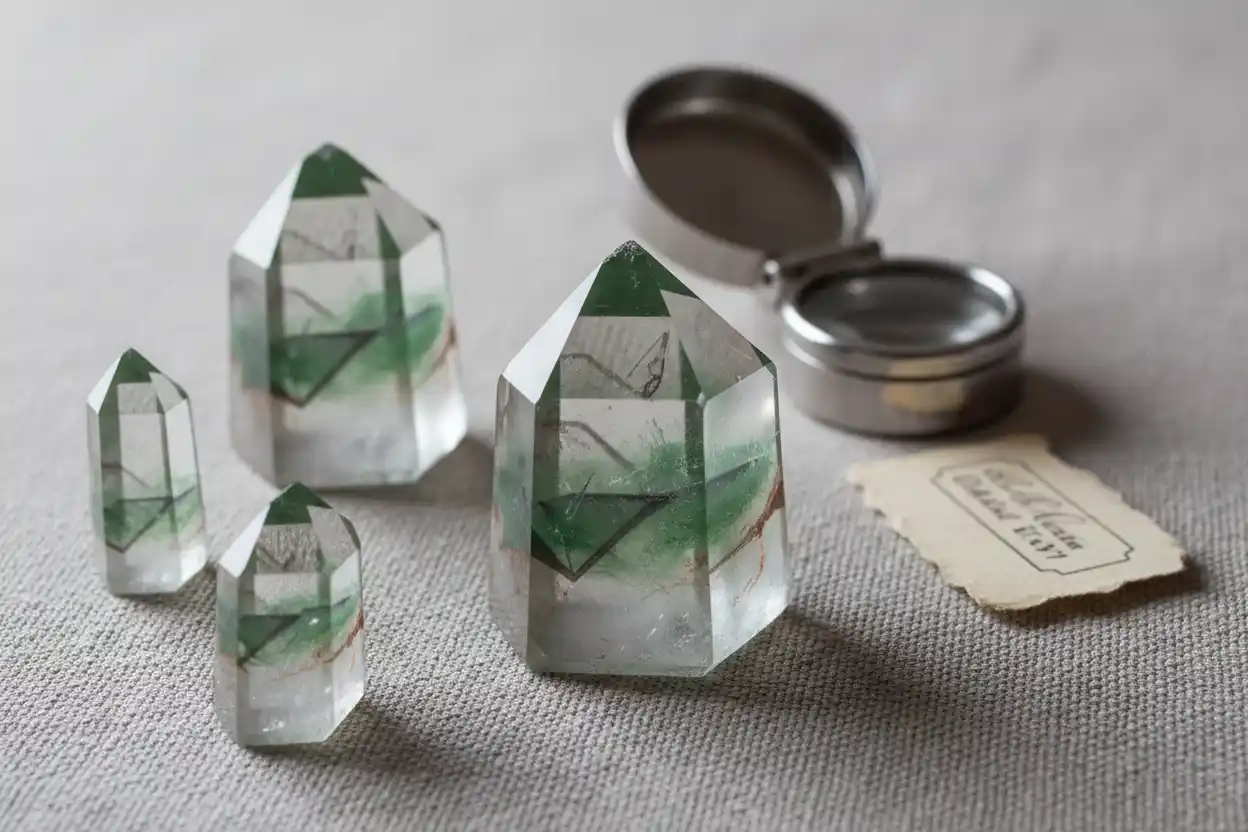
Where to Buy Real Phantom Quartz and Avoid Artificial Phantoms
Real Phantom Quartz contains one or more visible internal outlines that trace an earlier stage of the crystal’s growth. Each phantom formed when material settled on an existing quartz surface, crystal growth paused or conditions changed, and later quartz enclosed that earlier form.
The resulting outline may appear green, white, gray, black, brown, red, golden, smoky or purple. It can be sharp and complete or partial and irregular.
Not every included quartz crystal is Phantom Quartz. Random mineral clouds, scenic Garden Quartz inclusions, fracture staining, chevron color bands and ordinary internal veils do not automatically represent an earlier crystal surface.
The Phantom Quartz meaning and properties guide covers identity and traditional symbolism. This guide focuses on authentic growth outlines, sellers, natural-versus-artificial inclusions, treatment, value and selecting a crystal whose internal structure supports the name.
How a Quartz Phantom Forms
Quartz grows by adding material to its external crystal faces.
If growth conditions change, another mineral, fine sediment, fluid-related material or a layer of differently colored quartz can settle on those surfaces.
When quartz growth resumes, the earlier coated surface becomes enclosed inside the expanding crystal. Its outline preserves the shape of a previous termination or growth stage.
A complete phantom commonly resembles a smaller quartz point nested inside the larger host.
Several interruptions can produce stacked or multiple phantoms. Their outlines may repeat the same general crystal geometry at progressively larger scales.
The quartz family guide provides broader formation context, while the Clear Quartz guide covers the colorless host.
A Phantom Must Trace Earlier Crystal Geometry
The defining feature is not simply an internal inclusion.
A convincing phantom should follow part or all of an earlier quartz crystal surface, often including sloping termination faces and sometimes prism boundaries.
The outline can be uneven because deposition may cover one side more heavily than another. A partial phantom can therefore be natural.
However, a random cloud, isolated mineral grain or horizontal layer with no relationship to crystal geometry is better described as included quartz.
The types of Clear Quartz guide places phantoms among other growth and inclusion varieties.
Choose the Product Form Before Shopping
| Phantom Quartz product | Best source | Main buying concern |
|---|---|---|
| Natural single crystal | Specialist mineral dealer | Natural termination, clear phantom geometry and condition |
| Multiple-phantom point | Included-quartz specialist | Distinct growth stages, repairs and image editing |
| Matrix specimen | Mineral dealer | Glued crystals, provenance and specimen stability |
| Partly polished crystal | Lapidary or mineral dealer | Which faces are natural and whether polishing altered the outline |
| Cabochon | Included-quartz specialist | Phantom visibility, backing, filler and construction |
| Faceted collector gem | Specialist gem dealer | Inclusion orientation, fractures and natural origin |
| Sphere | Experienced lapidary retailer | Artificial layers, assembly seams and weak reverse view |
| Carved tower | Seller with exact-item video | Natural phantom rough versus printed or inserted material |
| Pendant | Independent jeweler | Drilling, glue and internal fracture stability |
| Bulk parcel | Established wholesaler | Ordinary included quartz mixed with genuine phantoms |
Natural crystal points provide the clearest relationship between the outer shape and the enclosed earlier growth form.
Where to Buy Genuine Phantom Quartz
Specialist mineral dealers
A mineral dealer should describe the host quartz, phantom material, locality, condition and any repair.
Request photographs of every prism face, termination and the base.
A good seller should distinguish an observation from a laboratory identification. “Green inclusion layer consistent with chlorite” is more credible than naming several minerals solely from color.
Ask whether the crystal was acid-cleaned, polished, repaired or mounted.
Included-quartz specialists
Dealers who work with Garden Quartz, Rutilated Quartz and Tourmalinated Quartz should understand different inclusion geometries.
They should be able to explain why the internal layer qualifies as a phantom rather than a random inclusion scene.
The completed guide to buying genuine Garden Quartz owns scenic inclusions, inserted material and Lodolite trade terminology.
Gem and mineral shows
Shows allow direct comparison with ordinary included quartz, Garden Quartz, Chevron Amethyst, synthetic quartz and assembled products.
Rotate the crystal over both light and dark backgrounds. The phantom should maintain a coherent three-dimensional relationship with the host.
Use a loupe to inspect drilled channels, resin, seams and color concentrations. Do not scratch or heat the stone.
The crystal identification guide explains safer methods based on morphology, microscopy and instrumental evidence.
Established online sellers
The online gemstone buying guide covers seller verification, protected payments and return policies.
Request a continuous rotation rather than one backlit photograph. Backlighting can make an incomplete or diffuse inclusion layer appear sharper than it is.
Ask whether the item is photographed wet, oiled or digitally sharpened.
Exact-item images are essential because one crystal’s phantom cannot represent another’s geometry.
Independent lapidaries and jewelers
A cutter may know whether the phantom continued through the rough and whether resin entered surface-reaching fractures.
For cabochons and pendants, request photographs before setting.
A dark backing can make a pale phantom more visible. It should be disclosed because the appearance may change when the stone is removed from the mount.
What Genuine Phantom Quartz Looks Like
Natural phantoms can appear as:
- A complete internal quartz-point outline
- A partial termination outline
- Several nested internal crystals
- One-sided deposition on an earlier growth plane
- Thin clouds following sloping crystal faces
- Mineral crystals arranged along a former surface
- Smoky, purple or milky growth zones tracing earlier geometry
The host may be clear, smoky, Amethyst, milky or partly included.
A sharp phantom can have clean boundaries, while diffuse material may produce a softer ghost-like outline.
The phantom should have depth. As the crystal rotates, its front and back surfaces should move relative to the outer quartz.
An internal layer can touch the outer surface if later growth was incomplete or the crystal was cut. Surface access does not automatically mean the feature is artificial.
Green Phantom Quartz
Green phantoms are commonly attributed to chlorite or related green silicate inclusions.
However, not every green layer consists of chlorite. Fluorite and other minerals have also been documented on phantom planes within quartz.
The exact inclusion should be identified through Raman spectroscopy or another suitable method when its composition affects value.
A seller should not use “chlorite phantom” as a certainty based only on green color.
Red, Brown and Golden Phantoms
Red, orange, brown and yellow phantom layers may involve Hematite, Goethite, clay-rich material or other iron-bearing phases.
The Hematite guide and Goethite guide provide context for common iron-mineral possibilities.
Color does not provide a complete mineral identification. A reddish layer can contain more than one phase.
Natural iron staining may also enter fractures without tracing an earlier crystal form. Geometry remains essential.
White and Milky Phantoms
White or pale phantoms may result from fine inclusions, cloudy growth zones, fluid inclusions or microscopic structures.
A genuine white phantom should still reflect earlier quartz morphology.
Random milky clouds that lack sloping termination boundaries are better described as internal zoning or included quartz.
Smoky Phantom Quartz
Smoky Quartz can contain internal darker growth outlines or color zones.
A smoky phantom may record a previous growth stage, but ordinary smoky color zoning does not automatically qualify.
Artificial irradiation can deepen quartz color, so natural phantom structure and color treatment should be considered separately.
The Smoky Quartz buying guide owns the broader natural-color and treatment market.
Amethyst Phantom Quartz
Amethyst can show internal purple growth stages.
A true phantom follows an earlier crystal shape. By contrast, Chevron Amethyst commonly shows repeated V-shaped white-and-purple bands related to growth zoning.
The completed guide to buying Chevron Amethyst owns band quality, dye and Dream Amethyst trade terminology.
A chevron pattern cut from massive Amethyst should not be sold as one naturally terminated Phantom Quartz crystal.
Phantom Quartz Versus Garden Quartz
Garden Quartz contains scenic inclusions that may resemble landscapes, moss or underwater environments.
Phantom Quartz is defined more narrowly by an earlier crystal outline.
One crystal can show both features. For example, chlorite may form a distinct phantom while additional inclusions create a broader garden scene.
The seller should identify the observable features rather than stacking names without explanation.
Phantom Quartz Versus Rutilated Quartz
Rutilated Quartz contains needle-like rutile inclusions.
Rutile can occur along a growth plane, but scattered needles do not form a phantom unless their arrangement traces an earlier crystal surface.
The future guide to buying Rutilated Quartz will own needle identity, inserted wires and treatment.
Phantom Quartz Versus Tourmalinated Quartz
Tourmalinated Quartz contains Tourmaline crystals, commonly black Schorl.
A layer of Tourmaline inclusions can follow a growth stage, although most commercial Tourmalinated Quartz displays individual needles or rods rather than a complete phantom.
The future guide to buying Tourmalinated Quartz will address inserted needles and Tourmaline-specific identification.
Phantom Quartz Versus Lemurian Quartz
Lemurian Quartz is a trade name applied to selected natural quartz points with pronounced surface striations and related morphology.
The completed guide to buying real Lemurian Quartz owns natural surface lines, engraving and synthetic quartz concerns.
A Lemurian-labeled point may contain a phantom, but external striations do not create one.
Natural Phantoms Versus Artificial Layers
Artificial color can be introduced along fractures or into drilled cavities.
A straight cylindrical channel, polished plug or inclusion layer ending at adhesive suggests manipulation.
Flat pigment sheets can also be enclosed between two joined quartz or glass pieces.
Natural phantoms should follow three-dimensional crystal geometry and show plausible relationships with quartz growth.
Perfectly flat decorative layers unrelated to termination faces deserve scrutiny.
Assembled Doublets and Spheres
Two quartz pieces can be joined around mineral powder, pigment or a thin decorative layer.
Spheres can also be constructed from two hemispheres.
Inspect the full circumference for a straight seam. Under magnification, adhesive may contain bubbles or show a different refractive appearance.
An assembled object can be sold honestly as a composite, but it should not be described as one naturally grown Phantom Quartz crystal.
Glass and Resin Imitations
Glass can contain suspended color layers, bubbles and swirls that imitate phantoms.
Round bubbles, flow lines, mold seams and a lack of quartz optical behavior support glass.
Resin can suspend pigment, mineral fragments or printed structures. Casting seams, soft scratches and repeated internal forms suggest polymer construction.
The fake-crystal buyer’s guide provides broader checks for glass, resin and composites.
Natural Versus Synthetic Quartz
Hydrothermal synthetic quartz has the same essential composition and structure as natural quartz.
Synthetic quartz can show growth zoning, seed-related features and deliberately introduced inclusions.
Therefore, a visible internal outline does not by itself prove natural origin.
The treated or synthetic Clear Quartz guide owns the detailed natural-versus-synthetic workflow. The real-versus-fake Clear Quartz guide covers glass and broad identity checks.
Microscopy and infrared spectroscopy may be necessary for expensive, unusually clean or suspiciously uniform crystals.
Dye, Coating and Fracture Filling
Dye can enter surface-reaching phantom layers and strengthen their green, red, purple or black color.
Artificial color may be strongest near the surface and fade inward.
A coating over the outer crystal does not create an internal phantom but can change the host’s apparent color and contrast.
Clear resin may fill fractures and make the phantom easier to view. Colored filler can also imitate an inclusion layer.
The gemstone treatments guide explains coating, filling and assembly terminology.
Natural Point Versus Carved Tower
A natural quartz point grew with its existing prism and termination faces.
A carved tower has polished sides, a cut base and a manufactured point.
A tower may be cut from genuine Phantom Quartz rough, so it is not automatically fake. However, the outer form is lapidary-made.
Ask whether the phantom existed in the rough and whether any surface lines or colored layers were added after cutting.
How to Evaluate a Natural Crystal
Outer crystal form
Inspect the prism faces, termination and base for natural growth features, polishing and repair.
Phantom geometry
Determine whether the internal layer traces an earlier termination or crystal surface.
Depth
Rotate the stone and observe how the phantom shifts relative to the host.
Completeness
A full phantom may carry a premium, but partial natural outlines are also valid.
Contrast
The phantom should be visible without extreme backlighting or digital sharpening.
Fractures
Check whether cracks reach the surface or threaten the termination.
Inclusion identity
Treat precise mineral names cautiously unless testing supports them.
Locality
Request source records rather than inferring origin from color.
How to Evaluate Multiple Phantoms
Several nested outlines can create a staircase or repeated internal-crystal effect.
The layers should remain geometrically related. Their spacing may vary because growth rates and interruptions changed.
Perfectly uniform printed-looking layers deserve scrutiny.
Multiple phantoms generally command more interest when they remain distinct, attractive and visible from several angles.
Buying Cabochons and Faceted Gems
A cabochon should orient the phantom so its geometry remains visible face-up.
Inspect the back for backing, dye and filler. A dark support can strengthen a pale outline dramatically.
Faceted stones may fragment the internal image through multiple reflections. They are best treated as collector gems rather than conventional transparent jewelry stones.
Request videos from several angles because one still photograph can hide windowing or fractures.
Buying Spheres and Carvings
Request a complete rotation. One side may reveal a distinct phantom while the reverse looks like ordinary included quartz.
A sphere should have no equatorial assembly seam.
A carving should show that the phantom continues naturally through the body rather than stopping at a surface-applied layer.
Ask whether resin fills cavities or fractures.
Buying Beads and Jewelry
Small Phantom Quartz beads may contain only partial growth outlines.
Natural strands should vary rather than repeating identical miniature internal points.
Inspect drill holes for dye, filler and radial fractures.
Quartz has Mohs hardness 7, but internal cracks affect toughness. The gemstone hardness chart and toughness-versus-hardness guide explain the distinction.
Pendants are more practical than exposed rings for highly fractured stones.
Locality and Provenance
Phantom Quartz occurs in many quartz-producing regions.
Commercial material is associated with Brazil, Madagascar, China, the United States, Canada, Switzerland, Romania and other sources.
Certain inclusion minerals and habits may be characteristic of particular deposits, but appearance alone rarely proves a locality.
A mine-level premium requires labels, invoices or a reliable dealer chain.
The ethical crystal sourcing guide provides practical questions about legal extraction, labor and traceability.
Price and Value
Phantom Quartz has no standardized grading scale.
Value depends on:
- Clear phantom geometry
- Completeness
- Number of growth outlines
- Contrast
- Host transparency
- Inclusion color
- Natural crystal form
- Size
- Condition
- Treatment
- Locality and provenance
- Cutting quality
A small crystal with one sharp complete phantom may be more desirable than a large cloudy point with several indistinct layers.
Unsupported claims that a phantom contains rare minerals should not create a premium.
The gemstone pricing guide explains how evidence, rarity and cutting affect retail value.
Questions to Ask the Seller
Ask how the internal feature traces an earlier crystal surface.
Request the seller’s evidence for any named inclusion mineral.
Confirm whether the host quartz is natural or synthetic and whether the point is natural, polished or carved.
Ask about dye, coating, resin, fracture filling, drilling, assembly and repair.
Request photographs of every outer face, the termination and base. For spheres or cabochons, obtain a complete rotation and edge views.
Finally, confirm that the return policy allows magnified and gemological inspection.
Professional Identification
Standard gemological testing can confirm quartz and distinguish it from most glass and resin.
Microscopy is central to evaluating phantom geometry, mineral deposition, drilled channels, filler and synthetic growth features.
Raman spectroscopy can identify many solid inclusions, although several layers may require separate measurements.
Infrared spectroscopy may assist with synthetic quartz and resin detection.
A report identifying natural quartz does not automatically confirm every inclusion name, natural color or locality claim.
Cleaning and Storage
Clean sound untreated Phantom Quartz with lukewarm water, mild soap and a soft cloth.
Avoid prolonged soaking when fractures, dye, filler or glue are present.
Do not use ultrasonic or steam cleaning on heavily included, repaired or assembled pieces.
Store natural points separately so their terminations cannot strike one another.
Frequently Asked Questions
1. What makes quartz a Phantom Quartz?
It must contain an internal outline tracing an earlier stage of the crystal’s growth.
2. Is every included quartz crystal a phantom?
No. Random clouds, needles, landscapes and fractures do not qualify unless they follow earlier crystal geometry.
3. Can a phantom be partial?
Yes. Deposition may cover only part of the earlier crystal surface.
4. What minerals create green phantoms?
Chlorite is commonly cited, but Fluorite and other minerals can also occur. Testing is needed for precise identification.
5. What creates red or brown phantoms?
Iron-bearing minerals such as Hematite or Goethite may contribute, although composition varies.
6. Is Phantom Quartz the same as Garden Quartz?
No. Garden Quartz emphasizes scenic inclusions, while Phantom Quartz preserves an earlier crystal outline. One stone can show both.
7. Is Chevron Amethyst a Phantom Quartz?
Not automatically. Chevron Amethyst commonly shows V-shaped color zoning rather than one enclosed earlier crystal surface.
8. Can synthetic quartz contain phantom-like growth features?
Yes. Laboratory-grown quartz can show zoning and introduced inclusions, so natural origin must be verified separately.
9. Can artificial phantoms be inserted?
Yes. Pigment, fragments or decorative layers can be placed through drilled channels or between assembled pieces.
10. Is a carved Phantom Quartz tower fake?
The quartz and phantom may be natural, but the tower shape is manufactured and should be disclosed.
11. Do ordinary crystals need laboratory reports?
Usually not. Testing is more useful for expensive specimens, rare inclusion claims or suspected synthetic and assembled material.
12. What is the biggest warning sign in a listing?
Be cautious when a perfectly flat colored layer has no relationship to quartz crystal geometry and ends at a seam, plug or drilled channel.
Buy the Earlier Crystal Outline, Not Merely an Inclusion
Phantom Quartz should preserve a recognizable stage of crystal growth. Its internal feature needs geometry, depth and a plausible relationship with the outer quartz.
The P crystal directory, P gemstone directory and visual gemstone guide provide wider comparisons. Choose the specimen whose phantom remains coherent from several angles without relying on extreme lighting or unsupported mineral claims.
Safety note: Quartz contains crystalline silica. Cutting, drilling, sanding or grinding can create hazardous respirable silica dust. Never dry-work quartz; use professional wet methods, effective local extraction and suitable respiratory and eye protection.