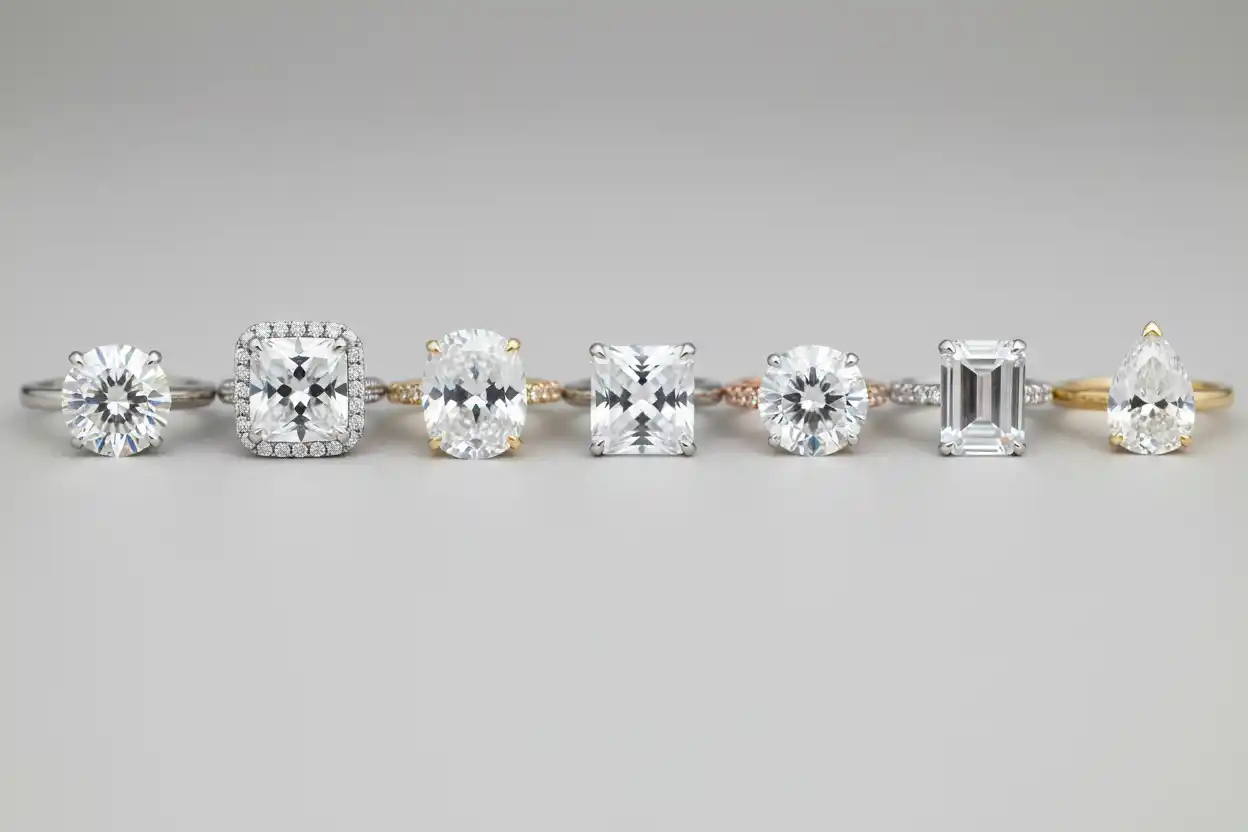
White Gemstones for Engagement Rings: Best Stones Compared
White gemstones for engagement rings range from highly durable Diamond and Sapphire to brilliant simulants, natural collector gems and soft ornamental stones that require protective settings. The best choice depends on how often the ring will be worn, the desired sparkle, the available budget and whether natural origin matters to the buyer.
In gemological terms, many stones marketed as white are actually colorless or near-colorless. A transparent Diamond, Moissanite or White Sapphire transmits light without a strong body color, while White Opal, White Jade and Moonstone have genuinely pale or milky bodies.
No single white stone replaces Diamond in every respect. Some alternatives offer more fire, lower prices or distinctive optical effects, while others need more maintenance or protection.
The broader best gemstones for engagement rings guide compares durable stones across all colors. This page focuses specifically on white and colorless center stones without duplicating the dedicated guides for Diamond, Moissanite, Sapphire and other individual gems.
Best White Engagement-Ring Stones at a Glance
| Stone | Mohs hardness | Everyday suitability | Visual character | Main buying concern |
|---|---|---|---|---|
| Natural Diamond | 10 | Excellent | High brilliance, fire and scintillation | Grading, origin, treatment and price |
| Laboratory-grown Diamond | 10 | Excellent | Same fundamental optical character as Diamond | Clear origin disclosure and long-term pricing |
| Moissanite | About 9.25 | Excellent | Very high brilliance and strong rainbow fire | Double refraction, warmth and accurate identity |
| White Sapphire | 9 | Very good | Bright but softer-looking than Diamond | Cut quality, treatment and synthetic material |
| Colorless Spinel | 8 | Good | Clean, crisp and moderately brilliant | Natural colorless material is uncommon |
| Colorless Zircon | 6–7.5 | Moderate | Strong brilliance and noticeable fire | Brittleness, abrasion and CZ confusion |
| White Topaz | 8 | Moderate | Bright, glassy and understated | Perfect cleavage and rapid surface wear |
| Goshenite | 7.5–8 | Moderate | Clear, subtle and elegant | Low brilliance and treatment disclosure |
| Rock Crystal Quartz | 7 | Moderate | Clean, understated and widely available | Scratching, inclusions and glass substitution |
| Cubic Zirconia | About 8–8.5 | Moderate | Strong initial brilliance and fire | Abrasion, clouding and simulant disclosure |
| White Moonstone | 6–6.5 | Limited | Floating blue, silver or white sheen | Cleavage and surface scratching |
| White Opal | About 5.5–6.5 | Limited | Milky body with possible play-of-color | Crazing, impact and heat sensitivity |
| White Jade | About 6–7 | Good for cabochons | Smooth, waxy or vitreous appearance | Correct Jade species and treatment |
| Pearl | About 2.5–4.5 | Poor for daily rings | Soft nacreous luster | Abrasion, chemicals and organic surface wear |
Hardness measures scratch resistance rather than the complete durability of a ring stone. Cleavage, brittleness, internal fractures, stability and setting design also matter.
The gemstone hardness chart explains scratch resistance, while the gemstone toughness-versus-hardness guide separates hardness from resistance to breaking. The gemstone cleavage guide explains why even a hard stone can chip in a vulnerable direction.
Natural Diamond
Natural Diamond remains the most established white engagement-ring stone because it combines exceptional scratch resistance, strong brilliance, useful toughness and widespread grading standards.
Diamond reaches 10 on the Mohs scale, although this does not make it indestructible. Sharp impacts can chip corners, girdles and areas near cleavage directions.
A natural Diamond’s value depends heavily on the traditional four quality factors:
- Cut
- Color
- Clarity
- Carat weight
Cut has the strongest direct effect on face-up brightness and sparkle. A well-cut smaller Diamond can appear livelier than a larger poorly proportioned stone.
Colorless and near-colorless Diamonds are graded through the D-to-Z system when an appropriate grading report is used. D represents the highest colorless grade, although many near-colorless stones appear white once mounted.
The Diamond buying guide owns the full grading and seller workflow, while the Diamond engagement-ring guide covers shapes, settings and purchase decisions.
Choose a grading report from a reputable independent laboratory for a significant natural Diamond. Verify that the report number, measurements and inscription match the actual stone.
Laboratory-Grown Diamond
A laboratory-grown Diamond is Diamond produced through controlled technological processes rather than mined from Earth.
It has essentially the same chemical composition, crystal structure and fundamental optical properties as natural Diamond. It is not Cubic Zirconia, Moissanite or glass.
Laboratory-grown Diamonds provide:
- Diamond hardness
- Familiar Diamond brilliance
- Broad availability in colorless grades
- Larger apparent size for a given initial budget
- Independent grading options
- A clear distinction from mining-based origin
However, buyers should consider long-term pricing and resale expectations. Laboratory production can expand supply, and retail prices may change more quickly than prices for comparable natural stones.
The seller must describe the origin clearly as laboratory-grown or laboratory-created. The word Diamond should never appear in a way that implies mined origin when the stone was produced in a laboratory.
The laboratory-grown Diamond buying guide covers growth processes and reports. The laboratory-grown Diamond engagement-ring guide addresses ring-specific choices.
Moissanite
Moissanite used in modern jewelry is laboratory-created silicon carbide.
It is one of the most durable and visually dramatic Diamond alternatives. Its hardness is approximately 9.25, while its strong brilliance and dispersion create abundant rainbow flashes.
Moissanite generally displays more spectral fire than Diamond. Some buyers love this colorful appearance, while others prefer Diamond’s balance of white light, fire and scintillation.
Larger colorless Moissanite may show:
- Strong rainbow flashes
- Slightly warm, gray or greenish impressions in certain lighting
- Visible doubling of some facet edges
- A different pattern of scintillation from Diamond
- Greater apparent spread at certain weights
Moissanite is not a laboratory-grown Diamond. It is a separate synthetic gemstone and Diamond simulant.
The Moissanite buying guide covers quality and grading. The Moissanite engagement-ring guide owns shapes, settings and ring construction.
The detailed Moissanite, natural Diamond and laboratory-grown Diamond comparison helps buyers choose among the three categories.
White Sapphire
White Sapphire is colorless or nearly colorless Corundum.
With Mohs hardness 9 and generally good toughness, it is one of the strongest natural Diamond alternatives for everyday rings.
White Sapphire has less dispersion and usually less brilliance than Diamond or Moissanite. Its sparkle can appear calmer, softer and more silvery.
Cut quality matters significantly. A poorly cut Sapphire may show a large transparent window through the center, while a well-cut stone returns more light.
Natural White Sapphire may contain:
- Fine needles
- Crystals
- Color zoning
- Feathers
- Fingerprints
- Growth structures
Synthetic White Sapphire is also widely available. It has essentially the same composition and properties as natural Sapphire but requires clear origin disclosure.
Heat treatment may be used on Sapphire, although colorless stones have different market considerations from strongly colored varieties. A report is useful when natural origin, treatment and value matter.
The Sapphire engagement-ring guide owns family-wide ring suitability and setting design.
Colorless Spinel
Colorless Spinel is a durable natural gemstone with Mohs hardness 8 and generally good toughness.
It can produce clean, crisp brilliance without the strong fire of Diamond or Moissanite.
However, truly colorless natural Spinel is uncommon. Many apparently colorless Spinel stones in inexpensive jewelry are laboratory-grown.
Synthetic Spinel is a legitimate manufactured gem when disclosed correctly. It has also been used historically as an imitation for numerous other gemstones.
A natural colorless Spinel offered at a substantial premium should receive an independent identification report.
Spinel can work well in protected daily rings, particularly in rounded shapes without vulnerable points.
Colorless Zircon
Natural Zircon is frequently confused with Cubic Zirconia, but they are unrelated materials.
Colorless Zircon has high refractive index and strong dispersion, producing attractive brilliance and rainbow fire. Before modern synthetic simulants became widespread, it served as an important natural Diamond substitute.
Its principal limitation is durability. Zircon’s hardness varies, and facet edges can abrade or chip during daily wear.
Strong double refraction can make the rear facets look doubled when viewed through the stone. This feature contributes to its characteristic appearance.
Colorless Zircon may be naturally pale or produced by heating certain brownish material. Treatment disclosure matters.
Choose a protective setting, avoid sharp exposed corners and expect occasional professional repolishing if the ring receives heavy use.
White Topaz
White Topaz is colorless Topaz.
It offers a bright, transparent appearance at a relatively accessible price. However, it has lower brilliance than Diamond, Moissanite and Zircon.
Topaz reaches Mohs hardness 8 but has perfect cleavage. A hard blow in the wrong direction can split the stone.
Surface abrasion also becomes visible over time, particularly around facet junctions.
White Topaz works best for:
- Occasional-wear rings
- Protected bezel or halo settings
- Buyers who prefer subtle sparkle
- Easily replaceable center stones
- Larger designs with modest material cost
Avoid unsupported terms such as white Diamond Topaz. The stone is Topaz rather than Diamond.
Goshenite
Goshenite is colorless Beryl, the same mineral family that includes Emerald, Aquamarine and Morganite.
It has Mohs hardness approximately 7.5 to 8 and can be suitable for careful ring wear.
Goshenite usually has restrained brilliance and low dispersion. Its appeal comes from clarity, natural origin and an elegant glassy appearance rather than Diamond-like fire.
Inclusions and fractures affect durability. Large transparent stones can also show windowing when cut primarily to retain weight.
Colorless Beryl can receive coatings or foil backing to alter its appearance. Treatment and construction should be disclosed.
The Goshenite buying guide covers clarity, cutting and identification in greater detail.
Rock Crystal Quartz
Rock Crystal is the traditional name for colorless Clear Quartz.
The tracker routes Rock Crystal to Clear Quartz rather than treating it as a separate gemstone page.
Quartz has Mohs hardness 7 and is suitable for occasional or careful ring use. It scratches more readily than Diamond, Sapphire and Moissanite, while internal fractures can reduce toughness.
A well-cut colorless Quartz can look clean and understated, although it has significantly less brilliance and fire than the leading engagement-ring stones.
Glass is a common substitute. Large flawless stones should be identified rather than assumed to be natural Quartz.
Rock Crystal suits buyers who value natural inclusions, carved designs or a quiet transparent appearance over intense sparkle.
Cubic Zirconia
Cubic Zirconia is a laboratory-created zirconium oxide material.
It is neither Zircon nor Diamond.
CZ offers strong initial brilliance and dispersion at a very low cost. It is widely available in large calibrated shapes and consistent colorless grades.
Its disadvantages include:
- Faster facet abrasion than Diamond, Sapphire or Moissanite
- Greater tendency to lose a crisp surface appearance
- Higher density than Diamond
- Limited resale value
- Frequent confusion in poorly disclosed listings
CZ can work well as a temporary ring, travel ring, placeholder stone or easily replaceable budget option.
The Moissanite versus Cubic Zirconia guide explains the differences in durability, fire and long-term wear.
White Moonstone
White Moonstone offers a visual effect that Diamond alternatives cannot reproduce.
Its adularescence appears as a floating blue, silver or white light that moves beneath the surface.
Moonstone generally has Mohs hardness around 6 to 6.5 and pronounced cleavage. It can scratch, chip or split under daily ring wear.
Choose Moonstone when:
- The optical glow matters more than brilliance
- The wearer accepts careful maintenance
- The setting has a protective bezel
- The stone sits low on the hand
- Replacement remains financially practical
Avoid open prong settings with exposed girdles and high domes.
Moonstone works better for occasional engagement rings than for continuous hard use.
White Opal
White Opal may have a milky white body with play-of-color or a quieter common-Opal appearance.
Its flashes can create a highly personal and distinctive ring.
However, Opal is softer and more sensitive than the leading white stones. Heat, impact, rapid temperature change and dehydration can cause damage or crazing in susceptible material.
Doublets and triplets contain thin Opal layers attached to backing and sometimes a transparent cap. These constructions are legitimate when disclosed but require different care from solid Opal.
White Opal engagement rings suit careful wearers who accept maintenance, protective settings and possible future replacement.
White Jade
White Jade may be white Nephrite or pale Jadeite.
It does not imitate Diamond. Instead, it offers an opaque-to-translucent body with smooth luster and exceptional cultural significance.
Nephrite is especially tough because of its interlocking fibrous structure. Jadeite can also work well in cabochon rings when untreated and structurally sound.
The main buying concern is identity. Numerous white minerals and rocks are marketed as Jade.
Polymer impregnation, bleaching, dye and assembled material should be disclosed. A significant White Jade purchase should receive a report identifying Jadeite or Nephrite and any detectable treatment.
Pearl
Pearl offers a soft white luster but is generally unsuitable as an exposed everyday engagement-ring center.
Pearl is an organic gem composed primarily of calcium carbonate and organic material. Its surface can be damaged by abrasion, perfume, cosmetics, acids and ordinary household wear.
A Pearl ring works best when:
- Worn occasionally
- Set low
- Protected by a surrounding design
- Cleaned gently
- Removed before washing and cosmetic application
- Treated as replaceable over a lifetime
A buyer choosing Pearl should accept that routine surface wear is part of ownership.
Natural Diamond, Laboratory-Grown Diamond or Moissanite?
These are the three strongest mainstream options for buyers seeking a bright colorless center stone.
Choose natural Diamond when geological rarity, established grading and traditional market identity matter most.
Choose laboratory-grown Diamond when Diamond’s composition and optical performance matter more than mined origin or long-term scarcity.
Choose Moissanite when a lower initial price, strong durability and abundant rainbow fire are priorities.
The laboratory-grown Diamond versus Moissanite guide compares origin, optics, testing and value directly.
None is universally superior. The best choice follows the wearer’s visual preference and priorities rather than one marketing hierarchy.
Choosing the Right Stone for Your Lifestyle
A person who wears a ring continuously should prioritize Diamond, laboratory-grown Diamond, Moissanite or White Sapphire.
Moderately active wearers may consider Spinel, Zircon, Goshenite or Quartz with protective settings.
Moonstone, Opal, Pearl and White Topaz suit buyers who remove jewelry during work, cleaning, exercise and sleep.
Consider the wearer’s daily routine:
- Does the ring contact tools or gym equipment?
- Is frequent handwashing required?
- Does the wearer garden, cook or clean in the ring?
- Are gloves worn over the jewelry?
- Will the ring be removed safely?
- Is professional maintenance acceptable?
- Would replacing the center stone cause distress?
The most beautiful option is not practical when its care requirements conflict with the wearer’s habits.
Shape and Cutting Style
Round brilliant cuts generally protect light return and avoid vulnerable corners.
Oval, cushion and pear shapes provide larger-looking outlines, although pear tips need protection.
Princess, radiant and emerald cuts have corners that can chip if the setting leaves them exposed.
Step cuts emphasize clarity and quiet reflections rather than intense sparkle. They suit Goshenite, White Sapphire and Diamond when the material has adequate clarity.
Cabochons are appropriate for Moonstone, Opal, Jade and Pearl-like designs.
Cut should suit the gemstone’s optical behavior. A Diamond-style brilliant does not automatically improve every white material.
Protective Settings
A bezel surrounds the stone’s edge and provides strong protection. It works especially well for Moonstone, Opal, Topaz, Zircon and cabochon Jade.
A halo can protect the center stone indirectly while increasing visual size.
V-shaped prongs shield pointed corners on princess, pear and marquise shapes.
Low-profile basket settings reduce leverage and snagging.
Thin tension settings and exposed girdles demand durable stones and precise workmanship.
The setting metal should hold the stone securely without applying damaging pressure across cleavage or major inclusions.
Choosing the Metal
Platinum and white gold reinforce a bright white appearance. Yellow and rose gold create visible contrast and may make a slightly warm stone appear intentional.
White metal can emphasize yellow or gray undertones in a near-colorless stone.
Yellow gold can make a warmer Diamond, Moissanite or Sapphire look whiter by comparison.
Rose gold works well with Moonstone, Pearl, White Opal and softer antique-inspired designs.
Metal durability, maintenance and allergy concerns matter alongside color.
Reports and Disclosure
Obtain independent reports when identity, natural origin, treatment or price justifies the cost.
Reports are especially important for:
- Natural Diamond
- Laboratory-grown Diamond
- Natural White Sapphire
- Colorless natural Spinel
- Expensive colorless Zircon
- Premium Jadeite or Nephrite
- Unusually transparent Moonstone
- High-value natural Opal
- Any stone represented as untreated and rare
A seller should disclose whether a stone is natural, laboratory-grown, synthetic, imitation, composite or treated.
The gemstone treatments guide explains how heat, filling, coating, dye and irradiation affect buying decisions.
Budget and Long-Term Value
Initial price and long-term value are separate questions.
Natural Diamond generally has the strongest established secondary market, although resale is often lower than retail.
Laboratory-grown Diamond provides more size at a lower initial cost but may have less predictable resale value.
Moissanite and CZ should be purchased primarily for wear rather than investment.
Natural White Sapphire, Zircon, Spinel and Goshenite can hold collector or jewelry value when quality and provenance are strong, but they do not have Diamond’s standardized market.
The gemstone pricing guide explains why retail markup, reports, treatments and resale conditions affect outcomes.
Ethical and Sourcing Questions
Ethical considerations differ among mined, laboratory-grown and manufactured stones.
Ask mined-stone sellers about origin, supply-chain documentation and cutting labor.
Ask laboratory-grown sellers about the producer, growth method, energy disclosures and factory location.
Avoid assuming that every mined stone is unethical or every laboratory product has minimal environmental impact. Both categories require evidence.
The ethical gemstone sourcing guide provides a wider due-diligence framework.
Frequently Asked Questions
1. What is the best white gemstone for an everyday engagement ring?
Natural Diamond, laboratory-grown Diamond, Moissanite and White Sapphire offer the strongest overall combination of scratch resistance and practical durability.
2. Which white stone looks most like Diamond?
Laboratory-grown Diamond is Diamond. Among simulants, Moissanite and Cubic Zirconia create the closest mainstream visual alternatives, though each has different optics.
3. Is Moissanite a fake Diamond?
No. Moissanite is a separate laboratory-created gemstone used as a Diamond alternative and should be sold under its own name.
4. Is White Sapphire durable enough for daily wear?
Yes. White Sapphire has Mohs hardness 9 and generally good durability, provided the stone and setting are structurally sound.
5. Is colorless Zircon the same as Cubic Zirconia?
No. Zircon is a natural mineral, while Cubic Zirconia is a laboratory-created zirconium oxide simulant.
6. Does White Topaz make a good engagement ring?
It can work for careful or occasional wear, but cleavage and surface abrasion make it less durable than Diamond, Sapphire or Moissanite.
7. Is Goshenite suitable for an engagement ring?
Yes, with reasonable care and a protective setting. Its appearance is subtler and less brilliant than Diamond.
8. Can Moonstone be worn as an engagement ring?
It can, but it needs a low protective setting and careful wear because cleavage and low hardness increase damage risk.
9. Is White Opal suitable for daily wear?
Usually not for unrestricted daily wear. It requires protection from impact, heat, dehydration and rapid temperature changes.
10. Should a laboratory-grown Diamond have a report?
A report is strongly recommended for significant purchases because it verifies that the stone is Diamond, identifies laboratory origin and records quality characteristics.
11. Which white engagement-ring stone is most affordable?
Cubic Zirconia usually has the lowest initial cost. White Topaz, Goshenite, Quartz and some White Sapphires can also be affordable.
12. What is the most important question to ask before buying?
Ask for the stone’s exact identity, whether it is natural or laboratory-created, all known treatments and the return policy for independent verification.
Match the Stone to the Marriage and the Wearer
A white engagement-ring stone should fit the wearer’s daily life as well as the design. Diamond, laboratory-grown Diamond, Moissanite and White Sapphire serve demanding routines, while Moonstone, Opal, Pearl and Topaz reward more deliberate wear.
The complete white gemstones guide provides wider names, meanings and uses. Choose the center stone whose appearance, origin, maintenance and price remain comfortable after the proposal photographs are over.