

People often ask, “What is my angel number?” The answer depends on what they mean by a personal angel number.
In modern spiritual practice, your angel number may be the sequence you repeatedly notice in everyday life, such as 111, 444 or 1212. In numerology-based approaches, it may instead be calculated from your full birth date, the day of the month you were born or the letters in your name.
There is no universally accepted method and no official angel-number calculator. These approaches come from different numerology and spiritual traditions, so they can produce different results without one necessarily being “wrong.”
The four most common methods are:
- Track the number you repeatedly encounter.
- Calculate a number from your full birth date.
- Reduce the day of the month you were born.
- Calculate a number from the letters in your name.
The first method identifies a sequence connected with your current experiences. The other three produce stable personal numerology numbers that some people informally call angel numbers.
Before calculating anything, it helps to understand what angel numbers are and how they are read.
Can You Really Have a Personal Angel Number?
You can choose to treat a recurring or calculated number as personally meaningful, but there is no scientific test that identifies one official angel number for each person.
The phrase “my angel number” is commonly used for several different ideas:
- The number you keep seeing
- A number calculated from your birth date
- The reduced number of your birth day
- A number calculated from your name
- A sequence connected with an important date
- A number you associate with a meaningful life event
- A favorite or intuitively significant number
These methods do not measure the same thing.
A recurring number may change as your attention and circumstances change. A birth-date number remains fixed. A name number may change when you use a different name, spelling or professional identity.
For that reason, it is better to ask:
Which type of personal number am I trying to find?
The Four Methods at a Glance
| Method | What you use | Typical result | Best understood as |
|---|---|---|---|
| Recurring-sequence method | Numbers encountered in daily life | 111, 444, 1212 or another sequence | A current reflective pattern |
| Full-birth-date method | Month, day and year of birth | Usually 1–9, 11, 22 or 33 | A stable numerology number |
| Birth-day method | Day of the month you were born | Usually 1–9, 11 or 22 | A simplified birthday number |
| Name-number method | Letters in a chosen name | Usually 1–9, 11, 22 or 33 | A name-based numerology number |
You may calculate all four, but avoid combining them into one complicated message. Each method has a different purpose.
Method 1: Find the Number You Keep Seeing
The most direct way to find an angel number is to identify the sequence that repeatedly attracts your attention.
This method does not use your date of birth or name. It begins with real-world sightings.
Your recurring sequence may appear on:
- Digital clocks
- Receipts
- Order totals
- License plates
- Addresses
- Phone numbers
- Tickets
- Account balances
- Page numbers
- Dates
- Social-media statistics
Common examples include:
- 000
- 111
- 222
- 444
- 555
- 1010
- 1111
- 1212
- 1234
Step 1: Record the Complete Sequence
Write down the number exactly as it appeared.
Do not turn:
- 11:10 into 111
- 12:21 into 1212
- 10:01 into 101
- 4447 into 444
Similar-looking patterns may have different structures. Interpreting the exact sequence prevents you from adjusting a number to fit the meaning you want.
Step 2: Note Where It Appeared
Record whether you saw the sequence on:
- A clock
- A receipt
- An address
- A vehicle
- A document
- A screen
- Another numerical display
Location can reveal whether routine exposure is contributing to the pattern.
For example, repeatedly seeing 11:11 may be connected with checking your phone during the same daily break. The guide to seeing angel numbers on clocks explains why patterned times are especially noticeable.
Step 3: Record the Context
Write down:
- What you were doing
- What you were thinking about
- How you felt
- Whether you deliberately checked
- Whether you expected to see the number
A simple record might look like this:
| Date | Number | Location | Thought or situation | Expected it? |
|---|---|---|---|---|
| Monday | 444 | Receipt | Worried about moving costs | No |
| Wednesday | 4:44 | Phone | Planning the move | Partly |
| Friday | 444 | Order number | Reviewing housing options | No |
The context may show why the sequence has become personally meaningful.
Step 4: Track It for at Least Two Weeks
One or two sightings may be coincidence. A short log gives you a more accurate picture of frequency.
Track both matching and non-matching observations. Otherwise, you may remember only the appearances that support your expectations.
After two to four weeks, ask:
- Does one exact number recur?
- Does it appear mainly in one place?
- Is it connected with one concern?
- Do sightings increase when I actively check?
- Am I counting partial matches?
- Does the number still appear when I stop looking for it?
The article explaining why you keep seeing angel numbers covers selective attention, pattern recognition and spiritual interpretations in more depth.
Step 5: Look Up the Exact Pattern
Once you identify the recurring sequence, use the complete Angel Numbers List to find its dedicated guide.
Do not combine several unrelated meanings immediately. Start with the exact number and compare its broad symbolism with your actual situation.
Example
Suppose you record repeated sightings of 555 while preparing to leave a job.
Five is commonly associated with movement, transition and adaptability. The sequence may therefore feel relevant to the change you are already considering.
A grounded interpretation would not be:
Seeing 555 means I must resign immediately.
A more useful interpretation would be:
Change is already on my mind. What preparation would help me make a responsible decision?
You might then review your finances, update your résumé or research alternatives.
The number creates a reflective pause. It does not make the decision.
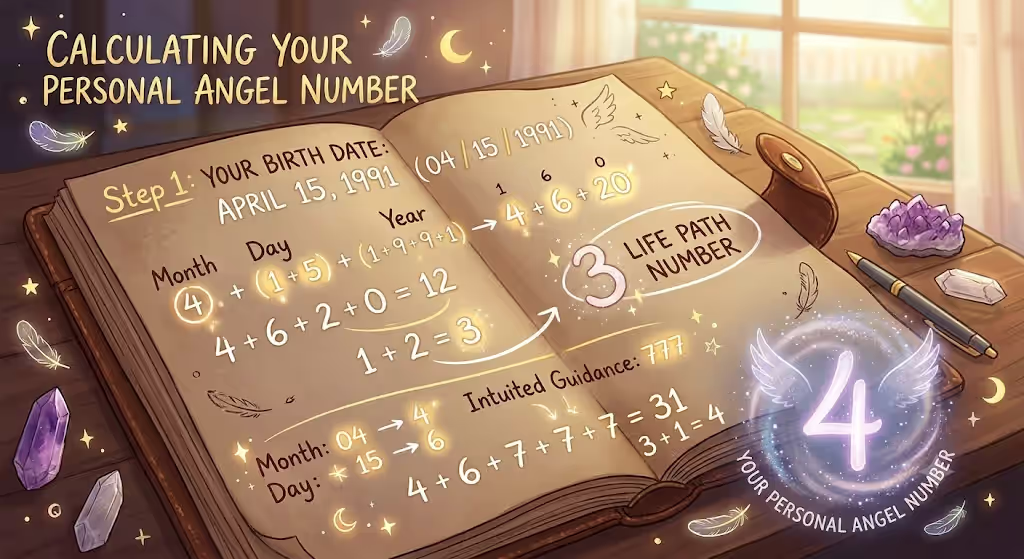
Method 2: Calculate a Number From Your Full Birth Date
A second approach uses every digit in your date of birth.
This calculation resembles the life-path method used in numerology. Some websites call the result a birth angel number, although traditional numerologists may use different terminology.
The Formula
Add every digit in your birth date:
Birth-date number = month digits + day digits + year digits
Continue adding the digits of the result until you reach:
- A single number from 1 to 9, or
- A master number such as 11, 22 or 33, when using a system that preserves them
Example 1: Single-Digit Result
Suppose the birth date is October 14, 1996.
Write it numerically:
10/14/1996
Add every digit:
1 + 0 + 1 + 4 + 1 + 9 + 9 + 6 = 31
Reduce 31:
3 + 1 = 4
The full-birth-date number is 4.
Four is broadly associated in numerology with stability, structure, discipline and practical foundations.
Example 2: Master-Number Result
Suppose the birth date is July 24, 1991.
Write it numerically:
07/24/1991
Add the digits:
0 + 7 + 2 + 4 + 1 + 9 + 9 + 1 = 33
Some numerology systems stop at 33 because it is treated as a master number.
Other systems reduce it further:
3 + 3 = 6
Depending on the method, the result may therefore be written as:
- 33
- 33/6
- 6
Choose one convention and apply it consistently.
An Alternative Calculation Style
Some numerologists reduce the month, day and year separately before adding them.
Using October 14, 1996:
Month:
1 + 0 = 1
Day:
1 + 4 = 5
Year:
1 + 9 + 9 + 6 = 25
2 + 5 = 7
Then add:
1 + 5 + 7 = 13
1 + 3 = 4
The result is still 4 in this example.
However, methods may produce different master-number results depending on when reduction occurs. This is another reason there is no single universal angel-number formula.
What Your Full-Birth-Date Number Represents
This number is usually interpreted as a broad life theme rather than a sequence currently being sent to you.
It may be associated with:
- Natural tendencies
- Recurring lessons
- Decision-making style
- Personal development
- Long-term direction
Because your birth date does not change, this result remains stable.
That makes it different from a recurring angel number, which may appear only during one stage of life.
Method 3: Calculate Your Birth-Day Number
The birth-day method uses only the day of the month on which you were born.
It is simpler than the full-birth-date calculation and produces a number associated with personal qualities or a specific natural tendency.
The Formula
Birth-day number = digits of the calendar day added together
Birth days from 1 through 9 already produce a single digit.
Double-digit days are usually reduced, although 11 and 22 may be preserved as master numbers.
Examples
| Birth day | Calculation | Result |
|---|---|---|
| 3 | Already one digit | 3 |
| 14 | 1 + 4 | 5 |
| 19 | 1 + 9 = 10; 1 + 0 | 1 |
| 22 | Preserve 22 or reduce 2 + 2 | 22 or 4 |
| 28 | 2 + 8 = 10; 1 + 0 | 1 |
| 31 | 3 + 1 | 4 |
Example: Born on the 28th
Add the digits:
2 + 8 = 10
Reduce again:
1 + 0 = 1
The birth-day number is 1.
One is commonly associated with independence, initiative and beginnings.
Birth-Day Number Versus Full-Birth-Date Number
These two calculations can produce different results.
Suppose someone was born on October 14, 1996:
- Birth-day number:
1 + 4 = 5 - Full-birth-date number:
4
The birth-day number 5 may represent a narrower personal quality connected with adaptability or change.
The full-birth-date number 4 may represent a broader life theme involving structure and stability.
These results do not cancel each other out. They come from different calculations.
Should You Preserve 11 and 22?
Numerology traditions commonly treat 11 and 22 as master numbers. Some also preserve 33.
Using the birth-day method:
- Born on the 11th: result may remain 11.
- Born on the 22nd: result may remain 22.
- No one is born on the 33rd, so 33 cannot occur as a calendar birth day.
You may also write the reduced form:
- 11/2
- 22/4
This preserves the master-number interpretation while acknowledging its underlying single digit.
Method 4: Calculate a Number From Your Name
A fourth method converts the letters in a name into numbers.
This is a name-numerology calculation rather than an observational angel-number method. Some people nevertheless use the result as a personal spiritual number.
The most widely used modern Western system assigns numbers from 1 to 9 to letters in repeating order.
Letter-to-Number Chart
| Number | Letters |
|---|---|
| 1 | A, J, S |
| 2 | B, K, T |
| 3 | C, L, U |
| 4 | D, M, V |
| 5 | E, N, W |
| 6 | F, O, X |
| 7 | G, P, Y |
| 8 | H, Q, Z |
| 9 | I, R |
The Formula
- Write the name you want to calculate.
- Convert each letter using the chart.
- Add the numbers.
- Reduce the total to 1–9.
- Optionally preserve 11, 22 or 33.
Example: MIA
Convert each letter:
- M = 4
- I = 9
- A = 1
Add them:
4 + 9 + 1 = 14
Reduce:
1 + 4 = 5
The name number for Mia is 5.
Five is commonly associated with change, curiosity, flexibility and freedom.
Example: JAMES
Convert each letter:
- J = 1
- A = 1
- M = 4
- E = 5
- S = 1
Add them:
1 + 1 + 4 + 5 + 1 = 12
Reduce:
1 + 2 = 3
The name number is 3, which is broadly associated with communication, creativity and expression.
Which Name Should You Use?
Different choices produce different results.
You might calculate:
- Your full birth name
- Your current legal name
- The name you use every day
- A professional name
- A nickname
- A changed surname
Traditional name-numerology systems often prefer the full birth name for one type of calculation and the current name for another.
For the simpler method described here, use the name most closely connected with the question you are exploring.
For example:
- Use a professional name when reflecting on work or public identity.
- Use the name you use daily for present-day self-expression.
- Use a birth name when exploring a long-standing personal theme.
Record exactly which version you used so the calculation can be repeated.
What Do the Calculated Numbers Mean?
After completing a birth-date, birthday or name calculation, you will usually receive a single digit or master number.
The following themes are intentionally brief. For broader sequence comparisons, use the Angel Numbers and Their Meanings chart.
| Result | Common numerology themes |
|---|---|
| 1 | Initiative, independence and beginnings |
| 2 | Cooperation, patience and balance |
| 3 | Communication, creativity and expression |
| 4 | Stability, discipline and foundations |
| 5 | Change, adaptability and freedom |
| 6 | Responsibility, care and relationships |
| 7 | Reflection, learning and inner wisdom |
| 8 | Resources, authority and achievement |
| 9 | Completion, compassion and release |
| 11 | Intuition, awareness and inspiration |
| 22 | Vision, organization and practical building |
| 33 | Service, expression and compassionate responsibility |
These meanings are symbolic, not personality diagnoses.
A result of 4 does not mean someone is always organized. A result of 5 does not mean they should act impulsively. A number describes a broad interpretive theme rather than a fixed identity.
Which Angel-Number Method Is Best?
The best method depends on what you want to understand.
Use the Recurring-Sequence Method When:
- You keep noticing one exact number.
- The pattern feels connected with a current situation.
- You want to understand a temporary theme.
- You prefer observation over calculation.
Use the Full-Birth-Date Method When:
- You want a stable personal numerology number.
- You are exploring long-term life themes.
- You want a result that does not change.
- You are comfortable using a calculation-based system.
Use the Birth-Day Method When:
- You want a fast, simple calculation.
- You are interested in a narrower personal tendency.
- You want to compare the day number with the full birth-date result.
Use the Name-Number Method When:
- You are exploring identity or self-expression.
- You want to compare different forms of your name.
- You are interested in traditional letter-number symbolism.
None of these methods is scientifically more accurate than the others. Choose the one that matches your purpose.
Can You Have More Than One Angel Number?
Yes, particularly when using more than one method.
You might have:
- A recurring sequence of 444
- A full-birth-date number of 7
- A birth-day number of 5
- A name number of 3
These results refer to different symbolic frameworks.
You do not need to merge them into a sequence such as 4753 or interpret them as one coded message.
A practical approach is to keep them separate:
- 444: a number currently attracting attention
- 7: a full-birth-date numerology theme
- 5: a birthday-based personal quality
- 3: a name-based expression theme
This preserves the purpose of each calculation.
Can Your Angel Number Change?
A calculated number based on your date of birth does not change.
A name number can change when:
- You legally change your name.
- You adopt a married surname.
- You use a different professional name.
- You begin using a nickname.
- You change the spelling of your name.
A recurring angel number may change naturally.
You might notice 555 during a major transition and later become more aware of 444 while building stability. This does not necessarily mean one number replaced another. Your attention and circumstances have changed.
What If You Do Not Keep Seeing Any Number?
You do not need to have a recurring angel number.
Not noticing number patterns does not mean you are:
- Spiritually disconnected
- Missing guidance
- On the wrong path
- Being ignored
- Making a bad decision
- Less intuitive than someone else
Some people notice numbers frequently, while others pay more attention to words, dreams, images, feelings or practical evidence.
Do not begin checking clocks and receipts compulsively to force a pattern to appear.
A personal reflection practice should reduce confusion, not create another source of pressure.
What If You Keep Seeing Several Different Numbers?
Several numbers may become noticeable during the same period.
Before combining them, ask:
- Are they repeated-digit sequences?
- Are they mixed or alternating patterns?
- Do they appear in the same context?
- Am I actively scanning for any unusual number?
- Have I recently consumed a large amount of numerology content?
Patterns such as 1010, 1122 and 1234 require a different reading method from repeated sequences. The guide to mixed angel numbers explains how order, pairs and structure affect interpretation.
Different sightings do not automatically form one message.
How to Check Your Calculation
Use these steps before accepting a result.
Write the Inputs Clearly
For birth dates, use an unambiguous format:
October 14, 1996
Then convert it to digits:
10/14/1996
This prevents confusion between month-day and day-month formats.
Show Every Addition Step
Do not calculate mentally when several digits are involved.
Write:
1 + 0 + 1 + 4 + 1 + 9 + 9 + 6 = 31
Then:
3 + 1 = 4
Decide How You Handle Master Numbers
Choose whether you stop at:
- 11
- 22
- 33
Apply the same rule to every calculation.
Check Name Spellings
One added, removed or changed letter can alter the result.
Calculate Twice
Repeat the calculation from the beginning rather than reviewing only the final line.
Common Calculation Mistakes
Mixing Several Methods
Do not add your birth-date number to the recurring sequence you saw unless the system you are following explicitly requires it.
Forgetting Zero
Zero contributes nothing to addition, but it should still be written so the original date remains accurate.
Reducing Master Numbers Inconsistently
Do not preserve 11 in one calculation and reduce it in another without explaining why.
Using Different Date Formats
Write the month in words before converting it into digits.
Changing a Name to Reach a Preferred Result
Use the actual spelling associated with the identity you are calculating.
Treating a Numerology Number as a Prediction
A result may offer a symbolic theme, but it cannot forecast an event.
Assuming One Method Is Official
Angel-number traditions do not have one governing authority or universally accepted calculation.
How to Use Your Result Constructively
Once you find or calculate a personal number, turn the interpretation into a question.
Number 1
Where would greater initiative help?
Number 2
Which relationship or decision needs balance?
Number 3
What needs to be expressed or developed?
Number 4
Which foundation or routine needs strengthening?
Number 5
How can I adapt to change responsibly?
Number 6
Which responsibility needs care or a healthier boundary?
Number 7
What do I need to study or understand more deeply?
Number 8
How am I managing resources and responsibility?
Number 9
What is ready for completion or release?
The usefulness comes from the quality of the reflection and the action that follows—not from treating the number as an instruction.
Can an Angel-Number Calculator Predict Your Future?
No calculator can reliably determine:
- When you will meet a partner
- Whether an ex will return
- Whether a marriage will happen
- Whether money will arrive
- Which career will succeed
- Whether a manifestation is guaranteed
- Whether someone is your twin flame
- What date an event will occur
A calculator performs arithmetic according to a chosen numerology system. It does not access hidden information about future events.
Be cautious with tools that present ordinary calculations as certain predictions or request payment to reveal an allegedly urgent message.
Frequently Asked Questions
How do I find my angel number?
You can track the sequence you repeatedly notice or calculate a personal numerology number from your full birth date, birth day or name.
What is the easiest angel-number method?
The birth-day method is the simplest calculation. Add the digits of the day of the month you were born and reduce the result.
How do I calculate my angel number by birthday?
Add every digit in your full birth date and reduce the total to 1–9. Some systems preserve 11, 22 and 33.
Is my angel number the same as my life-path number?
Not necessarily. A life-path-style calculation uses the full birth date, while an angel number commonly refers to a sequence repeatedly encountered in everyday life.
Can my angel number be two digits?
Yes. Some systems preserve master numbers 11, 22 and 33. People may also identify multi-digit recurring sequences such as 111 or 1212 as personal angel numbers.
Can my angel number be zero?
A birth-date or name calculation usually produces 1–9 or a master number. However, recurring sequences such as 000 may be treated as angel numbers.
Can I have two angel numbers?
Yes. Different methods may produce different personal numbers, and more than one sequence may attract your attention.
Does my angel number change?
Birth-date numbers remain fixed. Name numbers can change with the name used, while recurring sequences may change with attention and circumstances.
What if my calculation produces 10?
Reduce it again:
1 + 0 = 1
What if my calculation produces 11, 22 or 33?
You may preserve the master number or reduce it further, depending on the numerology method you choose.
Is there an official angel-number calculator?
No. Different websites and traditions use different formulas and terminology.
Use One Method Consistently
Finding your angel number can mean identifying the sequence you keep encountering or calculating a personal number through numerology.
The four methods answer different questions:
- Recurring sequences reflect what currently attracts your attention.
- Full birth dates produce a stable long-term number.
- Birth days provide a simpler personal theme.
- Names create an identity-based number.
Choose one method, show the calculation clearly and apply the same reduction rules throughout.
Then use the result as a prompt for reflection—not as proof of destiny or a substitute for evidence.
For more individual sequences and supporting topics, browse the Angel Numbers & Numerology guides.