
Throat Chakra Crystals: The Best Stones for Communication and Truth

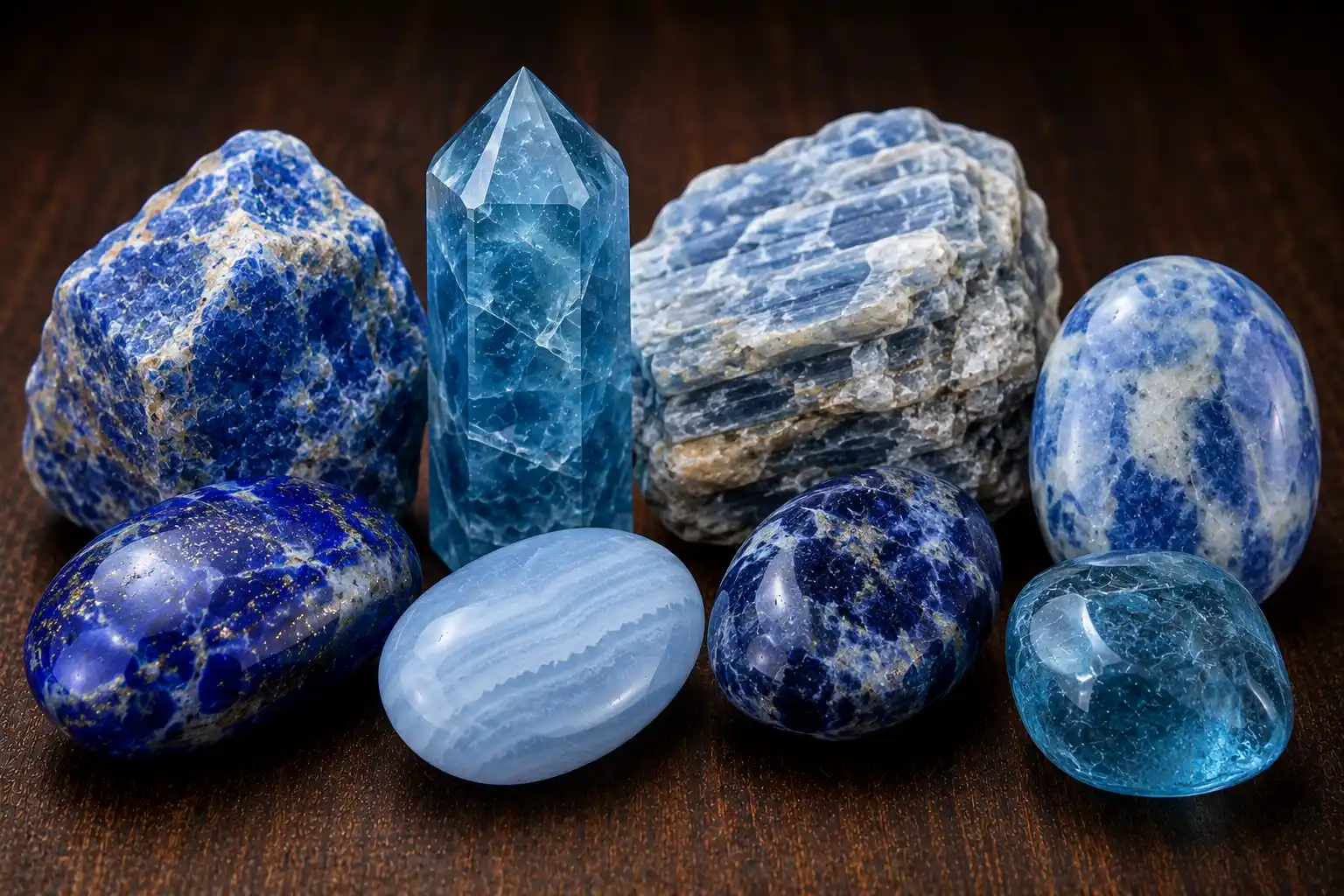
Throat chakra crystals are blue, blue-green and colorless stones used symbolically for communication, listening, truthfulness, boundaries and creative expression. Blue Lace Agate, Aquamarine, Lapis Lazuli and Sodalite are among the most familiar choices, while Amazonite, Chrysocolla, Turquoise and Blue Kyanite support more specific themes.
No crystal can physically open a chakra, treat thyroid disease, repair the voice or force another person to understand. A stone becomes useful when it supports a concrete practice such as preparing a boundary statement, listening without interruption or checking whether a claim is accurate.
The main throat chakra guide explains Vishuddha, balance and communication practices. This page owns the detailed crystal list.
Throat Chakra Crystals at a Glance
| Crystal | Symbolic communication role | Practical use | Main care concern |
|---|---|---|---|
| Blue Lace Agate | Gentle, measured speech | Difficult conversations | Dye and impact |
| Aquamarine | Calm communication | Presentations and reflection | Fractures and treatment |
| Lapis Lazuli | Truth and considered judgment | Honest self-review | Porosity, dye and acids |
| Sodalite | Organized thought | Writing and study | Cleavage and treatment |
| Amazonite | Boundaries and direct expression | Saying no clearly | Feldspar cleavage |
| Chrysocolla | Compassionate communication | Conflict de-escalation | Variable softness |
| Turquoise | Wisdom and protected expression | Jewelry or reflective practice | Porosity and stabilization |
| Blue Kyanite | Alignment between thought and speech | Decision statements | Cleavage and variable hardness |
| Blue Apatite | Motivation to express an idea | Creative planning | Mohs 5 and cleavage |
| Larimar | Calm emotional expression | Cooling an intense response | Softness and light sensitivity |
| Angelite | Quiet listening | Gentle meditation | Softness and water sensitivity |
| Celestite | Reflective silence | Protected bedside or altar use | Softness and fragile crystals |
| Blue Calcite | Slow, thoughtful speech | Journaling | Softness and acid sensitivity |
| Sapphire | Disciplined truth | Durable everyday jewelry | Treatment disclosure |
| Azurite | Deep inquiry | Protected meditation specimen | Softness and copper-mineral care |
How Throat Chakra Stones Are Chosen
Modern throat-chakra lists favor blue and blue-green stones because these colors are associated with open space, calmness and communication.
Color alone does not create a fixed spiritual property. A blue stone may be selected because its appearance helps the practitioner remember a communication intention.
Mineral identity matters for practical use. Sapphire can withstand regular jewelry wear, while Celestite and Blue Calcite are too soft for casual bracelet stacking or pocket carry.
Choose a stone according to both the symbolic goal and the physical environment.
1. Blue Lace Agate
Blue Lace Agate is the most direct choice for gentle communication.
Its pale blue bands inspire symbolism based on slowing down, softening delivery and leaving room for another person to respond.
It is useful when the message is necessary but emotionally difficult. Before the conversation, write the central point in one sentence and remove unnecessary accusation or exaggeration.
Blue Lace Agate belongs to the Chalcedony family and has useful Quartz-based hardness. However, fractures, dye and imitation material can occur.
The stone should support clarity rather than avoidance. Gentle language can still state a firm boundary.
2. Aquamarine
Aquamarine is associated with calm communication and maintaining perspective under pressure.
Its transparent green-blue to blue color suits presentations, interviews and conversations in which anxiety makes speech feel rushed.
A practical exercise is to pause before answering and identify the shortest accurate response. Additional detail can be added after the main point is clear.
Aquamarine is a Beryl variety with good jewelry durability. Heat treatment is common and usually reduces green components, while fracture filling can occur.
The Aquamarine buying guide explains quality and disclosure. Follow the dedicated guide to cleaning Aquamarine jewelry for valuable pieces.
3. Lapis Lazuli
Lapis Lazuli represents truth, judgment and communication informed by reflection.
It is a metamorphic rock composed principally of Lazurite with variable Calcite, Pyrite and other minerals.
The stone suits a practice of distinguishing what is known from what is assumed. Write the facts first, then label interpretations separately.
Lapis can also symbolize the responsibility that accompanies influence. A confident voice still needs accuracy.
The material is relatively porous and can be dyed, waxed or reconstructed. The real-versus-fake Lapis Lazuli guide covers common imitations, while cleaning Lapis Lazuli safely requires conservative methods.
4. Sodalite
Sodalite is associated with organized thought and communicating an idea in a logical sequence.
Its blue material commonly contains white Calcite veining and can resemble Lapis Lazuli without the same typical Pyrite appearance.
Use Sodalite while outlining a message. State the purpose first, then the essential facts, desired action and deadline.
This practice is particularly useful for work emails, presentations and requests that become unclear through too much background information.
Sodalite has moderate hardness and cleavage. Dyed stones and other blue materials may be sold under its name.
The real-versus-fake Sodalite guide covers identification, while Lapis Lazuli versus Sodalite explains the material differences.
5. Amazonite
Amazonite is a blue-green Microcline feldspar associated with boundaries and direct expression.
It suits situations in which the speaker knows what they need but repeatedly weakens the request through apology or over-explanation.
A useful Amazonite statement has three parts: the decision, the necessary context and the next step.
For example: “I cannot take on that task this week. My existing deadline is Friday. We can discuss a later date.”
Amazonite has feldspar cleavage and can chip after impact. The real-versus-fake Amazonite guide explains common substitutes, while treated Amazonite covers coatings and enhancement.
6. Chrysocolla
Chrysocolla is associated with compassionate communication and reducing escalation.
The name can describe copper-rich material with variable composition and hardness. Some pieces are soft and earthy, while silicified material may take a stronger polish.
Chrysocolla suits conversations in which both honesty and emotional regulation matter. Before speaking, identify the result you want beyond simply releasing frustration.
Its symbolism does not require avoiding conflict. Compassionate language can still identify harm and demand change.
Because the material can be porous, stabilized or matrix-rich, use gentle care. The guide to cleansing Chrysocolla avoids unnecessary soaking.
7. Turquoise
Turquoise has long-standing cultural associations with protection, status, wisdom and expression.
Modern throat-chakra practice uses it as a reminder that speech carries consequences. A message should protect what is valuable without becoming dishonest.
Turquoise ranges from blue to green and may contain brown, black or tan matrix.
It is relatively soft and porous. Stabilization, dye, impregnation and reconstruction are common.
The Turquoise buying guide explains quality and treatment. The real-versus-fake Turquoise guide covers dyed Howlite, composite products and plastic imitations.
Use the dedicated guide to cleaning Turquoise jewelry rather than soaking it.
8. Blue Kyanite
Blue Kyanite is used symbolically for alignment between thought, values and speech.
It suits a decision that has been considered privately but not yet expressed clearly.
Write the decision first. Then compare it with the words being used. If the language still leaves an unintended promise or ambiguity, revise it.
Kyanite has unusual directional hardness and prominent cleavage. Bladed crystals can split and should not be carried loose with harder stones.
The broader Kyanite meaning guide explains its mineral identity, while the guide to types of Kyanite covers blue, black, green and orange material.
9. Blue Apatite
Apatite can appear bright aqua, turquoise or deep blue.
Modern traditions associate Blue Apatite with motivation, idea-sharing and moving from planning into expression.
It is useful for creative work that remains private because the creator fears criticism. The practice is to choose a safe, specific audience rather than waiting until all fear disappears.
Apatite ranks only around 5 on the Mohs scale and has cleavage. It scratches easily and is safer in earrings, pendants or protected display than in an exposed daily ring.
The guide to types of Apatite explains its major colors and mineral varieties.
10. Larimar
Larimar is associated with calm emotional expression.
Its pale blue and white patterns make it a natural symbol for slowing an intense reaction before communicating.
A Larimar practice begins by naming the emotion privately. Then wait until the intended message can be stated without using the other person merely as a target for release.
Calmness does not mean suppressing anger or tolerating mistreatment. It means selecting language that serves the actual boundary or decision.
Larimar is blue Pectolite from the Dominican Republic and ranks only about 4.5–5. Protect it from scratching, hard impact and prolonged strong light.
The real-versus-fake Larimar guide covers imitations, while cleaning Larimar jewelry requires gentle methods.
11. Angelite
Angelite is the trade name commonly used for blue Anhydrite.
Modern spiritual traditions associate it with quiet listening, gentle reassurance and communication that does not demand an immediate answer.
It is useful when the appropriate role is supportive presence rather than advice.
Angelite is soft and can alter with prolonged water exposure because Anhydrite can hydrate toward Gypsum. It should not be soaked or used in crystal water.
The guide to cleansing Angelite emphasizes dry methods.
12. Celestite
Celestite is a pale blue Strontium sulfate mineral known for delicate transparent-to-translucent crystals.
Its symbolism centers on reflective silence and allowing a conversation to settle before responding.
Celestite works best as a protected display specimen. Clusters are fragile, and individual crystals can chip or detach.
It is not suitable for loose pocket carry, harsh washing or frequent handling.
The guide to cleansing Celestite explains gentle, noncontact methods.
13. Blue Calcite
Blue Calcite is associated with slow, thoughtful speech and emotional decompression.
It suits journaling after a difficult conversation. Rather than composing an immediate reply, write what was heard, what felt threatening and what requires clarification.
Calcite ranks only 3 on the Mohs scale and reacts with acids. It scratches easily and is better kept as a stable specimen than worn in exposed jewelry.
Do not use vinegar, citrus products or acidic cleaners around it.
14. Sapphire
Sapphire represents disciplined truth, loyalty and communication that remains consistent over time.
It is the most durable major throat-chakra jewelry stone in this list, ranking 9 on the Mohs scale.
A Sapphire practice may focus on commitments. Before making a promise, identify what resources and time are actually available.
Blue Sapphire is commonly heated, while diffusion treatment, filling and laboratory-grown material also occur.
The guide to types of Sapphire explains color varieties and treatment terminology.
15. Azurite
Azurite is a deep-blue copper carbonate associated with inquiry and recognizing an avoided truth.
For throat work, it can represent the question that must be understood before a statement is made.
Azurite is soft, cleavage-prone and sensitive to acids. It is best used as a protected specimen.
Do not prepare drinking water with it, grind it without professional dust controls or use harsh cleaning products.
The Malachite versus Azurite guide explains the relationship between these copper minerals.
Best Throat Chakra Crystal for Beginners
Blue Lace Agate is the easiest symbolic starting point for gentle, measured communication.
Sodalite is useful when the problem is organizing thoughts, while Amazonite suits boundaries.
A beginner does not need a complete collection. One clearly identified stone and one consistent communication practice are enough.
The stone should have a defined purpose rather than being expected to solve every relationship or speaking concern.
Best Crystal for Public Speaking
Aquamarine and Blue Apatite are common symbolic choices for public speaking.
Aquamarine represents calm delivery, while Apatite represents the willingness to present an idea visibly.
Sodalite can support organization, and Sapphire represents preparation and disciplined follow-through.
The broader crystals for communication and public speaking guide covers the dedicated search intent.
A stone cannot replace rehearsal, accurate information or accessible presentation design.
Best Crystal for Setting Boundaries
Amazonite is the strongest symbolic choice for clear boundaries.
Blue Lace Agate can soften the delivery, while Lapis Lazuli supports accuracy and accountability.
A boundary should state the action the speaker will take rather than attempt to control another person’s feelings.
The crystal can remain beside a written statement while it is edited into direct, practical language.
Best Crystal for Listening
Angelite and Celestite are common choices for quiet, receptive practice.
Chrysocolla adds a theme of listening during conflict, while Turquoise represents wisdom gained through experience.
Listening does not require agreement. It requires understanding the message before deciding how to respond.
Best Crystal for Creative Expression
Blue Apatite supports sharing an idea, while Aquamarine represents calm presentation.
Lapis Lazuli suits writing and storytelling based on truth. Blue Kyanite represents alignment between the work and the creator’s values.
The sacral chakra crystals guide covers creativity and emotional movement, while throat stones focus on expression and communication.
How to Meditate With a Throat Chakra Crystal
Choose one stone and place it on a table or hold it loosely.
Sit with the body supported and allow the breath to remain comfortable.
Select one communication intention, such as listening without interruption or stating a request directly.
Do not force vocal sounds or press the stone against the neck.
After the meditation, write one sentence that turns the intention into behavior.
Wearing Throat Chakra Crystals
Pendants place blue stones near the symbolic throat area, but physical proximity is not necessary for the practice.
The necklace should fit comfortably and must not restrict breathing or movement.
Sapphire and Aquamarine handle jewelry wear better than Celestite, Blue Calcite, Angelite or Azurite.
Turquoise, Lapis Lazuli and Larimar require protection from chemicals, cosmetics and prolonged soaking.
A bracelet or earring can serve the same symbolic purpose as a necklace.
Throat Chakra Crystal Pairings
Blue Lace Agate and Amazonite combine gentle delivery with firm boundaries.
Lapis Lazuli and Sodalite pair truth with organized thought. Aquamarine and Chrysocolla combine calmness with compassion.
Sapphire can be paired symbolically with Clear Quartz for disciplined focus, although hard stones should remain physically separated from softer materials.
The completed crystal pairings guide explains symbolic and physical compatibility.
Cleansing Throat Chakra Stones
No cleansing method is safe for every blue crystal.
Sound, visualization and placement on a clean dry cloth are conservative options.
Aquamarine and sound Quartz-based Agate can tolerate brief gentle washing. Turquoise, Lapis Lazuli, Chrysocolla, Angelite, Celestite and Blue Calcite require greater caution.
Do not soak a mixed collection. One water-tolerant gem does not make the others safe.
The completed guide to cleansing crystals explains method selection.
Storage
Store the stones according to hardness and structure.
Sapphire can scratch every softer stone in this list. Aquamarine can damage Calcite, Celestite, Angelite and Azurite.
Use separate padded compartments rather than one shared pouch.
Keep fragile clusters stable and prevent crystal points from pressing against softer polished surfaces.
The water and sunlight guides should be consulted before creating a permanent altar near a window or using moisture-based rituals.
Frequently Asked Questions
1. What is the best throat chakra crystal?
Blue Lace Agate is a common starting choice. Aquamarine, Lapis Lazuli, Sodalite and Amazonite are also widely used.
2. Can crystals open the throat chakra?
No scientific evidence shows that crystals physically open chakras. They can function as reminders within communication and meditation practices.
3. Which throat chakra stone is best for public speaking?
Aquamarine, Blue Apatite and Sodalite are common symbolic choices. Preparation and rehearsal remain more important than the stone.
4. Which crystal helps with setting boundaries?
Amazonite is commonly associated with direct but balanced boundaries.
5. Which throat chakra crystal represents truth?
Lapis Lazuli and Sapphire are strongly associated with truth, integrity and considered judgment.
6. Which stone supports gentle communication?
Blue Lace Agate and Chrysocolla are common choices for calm, compassionate delivery.
7. Which throat crystal is most durable for jewelry?
Sapphire is the most durable major option. Aquamarine also handles many jewelry formats well.
8. Can I wear a throat chakra stone as a necklace?
Yes, provided the necklace fits safely and the gemstone is suitable for jewelry. It should never restrict the throat.
9. Should I place the crystal directly on my neck?
It is safer to hold the stone or place it nearby. Avoid heavy, sharp or unstable objects on the throat.
10. Can all blue crystals go in water?
No. Turquoise, Lapis Lazuli, Angelite, Celestite, Calcite and several other blue materials require conservative care.
11. Can I combine several throat chakra crystals?
Yes, but a small purposeful pairing is easier to use. Store stones separately when their hardness differs.
12. Can throat chakra crystals treat speech or thyroid disorders?
No. Crystals do not diagnose or treat medical conditions. Consult qualified healthcare or speech professionals for symptoms and functional concerns.
Throat-chakra crystal meanings and healing associations belong to spiritual traditions and are not scientifically established medical effects. Do not ingest stones, prepare drinking water with unidentified minerals or use crystals in place of healthcare, speech therapy or mental-health support.