

The heart chakra is commonly known by the Sanskrit name Anāhata and is traditionally placed at the heart or center-chest region within several Hindu and Tantric subtle-body systems. In many contemporary yoga and chakra practices, it represents compassion, relationship, openness and the movement between more personal concerns and broader awareness.
Modern crystal traditions frequently associate the heart chakra with green and pink stones. These correspondences belong to spiritual practice rather than scientifically established anatomy or medicine, so “healing” the heart chakra should not be confused with treating cardiovascular disease, grief disorders, depression or another health condition.
Heart Chakra at a Glance
| Feature | Common Traditional or Modern Association |
|---|---|
| Sanskrit name | Anāhata |
| General location | Heart or center of the chest |
| Meaning of name | Commonly rendered as “unstruck” |
| Traditional imagery | Lotus symbolism |
| Modern seven-chakra position | Fourth chakra |
| Common modern color | Green |
| Secondary modern color | Pink |
| Traditional element | Air in widely used mappings |
| Main symbolic themes | Compassion, relationship, openness, balance |
| Common practices | Meditation, breath awareness, yoga, reflection |
| Common modern stones | Rose quartz, green aventurine, emerald, malachite, rhodonite |
| Scientific status | Spiritual framework, not established anatomy |
What Is the Heart Chakra?
The chakra concept comes from South Asian religious and yogic traditions.
The Sanskrit word cakra means “wheel.”
Historical Tantric systems described subtle centers arranged within the body and connected with complex networks of symbols, sounds, deities, elements and practices.
One influential mapping places Anāhata at the heart.
Modern Western yoga culture commonly presents a seven-chakra system running from the base of the spine to the crown.
That presentation is useful as a contemporary teaching model, but historical chakra systems were more varied than many modern diagrams imply.
Different traditions used different numbers of centers and different correspondences.
Therefore, the heart chakra should be treated as part of a spiritual and historical framework rather than a universally agreed biological structure.
What Does Anāhata Mean?
Anāhata is commonly translated as “unstruck.”
The term has associations in Indian religious and musical thought with an unstruck or subtle sound—not sound produced by physically striking two objects together.
This gives the name a richer historical context than the modern phrase “love chakra.”
Contemporary practice emphasizes compassion and relationships, but the traditional symbol belongs to a much broader spiritual system involving subtle consciousness and yogic practice.
Where Is the Heart Chakra Located?
Modern chakra diagrams typically position the heart chakra in the center of the chest around the heart region.
This location is symbolic rather than an anatomical structure visible through medical imaging.
It should not be confused with the physical heart, cardiac nerves, thymus gland or another biological organ.
Claims that a chakra directly controls those organs go beyond established evidence.
Within spiritual practice, the chest location provides a focal area for attention during meditation or breath work.
Is the Heart Chakra Green?
Green is the color most commonly assigned to the heart chakra in today’s rainbow-colored seven-chakra system.
Pink is also widely used in modern crystal practice because of its association with affection and compassion.
However, historical chakra traditions do not map perfectly onto one universal modern rainbow system.
Consequently, green should be understood as a familiar contemporary correspondence, not an objective physical color emitted by the chest.
This distinction helps preserve the spiritual tradition without turning a symbolic system into anatomy.
What Does the Heart Chakra Represent?
Modern heart-chakra practice generally focuses on relationships and how someone relates to themselves and others.
Common themes include:
compassion, reciprocity, trust, boundaries, grief, forgiveness, openness and the capacity to receive as well as give.
A balanced interpretation does not mean endless accommodation.
Compassion without boundaries can become self-neglect.
Likewise, boundaries without empathy can become unnecessary isolation.
Heart-chakra symbolism is therefore most useful when it represents a relationship between openness and discernment.
What Does a “Blocked” Heart Chakra Mean?
“Blocked heart chakra” is spiritual language rather than a clinical diagnosis.
Practitioners may use the phrase when describing experiences such as:
difficulty trusting, resentment, guardedness, loneliness or discomfort receiving care.
Those experiences can have many ordinary psychological and situational causes.
A chakra framework may provide someone with a symbolic way to reflect on them, but it cannot determine why they are occurring.
Persistent grief, anxiety, depression, trauma symptoms or relationship distress may deserve appropriate professional support rather than being explained solely as an energetic blockage.
What Does a Balanced Heart Chakra Mean?
In modern chakra traditions, a balanced heart chakra often symbolizes the ability to care without losing personal boundaries.
Examples might include:
offering compassion without taking responsibility for another person’s choices, accepting support without feeling undeserving, expressing affection without demanding control and maintaining boundaries without treating conflict as a failure.
These are behavioral ideals rather than measurable chakra states.
A person cannot prove a heart chakra is “balanced” through a physical test.
The language functions more like a reflective model.
Heart Chakra Healing
Heart-chakra healing generally refers to spiritual practices intended to restore a sense of openness, connection or balance.
A grounded approach begins by choosing a specific area of reflection.
For example:
Compassion: Where could I respond more gently?
Boundary: What behavior am I no longer willing to accept?
Receiving: Why is accepting help difficult for me?
Grief: What am I trying to rush through rather than acknowledge?
The practice becomes meaningful through honest reflection and subsequent action.
No claim about invisible energy is necessary.
Breath Awareness for the Heart Chakra
Breath practice is commonly incorporated into chakra meditation.
Sit comfortably and notice the movement of breathing through the chest and ribs.
Do not force unusually deep breaths.
Instead, allow the breathing rhythm to become steady.
On each exhalation, relax unnecessary muscular tension.
Then choose one theme such as compassion or boundaries and reflect on it briefly.
If you have a medical condition that makes breathing exercises uncomfortable, follow appropriate clinical guidance rather than forcing a spiritual technique.
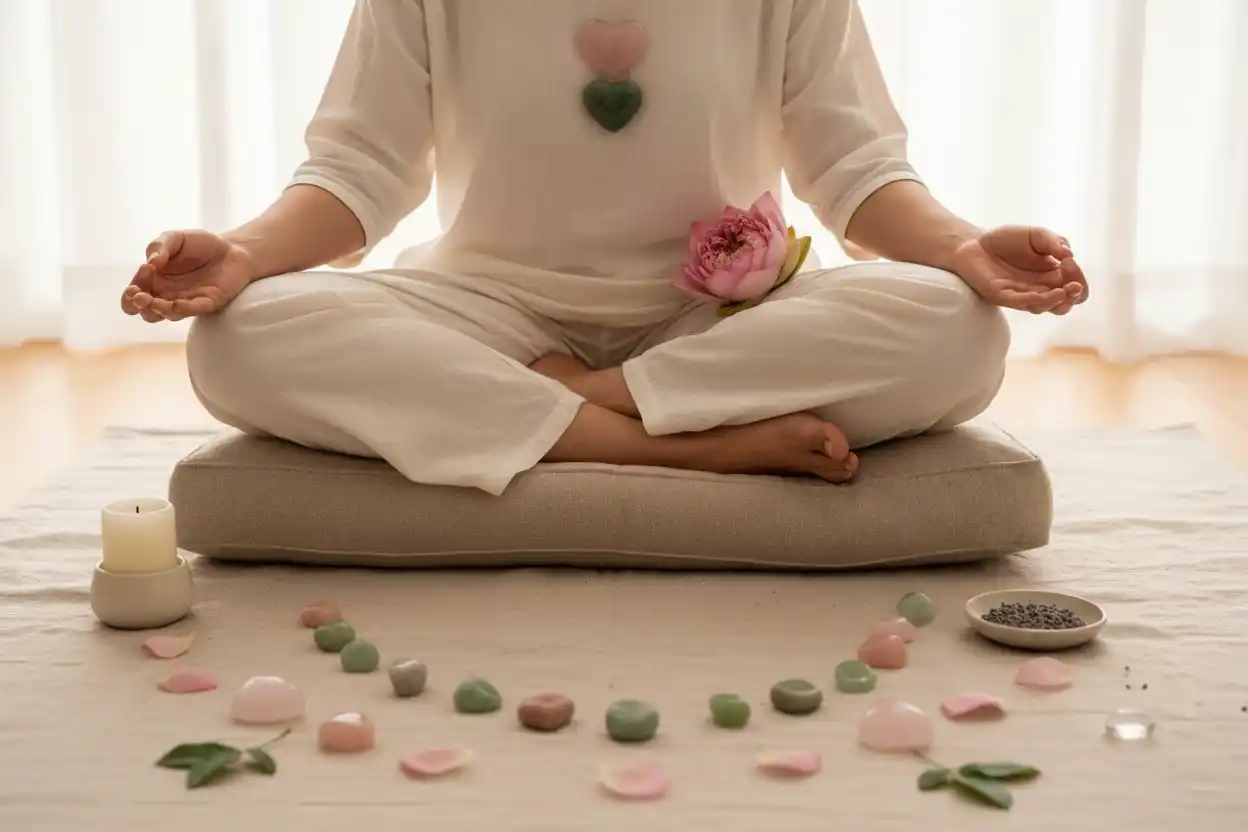
Heart Chakra Meditation
A simple meditation can last five to ten minutes.
Bring attention to the center of the chest.
Notice physical sensations without interpreting every sensation as an energetic event.
Then introduce a phrase such as:
May I respond with compassion and discernment.
or
I can care about someone without abandoning my boundaries.
When thoughts wander, return to breathing.
The goal is not to create heat, tingling or a dramatic emotional release.
Those sensations are not required and do not prove chakra activation.
Heart Chakra Journaling
Writing can make the symbolism more concrete.
Useful prompts include:
Where am I giving more than I can sustainably give?
What type of support do I resist receiving?
Who deserves forgiveness, and does forgiveness actually require renewed access to me?
What relationship needs clearer communication?
What would compassion toward myself look like in behavior today?
These questions move heart-chakra practice away from vague language and toward observable choices.
Heart Chakra and Boundaries
Heart symbolism is often reduced to “opening up.”
That can be misleading.
Healthy connection also requires boundaries.
A person does not need to remain available to someone who repeatedly behaves harmfully merely because spiritual language emphasizes forgiveness or unconditional love.
A more balanced heart-chakra interpretation includes:
compassion, self-respect, reciprocity and the ability to say no.
This prevents spirituality from being used to justify self-neglect.
Heart Chakra and Forgiveness
Forgiveness is another common theme.
Spiritually, forgiveness may represent releasing an ongoing commitment to resentment.
However, it does not necessarily mean:
forgetting what happened, trusting someone again, restoring a relationship or removing a protective boundary.
Someone can choose not to remain consumed by an event while still deciding that renewed contact is inappropriate.
This distinction makes heart-centered practice more realistic and safer.
Heart Chakra and Grief
Grief often appears in modern heart-chakra discussions because loss affects attachment and connection.
A chakra ritual can provide a personal framework for remembering someone or acknowledging sadness.
However, grief is not evidence that a chakra is malfunctioning.
Nor should grief be rushed in order to become “spiritually balanced.”
A stone, candle, journal or meditation practice may be meaningful as part of remembrance, but prolonged or overwhelming grief may also deserve professional support.
Heart Chakra Stones
Modern crystal traditions commonly use both green and pink stones for heart-chakra symbolism.
Representative choices include:
Rose quartz for compassion and affection.
Green aventurine for growth and openness.
Emerald for renewal and loyalty.
Malachite for transformation and boundaries.
Rhodonite for relationship reflection and emotional responsibility.
These associations are symbolic rather than physiological.
The point is not to collect every possible heart stone but to choose one whose meaning fits the practice.
Rose Quartz and the Heart Chakra
Rose Quartz is probably the most familiar pink stone associated with modern heart-chakra practice.
It symbolizes love, compassion and gentleness.
Instead of using it to “make someone love you,” connect it with behavior within your own control.
For example:
speak to yourself without unnecessary cruelty, express appreciation clearly or establish a respectful boundary.
That is more grounded than treating the gemstone as a relationship-control tool.
Green Aventurine and the Heart Chakra
Green Aventurine is commonly connected with the heart chakra because of its green color.
Its modern symbolism adds growth, optimism and opportunity.
This makes it suitable for reflection after relational change.
A useful intention could be:
I can remain open to healthier possibilities without repeating the same pattern automatically.
The stone represents the intention; it does not guarantee what another person will do.
Emerald and the Heart Chakra
Emerald has longstanding symbolism involving renewal, loyalty and growth.
Modern chakra practices often incorporate those themes into heart-centered meditation.
Its historical jewelry symbolism is far older than the contemporary Western heart-chakra crystal system.
Therefore, it is better to say that modern practitioners associate emerald with the heart chakra rather than implying that every historical emerald culture used that correspondence.
Malachite and the Heart Chakra
Malachite is frequently used symbolically for transformation and boundaries.
Its striking green bands make it a natural fit within contemporary heart-chakra color systems.
A practical malachite reflection might ask:
Which relationship pattern needs to change rather than merely be tolerated?
Again, the useful part is the question and subsequent decision.
The mineral itself does not force transformation.
Rhodonite and the Heart Chakra
Rhodonite is commonly pink with black manganese-oxide patterning.
Modern crystal traditions often connect it with forgiveness, relationship repair and emotional responsibility.
The symbolism can support questions such as:
What part of this conflict belongs to me?
and
What part does not?
This encourages accountability without taking responsibility for another person’s actions.
Heart Chakra Yoga
Modern yoga classes may incorporate chest-opening postures into heart-chakra themes.
These often include movements that extend the upper spine or open the front of the shoulders and chest.
A posture should not be interpreted as physically “opening” an invisible chakra.
It is simply a movement practice layered with symbolic intention.
Range of motion differs between people.
Pain, dizziness or instability is a reason to stop rather than push farther for spiritual reasons.
Heart Chakra Affirmations
An affirmation works best when it is realistic enough to guide behavior.
Examples include:
I can be compassionate without abandoning my boundaries.
I am allowed to receive support.
I can communicate care directly.
Forgiveness and renewed access are not the same thing.
I can acknowledge grief without rushing it.
These phrases do not need to be repeated a prescribed number of times.
Their value lies in whether they support a meaningful reflective practice.
Heart Chakra and Other Chakras
In contemporary seven-chakra models, the heart chakra sits between three lower and three higher centers.
That position encourages interpretations of Anāhata as a bridge between personal survival and action themes below and communication, insight and spiritual themes above.
The already completed Root Chakra, Sacral Chakra, Solar Plexus Chakra, Throat Chakra, Third Eye Chakra and Crown Chakra pages preserve each center’s separate intent.
The beginner framework in Healing Crystals also explains how crystal symbolism can be used without presenting it as medical treatment.
How to Balance the Heart Chakra
There is no clinical test showing that a chakra needs balancing.
Within spiritual practice, “balancing” can instead mean bringing attention to relationship patterns associated with the heart theme.
A useful sequence is:
notice the current issue, name the emotion without judgment, identify what is within your control, decide whether compassion or a boundary is needed, and choose one specific action.
Meditation, yoga, journaling or a symbolic stone can support that process.
The action is what turns the reflection into something practical.
Frequently Asked Questions
1. What is the heart chakra?
The heart chakra, commonly called Anāhata, is a subtle-body center associated with the heart region in several Hindu, Tantric and modern yoga traditions.
2. What does Anāhata mean?
Anāhata is commonly translated as “unstruck” and has connections with ideas of subtle or unstruck sound in Indian spiritual thought.
3. Where is the heart chakra located?
Modern chakra systems generally place it at the center of the chest around the heart region. This is a symbolic subtle-body location rather than an anatomical organ.
4. What color is the heart chakra?
Green is the most common contemporary color correspondence, while pink is also widely used in modern crystal traditions.
5. What does the heart chakra symbolize?
Common themes include compassion, relationships, openness, reciprocity, forgiveness, grief and healthy boundaries.
6. What does a blocked heart chakra mean?
It is spiritual language sometimes used for patterns involving guardedness, resentment or difficulty with connection. It is not a medical or psychological diagnosis.
7. How do you balance the heart chakra?
Modern practices include meditation, breath awareness, yoga, journaling, affirmations and symbolic stones. None provides a scientifically measurable chakra-balance test.
8. What stones are associated with the heart chakra?
Rose quartz, green aventurine, emerald, malachite and rhodonite are common modern choices.
9. Is the heart chakra always associated with green?
Green dominates contemporary seven-chakra systems, but historical chakra traditions were more varied and did not all use today’s standardized rainbow correspondences.
10. Can heart-chakra healing cure heart disease?
No. Chakra practice is spiritual and should not replace cardiovascular diagnosis or treatment.
11. Is forgiveness required to balance the heart chakra?
No universal spiritual rule requires reconciliation or renewed access. Forgiveness, boundaries and relationship decisions remain personal and context-dependent.
12. Can I practice heart-chakra meditation without believing in chakras literally?
Yes. The framework can be used symbolically for reflection on compassion, boundaries and relationships without treating chakras as physical anatomy.
Conclusion
The heart chakra is best understood in its proper context: Anāhata belongs to South Asian subtle-body and yogic traditions, while today’s green-colored fourth-chakra model reflects a widely used modern synthesis.
Its central themes—compassion, connection, reciprocity, grief and boundaries—can provide a useful framework for reflection.
However, heart-centered spirituality does not require constant openness or self-sacrifice. Compassion works best when paired with discernment, while forgiveness does not automatically require reconciliation.
Meditation, breath awareness, journaling and symbolic stones can all support a personal heart-chakra practice. Their role is spiritual and reflective rather than medical, allowing the tradition to retain meaning without confusing symbolic healing with treatment of the physical heart or mental-health conditions.
Disclaimer: Chakras and chakra healing belong to spiritual, religious and cultural traditions rather than scientifically established anatomy or medical treatment. Heart-chakra practices should not replace healthcare for cardiovascular symptoms, mental-health concerns, trauma, grief or other conditions requiring professional support.