Where to Buy Real Orange Calcite and Avoid Dyed Fakes
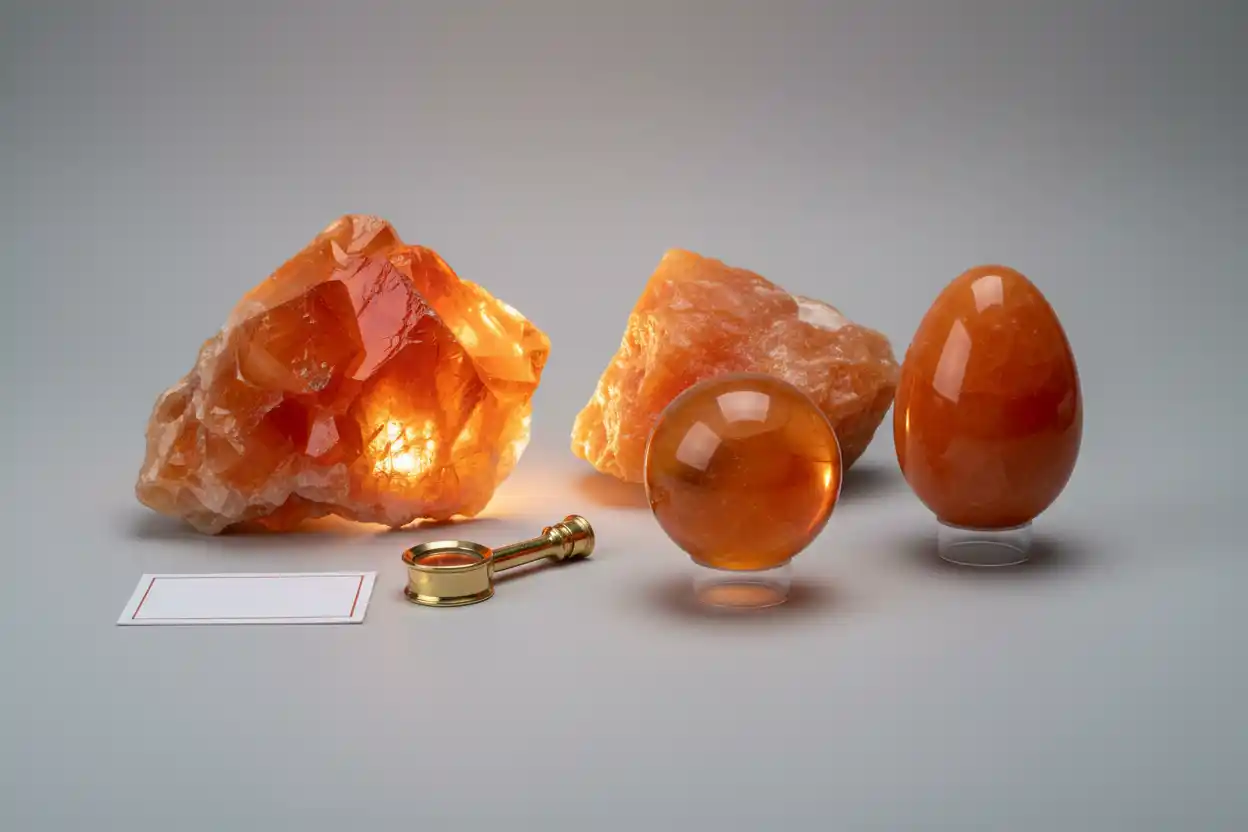
Real Orange Calcite is a warm-colored variety of Calcite ranging from pale apricot and peach through tangerine, amber-orange, reddish orange and brownish orange. It commonly appears as translucent massive rough, cleavage pieces, crystals, spheres, towers, carvings, cabochons and beads.
The name describes color rather than a separate mineral species. Consequently, commercial boundaries overlap with Honey Calcite, Yellow Calcite and Red Calcite. Two honest sellers may apply different color names to the same yellow-orange piece.
More serious buying problems include dyed white Calcite, color-enhanced carbonate rock, resin-filled carvings, coated material, orange glass and other minerals sold under the Calcite name. The Orange Calcite meaning and properties guide covers identity and traditional symbolism. This guide focuses on sellers, natural color, treatment, lookalikes, durability and value.
Orange Calcite Is a Color Variety of Calcite
Calcite is calcium carbonate, CaCO3, and crystallizes in the trigonal system. It has Mohs hardness 3, perfect rhombohedral cleavage and strong birefringence.
The Calcite meaning and properties guide explains the parent mineral. The types of Calcite guide separates its colors, habits and commercial varieties.
Orange color may relate to iron-rich inclusions, staining, trace impurities or other material enclosed within the Calcite. The precise cause can differ among deposits, so a seller should not claim that every orange specimen has one identical coloring agent without analysis.
The Calcite color guide covers the symbolic use of color without replacing mineral identification.
Choose the Product Form Before Shopping
| Orange Calcite product | Best source | Main buying concern |
|---|---|---|
| Natural crystal specimen | Specialist mineral dealer | Cleavage, repairs, coating and locality |
| Cleavage piece | Educational mineral supplier | Accurate labeling and chipped edges |
| Massive rough | Lapidary supplier | Dye, fractures and usable cutting yield |
| Slab | Lapidary dealer | Color depth, resin and mixed carbonate composition |
| Sphere | Experienced carving retailer | Filled cleavage, coating and hidden pale areas |
| Tower | Stone seller with exact-item video | Repaired point, resin and carved-crystal wording |
| Carving | Skilled lapidary retailer | Dye, coating and weak projections |
| Cabochon | Independent cutter | Backing, filler and limited jewelry durability |
| Bead strand | Established supplier | Dyed white stone, glass and drill-hole cracking |
| Jewelry | Jeweler familiar with Calcite | Protective setting, glue and acid sensitivity |
A collector specimen should be judged for natural form and provenance. A sphere or carving requires more attention to filling, structural stability and whether the color continues through the object.
Where to Buy Genuine Orange Calcite
Specialist mineral dealers
Mineral dealers are the strongest source for natural crystals, matrix specimens and documented localities.
The listing should state dimensions, weight, crystal habit, locality, condition and associated minerals. Request photographs of every termination, the reverse and the base.
Ask whether the specimen was repaired, oiled, waxed or coated. Orange-colored oil can intensify the stone and conceal fine cleavage temporarily.
A knowledgeable seller should distinguish a naturally crystallized specimen from a cleavage fragment. Both can be genuine Calcite, but their formation and value differ.
Lapidary suppliers
A lapidary supplier should provide dry photographs of natural and sawn surfaces.
Water and oil deepen orange coloration and make surface bruising less obvious. Therefore, wet views should supplement rather than replace dry images.
Ask whether sample spheres or cabochons have been cut from the same parcel. Calcite’s perfect cleavage can reduce finished yield dramatically.
Determine whether the rough consists of relatively pure massive Calcite, banded Calcite-Aragonite, marble or another mixed carbonate rock.
Gem and mineral shows
Shows allow you to compare Orange Calcite with Carnelian, Orange Aragonite, Sunstone, Selenite, glass and dyed stone under the same light.
Use a loupe to examine cleavage planes, color concentrations, coatings and resin-filled fractures.
Do not apply vinegar, lemon juice or hydrochloric acid. An acid reaction would damage Calcite and several related carbonate materials.
Likewise, avoid scratch testing. Calcite is too soft for destructive retail tests to be appropriate.
Established online shops
The online gemstone buying guide explains seller verification, protected payment methods and return policies.
Request images against white and neutral-gray backgrounds. Warm lighting can turn pale yellow Calcite into deep orange, while digital saturation can create an unrealistic tangerine appearance.
Exact-item photography is important because fractures, color and translucency vary widely.
Ask whether the item was photographed wet, oiled or backlit and whether the seller adjusted hue or saturation.
Independent cutters and jewelry makers
A cutter may know whether the rough required resin stabilization or whether the color continued beyond its surface.
Ask to see the cabochon or carving before setting. Dark adhesive or reflective backing can deepen pale orange color.
For jewelry, determine whether the stone is solid Calcite or a thin layer over another material.
What Genuine Orange Calcite Looks Like
Natural Orange Calcite can be:
- Pale apricot
- Peach-orange
- Yellow-orange
- Tangerine
- Amber
- Rust-orange
- Brownish orange
- Reddish orange
Transparency ranges from clear to translucent and opaque. Most commercial towers and carvings are cloudy or massive rather than gem-transparent.
Color may appear even, mottled, banded or concentrated around inclusions and growth zones.
Natural material can contain white Calcite patches, brown matrix, fractures and cleavage planes. A completely flawless uniform body is possible but deserves closer treatment inspection in a large carving.
Fresh crystal faces have vitreous luster. Cleavage surfaces can look pearly or especially reflective.
Clear sections may display double refraction, causing a line or object viewed through them to appear doubled. Cloudy massive material may not show the effect visibly.
Orange Calcite Versus Honey Calcite
Honey Calcite generally has warmer golden, amber or brownish-yellow tones.
Orange Calcite tends to show more peach, tangerine or orange-red color. However, the boundary is commercial and subjective.
The completed guide to buying genuine Honey Calcite owns golden-color treatment and naming concerns.
A seller should not charge substantially more merely because the same material is relabeled from Honey to Orange Calcite.
Orange Calcite Versus Yellow Calcite
Yellow Calcite ranges from pale lemon and straw through mustard and golden yellow.
Some pieces sit directly between yellow and orange. Lighting can shift the apparent category.
Color terminology should describe the actual stone rather than imply a different composition.
Orange Calcite Versus Red Calcite
Red Calcite contains stronger brick, rust, red-orange or deep reddish coloration.
A brownish orange piece may be sold under either name. Again, this is not necessarily deceptive unless one label carries an unsupported rarity premium.
Laboratory analysis may be needed when a seller attributes the red or orange color to a specific trace element.
Orange Calcite Versus Mangano Calcite
Mangano Calcite is manganese-bearing Calcite commonly associated with pale pink, peach and salmon color.
Some peach-orange material may overlap visually, especially under warm light.
The completed guide to buying genuine Mangano Calcite owns manganese content, fluorescence and Rhodochrosite comparisons.
An orange body color does not prove that a stone is manganese-bearing.
Orange Calcite Versus Carnelian
Carnelian is orange-to-red chalcedony with Mohs hardness around 6.5 to 7.
It is considerably harder and generally more durable than Calcite. Carnelian also lacks Calcite’s rhombohedral cleavage and strong birefringence.
The completed guide to buying genuine Carnelian covers heat, dye, glass and chalcedony quality.
A translucent orange cabochon sold as Calcite should be tested if it appears unusually hard, glassy and free of cleavage.
Orange Calcite Versus Sunstone
Sunstone is feldspar that may display aventurescence from reflective inclusions.
Orange Calcite generally lacks Sunstone’s metallic sparkle and feldspar structure.
The Sunstone buying guide covers aventurescence, copper inclusions and faceted quality.
A glittering orange feldspar should not be called Calcite merely because both materials share a warm body color.
Orange Calcite Versus Aragonite
Aragonite has the same CaCO3 composition as Calcite but a different crystal structure.
Orange Aragonite can appear as clusters, radiating aggregates, banded material and carvings.
The completed guide to buying real Aragonite addresses reconstructed clusters and Calcite substitution.
Both minerals react with acids, so an acid test cannot separate them safely. Raman spectroscopy or X-ray diffraction is more appropriate.
Orange Calcite Versus Selenite
Selenite is a transparent-to-translucent variety of Gypsum.
Orange or peach Gypsum may owe its color to iron staining or inclusions. It is softer than Calcite and commonly has fibrous, tabular or bladed structure.
A polished orange tower can hide these visual distinctions. Instrumental identification is safer than scratching.
Orange Calcite Versus Glass and Resin
Orange glass can imitate transparent Calcite. Round bubbles, flow lines, mold seams and conchoidal chips support glass.
Glass lacks Calcite’s perfect rhombohedral cleavage and extreme birefringence.
Resin can imitate cloudy Orange Calcite in spheres, towers and carvings. Casting seams, soft scratches, bubbles and repeated internal swirls suggest polymer.
The fake-crystal buyer’s guide provides broader checks for glass, resin and composite products.
Dyed Orange Calcite
White or pale Calcite can be dyed orange, yellow or red.
Artificial color may concentrate along cleavage planes, fractures, pores, pits and drill holes. A chipped edge may reveal a much paler interior.
Some dye penetrates deeply, particularly in fractured or granular material. Therefore, a uniform interior does not prove natural color.
Natural iron staining can also follow cracks. Several observations, supplier records and spectroscopy may be needed for an expensive claim.
A dyed stone remains Calcite, but it should not receive an untreated natural-color premium.
Coatings, Wax and Oil
Oil and wax can deepen orange color and temporarily make cleavage less visible.
A clear coating may improve gloss and reduce surface abrasion. Colored lacquer can intensify the body color.
Inspect corners, drill holes and worn areas for a change in luster. Thick coating may pool within pits and fractures.
The gemstone treatments guide explains the differences among surface coating, filling and impregnation.
Resin Filling and Reconstructed Material
Clear resin can fill cleavage fractures and improve the stability of spheres or carvings.
Color-matched filler may conceal missing material or strengthen orange zones.
Calcite powder and fragments can also be mixed with polymer and molded. Such objects may contain genuine calcium carbonate but are not one solid natural stone.
Bubbles, mold seams and resin-rich chips support composite construction.
How to Evaluate a Natural Crystal Specimen
Crystal habit
Look for plausible rhombohedral, scalenohedral, tabular or complex Calcite forms.
Color distribution
Assess whether orange coloration follows growth zones, inclusions, staining or a surface coating.
Cleavage and condition
Inspect flat internal planes, chipped corners and fresh breaks. Extensive cleavage reduces both collector value and shipping stability.
Transparency
Clear zones can increase interest but may expose fractures. Judge transparency alongside structural soundness.
Luster
Natural faces may be vitreous, etched or partly dull. A uniform plastic gloss can indicate coating.
Repairs
Request close-up photographs of crystal bases and matrix seams. Adhesive should appear in the condition report.
Locality
Orange Calcite is widespread. A precise mine claim needs labels or supplier records.
How to Evaluate Rough and Slabs
Request dry natural surfaces and at least one sawn face.
Look for color that continues through the material. A thin orange surface stain may disappear during cutting.
Cleavage planes matter more than gross size. A large block can split before producing one usable sphere.
Ask whether sample objects from the parcel were stabilized and whether they maintained their color after polishing.
How to Judge Spheres, Towers and Carvings
Request a complete rotation. One face may be vivid orange while the reverse is pale, white or heavily fractured.
A sphere should have no straight assembly seam or resin-filled cavity hidden beneath its stand.
Most towers are carved rather than naturally crystallized. Ask whether the tip was repaired.
Carvings should avoid very thin details because Calcite scratches and splits readily.
Buying Beads and Jewelry
Calcite beads are vulnerable at drill holes. Inspect for radial cracks, concentrated dye and resin.
Natural strands can vary in shade and translucency. Perfectly identical bright-orange beads may indicate glass, resin or heavily sorted treated material.
Pendants and earrings are more practical than rings and bracelets.
The gemstone hardness chart, gemstone cleavage guide and toughness-versus-hardness guide explain why Calcite needs protection from both scratching and impact.
Locality and Provenance
Orange Calcite occurs in many limestone, hydrothermal, sedimentary and mineral-deposit environments.
Commercial material is often attributed to Mexico, Brazil, Pakistan, Madagascar and other sources. However, appearance cannot establish a country.
Fine collector specimens may carry a locality premium when accompanied by original labels or a documented dealer chain.
The ethical crystal sourcing guide provides practical questions about legal extraction, lapidary labor and traceability.
Price and Value
Common Orange Calcite rough and carvings are generally affordable.
Value increases with:
- Attractive natural orange color
- Transparency
- Well-developed crystal habit
- Large intact size
- Minimal cleavage damage
- Strong polish
- Treatment disclosure
- Aesthetic matrix
- Documented locality
- Skilled carving
A large filled tower should not automatically cost more than a smaller untreated crystal specimen.
Likewise, an arbitrary “AAA” label has little value unless the seller defines color, transparency, condition and treatment criteria.
The gemstone pricing guide explains how cutting loss, treatment and retail overhead influence price.
Questions to Ask the Seller
Ask whether the item is natural-color Orange Calcite and how the seller distinguishes it from Honey, Yellow or Red Calcite.
Request disclosure of dye, oil, wax, lacquer, resin, filling and reconstruction.
For crystals, ask for the reverse, base and every termination. For spheres and towers, obtain a complete rotation.
For rough, request a dry sawn face. For beads, request drill-hole close-ups.
Finally, confirm that the return policy allows nondestructive gemological identification.
Professional Identification
A gemologist can identify Calcite through its refractive properties, strong birefringence, specific gravity, cleavage and microscopy.
Raman spectroscopy and X-ray diffraction can separate it from Aragonite, Gypsum, Carnelian, glass and other orange materials.
Microscopy may reveal dye concentrations, coatings and resin-filled fractures.
Confirming Calcite does not prove that its orange color is natural. Treatment analysis must target the colored areas.
Cleaning and Storage
For physical care, use a soft dry cloth or a slightly damp cloth followed by immediate drying.
Avoid vinegar, lemon juice, acidic cleaners and descalers. Even weak acids etch Calcite.
Do not soak dyed, filled, coated or glued objects. Avoid steam and ultrasonic equipment.
The completed Calcite cleansing and charging guide offers non-destructive options for traditional practices.
Store Orange Calcite away from quartz and harder stones. Support specimens from the base rather than lifting exposed crystals.
Frequently Asked Questions
1. Is Orange Calcite a separate mineral species?
No. It is an orange-colored commercial variety of Calcite.
2. What causes Orange Calcite’s color?
Iron-rich staining, inclusions, trace impurities and other material can contribute. The precise cause varies among deposits.
3. Is Orange Calcite the same as Honey Calcite?
The names overlap. Honey Calcite is usually more golden or brownish yellow, while Orange Calcite tends toward peach or tangerine.
4. Is Orange Calcite the same as Carnelian?
No. Carnelian is harder chalcedony, while Orange Calcite is soft calcium carbonate with perfect cleavage.
5. Can Orange Calcite be dyed?
Yes. Pale Calcite can absorb orange, yellow or red dye through fractures and porous areas.
6. Can Orange Calcite contain resin?
Yes. Cleavage cracks in spheres, towers and carvings may be filled or stabilized.
7. Does strong orange color prove treatment?
No. Natural Calcite can be strongly colored. Distribution, structure and seller evidence matter more than intensity alone.
8. Can glass imitate Orange Calcite?
Yes. Orange glass and resin can imitate transparent or cloudy polished pieces.
9. Does double refraction prove the color is natural?
No. Double refraction supports Calcite identity but does not determine whether its color was treated.
10. Is Orange Calcite suitable for daily-wear rings?
Generally, no. Mohs hardness 3 and perfect cleavage make exposed daily wear impractical.
11. Should I use vinegar to test it?
No. Vinegar permanently etches Calcite and should not be used on a finished or collectible object.
12. What is the biggest warning sign in a listing?
Be cautious when a flawless neon-orange carving has no dry photographs, cleavage views, treatment statement or information about its underlying mineral.
Buy the Calcite Beneath the Orange Label
Orange Calcite should remain identifiable as a soft, cleavable carbonate after the color description is removed. Its value comes from natural color, transparency, form, workmanship and honest treatment disclosure.
The O crystal directory, O gemstone directory and visual gemstone guide provide wider comparisons. Choose the seller who explains both the orange appearance and the physical limitations of the stone.
Safety note: Do not use acid as a home test for Orange Calcite. Acid permanently damages the surface. Cutting, drilling or grinding carbonate material also creates irritating dust and requires wet methods, effective extraction and suitable eye and respiratory protection.