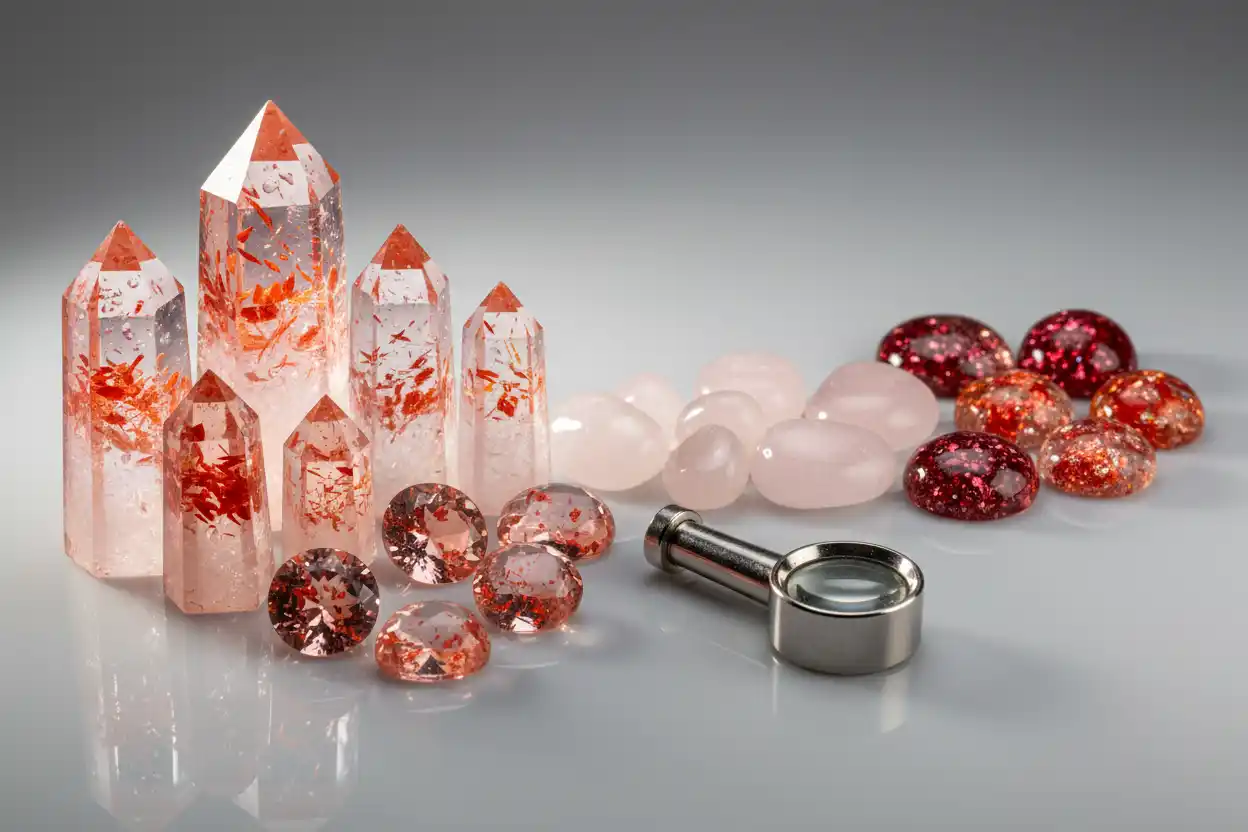
Where to Buy Real Strawberry Quartz and Avoid Glass Fakes
Real Strawberry Quartz is natural Quartz containing numerous pink, red, reddish-brown or orange-red mineral inclusions. These inclusions may appear as fine flakes, short needles, plates, clouds or scattered specks that give the transparent-to-translucent host a strawberry-like color.
The name is a commercial description rather than a precisely standardized mineral variety. In its narrower gemological use, Strawberry Quartz commonly refers to single-crystal Quartz colored by visible red Hematite inclusions. However, the retail name is also applied to Quartz containing iron-rich mica, Goethite and other pink or red inclusions.
This loose terminology creates several buying problems. Pink aventurine quartz, dyed crackled Quartz, Rose Quartz, glitter-filled glass, resin and manufactured “Cherry Quartz” may all appear under Strawberry Quartz listings.
The Strawberry Quartz meaning and properties guide covers its identity and traditional symbolism. This buying guide focuses on inclusion structure, sellers, natural-versus-manufactured material, treatments and value.
Strawberry Quartz Is an Included Quartz Trade Variety
The host material is Quartz, silicon dioxide, with Mohs hardness 7 and no easy cleavage.
The Quartz family guide explains the parent mineral. The Clear Quartz guide covers the colorless host without duplicating Strawberry Quartz’s inclusion-driven buying intent.
The inclusions are separate minerals enclosed within the Quartz. They do not change the host’s basic identity, although dense inclusions and fractures can influence its transparency, durability and cutting behavior.
Hematite is one of the best-documented red inclusions. The Hematite meaning and properties guide explains the iron oxide itself.
However, color alone cannot identify an inclusion. Red or pink platelets may also consist of iron-bearing mica or another mineral. Consequently, sellers should distinguish visual description from laboratory confirmation.
The Trade Name Has Broad and Narrow Uses
Under a strict buying standard, Strawberry Quartz should contain natural red or pink inclusions within macrocrystalline Quartz.
Broader commercial use may include:
- Transparent Quartz with Hematite flakes
- Quartz with red-brown iron oxide needles
- Quartz with pink or orange-red mica inclusions
- Pink aventurine quartz with visible reflective flakes
- Quartz with mixed red mineral inclusions
- Cloudy pink Quartz marketed for its strawberry-like appearance
These products can all be natural, but they are not necessarily identical materials.
A strong seller should explain what the host and inclusions are believed to be instead of relying only on the Strawberry Quartz name.
Choose the Product Form Before Shopping
| Strawberry Quartz product | Best source | Main buying concern |
|---|---|---|
| Natural crystal point | Specialist Quartz or mineral dealer | Natural termination, inclusion identity and repairs |
| Included rough | Lapidary supplier | Inclusion depth, fractures and usable yield |
| Cabochon | Independent cutter | Three-dimensional inclusions, filler and backing |
| Faceted gem | Collector-gem dealer | Host clarity, inclusion placement and windowing |
| Bead strand | Established bead supplier | Glitter glass, resin and dyed fractures |
| Sphere | Included-Quartz specialist | Composite construction, seams and hidden filler |
| Tower | Seller with exact-item video | Carved point, coating and inserted material |
| Tumbled stone | Reputable crystal retailer | Rose Quartz, Aventurine and glass substitution |
| Pendant | Independent jeweler | Backing, glue and surface-reaching fractures |
| High-value specimen | Mineral dealer | Locality, analytical testing and provenance |
The most convincing pieces show inclusions at several depths. A surface-only red pattern deserves closer investigation.
Where to Buy Genuine Strawberry Quartz
Specialist included-Quartz dealers
Dealers familiar with Rutilated Quartz, Phantom Quartz and Garden Quartz are usually better equipped to explain Strawberry Quartz inclusions.
Ask whether the seller identified Hematite through microscopy, Raman spectroscopy or appearance alone.
Request front, back, edge and transmitted-light photographs. The inclusions should appear to occupy three-dimensional space within the Quartz.
A careful description might say “natural Quartz with red plate-like inclusions consistent with Hematite” when no laboratory analysis exists.
Mineral dealers
Mineral dealers are preferable for natural points and locality specimens.
The listing should identify the Quartz habit, dimensions, condition, locality and any repair.
Request close-up photographs of the termination and base. A natural crystal may have contact damage, partly healed fractures or a cut base.
Ask whether the red mineral formed inside the Quartz or was applied to an exterior fracture.
Lapidary suppliers
Request dry photographs of rough and slabs.
Water and oil can make the host clearer, deepen red inclusions and conceal surface-reaching fractures.
Ask whether test cabochons from the same parcel preserved their color after polishing.
A large rough piece can contain one attractive inclusion-rich window surrounded by relatively plain Quartz. Usable inclusion coverage matters more than total weight.
Gem and mineral shows
Shows allow direct comparison with Rose Quartz, Red Aventurine, Rutilated Quartz, glass and resin.
Rotate the stone over white and dark backgrounds. Genuine inclusions should move relative to one another as the viewing angle changes.
Use a loupe to inspect bubbles, mold seams, drilled channels, dye concentrations and surface coatings.
Do not scratch or heat the stone. Those tests damage merchandise and do not identify the inclusions reliably.
Established online stores
The online gemstone buying guide explains payment protection, seller verification and return policies.
Request a continuous neutral-light rotation. Strong backlighting can make sparse inclusions appear much denser than they look in ordinary wear.
Ask whether the seller adjusted red saturation. Digital editing can turn pale brown inclusions into vivid crimson.
The pictured stone should be the exact item that will ship.
What Genuine Strawberry Quartz Looks Like
Natural material may have a colorless, pale pink, smoky or slightly cloudy Quartz body.
The inclusions can appear as:
- Red flakes
- Hexagonal or irregular plates
- Thin reddish-brown needles
- Fine orange-red specks
- Dense internal clouds
- Radiating sprays
- Scattered reflective particles
- Layered inclusion zones
- Hematite rosettes
- Mixed red and dark inclusions
Natural inclusion density varies. One side can appear strongly pink while another remains almost colorless.
The host may contain veils, fluid inclusions, healed fractures and internal rainbows. These features do not automatically reduce authenticity.
A genuine stone does not need perfectly even color. In fact, mechanically uniform inclusion patterns can indicate glass or resin.
Strawberry Quartz Versus Rose Quartz
Rose Quartz usually has a cloudy pink body created by microscopic inclusions rather than clearly visible red flakes.
Strawberry Quartz commonly has a more transparent host with eye-visible included crystals or plates.
The Rose Quartz buying guide owns general pink body color, cutting and market quality. The real-versus-fake Rose Quartz guide covers glass, dye and synthetic-looking substitutes.
Some sellers use Strawberry Quartz for intensely colored Rose Quartz with no distinct red inclusions. That broader usage should be stated rather than presented as one narrowly defined variety.
The treated Rose Quartz guide addresses irradiation, dye, coating and synthetic-material questions specific to Rose Quartz.
Strawberry Quartz Versus Pink Aventurine Quartz
Aventurine quartz is usually a polycrystalline Quartz-rich material containing reflective platelets that produce aventurescence.
The Aventurine meaning and properties guide explains the wider material.
Pink aventurine quartz can contain red or orange-red mica flakes and may be marketed as Strawberry Quartz. It is a natural product, but it differs from single-crystal Quartz containing Hematite.
Under magnification, aventurine quartz may show a granular aggregate structure and widespread directional sparkle.
The completed guide to buying real Aventurine owns family-wide glass, dye and polymer concerns.
A seller should specify “pink aventurine quartz sold under the Strawberry Quartz trade name” when that description is more accurate.
Strawberry Quartz Versus Red Aventurine
Red Aventurine is typically an opaque-to-translucent Quartz-rich aggregate with red, orange or brownish coloration and possible reflective inclusions.
Strawberry Quartz generally has a clearer single-crystal host and more visibly separated internal flakes.
A tumbled stone may obscure the distinction, particularly when both products are densely included.
Microscopy, polariscope testing and Raman spectroscopy can separate single-crystal Quartz from polycrystalline aventurine material.
Strawberry Quartz Versus Rutilated Quartz
Rutilated Quartz contains Rutile, which commonly appears as golden, copper, red-brown, silver or dark needles.
The completed guide to buying real Rutilated Quartz covers Rutile identity, inserted wires and composite spheres.
Thick reddish Rutile can resemble the inclusions in some Strawberry Quartz. However, many Strawberry Quartz stones contain platy Hematite rather than prismatic Rutile.
Precise naming requires inclusion analysis rather than color alone.
Strawberry Quartz Versus Fire Quartz
Fire Quartz commonly refers to Quartz with Hematite, Limonite or related iron-rich inclusions.
The two trade names can overlap substantially.
Fire Quartz is often more opaque, cloudy or dominated by red and brown iron staining. Strawberry Quartz generally implies a lighter transparent-to-translucent host with smaller strawberry-like inclusions.
A seller should not charge separate rarity premiums when both names describe the same parcel.
Strawberry Quartz Versus Cherry Quartz
Cherry Quartz is often a manufactured glass product containing swirls, clouds or glitter-like inclusions.
Its color may range from pale pink to vivid cherry red.
Common clues include:
- Round bubbles
- Flow lines
- Mold seams
- Repeated internal swirls
- Strongly uniform pink color
- Glitter suspended at similar depths
- Factory-calibrated shapes
- No natural rough or locality information
The Cherry Quartz name is not proof of natural Quartz.
Ask the seller to state clearly whether the product is natural Quartz, glass, resin or a composite.
Glass Imitations
Glass can contain metallic flakes, red crystals, pigment and elongated bubbles that imitate included Quartz.
Round bubbles and flow lines support glass, but their absence does not prove natural Quartz.
Natural inclusions often have recognizable crystal faces, varying thickness and independent orientation.
The real-versus-fake Clear Quartz guide provides the broader Quartz-versus-glass workflow.
A convincing imitation may require refractive-index testing rather than visual inspection alone.
Resin and Polymer Products
Transparent resin can suspend red mica, glitter, metal fragments or mineral powder.
Casting seams, soft scratches, numerous bubbles and repeated patterns support polymer manufacture.
Some products contain crushed natural Quartz. Their mineral content does not make the object one solid natural crystal.
Resin can also fill fractures within genuine Strawberry Quartz. Limited filling and complete molded construction should be disclosed differently.
Dyed Crackled Quartz
Clear Quartz can be heated or mechanically fractured and then dyed pink or red.
Artificial color commonly concentrates along the crack network, producing bright angular lines rather than isolated mineral crystals.
Drill holes and surface-reaching fractures may show especially strong color.
A dyed stone remains Quartz, but its red appearance does not come from natural Strawberry Quartz inclusions.
The treated Clear Quartz guide owns the wider treatment and synthetic-host workflow.
Coatings and Surface Color
A transparent pink coating can deepen pale material or create a uniform rose tint.
Inspect scratches, girdle edges, drill holes and the reverse for peeling or color loss.
Natural Strawberry Quartz color should arise primarily from internal inclusions rather than an outer film.
Aura-style metallic coatings can be decorative but should not be sold as untreated inclusion color.
The gemstone treatments guide explains coating, dye, filling and reconstruction.
Synthetic Quartz and Assembled Stones
Hydrothermal synthetic Quartz has essentially the same composition and structure as natural Quartz.
It can be grown with inclusions or combined with natural included material.
Two Quartz or glass pieces may also be joined around red mineral powder or a printed layer.
Inspect the girdle for straight seams, adhesive bubbles and inclusions confined to one thin plane.
For unusually large, clear or expensive pieces, infrared spectroscopy and microscopy may be needed.
How to Evaluate a Natural Crystal Point
Determine whether the point is naturally terminated or carved.
Natural Quartz should show plausible prism and termination faces, although contact damage and regrowth can modify them.
Trace the red inclusions through several angles. They should occupy internal planes or volumes rather than one painted face.
Inspect the base for glue and the termination for repair.
Ask whether any inclusion reaches the surface and whether resin entered surrounding fractures.
How to Evaluate Rough and Slabs
Request dry exterior and sawn-face photographs.
Look for inclusion zones that continue beyond one attractive window.
Assess fractures around dense Hematite clusters. Different thermal expansion and growth stresses can create cracks around large inclusions.
Ask whether representative material from the parcel has been cut successfully.
A smaller inclusion-rich block can be more valuable than a larger mostly clear piece.
How to Judge Cabochons and Faceted Gems
A strong cabochon should reveal inclusion depth under reflected and transmitted light.
The dome needs an even polish without broad windows or resin-filled pits.
Faceting may multiply reflections from inclusions, creating a lively appearance. However, excessive density can obscure brilliance.
Inspect the girdle for chips, seams and surface-reaching red material.
The back should reveal any foil, coating or color-enhancing support.
Buying Beads and Bracelets
Natural strands should vary in inclusion density and pattern.
Inspect drill holes for dye, resin, glassy cores and radial fractures.
Perfectly identical red glitter in every bead suggests glass or polymer.
Ask whether the strand consists of single-crystal Strawberry Quartz, pink aventurine quartz or mixed materials.
Quartz beads are generally durable, although heavily fractured stones can fail around drill holes.
Buying Spheres, Towers and Carvings
Request a complete rotation.
A sphere should show inclusions at several depths and have no straight equatorial seam.
Most towers are carved rather than naturally terminated.
Inspect points and thin carved details for repair. Color-matched resin may conceal chipped areas.
Large inclusion-rich objects should receive stronger solid-construction evidence because glass and resin become more economically attractive at larger sizes.
Buying Strawberry Quartz Jewelry
Sound Quartz has good scratch resistance, but inclusions and fractures affect toughness.
The gemstone hardness chart and gemstone toughness-versus-hardness guide explain why hardness alone does not guarantee impact resistance.
Pendants, earrings, bracelets and protected rings can be practical.
Avoid setting pressure directly over a major surface-reaching inclusion.
Request the loose stone’s back and girdle before purchasing closed-back jewelry.
Locality and Provenance
Strawberry Quartz has been reported from Kazakhstan, Russia, Brazil, Mexico, Madagascar and other Quartz-producing regions.
However, the broad trade-name usage makes locality claims difficult to verify through appearance.
A Kazakhstan or Russian premium should come with supplier records or original labels.
Likewise, the inclusion mineral should not be inferred solely from country of origin.
Price and Value
Strawberry Quartz lacks a standardized grading system.
Value depends on:
- Natural Quartz identity
- Host transparency
- Inclusion color
- Inclusion distribution
- Three-dimensional depth
- Aesthetic pattern
- Size
- Structural condition
- Cutting quality
- Treatment disclosure
- Solid construction
- Provenance
A small transparent cabochon with balanced red Hematite flakes may be more desirable than a large dark resin-filled sphere.
Undefined “AAA” grades add little information. Ask the seller to describe clarity, inclusion type, treatment and construction instead.
Questions to Ask the Seller
Ask whether the host is single-crystal Quartz or polycrystalline aventurine quartz.
Request the basis for identifying the red inclusions as Hematite or another mineral.
Confirm whether the product is natural Quartz, glass, resin or a composite.
Ask about dye, coating, fracture filling, backing, glue and synthetic Quartz.
Request front, back, edge and drill-hole views as appropriate.
For spheres, obtain a complete rotation. For natural points, request every face, termination and base.
Finally, confirm that the return policy allows nondestructive gemological testing.
Professional Identification
Standard gemological tests can confirm the Quartz host and distinguish it from most glass and resin.
Microscopy can reveal natural crystal inclusions, synthetic growth, dye-filled cracks, coatings and assembly seams.
Raman spectroscopy can identify Hematite, Rutile, mica and many other solid inclusions.
Several inclusions may require separate tests because one stone can contain more than one mineral.
Confirming Quartz does not automatically prove the narrower Strawberry Quartz definition or a geographic origin.
Cleaning and Storage
Clean sound untreated Strawberry Quartz with lukewarm water, mild soap and a soft cloth.
Avoid ultrasonic and steam cleaning when large fractures, filler, glue or coatings are present.
Do not use abrasive cleaners on coated stones.
Store the jewelry away from diamonds, sapphires and other harder gems.
Frequently Asked Questions
1. Is Strawberry Quartz a recognized mineral species?
No. It is a trade name for Quartz containing pink or red inclusions.
2. What usually creates Strawberry Quartz’s red color?
Visible Hematite flakes are common, although iron-bearing mica, Goethite and other minerals may also contribute.
3. Is Strawberry Quartz the same as Rose Quartz?
No. Rose Quartz generally has cloudy pink body color, while Strawberry Quartz commonly contains eye-visible red inclusions in a clearer host.
4. Is pink aventurine quartz Strawberry Quartz?
It may be sold under that trade name, but it is usually a polycrystalline Quartz-rich aggregate rather than classic single-crystal Hematite-included Quartz.
5. Is Strawberry Quartz the same as Cherry Quartz?
No. Many Cherry Quartz products are manufactured glass, so the seller must identify the material.
6. Can glass imitate Strawberry Quartz?
Yes. Glitter, metallic flakes and red particles can be suspended in glass.
7. Can Strawberry Quartz be dyed?
Yes. Clear or fractured Quartz can receive pink or red dye, especially along surface-reaching cracks.
8. Can it contain resin?
Yes. Natural fractures may be filled, and complete imitations may be molded from resin.
9. Do red inclusions always consist of Hematite?
No. Precise identification may require Raman spectroscopy because several minerals can appear red inside Quartz.
10. Is Strawberry Quartz suitable for everyday jewelry?
Sound material is generally wearable, though heavily fractured or filled pieces need additional protection.
11. Do ordinary pieces need laboratory reports?
Usually not. Testing becomes more useful for expensive inclusion claims, synthetic Quartz or suspected composites.
12. What is the biggest warning sign in a listing?
Be cautious when perfectly identical red glitter appears in every bead and the seller provides no inclusion close-ups, edge views or material identification.
Buy the Natural Inclusion Scene, Not Only the Pink Name
Strawberry Quartz should reveal real mineral inclusions occupying three-dimensional space within a genuine Quartz host. Its value should follow that internal geology rather than a loose trade label.
The pink gemstones guide, red gemstones guide, pink crystals guide, red crystals guide, S crystal directory and S gemstone directory provide wider comparisons.
Safety note: Quartz contains crystalline silica. Cutting, drilling, sanding or grinding can generate hazardous respirable silica dust. Never dry-work Strawberry Quartz; use professional wet methods, effective local extraction and suitable respiratory and eye protection.