Yowah Opal Meaning, Properties, Value and Buying Guide
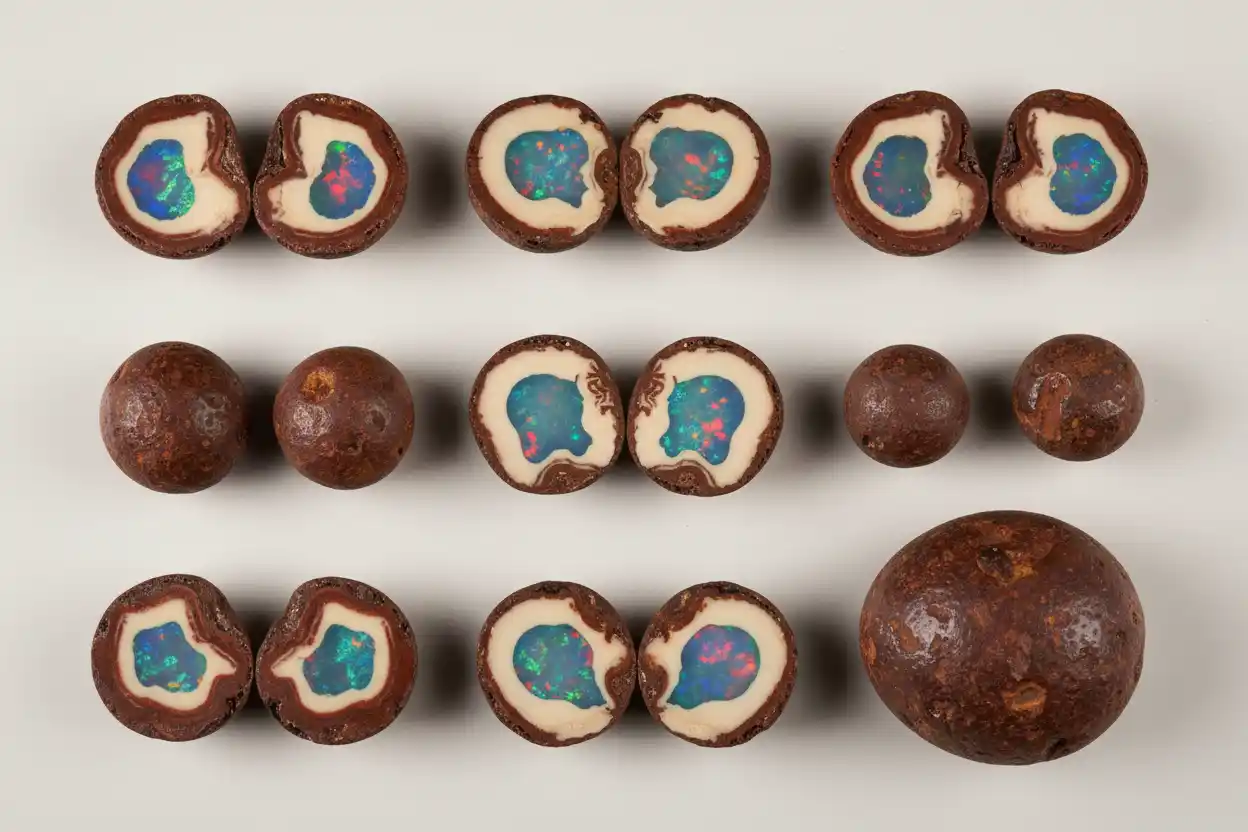
Yowah opal is a locality-specific form of Queensland boulder opal found around Yowah and the nearby Black Gate field. Its most distinctive form, the Yowah Nut, develops inside rounded ironstone concretions that may reveal precious opal veins, kernels, rings and picture-like patterns when sawn or split.
Not every Yowah Nut contains gem color, and not every opal from Yowah has a nut form. The locality also produces ironstone matrix and seam material that belongs to the wider opal family and the broader category of boulder opal.
Yowah Opal at a Glance
| Property | Yowah Opal |
|---|---|
| Material type | Locality-specific Australian boulder and matrix opal |
| Opal composition | Hydrated silica, SiO₂·nH₂O |
| Host material | Ironstone concretion or iron-rich sedimentary matrix |
| Typical forms | Yowah Nuts, ironstone matrix opal, seams, veins and patterned boulder pieces |
| Body colors | Colorless, white, cream, gray, honey, brown and dark brown |
| Play-of-color | Blue, green, yellow, orange, red, violet and multicolored |
| Crystal system | Amorphous opal within polymineralic ironstone |
| Luster | Vitreous to waxy |
| Transparency | Transparent opal through opaque ironstone |
| Refractive index | Opal portion commonly about 1.37–1.47 |
| Specific gravity | Opal near 2.15; whole pieces vary and are heavier because of ironstone |
| Mohs hardness | Opal approximately 5–6.5; matrix hardness varies |
| Cleavage | None in opal |
| Tenacity | Brittle |
| Common cuts | Free-form cabochons, polished nut halves, pairs, pendants and display specimens |
| Main care concern | Thin opal seams can chip or craze, while heat, impact and undisclosed treatment can affect durability |
What Is Yowah Opal?
Yowah opal identifies material from the western Queensland opal field around the town of Yowah.
The classic Yowah Nut is a rounded or oval ironstone concretion, commonly ranging from small pebble size to larger lemon-like forms. Precious opal can occupy its center, fill cracks or form irregular rings and networks through the ironstone.
Some nuts contain only common opal, potch, sand or solid ironstone. Miners may open large numbers before finding one with desirable play-of-color.
Yowah also produces matrix opal in which fine precious opal occurs throughout iron-rich host material. This appearance can differ from the cleaner veins seen in classic boulder opal.
The complete family-wide classification remains with the types of opal guide, while this page owns the locality, Yowah Nut, pattern and market intent.
Why Is It Called a Yowah Nut?
The name combines the Yowah locality with the concretion’s rounded, nut-like appearance.
From the outside, an uncut nut may look like an ordinary brown ironstone pebble. Once cut, it can reveal concentric patterns, cream opal, dark ironstone and flashes of spectral color.
Yowah Nut is a locality-linked trade and geological name rather than a separate mineral species. The opal remains hydrated silica, while the supporting material consists of iron-rich host rock.
A generic boulder opal from another Queensland field should not be called a Yowah Nut merely because it has a rounded shape.
Yowah Nut, Boulder Opal and Matrix Opal
Yowah Nut Opal
A true Yowah Nut forms inside a rounded ironstone concretion from the Yowah field. Its opal may occur as a central kernel, thin seams, irregular veins or concentric layers.
Cutters commonly polish one or both halves, preserving the complete pattern rather than extracting only the precious opal.
Yowah Boulder Opal
Boulder opal is precious opal naturally attached to ironstone. At Yowah, some material occurs in broader seams or irregular boulders rather than self-contained nuts.
The ironstone backing is natural and should not be confused with an assembled opal doublet.
Yowah Matrix Opal
Matrix opal contains many small opal areas distributed through the host rock. Fine material can display scattered pinfire, broad flashes or a luminous network across the surface.
Some matrix material is naturally dark enough to show good contrast. Porous, pale matrix may instead receive sugar-and-acid treatment to darken the host.
Black Gate Opal
Black Gate is a nearby field included within the broader Yowah mining area. Material from the locality may have a dark ironstone background and vivid play-of-color.
Black Gate is a geographic trade name, not a mineral species or guaranteed quality grade.
Fairy Opal
Fairy opal is a trade name used for fine precious opal dispersed through porous sandstone or matrix. Dealers may darken this material with sugar-and-acid treatment and seal it to make the color more visible.
It should not be confused with an untreated solid Yowah Nut. Treatment disclosure is essential whenever the fairy or treated matrix label appears.
Colors and Play-of-Color
Yowah opal can display every spectral color. Blue and green are common, while strong orange and red substantially increase value.
Play-of-color patterns include pinfire, rolling flash, broad flash, mosaic, ribbon and irregular patch patterns.
The ironstone can create natural brown, chocolate, red-brown and nearly black backgrounds. Cream, honey and gray potch may separate bright color areas.
Some pieces resemble miniature landscapes, maps, rivers or abstract paintings. These picture-like patterns add value even when the total area of precious opal is limited.
A dark body appearance should not automatically be classified as black opal. Black opal grading focuses on the opal’s body tone, while Yowah boulder opal often derives much of its darkness from ironstone matrix.
How Yowah Opal Forms
Yowah lies in western Queensland’s sedimentary opal fields. Opal formed within weathered Cretaceous rocks during long periods of groundwater movement and seasonal chemical change.
Silica-bearing water moved through fractures, pores and cavities in sandstone and ironstone. As conditions changed, hydrated silica precipitated as common or precious opal.
Iron-rich concretions had already formed or developed alongside the mineralization process. Opal entered cracks, central cavities and concentric structural zones within those rounded bodies.
The precise timing and chemistry remain complex, and not every concretion received enough ordered silica to create play-of-color.
Precious opal forms when silica spheres develop a sufficiently regular arrangement to diffract visible light. Irregular arrangements produce common opal or potch without spectral flashes.
The resulting combination of natural ironstone support and precious silica explains why Yowah opal belongs to the boulder family while preserving a distinctive nut-like structure.
The Yowah and Black Gate Fields
Yowah is part of Queensland’s western opal fields, located in the state’s arid southwest.
The field remains associated with small-scale miners, fossickers, local cutters and seasonal visitors. Production continues, although individual pockets and claims vary greatly in yield.
Black Gate lies within the broader Yowah area and produces dark ironstone material known for dramatic color contrast.
Unlike an underground deposit with uniform ore, Yowah mining is highly selective. Miners follow ironstone-bearing layers, extract potential nuts and then test or cut them individually.
The low success rate contributes to market value. A parcel of ordinary-looking nuts can yield few stones with worthwhile precious opal.
Internal Features and Pattern Types
Ironstone boundaries form the dominant internal structure. Brown limonite- and goethite-rich areas surround opal seams and pockets.
Common opal or potch may appear white, gray, cream or honey-colored. It can support precious areas or separate them into narrow ribbons.
Natural fractures may cross both the opal and ironstone. Some fractures are stable and visually integrated, while others can open during cutting or wear.
Sand grains and porous matrix can create uneven texture. Resin or varnish may collect within these areas if the stone has been sealed.
Play-of-color may follow curved fractures, concentric rings or irregular cavities. Consequently, two halves of the same nut can produce complementary but not identical patterns.
Some stones display transparent crystal-opal areas over dark ironstone. The background can intensify color without requiring artificial backing.
Identifying Genuine Yowah Opal
A genuine Yowah boulder opal should show a natural, irregular boundary between opal and ironstone. The opal may penetrate fractures, surround grains or form uneven islands within the host.
A glued doublet typically shows a flatter, more continuous cement plane between two layers. The distinction is explained in gemstone doublets and triplets.
The opal portion commonly gives a spot refractive-index reading near 1.44, although ironstone prevents reliable measurement across much of the surface.
Specific gravity is not directly comparable with solid opal because dense ironstone adds substantial weight.
Magnification may reveal natural sand grains, iron oxides, potch, irregular opal boundaries and polishing texture.
The practical warning signs in real versus fake opal apply, but locality proof also requires trustworthy provenance.
A laboratory can identify natural boulder opal and detect many treatments. It may not always prove the exact Yowah claim without mining records or a reliable chain of custody.
Yowah Opal Versus Ordinary Boulder Opal
All Yowah Nuts belong broadly to the boulder-opal family, but not all boulder opal comes from Yowah.
Other Queensland fields commonly produce opal in flat seams, veins and irregular ironstone boulders. Yowah’s rounded concretions and intricate internal rings are more locality-specific.
Boulder-opal buying standards remain relevant, so consult the dedicated boulder opal buying guide for broader assessment.
However, Yowah pieces receive additional value for nut form, complete pattern, matching halves and documented origin.
Yowah Opal Versus Black Opal
Black opal generally refers to precious opal with a dark natural body tone, particularly material associated with Lightning Ridge.
Yowah opal frequently looks dark because of natural brown or black ironstone behind or beside the opal.
A dark ironstone base does not convert a boulder opal into solid black opal. Sellers should describe the material as Yowah boulder or matrix opal rather than using the higher-value black-opal label inaccurately.
Yowah Opal Versus Doublets and Triplets
Solid Yowah boulder opal includes opal and naturally attached ironstone formed together geologically.
A doublet consists of a thin opal layer cemented to a separate backing. A triplet adds a transparent cap over the opal.
Look for a straight glue line, uniform backing, transparent cap or bubbles within adhesive.
Natural ironstone boundaries are usually irregular and penetrate the opal in ways that a manufactured layer does not.
The real-versus-assembled distinction strongly affects value because solid Yowah opal typically commands more than an imitation or composite of similar face-up appearance.
Treatments, Synthetics and Imitations
Most high-quality Yowah boulder opal is sold as natural solid material without color treatment.
Sugar-and-acid treatment may darken porous matrix opal. Sugar enters the pores, and acid carbonizes it, producing a darker background that makes play-of-color more visible.
The treated material may then receive resin, varnish or another sealant. Proper descriptions should disclose both darkening and sealing.
Clear resin can fill cracks or strengthen porous ironstone. Coatings may add gloss or conceal a rough surface.
Doublets and triplets can imitate Yowah boulder opal. Manufactured synthetic opal may also be attached to ironstone-like backing.
Plastic, glass and resin products can reproduce broad colors but usually lack the irregular mineral boundaries and natural opal microstructure.
The dedicated treated opal guide retains full treatment-detection intent, while lab-grown versus natural gemstones explains why synthetic opal and imitation glass are not the same.
Cutting and Polishing Yowah Nuts
Cutting a Yowah Nut requires judgment because its exterior rarely reveals exactly where the precious opal lies.
A cutter may saw through the center to produce matching halves, remove one side to expose a kernel or follow an external color trace into the concretion.
Thin seams can disappear if too much material is removed. Conversely, leaving excessive ironstone can create a heavy stone with limited visible opal.
Free-form cabochons preserve natural patterns more effectively than standardized ovals. Matching pairs are particularly attractive when the two halves show related rings or color areas.
The opal and ironstone polish differently. Soft opal may undercut beside harder or more granular matrix, so the lapidary must use controlled pressure and gradual abrasive steps.
Dry grinding should be avoided because silica-bearing dust creates a respiratory hazard and heat can damage opal.
Durability and Jewelry Suitability
Opal measures approximately 5–6.5 on the Mohs scale. Ironstone may support the precious layer but does not prevent surface scratching.
The gemstone hardness chart provides comparison with quartz, sapphire and other jewelry materials.
Boulder opal can be more structurally supported than a thin unsupported solid opal because the natural matrix acts as a backing.
Nevertheless, the opal seam remains brittle. Impacts can chip exposed edges or separate material along natural fractures.
The distinction in gemstone toughness versus hardness explains why a supported opal can still break despite moderate hardness.
Pendants and earrings offer the safest regular-wear options. The opal necklace guide and opal earrings guide cover those formats separately.
A well-designed opal ring should use a protective bezel or low-profile setting. Bracelets require the additional caution discussed in the opal bracelet guide.
Yowah Opal Prices in 2026
Yowah opal is usually priced by piece rather than simple carat weight because ironstone contributes much of the mass.
Low-grade rough slices and common-opal nuts commonly retail for approximately $20–$100.
Commercial polished nuts and cabochons with modest blue or green color often range from $75–$500.
Fine stones with bright multicolored play-of-color, attractive picture patterns or strong matching halves commonly sell for $500–$2,500.
Exceptional collector Yowah Nuts can reach approximately $3,000–$10,000 or more. Current specialist listings include individual polished pieces around $4,500 and matched collector material around $5,500.
Large amounts of ironstone do not automatically increase value. Brightness, color range, pattern, opal coverage, condition and workmanship matter more than gross weight.
The broad market context remains with the opal price guide and the more specific boulder opal price guide.
What Determines Yowah Opal Value?
Brightness is usually the strongest factor. Vivid color visible under ordinary movement and moderate lighting commands more than weak flashes seen only under a spotlight.
Red and orange play-of-color can add a premium, especially when combined with blue and green rather than appearing as isolated pinpoints.
Pattern influences collector demand. Concentric rings, riverlike seams, landscape scenes and well-balanced ironstone areas can make one stone memorable.
The proportion of attractive face-up opal matters more than the percentage of total material by weight.
Matching halves receive premiums when both show strong, complementary patterns.
Cracks, crazing, unstable matrix and poor polishing reduce value. Treatment and assembly status also change the appropriate pricing tier.
Documented Yowah or Black Gate origin can add value, particularly when accompanied by mining or cutting history.
Buying Guidance
Request photographs and video of the stone completely dry. Many rough sellers photograph Yowah slices wet because moisture temporarily reveals the likely polished appearance.
Wet images can also conceal fractures, porous matrix and dull areas. A seller should state clearly when photographs show wet rough.
Ask whether the piece is solid boulder opal, matrix opal, sugar-treated material, a doublet or a triplet.
Inspect the side profile for glue lines and transparent caps. Natural ironstone should merge irregularly with the opal.
Check the opal’s thickness at vulnerable edges. A bright but paper-thin seam can chip more easily than a supported central area.
Compare face-up dimensions rather than weight alone. Dense ironstone makes large carat numbers less meaningful than they are for solid transparent gems.
For an expensive purchase, request an independent laboratory report and documented Yowah provenance. The general opal buying guide retains seller, grading and documentation checks.
Cleaning, Water, Heat and Storage
Clean Yowah opal with lukewarm water, mild soap and a soft cloth or brush. Rinse briefly and dry gently.
The material-specific procedure appears in how to clean boulder opal jewelry, while broader care remains with how to clean opal jewelry.
Do not use ultrasonic or steam cleaners. Heat and vibration can extend fractures, loosen filled areas and damage opal.
Brief water contact is normally acceptable for sound untreated boulder opal, but prolonged soaking is unnecessary. Resin, varnish, adhesive and treated matrix may respond differently.
The broader water-safe crystal guide should therefore be adapted to the individual stone’s construction.
Avoid sudden transitions between very hot and cold environments. Rapid temperature change can create stress between the opal and ironstone.
Ordinary daylight is generally safe, but prolonged exposure to hot direct sunlight can dehydrate opal and damage sealants. The sunlight-fading guide provides additional display context.
Store each piece in a padded compartment away from harder gems. Avoid extremely dry, heated locations and inspect older stones periodically for new crazing.
Meaning and Symbolism
Modern wearers often associate Yowah opal with hidden potential, resilience and the discovery of value beneath an ordinary exterior.
The Yowah Nut’s plain ironstone shell and colorful interior naturally encourage symbolism involving patience, curiosity and looking beyond first impressions.
Its combination of solid earth-toned matrix and changing spectral color also inspires personal interpretations involving stability balanced with creativity.
These meanings are contemporary cultural, spiritual or personal associations rather than scientifically demonstrated effects.
The broader opal color meaning guide explores how different flashes and body colors receive symbolic interpretations. Any health-related claims should remain within the belief-framed limits explained in opal healing properties.
Frequently Asked Questions
1. What is a Yowah Opal Nut?
A Yowah Nut is a rounded ironstone concretion from the Yowah field that may contain common or precious opal in its center, cracks or concentric layers.
2. Is every Yowah Nut valuable?
No. Many contain little or no precious opal. Value depends on brightness, color pattern, opal coverage, condition and cutting.
3. Is Yowah opal a type of boulder opal?
Yes. Yowah opal belongs broadly to the Queensland boulder-opal family because precious opal remains naturally attached to ironstone.
4. Is the brown backing on Yowah opal artificial?
Usually not. Genuine Yowah boulder opal has natural ironstone matrix. A separate flat backing or glue line may instead indicate a doublet.
5. What is Black Gate opal?
Black Gate opal comes from a locality within the wider Yowah field and is known for dark ironstone backgrounds and vivid color.
6. What is fairy opal?
Fairy opal is a trade name for fine opal dispersed through porous sandstone or matrix. Much commercial material is sugar-and-acid treated and sealed.
7. How can treated Yowah matrix opal be identified?
A dark porous background, concentrated carbon-like coloration, resinous surface or treatment disclosure may indicate sugar-and-acid darkening and sealing. Laboratory testing provides stronger confirmation.
8. Why are Yowah Opal Nuts cut in half?
Sawing through a nut reveals its internal opal pattern and can produce matched halves for specimens, pendants or paired jewelry.
9. Is Yowah opal suitable for everyday rings?
It can work in a protective bezel, but repeated impacts, harsh cleaners and temperature changes can damage exposed opal seams.
10. Can Yowah opal go in water?
Brief gentle washing is normally safe for untreated solid boulder opal. Avoid prolonged soaking when treatment, resin, backing or glue may be present.
11. How much does Yowah opal cost?
Commercial pieces may cost $75–$500, while fine stones commonly reach $500–$2,500. Exceptional collector nuts can sell for several thousand dollars.
12. Does Yowah opal have scientifically proven healing properties?
No. Its symbolism may hold personal meaning, but scientific evidence does not establish medical, emotional or metaphysical healing effects.
Yowah opal does not offer the predictable yield of a transparent crystal deposit. Its appeal comes from uncertainty: an ordinary ironstone nut can remain empty, reveal quiet cream-colored potch or open into a complex natural picture illuminated by precious color.
Yowah opal appears in Crystals That Start With Y and Gemstones That Start With Y.