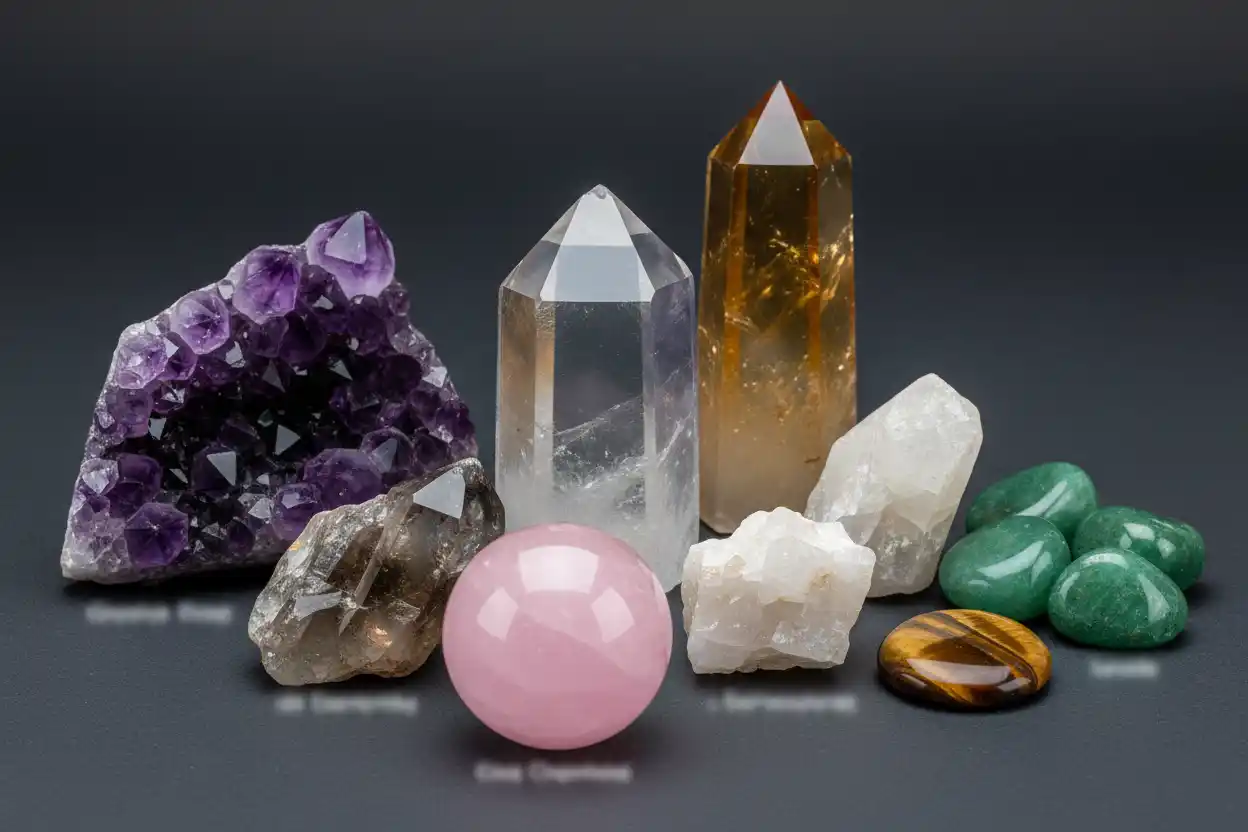
Quartz Types, Properties, Identification & Meaning
Quartz is a silicon-dioxide mineral with the formula SiO₂ and one of the most abundant mineral components of Earth’s continental crust. It occurs as transparent crystals, massive veins, microscopic grains, fibrous chalcedony, banded agate, opaque jasper, sand, sandstone, and countless inclusion-rich or color-zoned gem materials.
The Quartz family extends far beyond clear six-sided points. Amethyst, Citrine, Smoky Quartz, Rose Quartz, Prasiolite, Chalcedony, Agate, Jasper, Aventurine, Tiger’s Eye, and many other commercial stones owe their identity primarily to crystalline silica.
Quartz at a Glance
| Property | Quartz |
|---|---|
| Material type | Silicon-dioxide mineral and major rock-forming mineral |
| Composition | SiO₂ |
| Mineral classification | Framework silicate by structure; oxide by chemistry |
| Common colors | Colorless, white, purple, yellow, orange, brown, black, pink, green, red, blue-gray, and multicolored |
| Crystal system | Trigonal for ordinary low-temperature alpha quartz |
| Crystal family | Hexagonal |
| Typical habit | Six-sided prisms with rhombohedral terminations, massive veins, granular rock-forming grains, drusy crusts, fibrous aggregates, nodules, geodes, and cryptocrystalline masses |
| Luster | Vitreous; waxy in many chalcedony varieties |
| Transparency | Transparent to opaque |
| Mohs hardness | 7 |
| Cleavage | None |
| Tenacity | Brittle |
| Fracture | Conchoidal to uneven |
| Specific gravity | Approximately 2.65 |
| Refractive index | Approximately 1.544–1.553 |
| Optical character | Uniaxial positive with birefringence near 0.009 |
| Common uses | Gemstones, watches, electronics, oscillators, optics, glass, ceramics, foundry sand, construction, abrasives, laboratory equipment, silicon production, and mineral collections |
| Main care concern | Chipping, internal fractures, color instability in some varieties, undisclosed heat or irradiation, coatings, glass imitations, and respirable crystalline-silica dust during cutting |
What Quartz Is
Quartz consists of silicon and oxygen arranged in a continuous three-dimensional framework.
Every silicon atom sits inside a tetrahedron of four oxygen atoms. Each oxygen is shared between neighboring tetrahedra, producing the overall SiO₂ formula.
This strong framework contributes to Quartz’s hardness, chemical resistance, lack of cleavage, and widespread geological survival.
Quartz is not the only mineral made from silicon dioxide. Tridymite, cristobalite, coesite, stishovite, and other polymorphs have the same overall chemistry but different atomic arrangements.
Those materials are separate mineral species or high-pressure and high-temperature phases, not color varieties of ordinary Quartz.
Likewise, natural opal is hydrated amorphous silica rather than crystalline Quartz.
The parent classification in types of gemstones explains why one chemical formula can occur in several structurally distinct materials.
Alpha Quartz and Beta Quartz
Ordinary Quartz at Earth’s surface is alpha quartz, sometimes called low Quartz.
It has trigonal symmetry and remains stable below approximately 573°C at ordinary atmospheric pressure.
Above that temperature, the structure changes reversibly into beta quartz or high Quartz.
Beta quartz has higher symmetry and usually occurs only while the material remains hot.
As igneous rock cools, beta quartz transforms into alpha quartz without changing its SiO₂ composition.
The transformation involves a structural and volume change. It can contribute to cracking or altered crystal shape when cooling passes through the transition.
Many natural crystals preserve an external habit inherited from growth under high-temperature conditions even though their present structure is alpha quartz.
Heating a gemstone to this transition is unnecessary and dangerous. It can cause fractures, destroy color, and damage inclusions.
Quartz Crystal Symmetry
Quartz belongs to the trigonal system but commonly develops an apparently six-sided prismatic habit.
The hexagonal-looking exterior reflects its membership in the hexagonal crystal family.
A typical crystal has six prism faces and termination faces formed by positive and negative rhombohedra.
Right-handed and left-handed Quartz structures exist. They are mirror-related forms produced by the spiral arrangement of tetrahedra.
The structural handedness contributes to optical rotation and the way Quartz responds to polarized light.
Not every crystal develops a perfect pencil shape. Space, temperature, fluid supply, contact with surrounding minerals, and repeated growth stages can create tabular, tapered, scepter, skeletal, curved, drusy, split, and distorted habits.
Quartz Twinning
Twinning is common in Quartz and affects both natural crystals and industrial material.
Dauphiné twinning relates two crystals of the same handedness through a rotation around the c-axis.
Brazil-law twinning combines right- and left-handed structures and is common in Amethyst and many hydrothermal crystals.
Japan-law twins form two crystals meeting at a distinctive angle and can create heart-shaped or V-shaped specimens.
Twinning may remain invisible without optical or X-ray examination.
In gemstones, complex twinning can influence color zoning, fracture behavior, and the response to certain treatments.
In industrial synthetic Quartz, controlling defects and twin boundaries helps produce material with predictable electrical performance.
Macrocrystalline and Microcrystalline Quartz
The gem trade commonly divides Quartz into macrocrystalline and microcrystalline categories.
Macrocrystalline Quartz consists of crystals or grains large enough for their structure to be recognized directly or under ordinary magnification.
Clear rock crystal, Amethyst, Citrine, Smoky Quartz, Rose Quartz, Prasiolite, Ametrine, and included Quartz belong broadly within this category.
Microcrystalline Quartz consists of crystals too small to distinguish easily without high magnification or specialized analysis.
Chalcedony is the principal microcrystalline and fibrous Quartz-related gem material. It commonly contains both Quartz and moganite arranged in extremely fine intergrowths.
Agate, Jasper, Carnelian, Onyx, Chrysoprase, Bloodstone, and many other trade varieties fall within the Chalcedony branch.
The boundary can be structurally complex. A geode may contain an outer Chalcedony layer and an inner cavity lined with large Quartz crystals.
Clear Quartz and Rock Crystal
Clear Quartz is transparent colorless macrocrystalline Quartz.
The traditional term rock crystal distinguishes natural clear Quartz from glass and other transparent materials.
Pure Quartz is colorless, but most crystals contain growth zoning, fluid inclusions, mineral grains, healed fractures, or microscopic defects.
Large clear zones can be faceted into collector gems, carved into objects, or used in optical applications.
Natural clear Quartz is abundant enough that size alone rarely creates extreme gem value.
Crystal form, clarity, inclusion aesthetics, locality, and exceptional cutting usually matter more than carat weight.
The dedicated Clear Quartz page owns its symbolism, buying concerns, and variety-specific use rather than repeating them in this family guide.
Amethyst
Amethyst is purple macrocrystalline Quartz.
Its color involves iron-related defects modified by natural irradiation.
Hue ranges from pale lilac to deep reddish purple, blue-purple, and purple with color zoning.
Heat can transform some Amethyst into yellow, orange, brown, green, or colorless Quartz.
Most commercial Citrine-like geodes began as Amethyst and were heated, while natural Citrine forms through a different geological color history.
Amethyst’s market, treatments, origin, and quality factors belong on its dedicated page.
Citrine
Citrine is yellow-to-orange macrocrystalline Quartz.
Natural Citrine is less common than Amethyst and commonly shows pale yellow, smoky yellow, golden, or brownish color.
Much commercial dark orange Citrine is heat-treated Amethyst.
Irradiated and heated Quartz can also produce yellow or green-yellow products marketed under names such as lemon Quartz.
Color treatment does not make the material synthetic, but it must be disclosed when it affects value.
Citrine’s detailed natural-versus-treated distinction belongs on its own identification and buying pages.
Smoky Quartz
Smoky Quartz ranges from pale gray-brown to dark brown and nearly black.
Its color develops when natural or artificial radiation interacts with aluminum-related defects in the Quartz lattice.
Very dark material may be called morion.
Heating can lighten or remove smoky color.
Some dark stones are irradiated artificially, while others formed through natural geological radiation.
Visual appearance alone may not establish the source of the color.
Rose Quartz
Rose Quartz is the familiar massive pale-to-medium pink Quartz variety.
Its color is associated with microscopic mineral inclusions and structural features rather than one simple trace element in every sample.
Massive Rose Quartz commonly appears cloudy and is cut into beads, cabochons, spheres, carvings, and decorative objects.
Rare transparent euhedral pink Quartz crystals may have a different color mechanism and are sometimes distinguished as pink Quartz rather than conventional Rose Quartz.
Some Rose Quartz can fade under prolonged intense light.
Its color, identification, pricing, and treatment concerns remain separate from this family overview.
Prasiolite and Green Quartz
Prasiolite is transparent green Quartz.
Most commercial material is produced by heating certain Amethyst or through related treatment combinations.
Natural green Quartz exists but is uncommon.
The misleading name green Amethyst remains common in jewelry marketing, although Amethyst is purple by definition.
Green Quartz should be described through actual color and treatment rather than implying that every stone formed naturally.
Ametrine
Ametrine contains visible purple Amethyst and yellow-to-orange Citrine zones within one Quartz crystal.
The colors occupy different growth sectors and reflect variations in iron oxidation and treatment history.
Natural commercial Ametrine is strongly associated with Bolivia’s Anahí Mine.
Laboratory treatment can create or modify bicolored effects.
Its purple-yellow identity is covered on the separate Ametrine guide.
Chalcedony
Chalcedony is a microcrystalline, commonly fibrous silica material composed largely of Quartz and moganite.
It usually has a waxy luster and can be translucent or opaque.
Blue Chalcedony, Chrysoprase, Carnelian, Sard, Onyx, Agate, Jasper, and several other materials belong to this broad branch.
Chalcedony commonly forms in volcanic cavities, sedimentary nodules, veins, replacement deposits, and low-temperature hydrothermal environments.
Its microscopic structure, porosity, and frequent banding create treatment concerns different from those of transparent macrocrystalline Quartz.
Agate
Agate is banded or patterned Chalcedony.
It commonly develops when silica-rich fluids deposit repeated layers inside cavities, fractures, or nodules.
Bands can be straight, curved, concentric, fortification-like, plume-shaped, mossy, dendritic, or irregular.
Agate’s porosity makes dye treatment widespread.
Bright blue, green, pink, purple, and black material may be natural, dyed, heated, or otherwise altered depending on the deposit.
The extensive agate family owns its own type, treatment, identification, and buying intent.
Jasper
Jasper is an opaque silica-rich ornamental material containing microcrystalline Quartz, Chalcedony, iron oxides, clay, and other inclusions.
Red, yellow, brown, green, black, and multicolored varieties occur.
Commercial jasper naming is less precise than mineral species naming. Some stones carrying a jasper label are silicified volcanic or sedimentary rocks rather than uniform Chalcedony.
The parent Jasper page owns that classification problem, while the Quartz family guide establishes its silica relationship.
Aventurine and Tiger’s Eye
Aventurine is Quartz or Quartz-rich rock containing reflective mineral platelets that produce aventurescence.
Green Aventurine commonly contains fuchsite mica, while other colors may involve hematite, goethite, or additional inclusions.
Tiger’s Eye is a chatoyant fibrous Quartz-rich material associated with altered amphibole structures.
Its moving line of light comes from aligned fibers rather than transparency or ordinary faceting.
Both materials illustrate how inclusions and textures can become more important than the host Quartz’s original clarity.
Included Quartz Varieties
Quartz can enclose a wide range of minerals, fluids, gases, petroleum, clay, and earlier growth stages.
Rutilated Quartz contains needle-like rutile.
Tourmalinated Quartz contains tourmaline crystals, commonly black schorl.
Phantom Quartz preserves an earlier crystal-growth outline.
Garden Quartz contains scenic mineral inclusions commonly marketed as lodolite.
Included Quartz should not be identified through color or pattern alone. Similar-looking needles can belong to rutile, tourmaline, actinolite, amphibole, goethite, or another mineral.
Laboratory confirmation adds value when a rare inclusion species is part of the sales claim.
Druzy and Spirit Quartz
Druzy Quartz is a surface coating of small sparkling crystals lining a cavity, fracture, or earlier mineral surface.
The term describes crystal size and habit rather than one color variety.
Spirit Quartz consists of a larger central Quartz crystal covered by numerous smaller crystals, most famously from South Africa.
These habits show how later Quartz growth can transform an earlier crystal or matrix surface without changing the SiO₂ identity.
They require more careful cleaning than smooth polished Quartz because fine crystal points trap dust and break under pressure.
How Quartz Forms
Quartz forms across all three major rock groups.
In igneous rocks, it crystallizes from silica-rich magma. Granite, granodiorite, rhyolite, and pegmatite commonly contain Quartz.
Pegmatites can produce enormous crystals because water-rich residual melt allows ions to move rapidly and grow coarse minerals.
Hydrothermal veins form when hot silica-bearing fluids move through fractures and deposit Quartz as temperature, pressure, and chemistry change.
These veins may contain gold, silver, sulfides, carbonates, fluorite, and other ore minerals.
In sedimentary environments, resistant Quartz grains accumulate as sand and become sandstone.
Silica can also precipitate as Chalcedony, Agate, chert, nodules, and fossil replacements.
During metamorphism, Quartz recrystallizes under heat and pressure. Sandstone can become Quartzite, while silica-rich fluids form veins within schist, gneiss, marble, and other rocks.
Quartz in Rocks and Sediment
Quartz’s hardness and chemical resistance help it survive weathering.
Feldspar and many mafic minerals break down into clay, iron oxides, and dissolved components more readily.
Quartz grains therefore become concentrated in river sediment, beaches, dunes, and sandstone.
Rounded grains record transport and abrasion, while angular grains indicate a shorter journey from their source.
Quartz cement can bind sandstone grains during burial.
Metamorphism then recrystallizes grains into an interlocking Quartzite texture.
Not every white rock is Quartz, and not every sand is pure silica. Feldspar, shell fragments, volcanic minerals, heavy minerals, and rock fragments may remain mixed with Quartz.
Piezoelectric and Pyroelectric Behavior
Quartz is piezoelectric.
Mechanical stress applied in certain directions produces an electrical charge across the crystal.
The inverse effect also occurs: an applied electrical field causes a small mechanical deformation.
A properly cut Quartz plate can therefore vibrate at a highly stable frequency when placed in an electronic circuit.
This property supports clocks, watches, computers, radios, communication devices, sensors, filters, and precision instruments.
Quartz is also pyroelectric under changing temperature conditions because its polar response changes.
Industrial electronics require crystals with controlled orientation, purity, and defect levels.
Natural Quartz was historically important, but hydrothermal synthetic Quartz now supplies much of the electronic market because manufacturers can produce consistent large crystals.
Industrial Uses
Quartz sand is a major raw material for glass.
It also enters concrete, mortar, ceramics, foundry molds, abrasives, paint, adhesives, and filtration systems.
High-purity Quartz is processed for fused-silica glass, optical equipment, laboratory ware, semiconductor crucibles, solar-silicon production, and specialized high-temperature applications.
Quartz crystals serve in oscillators, pressure sensors, frequency-control devices, and electronic filters.
Silica is reduced industrially to produce silicon metal and ferrosilicon.
The word quartz is also used commercially for engineered countertops made from crushed Quartz, pigments, and polymer resin.
Those countertops are manufactured composites rather than single natural Quartz crystals.
Their cutting dust can contain very high levels of respirable crystalline silica and requires industrial controls.
How to Identify Quartz
Quartz has a Mohs hardness of 7 and scratches ordinary glass.
It has no cleavage and breaks with curved conchoidal surfaces.
Specific gravity is approximately 2.65.
Transparent Quartz has refractive indices around 1.544–1.553 and birefringence near 0.009.
It is uniaxial positive and commonly shows a bull’s-eye interference figure under suitable polarized-light testing.
Natural crystal habit includes six-sided prisms and rhombohedral terminations.
Magnification may reveal fluid inclusions, mineral crystals, growth zoning, twinning, healed fractures, or color-sector boundaries.
Raman spectroscopy identifies Quartz reliably and separates it from glass, calcite, fluorite, topaz, beryl, and many other materials.
The broader non-destructive workflow appears in how to identify crystals.
Quartz versus Glass
Glass and Quartz can both be colorless, transparent, vitreous, and conchoidally fractured.
Glass is amorphous, while Quartz has a crystalline structure.
Quartz is doubly refractive. Ordinary glass is singly refractive, although strain can create anomalous optical patterns.
Round gas bubbles, flow lines, mold seams, and a lower hardness often reveal glass.
Natural Quartz can also contain rounded fluid inclusions, so one apparent bubble does not prove imitation.
Refractive index, polariscope response, spectroscopy, and magnification provide a stronger conclusion.
Detailed consumer authentication belongs on real versus fake Clear Quartz.
Synthetic Quartz
Synthetic Quartz has the same essential SiO₂ composition and crystal structure as natural Quartz.
Most commercial production uses hydrothermal growth.
A nutrient of crushed silica dissolves in hot alkaline solution under pressure and recrystallizes onto seed plates in a cooler part of the vessel.
Manufacturers control orientation, impurity content, size, and electrical properties.
Synthetic Quartz is essential to electronics and is also used for gemstones.
Amethyst, Citrine-like, green, blue, and colorless synthetic products can enter jewelry markets.
Laboratory growth does not make the material glass. It remains genuine crystalline Quartz with an artificial origin.
The distinction between synthetic, imitation, and natural materials appears in lab-grown versus natural gemstones.
Quartz Treatments
Heat treatment alters many Quartz colors.
Amethyst can become yellow, orange, brown, green, or colorless, depending on the starting material and temperature.
Smoky Quartz can lighten through heating.
Irradiation can create or intensify smoky, green, yellow, black, or other colors before additional heat modifies them.
Dye is common in porous Agate, Chalcedony, and Jasper.
Fracture filling improves apparent clarity or adds color within cracks.
Surface coatings create aura Quartz, mystic effects, metallic iridescence, or intense colors.
Crackle treatment heats and cools Quartz to produce networks of fractures that can absorb dye.
The family-level treatment framework is discussed in treated Clear Quartz identification without duplicating every variety-specific treatment page.
Durability and Jewelry Suitability
Quartz defines hardness 7 on the Mohs scale.
Its position is explained in the gemstone hardness chart.
The mineral has no cleavage, making it less likely than Topaz or Feldspar to split along one preferred plane.
However, Quartz remains brittle and can chip after a sharp impact.
The distinction appears in gemstone toughness versus hardness.
Most sound Quartz varieties are suitable for rings, earrings, pendants, bracelets, necklaces, brooches, carvings, and beads.
Large crystal points require protection at their terminations.
Inclusion-rich, drusy, fractured, filled, or coated material may be less durable than ordinary solid Quartz.
Color stability also differs. Amethyst, Rose Quartz, Prasiolite, and treated stones may fade or change under prolonged intense light or heat.
Current Quartz Asking Prices
Quartz is abundant, so value depends more on variety, color, transparency, inclusions, crystal form, locality, and craftsmanship than on the SiO₂ composition alone.
| Quartz product | Broad July 2026 retail asking range |
|---|---|
| Small common tumbled stone | About $1–$10 |
| Small natural Quartz point | About $3–$30 |
| Palm stone, tower, or small carving | About $10–$60 |
| Standard colorless or Smoky Quartz faceted gem | About $1–$10 per carat |
| Commercial Amethyst or Citrine | About $5–$50 per carat |
| Fine natural-color or unusual included Quartz | About $10–$100 per carat or more |
| Large flawless precision-cut rock crystal | Commonly several hundred dollars total |
| Attractive crystal cluster or locality specimen | About $25–$500 |
| Fine cabinet specimen | About $500–$5,000 |
| Exceptional giant, historic, or museum-quality specimen | Several thousand to tens of thousands of dollars or more |
These are broad family-level asking ranges rather than appraisals or guaranteed resale values.
Specific price intent belongs to each variety’s dedicated page. Amethyst, Citrine, Rose Quartz, Smoky Quartz, Agate, Jasper, and rare included materials follow different markets.
What Gives Quartz Value?
Variety identity establishes the first market.
A clear rock crystal, Amethyst, Citrine, Agate, Jasper, Rutilated Quartz, and rare inclusion specimen cannot be valued through one universal per-carat chart.
Color matters strongly in colored macrocrystalline gems.
Transparency and clarity influence faceted stones, while inclusions can raise value when they create attractive needles, phantoms, landscapes, stars, or moving optical effects.
Crystal form drives specimen value. Sharp undamaged terminations, luster, twinning, matrix, size, and locality all matter.
Cut quality determines brilliance, symmetry, windowing, face-up size, and inclusion presentation.
Natural versus synthetic origin and treatment disclosure affect confidence.
Historic locality, collection provenance, exceptional size, and scientifically unusual inclusions can create collector premiums.
Buying Quartz
Ask which Quartz variety the seller is offering.
The word natural does not explain whether the color is heated, irradiated, dyed, coated, filled, or laboratory grown.
View colored stones under more than one light source.
Inspect crystal points for polished terminations, glued bases, broken tips, resin, and repaired clusters.
Magnification can reveal glass bubbles, coating scratches, dye inside cracks, and filler.
A laboratory report is usually unnecessary for an inexpensive common point but becomes useful for rare natural-color Citrine, valuable inclusion minerals, significant synthetic-versus-natural questions, or unusual provenance.
Quartz appears in the crystals beginning with Q directory and the gemstones beginning with Q directory.
Cleaning and Storage
Clean ordinary solid untreated Quartz with lukewarm water, mild soap, and a soft brush.
Rinse thoroughly and dry with a lint-free cloth.
Ultrasonic cleaning may be suitable for sound homogeneous Quartz but should be avoided when fractures, inclusions, coatings, dye, filler, glue, matrix, or delicate crystal points are present.
Steam creates unnecessary heat risk for colored or treated stones.
Avoid abrupt temperature change.
Store Quartz away from diamond, sapphire, ruby, Topaz, and other harder materials.
Do not place light-sensitive varieties in prolonged direct sunlight.
Drusy clusters and fine points should be stored so their crystal tips cannot strike another object.
Quartz Meaning and Symbolism
Quartz has been used for tools, seals, beads, vessels, carvings, lenses, ornaments, religious objects, and jewelry across many cultures.
Ancient Greek writers connected clear rock crystal with permanently frozen ice, while other traditions developed separate symbolism around Amethyst, Agate, Carnelian, Jasper, and additional silica materials.
No single historical meaning belongs to every Quartz variety or culture.
Modern crystal traditions commonly associate clear Quartz with clarity, focus, amplification, and intentionality.
Colored varieties receive separate interpretations based on hue, transparency, pattern, and historical trade.
Quartz’s piezoelectric behavior is sometimes invoked in metaphysical claims. Its ability to generate electrical charge under mechanical stress is scientifically real, but it does not prove that a worn crystal amplifies thoughts, cures disease, or changes a person’s biological energy.
These meanings remain personal, artistic, cultural, or spiritual interpretations rather than demonstrated medical effects.
Frequently Asked Questions
Is Quartz a mineral or a rock?
Quartz is a mineral with the formula SiO₂. Rocks such as granite, sandstone, Quartzite, and Agate-bearing volcanic material can contain large amounts of Quartz.
Why does Quartz look six sided if it is trigonal?
Quartz belongs to the trigonal system within the hexagonal crystal family, so its common habit develops six prism faces.
What is the difference between alpha and beta Quartz?
Alpha Quartz is the ordinary low-temperature form found at Earth’s surface. Beta Quartz is the higher-temperature structural form stable above about 573°C at ordinary pressure.
What is macrocrystalline Quartz?
It is Quartz whose crystals or grains are large enough to recognize directly, including Clear Quartz, Amethyst, Citrine, Smoky Quartz, and many Rose Quartz forms.
What is microcrystalline Quartz?
It consists of extremely small crystals and includes Chalcedony-related materials such as Agate and Jasper.
Are Agate and Jasper types of Quartz?
They belong to the microcrystalline silica family. Agate is generally banded Chalcedony, while Jasper is opaque silica-rich material containing additional mineral components.
What gives Quartz its different colors?
Trace elements, structural defects, natural radiation, microscopic inclusions, color centers, and treatment can all create color.
Is synthetic Quartz real Quartz?
Yes. Synthetic Quartz has the same essential composition and crystal structure as natural Quartz but grows in a laboratory or factory.
Is most Citrine natural?
Much commercial orange and dark-yellow Citrine is heat-treated Amethyst. Natural Citrine exists but is less common.
Can Quartz scratch glass?
Yes. Quartz has a Mohs hardness of 7 and normally scratches ordinary window glass.
Can Quartz go in water?
Brief washing is generally suitable for solid untreated Quartz. Included minerals, dye, coatings, filler, glue, matrix, and delicate clusters can require more conservative care.
What makes Quartz valuable?
Variety, natural color, clarity, inclusions, crystal form, size, cutting, locality, treatment status, provenance, rarity, and craftsmanship determine value.
Quartz is not merely one clear crystal but a mineral system linking transparent gemstones, microscopic Chalcedony, patterned Agate, opaque Jasper, industrial silica, and precision electronics. The next guide distinguishes Quartz itself from Quartzite, the metamorphic rock created when Quartz-rich sandstone recrystallizes under heat and pressure.
Cutting, drilling, sanding, grinding, or polishing Quartz can generate respirable crystalline-silica dust. Inhalation can cause irreversible lung disease and other serious health effects. Use professional wet methods, effective local exhaust, appropriate respiratory protection, eye protection, protective clothing, and strict dust-control procedures. Never dry-grind Quartz in an occupied indoor space.