Pink Gemstones: Names, Meanings, Properties and Uses
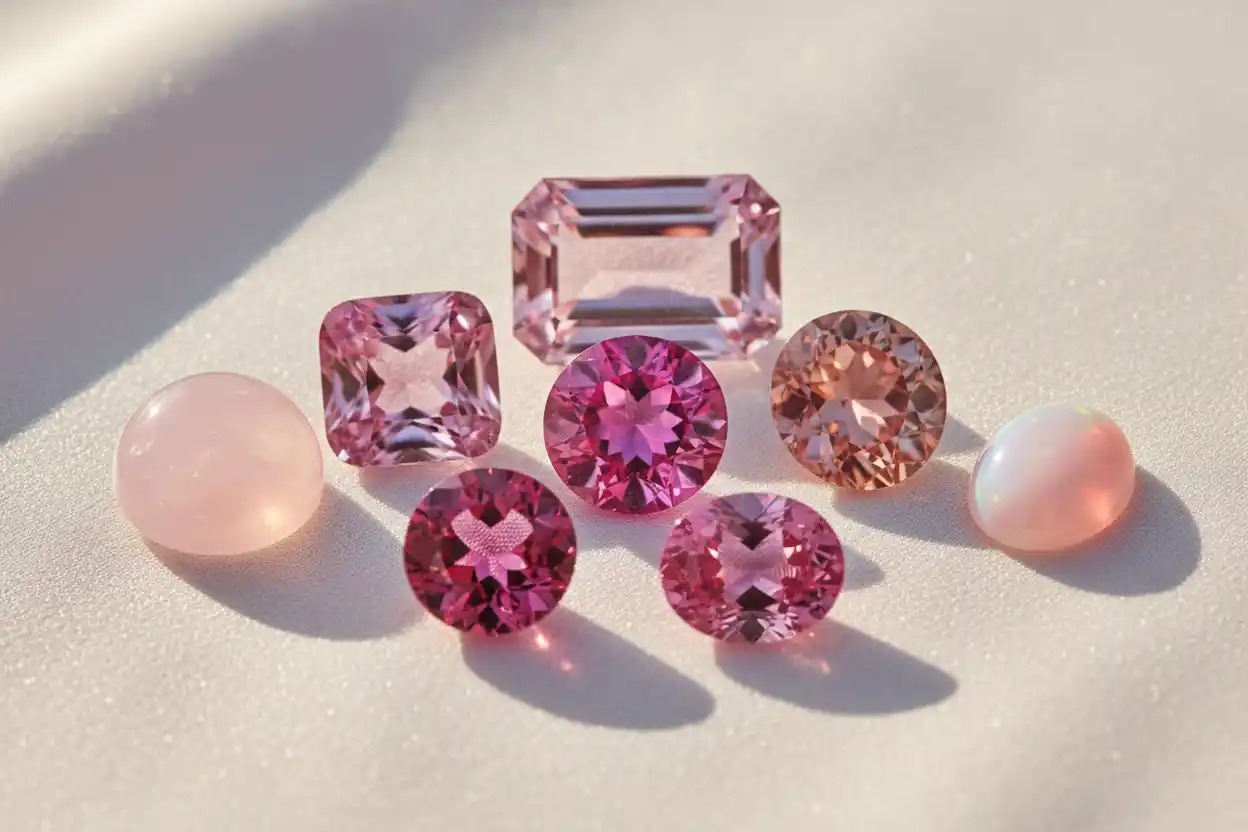
Pink gemstones range from pale translucent rose quartz to vivid pink sapphire, hot-pink spinel and richly saturated tourmaline. Although these materials share a color family, they differ substantially in mineral identity, hardness, transparency, treatment history, value and suitability for daily jewelry.
A pink stone may be a transparent faceted gem, an opaque ornamental material, an organic gem or a manufactured product. Therefore, color alone cannot establish what a gemstone is. Pink sapphire belongs to corundum, morganite belongs to beryl, pink tourmaline may belong to elbaite, and pink opal is hydrated silica with a very different structure and durability profile.
This guide focuses on pink gemstone names, physical characteristics, jewelry uses, treatments and concise symbolism. The pink crystals guide retains the belief-based crystal roundup, meditation ideas and emotional-intention practices. Buyers choosing a center stone for long-term ring wear should use the separate pink engagement-ring gemstones guide.
Pink Gemstones at a Glance
| Pink gemstone | Mineral or material | Approximate Mohs hardness | Typical appearance | Common jewelry use |
|---|---|---|---|---|
| Pink diamond | Diamond | 10 | Pale blush to intense fancy pink | Fine rings and collector jewelry |
| Pink sapphire | Corundum | 9 | Pastel pink to vivid magenta | Daily rings, earrings and pendants |
| Pink spinel | Spinel | 8 | Rose, hot pink, neon pink or lilac-pink | Rings and fine colored-stone jewelry |
| Morganite | Beryl | 7.5–8 | Peach, salmon, blush or rose pink | Large faceted rings and pendants |
| Pink topaz | Topaz | 8 | Pale rose to vivid treated pink | Occasion rings and statement jewelry |
| Pink tourmaline | Commonly elbaite | 7–7.5 | Soft pink to strong purplish pink | Rings, pendants, earrings and crystals |
| Rubellite | Tourmaline trade variety | 7–7.5 | Rich pink-red to purplish red | Fine jewelry and collector stones |
| Pink zircon | Zircon | About 6–7.5 | Bright salmon, rose or purplish pink | Earrings, pendants and careful-wear rings |
| Kunzite | Spodumene | 6.5–7 | Pale pink to violetish pink | Pendants and occasional jewelry |
| Rhodolite garnet | Garnet mixture | About 7–7.5 | Raspberry, rose-purple or pink-red | Rings and everyday colored jewelry |
| Rose quartz | Quartz | 7 | Translucent pale to medium pink | Cabochons, beads and carvings |
| Pink chalcedony | Microcrystalline quartz | About 6.5–7 | Even translucent or opaque pink | Cabochons, beads and carvings |
| Pink opal | Hydrated silica | About 5–6.5 | Soft opaque to translucent pink | Pendants and protected rings |
| Rhodonite | Manganese silicate | About 5.5–6.5 | Pink with black or brown veining | Cabochons and beads |
| Rhodochrosite | Manganese carbonate | About 3.5–4 | Banded pink-white or transparent red-pink | Collector gems and protected pendants |
| Mangano calcite | Manganese-bearing calcite | 3 | Pale waxy or translucent pink | Carvings and display specimens |
| Thulite | Pink zoisite | About 6–6.5 | Opaque mottled rose-pink | Cabochons and ornamental jewelry |
| Pink pearl | Organic gem | About 2.5–4.5 | Soft pink, peach or rose overtone | Earrings and necklaces |
| Pink coral | Organic material | About 3–4 | Uniform salmon to rose pink | Beads, carvings and vintage jewelry |
The hardness figures provide scratch-resistance context, not a complete durability ranking. Cleavage, inclusions, toughness and setting design also affect how safely each gem can be worn.
Pink Diamond
Natural pink diamond is among the rarest and most expensive pink gemstones. Its color may be faint, light, intense, vivid, purplish pink, orangy pink or brownish pink. Unlike many colored gems, the origin of diamond color can be complex, and laboratories may need advanced testing to determine whether a pink color is natural, treated or associated with laboratory growth.
Diamond’s hardness makes it highly resistant to scratching, although diamonds can still chip along vulnerable edges or cleavage directions. Fine natural pink diamonds typically appear in small sizes, and saturation can influence value more strongly than clarity.
Laboratory-grown pink diamonds offer the same fundamental crystal structure and hardness but form through a manufactured process. Some receive post-growth treatment to create or modify color. The laboratory-grown versus natural gemstones guide explains why natural origin, laboratory growth and treatment must be disclosed as separate facts.
Pink diamond commonly symbolizes commitment, rarity and enduring affection. Those associations are cultural rather than physical properties.
Pink Sapphire
Pink sapphire is pink corundum. Its color may range from pale blush to vivid hot pink, purplish pink or orangy pink. When red becomes dominant enough, the stone may be classified as ruby rather than pink sapphire, although the exact commercial boundary is not identical in every market.
With a Mohs hardness of 9, sapphire is one of the strongest practical choices for frequent jewelry wear. It also has excellent toughness and no cleavage, making it suitable for engagement rings, wedding jewelry, bracelets and daily earrings.
Heating is common in sapphire and may improve color or clarity. Diffusion treatment, fracture filling and laboratory growth also occur. Buyers should not treat “pink sapphire” as a complete disclosure without asking whether the material is natural, laboratory-grown and treated.
The sapphire meaning guide covers the family’s identity and symbolism, while types of sapphire retains the wider color and variety structure.
Pink sapphire is associated with loyalty, affection, resilience and promises kept through deliberate action.
Pink Spinel
Pink spinel occurs in pale rose, vivid hot pink, neon-like pink, lilac and pink-red shades. Fine material can display strong brilliance because spinel is singly refractive and often highly transparent.
At Mohs 8, spinel is a durable choice for rings and other frequently worn jewelry. It does not have the same cleavage concerns as topaz or kunzite, although every stone should still be protected from severe impact.
Synthetic spinel is well established and may be encountered in antique and modern jewelry. Therefore, unusually clean or intensely colored stones should be represented with accurate origin disclosure.
The spinel meaning guide owns the complete mineral and symbolism profile. Pink spinel commonly represents renewal, enthusiasm and emotional vitality.
Morganite
Morganite is the pink to orange-pink member of the beryl family. Its color comes from manganese and commonly appears as peach, salmon, champagne-pink, blush or violetish pink.
Morganite often forms in large crystals, so substantial cut stones are available at sizes that would be exceptionally rare in pink sapphire or natural pink diamond. Because the color is often pale, larger stones may show stronger saturation than small calibrated examples.
Heat treatment is very common and may remove yellow or orange components, leaving a purer pink. This treatment is generally stable but should still be disclosed accurately.
Morganite ranks 7.5–8 on the Mohs scale and can be used in rings with care. Windowing is a frequent buying concern because pale material makes a shallow transparent center easy to see.
Its modern symbolism emphasizes patience, mature affection and steady partnership rather than dramatic attraction.
Pink Tourmaline
Pink tourmaline ranges from nearly colorless blush through strong pink, purplish pink and red-pink. Many gem-quality pink tourmalines belong to elbaite, a lithium-rich tourmaline species associated with pegmatites.
Pink and red tourmalines commonly contain more visible inclusions than green and blue varieties. Buyers often accept moderate inclusions when color remains attractive, although surface-reaching fractures require attention.
Heating or irradiation may alter pink tourmaline color, and some fractured stones may be clarity-enhanced. Tourmaline ranks 7–7.5 but has fair toughness and should be protected from high heat and sudden temperature change.
Pink tourmaline symbolizes emotional openness, courage and affectionate communication. The stone does not compel love or guarantee relationship outcomes.
Rubellite
Rubellite is a trade term for richly saturated pink, red, purplish-red or orangy-red tourmaline. Some dealers reserve the name for stones that remain strongly red or pink across different lighting, while others apply it more broadly.
Fine rubellite may show visible inclusions, yet vivid color can make those features commercially acceptable. Large transparent stones with strong saturation can be valuable.
The distinction between pale pink tourmaline and rubellite is commercial rather than a separate mineral-species boundary. A seller should explain the color and quality rather than using the trade name alone as proof of exceptional value.
Rubellite is associated with passionate honesty, emotional depth and affection expressed without manipulation.
Pink Topaz
The topaz guide covers a mineral that can occur in pale pink naturally, although strongly saturated commercial pink topaz may involve treatment.
Topaz has a hardness of 8 but perfect cleavage. A sharp blow or setting pressure in an unfavorable direction can split the stone. Consequently, its hardness should not be interpreted as immunity to breakage.
Pink topaz can be exceptionally clear and available in large sizes. Protective settings are advisable for rings, while earrings and pendants expose it to less impact.
Its symbolism is often connected with joy, affection, generosity and warmth.
Pink Zircon
Zircon is a natural gemstone that should not be confused with cubic zirconia. Pink zircon may appear rose, salmon, peach-pink or purplish pink and can display strong brilliance and fire.
Zircon’s hardness varies by condition and composition, and its facet edges may abrade with wear. High birefringence can make rear facets appear doubled through the gem.
Some zircon colors result from heating. Treatment should be disclosed, particularly when it creates a commercially desirable pink or peach appearance.
Pink zircon is usually better suited to earrings and pendants than to an exposed daily-wear ring.
Kunzite
Kunzite is the pale pink to violetish-pink gem variety of spodumene. It can form large transparent crystals and display noticeable pleochroism, meaning different color strength appears along different crystal directions.
Its physical limitations are significant. Kunzite has perfect cleavage in two directions, poor toughness and a tendency for color to fade under prolonged intense light or heat.
For those reasons, kunzite works best in protective pendants, brooches and earrings worn away from severe impact. A ring should be reserved for deliberate, occasional wear.
Kunzite commonly symbolizes receptivity, calm affection and remaining emotionally open without abandoning judgment.
Rhodolite Garnet
Rhodolite garnet displays raspberry, rose-purple, pink-red and wine-pink shades. It is associated with pyrope–almandine garnet compositions rather than being a separate mineral species.
Rhodolite often provides strong brilliance and good transparency. It lacks cleavage, although it can still chip under impact and may abrade over time.
Darkness is the main color concern. A deeply cut stone may look bright beneath a spotlight but become nearly black in low indoor light.
Its symbolism includes vitality, affection, confidence and purposeful connection.
Rose Quartz
Rose quartz is the familiar translucent pink variety of quartz. Most material is cloudy rather than transparent, and fine color may range from pale blush to medium rose.
Rose quartz commonly appears as beads, cabochons, carvings, palm stones and decorative objects. Transparent faceted material exists but is much less common than translucent commercial quartz.
At Mohs 7, it resists light scratching reasonably well but can accumulate surface wear in frequently worn rings.
Rose quartz has become strongly associated with self-compassion, affection and emotional gentleness. Its symbolic popularity does not make it a treatment for anxiety, grief or relationship problems.
Pink Opal
Pink opal usually appears opaque to translucent and commonly lacks the play-of-color seen in precious opal. Its surface may be creamy, waxy or softly luminous.
Pink opal is more vulnerable to scratching, impact, dehydration and abrupt environmental change than sapphire, spinel or quartz. Pendants, earrings and protected cabochons are safer than exposed rings.
Dyed, impregnated, coated or composite opal products can occur. Buyers should ask whether the color is natural and whether the material is solid opal or an assembled product.
Its symbolism centers on emotional rest, reassurance and gentle recovery.
Rhodochrosite
Rhodochrosite is a manganese carbonate known for pink-and-white banding. Rare transparent crystals may be cut into vivid red-pink faceted gems, but most jewelry uses cabochons, beads or polished slabs.
Its low hardness makes it vulnerable to scratches, acids and everyday abrasion. Transparent faceted rhodochrosite is often more appropriate for collectors than for frequently worn rings.
The stone is associated with emotional honesty and examining patterns developed earlier in life. Those meanings should not be used to claim that it retrieves memories or heals trauma independently.
Rhodonite
Rhodonite is a manganese silicate commonly recognized by pink material crossed with black or brown manganese-oxide veining.
It is generally opaque and appears as cabochons, beads, carvings and ornamental objects. Its moderate hardness supports occasional jewelry, but rough storage beside harder gems can scratch it.
Rhodonite commonly symbolizes compassion paired with boundaries, forgiveness without denial and repair after conflict.
Mangano Calcite
Mangano calcite is a pink manganese-bearing calcite with a soft, often waxy or translucent appearance.
Calcite has a Mohs hardness of only 3 and reacts with acids. It should not be soaked in acidic solutions, scrubbed abrasively or carried beside harder crystals.
Its best uses include display specimens, carvings and carefully worn pendants. Symbolically, it is associated with comfort, reassurance and reducing unnecessarily harsh self-talk.
Thulite
Thulite is an opaque pink to rose-red variety of zoisite colored by manganese. It may show mottled white, gray or darker inclusions.
The material is usually cut as cabochons, beads and carvings. It offers more durability than calcite or rhodochrosite but remains less suitable for hard daily wear than sapphire or spinel.
Thulite is associated with confidence, sociability and expressing warmth through practical action.
Pink Chalcedony and Pink Moonstone
Pink chalcedony belongs to the microcrystalline quartz family. It may be naturally pink, dyed or treated, depending on the material. The chalcedony guide explains its structure and relationship to agate and other quartz materials.
Pink-to-peach moonstone appears more softly glowing and may show adularescence. The peach moonstone guide owns that material’s identity and symbolic associations.
Both stones work well in cabochons, pendants and earrings. Moonstone requires more protection from impact because of feldspar cleavage.
Pink Pearl and Coral
Pearl and coral are organic gems rather than mineral crystals.
Pink pearls may have a natural bodycolor or overtone, or their appearance may result from treatment. Pink coral includes pale angel-skin shades and stronger salmon or rose colors, but trade and conservation considerations vary by species and origin.
Both materials are relatively soft and sensitive to cosmetics, acids, heat and abrasion. They work best in earrings, necklaces and jewelry worn after perfume and hair products have dried.
Meanings of Pink Gemstones
Pink gemstones are commonly linked with affection, friendship, compassion, emotional openness and self-respect. These themes come primarily from color symbolism, historical jewelry traditions and modern crystal practice.
Different stones add more specific associations. Pink sapphire is linked with loyalty; rose quartz with tenderness; rhodonite with boundaries; morganite with patient partnership; pink spinel with renewal; and rubellite with emotionally honest passion.
Symbolism remains interpretive. It should support a personal reflection or gift message rather than being presented as a measurable force produced by the stone.
Choosing a Pink Gemstone by Use
A daily ring requires greater scratch and impact resistance than a pendant. Pink sapphire, pink spinel and diamond are the strongest choices for demanding wear. Morganite, tourmaline and rhodolite can work with protective construction and regular inspection.
Kunzite, pink opal, rhodochrosite, calcite, pearl and coral are better suited to earrings, pendants or occasional jewelry. Rose quartz, rhodonite and thulite work naturally as beads and cabochons.
The gemstone hardness chart helps compare scratch resistance. However, the gemstone toughness-versus-hardness guide is equally important because a hard stone may still possess cleavage or fracture-prone inclusions.
Treatments and Laboratory-Grown Pink Gems
Pink gemstones may be heated, irradiated, diffused, dyed, coated, filled or assembled. The treatment pattern depends on the material.
Morganite is commonly heated. Sapphire may be heated or diffusion-treated. Tourmaline may be heated or irradiated. Topaz and zircon may receive color-altering treatments. Opal, chalcedony, pearl and coral may be dyed or impregnated.
The gemstone treatments guide explains these processes and their disclosure implications.
A laboratory-grown pink sapphire or diamond is not an imitation, but its manufactured origin must be disclosed. Glass or cubic zirconia made to resemble a pink gem is an imitation and should be described accordingly.
How to Identify an Unknown Pink Stone
Begin with transparency, luster, visible inclusions, hardness range, weight and optical behavior. A loupe can reveal bubbles in glass, curved growth features in some synthetics, doubled facets in zircon or fibrous and granular structures in ornamental stones.
However, no single observation identifies every pink gem. The crystal identification guide provides a non-destructive starting framework.
Avoid scratch, flame and chemical tests on a finished stone. A valuable or disputed gem should be examined by a qualified laboratory.
Buying Pink Gemstones
Ask for the exact gem identity, natural or laboratory-grown origin, treatment disclosure, dimensions, carat weight and return terms.
Color photographs should show the stone in more than one lighting environment. Pink materials are easily oversaturated in digital images, while pale gems may be photographed over skin-toned backgrounds that conceal windowing.
The gemstone certification guide explains when independent reports are worthwhile. Use how to read a gem lab report to determine whether a document addresses identity, treatment, origin or only estimated value.
Remote purchases should follow the safeguards in how to buy gemstones online.
Frequently Asked Questions
1. What is the most durable pink gemstone?
Pink diamond is the hardest, while pink sapphire combines Mohs 9 hardness with excellent toughness and is one of the strongest practical colored stones for daily rings.
2. What is the rarest pink gemstone?
Fine natural pink diamond is exceptionally rare. Pezzottaite, fine pink topaz, vivid spinel and important untreated sapphires can also be scarce, depending on size and quality.
3. Which pink gemstone is best for an engagement ring?
Pink sapphire and spinel provide excellent durability. Pink diamond is also highly suitable, while morganite and tourmaline require more deliberate care.
4. Is morganite always pale?
Most morganite is relatively light in tone. Larger stones often show stronger color because light travels through more material.
5. Are pink sapphire and ruby the same mineral?
Yes. Both are corundum, but market and laboratory conventions classify predominantly pink material as sapphire and sufficiently red material as ruby.
6. Is rubellite the same as pink tourmaline?
Rubellite is a trade name for strongly saturated pink-to-red tourmaline. Pale or moderately saturated pink tourmaline may not meet a seller’s rubellite standard.
7. Is pink zircon the same as cubic zirconia?
No. Zircon is a natural mineral, while cubic zirconia is a manufactured diamond simulant with different properties.
8. Which pink gems are suitable for pendants but not daily rings?
Kunzite, pink opal, rhodochrosite, mangano calcite, pearl and coral are generally safer in pendants or earrings.
9. Are pink gemstones commonly treated?
Many are. Treatment may include heating, irradiation, dyeing, diffusion, coating or filling, depending on the material.
10. Can a pink gemstone’s identity be determined by color?
No. Numerous unrelated minerals and manufactured products overlap in pink color, so physical and optical testing may be necessary.
11. Which affordable pink gemstone looks best when faceted?
Morganite, pink tourmaline, rhodolite garnet, spinel and some pink zircon can provide attractive faceted options at different price levels.
12. Do expensive pink gemstones have stronger spiritual meanings?
There is no evidence that rarity or price produces greater spiritual power. Symbolic meaning depends on culture, intention and personal association.
Pink gemstones become easier to choose once color is separated from identity. A vivid pink sapphire and a pale rose quartz may communicate similar symbolic themes, yet they require completely different expectations for cutting, setting, care and value. Start with the intended use, confirm the material and treatment, and then choose the shade whose appearance remains attractive in ordinary light.
Pink gemstone meanings and healing associations are cultural, historical or contemporary spiritual interpretations. Gemstones do not diagnose, prevent or cure medical or mental-health conditions and cannot control another person’s emotions or consent.